
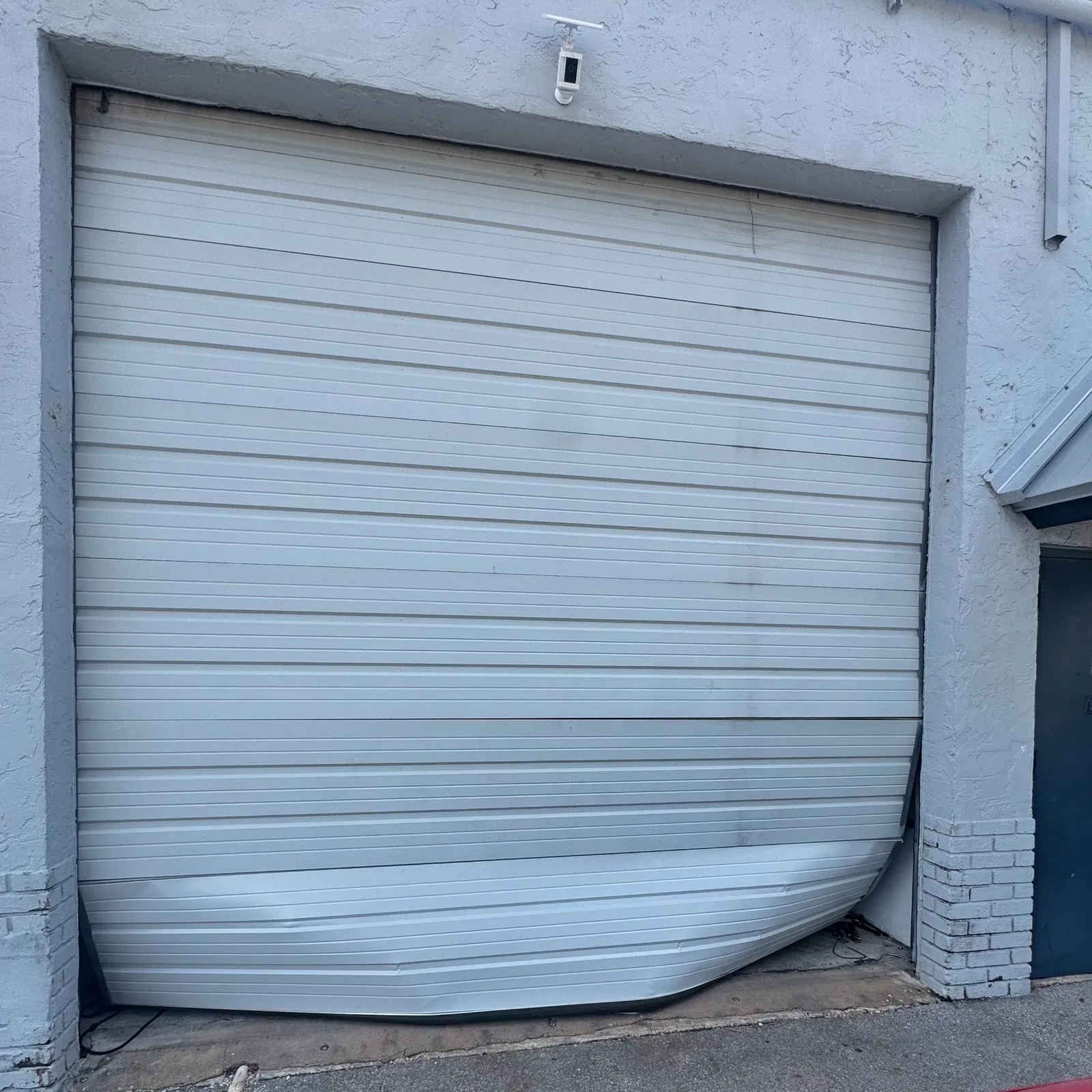
A door is meant to travel level, both bottom corners rising and falling together. When you find your garage door crooked or uneven, with a gap of daylight under one corner, a slanted bottom edge, or one side climbing ahead of the other, the parts that share the lifting work have fallen out of step. Usually it is a cable, a drum or a spring on one side, sometimes a roller that has left its track. The good news is that the slant points to where the fault is. The bad news is that most of those parts are under heavy load and are not a homeowner repair.
How a door is supposed to stay level
A sectional door is lifted from both bottom corners at once. A steel cable runs from a bracket at each corner up to a drum at each end of the spring shaft above the opening. When the springs unwind, both drums turn together and both cables wind on at the same rate, so the door rises flat. Doors with extension springs work the same way, with a spring and pulley on each side.
That arrangement depends on everything being matched: two cables of the same length, wound the same number of turns, on drums fixed at the same point on the shaft, with springs pulling equally. If any one of those slips, the door tilts toward the weaker side.
Signs to look for
With the door down, step out onto the driveway and study the bottom edge.
- A gap under one corner only. The cable on the low side has stretched, slipped or snapped, or the high side is being held up by a roller caught in its track.
- A cable hanging loose or coiled on the floor. It has come off its drum or broken. Do not touch it.
- One side rising first when the opener runs. A cable is slipping on its drum, or one extension spring has weakened.
- The door rubbing the frame on one side. The door has twisted in the opening, often because one side has jammed while the other kept moving.
- A roller sitting outside the track, or a track bent away from the wall.
Our guides to a derailed door and to a broken spring go deeper into two of these, and the blog holds the rest of the series.
What is safe and what is not
Faced with a garage door crooked or uneven in its frame, you can safely look. You can clear anything from the door’s path, check for a roller visibly out of the track, and photograph what you see to describe it when you call. You can also stop using the opener, which is the single most useful thing to do: an opener will keep pulling on a tilted door and can twist the sections, bend the tracks or snap the remaining cable.
Everything else should wait for a technician. The cables are connected to the spring force, and a cable that has slipped can jump back under load without warning. The bottom brackets the cables attach to carry the same tension. The springs, whether the single torsion coil above the header or the twin extension springs along the side rails, store enough energy to cause serious injury. Do not try to rewind a cable, unbolt a bracket or shove the low side upward. The red release cord is off limits too on a door hanging out of level: with the opener disconnected, a door that is only being held on one side can drop or swing.
Children, pets and cars belong well away from that doorway for now.
What usually causes it
A snapped or slipped lift cable. The most common reason for a garage door crooked or uneven in the opening. Cables wear where they wrap the drum and at the bottom bracket, and once a few strands go the rest follow. A cable can also unwind off its drum if something stops the door on its descent and the cable goes slack. Cable repair replaces the cables and resets both drums so the door rises level again.
A broken spring on one side. On doors with two torsion springs, or with extension springs, one spring breaking leaves the other side doing all the work. The door lifts lopsided or not at all. Spring repair covers both types.
A derailed roller or a buckled rail. If a car has nudged the track or a roller has cracked, one side of the door can hang up while the other keeps going. Off-track repair straightens or replaces track, swaps broken rollers and realigns the door.
A slipping drum. The drums are clamped to the shaft. If one loosens, it turns less than its partner, and the cable on that side falls behind.
A twisted or damaged section. Once a door has been run crooked, its panels can bend or its hinges crack. Panels and sections are part of general garage door repair, and a door that is badly bent may be better replaced with one of our new garage doors.
Why it happens more often around Boston
Two local conditions make a garage door crooked or uneven more common here than in milder places.
The first is cold. Springs are under the most stress on the coldest mornings, and a tired spring is likeliest to break when the weather turns. Ice frozen to the bottom seal on one side is another cause: the opener starts lifting, the frozen side stays down, the cable on that side goes slack and can jump off its drum.
The second is salt. The harbour towns of Winthrop, Revere and Marblehead get salt-laden air that works into cables, drums and rollers. Corroded cable strands break sooner, and a rusted roller can seize in its track and hold one side of the door while the other carries on.
Space matters too. Many city garages open onto a narrow drive or a lane shared with neighbours, and a door hanging askew in the opening can block the only parking a household has, and sometimes the drive next door.
When to call
Call as soon as you see a garage door crooked or uneven, a cable hanging loose, or a roller that has escaped its channel, and leave the opener idle until the repair. An open garage you cannot close, or a car trapped inside, makes it urgent; the phones are answered at all hours, and the emergency repair page covers how to keep the area safe until help comes.
Questions about a lopsided garage door
Can I keep using the door if it is only a little uneven?
It is better not to. Even a small tilt usually means one cable is slipping, and each run puts more strain on the other cable, the tracks and the sections. Stop using the opener and have it looked at.
Why is there a gap under one side of my closed door?
Usually the cable at that corner has lengthened or slipped on its drum, so that corner no longer comes all the way down. A roller hung up in the track on the other side can cause the same gap.
Can I rewind an unspooled cable myself?
No. The cable is attached to the spring force, and rewinding it means working against that tension. Leave it and call us.
Is a crooked door dangerous?
It can be. A door held on one side can drop or swing if the remaining cable fails or the release cord is pulled. Keep people, pets and vehicles clear.
Will the whole door need replacing?
Usually not. Most crooked doors are put right with new cables, a spring or track work. Replacement only comes up when the sections have been badly bent or twisted.
Get it level again
If one side of your door is sitting lower than the other, call us or book online. The phone gets answered at night and at weekends as readily as on a weekday morning, and the technician will check both sides of the lifting system, not only the side that dropped.