
It often happens when nobody is near the door. A sharp report, almost like a shot, comes from the garage, and later the opener hums, strains for a second and gives up, or lifts the door a few inches and stops. A broken garage door spring is the usual culprit when a door suddenly refuses to open, and it is also the one fault where a homeowner’s instinct to have a go can do real harm. The spring was carrying most of the door’s weight. With it gone, that load passes to the opener, the cables and anyone who tries lifting by hand.
What the spring was doing
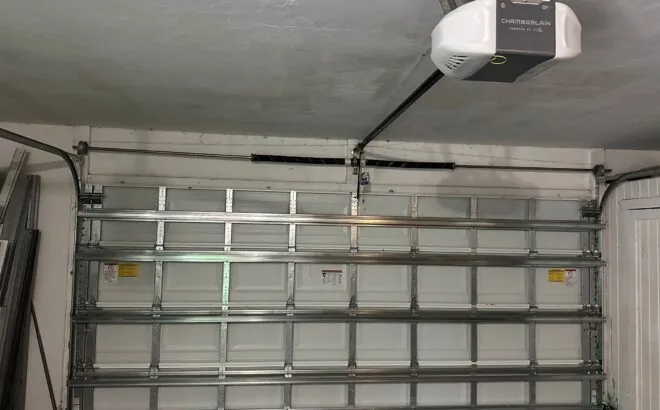
A garage door is too heavy to lift by arm or by opener alone. Springs make it light. On most doors around here, a torsion spring runs along a steel shaft just above the opening. With the door shut, its coils are twisted hard; as the panels climb, that twist lets go and spins drums at each end of the shaft, which reel in the lift cables attached to the bottom corners. Some older or lighter doors use extension springs instead: long coils running alongside the horizontal rails that stretch as the door closes and pull as it opens.
Either way, the spring stores a large amount of energy every time the door comes down. When the steel finally fatigues and snaps, that energy is released at once, which explains the bang, and the door loses its counterbalance.
How to tell a spring has gone
Signs that point to a broken garage door spring:
- A visible gap in the coil. On a torsion spring above the door, you may see the coil split into two pieces with a space between them.
- A loud bang with no obvious cause, followed by the door not working.
- The motor strains yet the door hardly moves, or creeps up a few inches and stops or reverses.
- The door feels like a dead weight if you have already tried the release, or it slams down when let go.
- Cables hanging loose at the bottom corners or looking slack along the sides.
- One side lifting ahead of the other on doors with two springs, when only one has failed.
If you are not sure, look from the floor rather than climbing up to it. A snapped coil is usually easy to see from below.
Safe moves and dangerous ones
This is the part that matters most. That torsion coil over the opening is loaded with enough twist to break bones, which is why swapping it out is never a DIY job for a homeowner. Side-mounted extension coils are just as hazardous, as are the cables, drums and bottom brackets tied to them. Serious injuries happen when these parts are wound, unwound or unbolted without the right bars and method. Do not loosen a set screw, cable, bracket or bolt to see what happens.
Safe steps while you wait:
- Stop pressing the button. Each attempt makes the opener haul a door that has lost its counterweight, straining the motor, gears and cables.
- Leave the door where it is, open, closed or partway.
- Hands off the red pull-cord whenever the door sits above the floor. Without the spring, the door can drop the moment the opener lets go.
- Clear the doorway of children, animals and vehicles.
- With the car shut inside, plan around that for now rather than forcing the door.
Why springs break
Behind nearly every broken garage door spring is plain age. Springs wear out by count: a coil gets a fixed budget of trips, and each trip up and down uses one. A door that cycles several times a day reaches the end of that life much sooner than one used occasionally. The steel fatigues and eventually cracks, usually without much warning.
Greater Boston weather helps it along. Cold stiffens spring steel and makes it more brittle, so snapped springs tend to cluster in the first bitter week of the season. Doors that are frozen to the floor along the bottom edge put a sudden extra load on the spring when the opener tries to lift them. Along the shore at Winthrop, Revere and Marblehead, the harbour’s salty air rusts the coils, and rust both adds friction between the turns and eats into the steel where it eventually fails.
A door that is badly balanced, or has springs that were never matched to its weight, also wears them faster, as does a door that drags in its rails or has a seized roller.
When it cannot wait
A failed spring is rarely just an inconvenience. A door frozen in the raised position leaves the bay, and sometimes the home, exposed to anyone passing. One jammed down traps the car. Across much of the inner city, that bay sits behind a slim drive and offers the household’s sole parking spot off the road, so a door that will not move can block a whole morning, and in a shared drive it may block neighbours as well.
A broken garage door spring can be phoned through whenever it happens, weekends and nights included. For tips on staying safe before help reaches you, read the emergency repair page.
What the repair involves
A technician secures the door first so it cannot fall, then takes the remaining tension out of the system with proper winding bars and clamps. The broken spring comes off, and a new one sized to that particular door goes on. On doors with two springs, both are usually looked at, because they have aged together. The cables and drums are checked, since the jolt of a failure can unwind a cable from its drum or fray it. The door is then rebalanced, run through its travel, and the opener’s force and limits checked.
This is the work on our spring repair page, for torsion and extension springs alike. If a cable has been damaged too, see cable repair. Where the opener has been strained by trying to lift the door, opener repair covers that. Not sure the spring is the culprit? The guide to a door that won’t open runs through the other causes, and a door knocked crooked by the failure is covered in the off-track guide.
Questions about a broken garage door spring
Can I still open the door by hand?
Not safely. Without the spring, the door weighs its full weight, and it may drop without warning once the opener is released. Leave it where it is and call.
Why did both springs need looking at when only one broke?
On a two-spring door, both springs have done the same work over the same number of cycles. When one gives up, the other is often near the end of its life too, so the technician will check it and tell you what they find.
Is it the cold that broke it?
Cold is a common trigger, because it makes spring steel less forgiving and frozen doors add sudden load. The underlying cause is usually that the spring has simply reached the end of its cycles, and the cold finishes it off.
My door has springs along the sides, not above. Is that different?
Those are extension springs. They work differently but carry the same danger when they fail, and the repair is the same kind of job for a technician, not a DIY fix.
Can the opener lift the door without the spring?
It may try, but it is not built to lift the door’s full weight. Running it like that can strip gears, burn out the motor or snap a cable, so stop using it until the spring is replaced.
Book the spring repair
Don’t touch the door, keep the household well back, and call us or book online. Someone is on the line through every night and weekend, so you can report it the moment you hear that bang. More homeowner guides are on the blog.