
Why Brookline’s older garages keep their repairers busy
Most calls for garage door repair in Brookline, MA start with a door that was fitted into a building nobody designed around it. Around Coolidge Corner and Washington Square, the large Victorians keep their garages at the back of the lot, detached from the house, and a few of the old carriage houses still stand and now hold a modern sectional door. The brick apartment buildings nearby have their own bays and rear garages, used by several households at once. Each of those buildings puts a different kind of strain on the springs, cables, rollers and opener.
The other local factor is the ground itself. Driveways that rise steeply from Beacon Street mean a car arrives at the door on a slope, a heavy door sits on a sloping threshold, and meltwater runs straight at the bottom section all winter.
Before calling, three things are worth noticing from where you stand, without touching the hardware:
- Whether the door is level in the opening or hanging lower on one side.
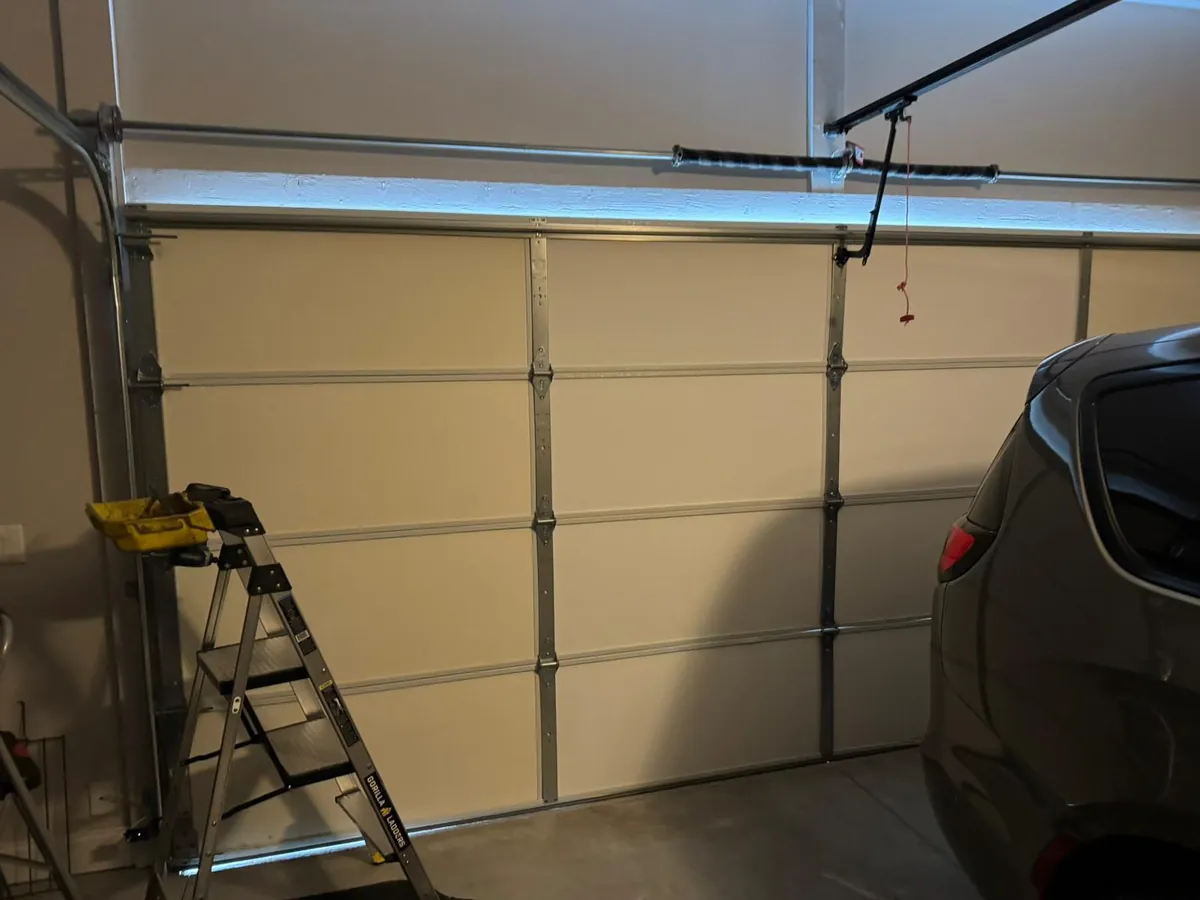
- Whether the spring above the door shows a gap between its coils.
- Whether the opener hums, clicks or stays silent when the button is pressed.
What a Brookline repair visit can put right
Springs that have snapped
Torsion springs on the shaft above the door and extension springs beside the tracks. A broken spring leaves the door too heavy to lift. More on spring repair in Brookline.
Cables and drums
A lift cable that frays or slips off its drum lets one corner drop, and the door twists in the opening.
Dented or split panels
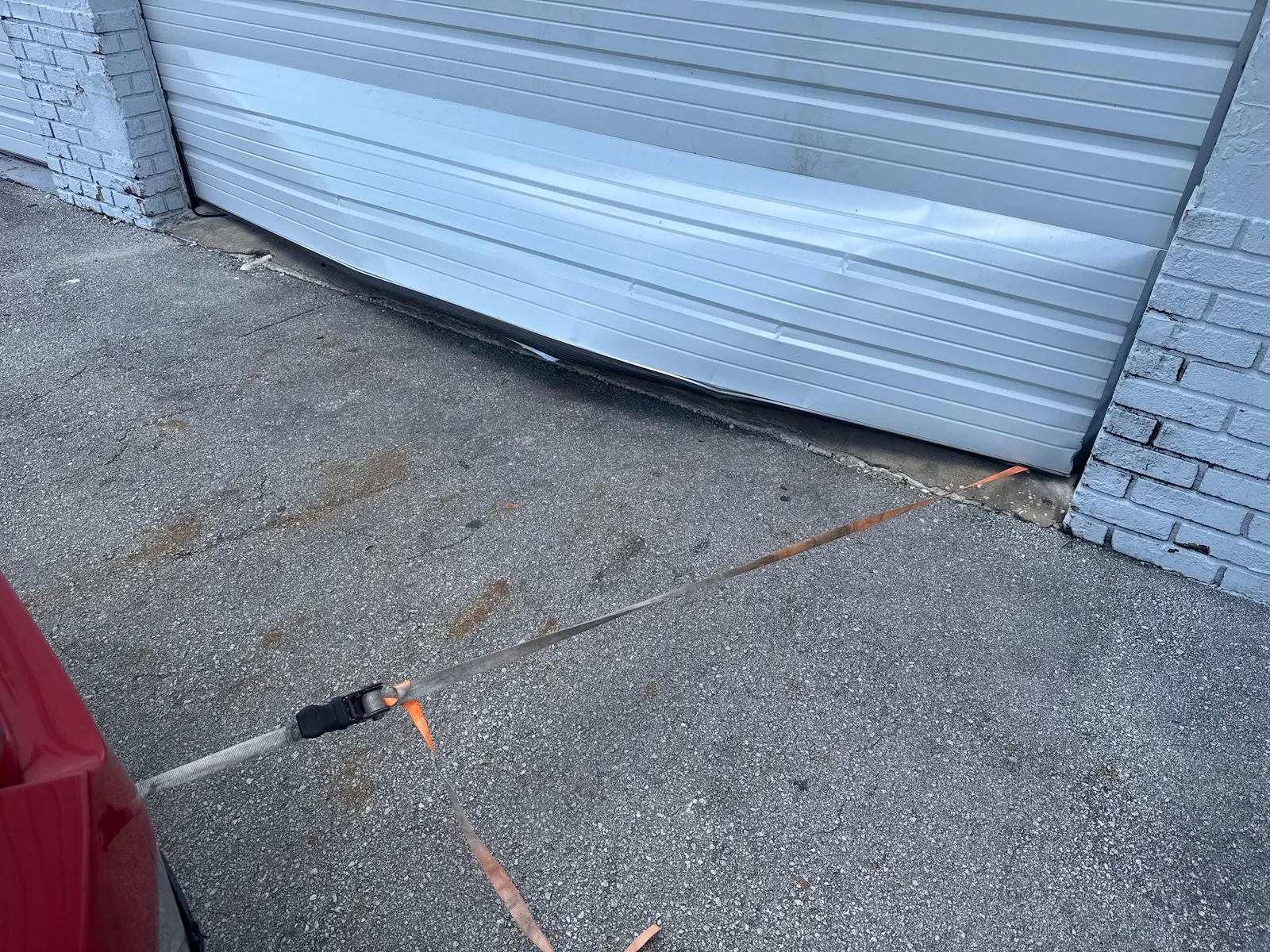
Sections bumped by a car on a tight turn into a rear garage, and bottom sections softened by water running down the drive.
Openers, remotes and wall buttons
Motors that hum without moving, remotes that have gone quiet and wall buttons that do nothing. More on opener repair in Brookline.
Tracks, rollers and off-track doors
Bent rails, loose brackets, worn rollers and doors that have jumped out of their tracks altogether.
Safety sensors
The two photo eyes near the floor that stop the door closing on a car, a bicycle or a person.
One door, many connected parts
Good garage door repair in Brookline starts from how the whole door works, not just the piece that broke. A sectional door is a balanced machine rather than a single object. The springs do the lifting, storing energy as the door comes down and giving it back as the door rises. On a torsion setup the spring sits on a steel shaft above the opening and turns a drum at each end; cables wound on those drums run down to the bottom corners of the door. On an extension setup, a long spring runs beside each horizontal track and pulls on the door through pulleys. Rollers on every section ride in the tracks, hinges join the sections so they can bend round the curve, and the opener pushes and pulls a door the springs are already holding up.
When that balance is right, a door lifts by hand with little effort and stays put halfway. When one part fails, the others take the strain. A weak spring makes the opener labour until its gears or its circuit board give out. A dry roller drags and wears a groove into the rail. A cable that has started to fray lets one side lag, and the door begins to rack in its frame. That is why a call about a noisy opener can end with a spring replaced, and why a good repair looks past the part that failed to the reason it failed.
Detached rear garages behind the Victorians
Many of the large Victorian houses around Coolidge Corner keep their garage at the back of the lot, reached by a long driveway down the side of the house. Those garages are separate buildings, often unheated, with plain walls, a simple roof and an overhead door added long after the house went up. Several features of these buildings show up again and again on repair calls.
They are cold. An unheated garage follows the outdoor temperature, so in winter the springs work in the same air as the street, and cold steel is less forgiving when it has been cycling for a long time. The grease in the rollers and on the hinges stiffens, and the opener has to push harder on the first runs of a frosty morning.
They are often a long way from the house. A door that fails late in the evening at the end of a dark driveway is awkward to inspect, and the wiring that feeds the opener may run through old conduit or across the yard. An opener that cuts out now and then is sometimes a supply problem rather than a fault in the motor, and that is worth ruling out before anything is replaced.
They are sometimes out of square. Wooden garages settle, and an opening that has shifted slightly will pinch a door on one side as it travels. The result is a door that binds at the same point every time, wears out rollers on one side faster than the other, and eventually pulls a track bracket loose from the jamb.
Carriage houses that predate the garage door
A few of the old carriage houses survive in Brookline, and the ones that still house cars now carry a sectional door in an opening first built for horses and carriages. They tend to be handsome buildings with awkward insides. The opening may be wide but the space above it short, with beams or a loft floor sitting close over the top of the door. That limited headroom decides where a torsion spring can go, whether the door needs low-headroom track, and which opener will fit at all.
Masonry and old timber move with the seasons, and the frame around the door moves with them. A door hung tight in late summer can rub in a damp spring. Where a carriage house has a loft or a room above the bay, a rattling door or a loud chain drive carries straight up into it, so quiet running matters as much as working parts.
Repairs in these buildings are about fitting the door to the structure rather than the other way round: brackets fixed into sound material, tracks set to follow the opening as it actually is, and a spring arrangement the ceiling can accommodate.
Bays in and behind brick apartment buildings
The brick apartment buildings around Washington Square and Coolidge Corner have their own garages, sometimes a row of rear bays, sometimes a door into a space beneath the building. These doors see far more use than a single-family garage. Every resident with a space opens and closes the door, often several times a day, so springs reach the end of their cycle life sooner, rollers wear flat, and remotes multiply until nobody is sure which ones still belong to current tenants.
Shared use also means a door can run with a fault for a long time before anyone reports it, because no single person notices the change. A door that has started to slam or to bounce back up is worth having looked at before it stops altogether and blocks every space behind it. Where the bay sits beneath living space, a noisy or shaking door is felt in the apartments above.
Remotes deserve a look too. When residents move out, their remotes often go with them and keep working. Clearing the opener’s memory and pairing the current remotes again closes that gap, and it is a sensible step whenever a shared door has had its opener repaired or replaced.
Steep driveways off Beacon Street
Several driveways off Beacon Street climb sharply from the road, and a slope changes how a garage door behaves. A car coming up the grade arrives at speed and close to the door, so bumped bottom panels and knocked track brackets are common. Where the threshold slopes, the door closes against uneven ground: the bottom seal touches down on one side first, the opener reads that as an obstruction, and the door reverses for no obvious reason. Packing the seal or adjusting the closing limit can help, but sometimes the bottom section itself has taken a twist.
Water is the other problem. Rain and snowmelt run down the drive toward the garage, collect against the bottom of the door and work their way under a worn seal. Over a few winters that rots wooden bottom sections and rusts the lower track ends and bottom brackets on steel doors. Salt carried up on tires speeds the corrosion. A torn bottom seal looks like a minor thing, but on a sloping drive it is often the start of a larger repair.
What you can safely check before the visit
A few checks are safe for anyone and often save time:
- If the door is stuck partway, unplug the opener so it cannot try to run again.
- Wipe both sensor lenses and move anything that might be blocking the beam between them.
- Swap the battery in a remote that has stopped, then try the wall button to see whether the fault lies with the remote or the opener.
- Look along both tracks for something in the way, such as a shovel, a bicycle wheel or a bin pushed against the rail.
Some parts should be left entirely alone. A torsion spring holds dangerous tension even with the door closed, and the cables and bottom brackets carry that same load. Loosening a set screw or prying at a bracket can release that force in an instant; a torsion spring is not a DIY repair. A door with a broken spring is also far heavier than it looks, and lifting it by hand or with the opener is a good way to get hurt or to bend the door.
How a repair visit runs
The order is the same whether the door sits behind a Victorian, inside a carriage house or under an apartment building. Each step of garage door repair in Brookline is done with the door held safely and the opener disconnected until the end.
- The door is looked at as a whole. The opener is disconnected so the door can be lifted and lowered by hand, and its balance is tested.
- Each part is inspected in turn: springs, cables and drums, hinges, rollers, tracks and brackets, then the opener and the sensors.
- You are told what has failed and what caused it before any work is done, including anything about the building itself, such as a settled opening or a sloping threshold, that has a part in it.
- The failed parts are replaced or adjusted, and the door is rebalanced so it lifts evenly.
- The opener is reconnected, its travel and force are set to suit the repaired door, and the safety reverse is tested so the door stops and backs off when it meets something.
When the door comes out of its tracks
A door that has left its tracks hangs crooked, with rollers sitting outside the rail on one or both sides. In Brookline’s rear garages the usual causes are a car clipping the door on the turn at the top of a drive, a cable snapping on one side, or an opener that kept driving a door that had already jammed. An off-track door is unstable. It should not be run with the opener or forced back by hand, because it can drop or fold. The repair means taking the weight off the door, easing the rollers back, straightening or replacing bent sections of rail, checking that both cables are even, and only then running the door again. The off-track garage door repair page goes into more detail.
Panels, hinges and the bottom seal
Panel damage on Brookline garages is mostly mechanical: a bumper on a tight turn, a gust catching a door left open, or a bin rolling down a sloped drive into the bottom section. A single damaged section can often be replaced on its own, provided a matching section can be sourced in the same profile and finish. Cracked hinges between sections let the door flex as it moves, which shows as a bow in the middle or a scraping noise at the same point on every run. The bottom seal takes the worst of it on a sloping drive, and replacing it before water reaches the bottom section is one of the simplest ways to protect a door.
Repair the door, or replace it
Most doors are worth repairing. A new spring, a pair of cables or a set of rollers keeps a sound door in service, and on a well-built garage that is nearly always the sensible choice. Replacement starts to make sense when several parts are failing together, when the bottom sections have rusted through or rotted from many winters of water off the drive, when more than one panel is past saving, or when an old wooden door has absorbed so much moisture that no reasonable spring can balance it. On a carriage house, a new door may also be the chance to choose one that suits the building better. If the answer is replacement, you will be told plainly, and the new garage doors page explains how a door is supplied and installed.
Booking a repair
The broader picture of what we fix sits on the main garage door repair page, and urgent breakdowns at night or over a weekend are covered on the emergency repair page for Brookline. The Brookline area page brings every service for the town together.
For garage door repair in Brookline, MA, the phone is answered day and night, every day of the week, so a door that fails late can be reported as soon as you find it. When you get through, say what the door is doing, what you can see from a safe distance, and whether a car is shut in. To arrange garage door repair in Brookline at a time that suits you, call us or book online.
Questions from Brookline
My garage is at the back of the lot and the opener cuts out now and then. Is the opener failing?
Not always. On detached garages the power often runs a long way from the house, and a loose connection or a tripped circuit can look like a faulty motor. Check the outlet the opener plugs into and the breaker first. If the power is steady and the opener still stops, it needs looking at.
The door reverses just before it touches the ground. Could the slope of my drive cause that?
It can. On a sloping threshold the bottom of the door lands on one side first, and the opener may read that as hitting something. Misaligned sensors cause the same symptom, so wipe the lenses and check their lights first. If those are fine, the closing limit or the bottom seal probably needs adjusting.
Can an old carriage house take a modern door and opener?
Usually, yes, though the space above the opening decides how. Short headroom may call for low-headroom track and a particular spring position, and the opener has to fit beneath whatever beams or loft floor sit above the door.
Several people share our building’s garage door. How do we know when it needs attention?
Listen for changes: a door that slams, bounces back up, runs more slowly or makes a new noise. Ask other residents whether they have noticed the same thing. Because the door works so hard, those signs tend to appear before a breakdown, and acting on them is easier than a door stuck shut with every car inside.
Is it safe to tighten the spring myself if the door feels heavy?
No. A torsion spring holds dangerous tension and adjusting one is not a DIY repair. A heavy door usually means a spring is weak or broken; unplug the opener, leave the door where it is and call us.