
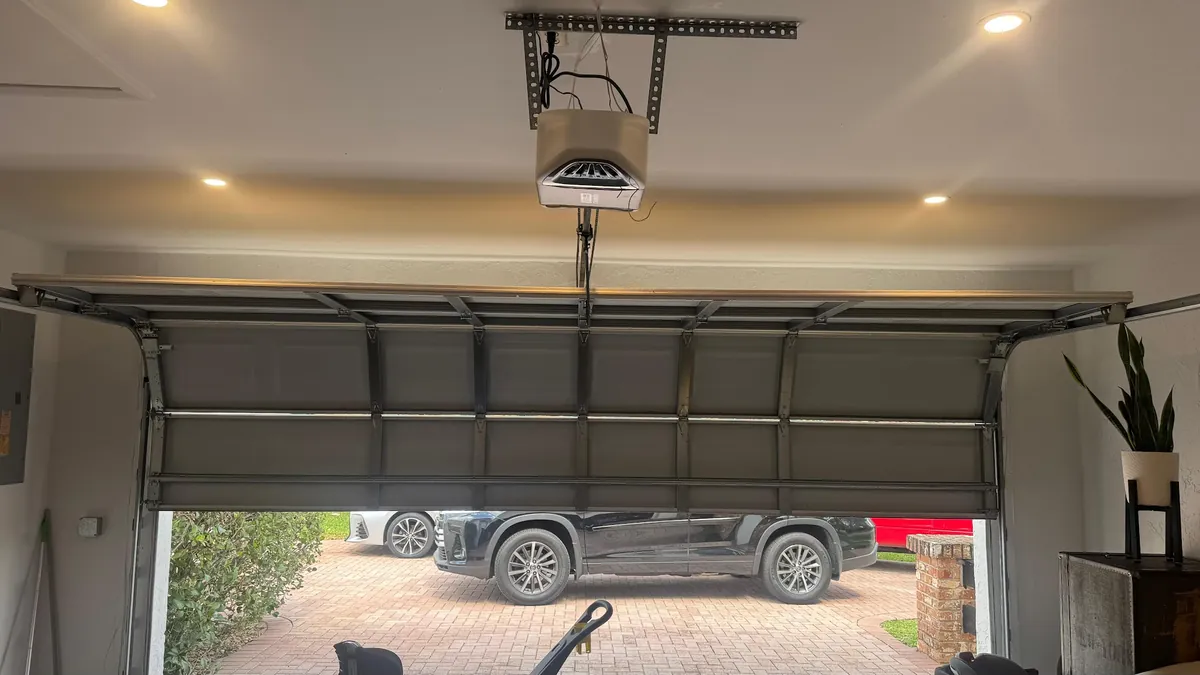
Openers that work hard in Brookline’s garages
When a door that has always answered the remote suddenly hums, clicks or ignores the button, garage door opener repair in Brookline, MA usually comes down to one of four things: the opener itself, the remotes, the wall button or the safety sensors. Brookline’s garages test all four. Behind the large Victorians around Coolidge Corner and Washington Square, the garage tends to be a detached building at the back of the lot, a long way from the house and its power supply. A few carriage houses still hold cars, often with an opener squeezed beneath low beams. Brick apartment buildings run shared doors that are opened by many remotes, many times a day.
Add the steep driveways that climb from Beacon Street, which leave a door closing on a slope, and an opener has plenty to contend with.
Three quick checks from the floor narrow it down before you call:
- Whether the light on the opener comes on when the button is pressed.
- Whether the wall button works when the remote does not, or the other way round.
- Whether the small lights on the two sensors near the floor are steady or blinking.
The opener problems we sort out
Openers that hum but do not move
A motor that runs without lifting the door often points to a stripped gear, a failed capacitor or a door too heavy for it.
Remotes that have stopped working
Flat batteries, lost pairings, worn buttons, or a remote that reaches the door only from a few feet away.
Wall buttons that do nothing
Broken buttons, damaged low-voltage wiring and loose connections at the opener head.
Safety sensors out of line
Photo eyes knocked, dirty or misaligned, so the door refuses to close or reverses before reaching the floor.
Doors that reverse or stop short
Travel and force limits that no longer suit the door, often after a change in the door’s weight or the threshold.
Openers replaced
Worn-out or damaged openers replaced, with LiftMaster among the openers we repair and replace.
What an opener does, and what it does not
An opener does less work than most people think. The springs on a garage door carry its weight; the opener simply pushes and pulls a door that the springs are already holding up, and stops it at the right points. A trolley runs along a rail from the opener head to the top of the door, driven by a chain, a belt or a screw. Limit settings tell the opener where to stop at the top and the bottom. A force setting tells it how hard it may push before deciding something is wrong. The safety sensors, mounted low on each side of the opening, send an invisible beam across the doorway; if anything breaks that beam while the door is closing, the opener stops and reverses.
Because the opener depends on a balanced door, many opener faults start somewhere else. When a spring snaps, a cable starts to fray or a roller seizes, the door gets heavier or rougher to move, and the opener strains until something gives. Gears strip, motors overheat and circuit boards fail. That is why every visit for garage door opener repair in Brookline starts with the door: the opener is disconnected and the door is lifted by hand to see whether it is balanced before any attention goes to the motor itself.
Detached garages a long way from the house
Garages at the back of a Victorian’s lot sit at the end of a long driveway, sometimes behind the house and out of sight of it. Two opener problems follow from that distance.
The first is power. The supply to a detached garage often runs a long way, through old cable or underground conduit. A loose connection, a damaged run or a circuit shared with other outdoor loads can make an opener cut out, restart or behave erratically. Before a perfectly good opener is condemned, the supply to it is checked.
The second is range. A remote that works at the garage door but not from the street, or from a car at the bottom of the drive, may have a weak battery, a damaged antenna on the opener, or interference from other equipment. The antenna wire hanging from the opener head is easily knocked or tucked out of the way, and that alone can shorten a remote’s reach. Repositioning or replacing the antenna often restores the range without any other work.
Cold matters as well. An unheated garage chills the grease in the opener’s gears and along the rail, as well as on the door’s own rollers and hinges. On the first frosty mornings an opener may stall or reverse simply because the door has become stiffer to move. Lubricating the door’s moving parts and checking the force setting usually cures it, but an opener that has been fighting a stiff door for a long time may have worn its gears.
Carriage houses with low ceilings
The surviving carriage houses in Brookline were not built with an overhead door, let alone an opener, in mind. The beams or loft floor above the opening often leave little space between the top of the door and the ceiling, and that restricts which openers fit. A standard ceiling-mounted opener needs room for the rail above the door’s path; where that room is not there, a wall-mounted opener that drives the torsion shaft directly can be the better choice, because it sits beside the door rather than above it.
Noise is the other concern. Where a carriage house has a room or loft above the bay, a chain drive rattling beneath the floor is heard clearly upstairs. A belt or a wall-mounted opener runs more quietly, and tightening the rail and the opener’s mounting often reduces vibration through the structure.
Mounting matters in an old building. An opener hung from timber that has dried and shrunk, or fixed into soft masonry, can loosen and shift, throwing off the door’s alignment and the opener’s limits. When an opener is repaired or replaced in a carriage house, its brackets are fixed into sound material so it stays where it is put.
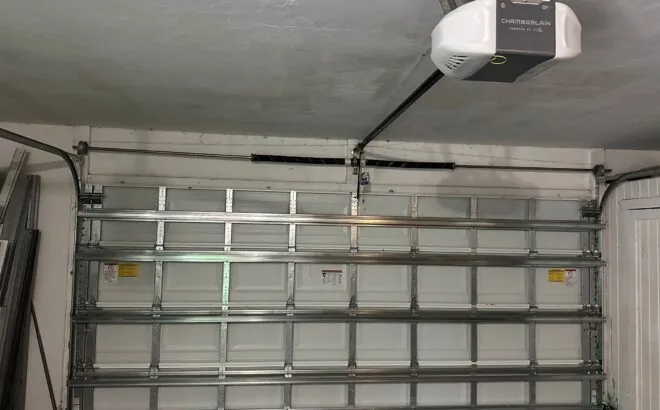
Shared doors in brick apartment buildings
Garage doors in the brick apartment buildings around Washington Square and Coolidge Corner see far more use than a single-family door, so openers wear out faster. Gears, drive belts and chains, trolley carriages and limit switches all have a working life measured in cycles, and a busy shared door uses them up quickly. An opener rated for heavier use can make sense on a door like that.
Remotes are the larger headache. Over time, a shared door collects remotes from residents past and present, and the opener’s memory can fill up, or old remotes still open the door long after their owners have moved away. Clearing the memory and pairing the current remotes again is a simple way to take back control of who can open the door. Wall buttons in shared garages also take a beating, and a cracked or sticking button can leave the door running unexpectedly or not at all.
Sensors in these garages are easily knocked by bicycles, bins and cars parking close to the wall. A sensor pushed even slightly out of line can stop the door closing for everyone, so it is one of the first things to check when a shared door refuses to go down.
Steep driveways and sloping thresholds
Driveways that climb sharply from Beacon Street often leave the bottom of the garage door meeting a sloping threshold. One side of the door touches the ground before the other, and the opener may read that early contact as an obstruction and send the door back up. The door’s closing limit and the opener’s force may both need adjusting to suit the slope, and sometimes the bottom seal needs to be replaced so the door lands evenly.
Sensors on a slope can sit at different heights on each side of the opening. If they do not face each other squarely, the beam may be only just connected, and the door will close on a still day and refuse on a windy one, when the brackets flex. Setting the sensors at matching heights and aiming them carefully cures most of these intermittent refusals.
Water running down the drive is another factor. Sensors mounted low beside the opening can be splashed, iced over or buried in snow, and their wiring can corrode where it runs along the bottom of the jamb. A sensor blinking after a storm is often simply wet or blocked.
Checks that are safe to make first
Some opener checks are easy and safe:
- Replace the remote’s battery, and see whether the wall button works. If the button works and the remote does not, the problem is in the remote or its pairing.
- Look at the sensors. Wipe both lenses, move anything in the beam, and check that their lights are steady.
- Make sure the opener is plugged in and the outlet has power. On a detached garage, check the breaker as well.
- If the opener has a lock or vacation switch on the wall control, make sure it has not been turned on by accident.
Some things are best left alone. If the door feels very heavy when you release it from the opener using the red cord, a spring has probably broken, and the door should not be lifted or run. Do not try to adjust springs, cables or the brackets at the bottom of the door; they hold dangerous tension. And do not keep pressing the button on an opener that strains or smells hot.
Sounds and signs of a tiring opener
Openers rarely fail without some warning, and the early signs are worth booking garage door opener repair in Brookline for before the door stops altogether. A grinding or clicking from the opener head often means worn gears inside it. A chain that slaps against the rail, or a belt that sags, has stretched and needs tensioning or replacing. A door that stops a little short of the floor, or a little short of fully open, points to limits that have drifted. An opener that runs for a moment and then stops partway may be protecting itself against a door that has become too heavy or too stiff.
Pay attention to the light on the opener as well. A light that flashes in a pattern after a failed run is often the opener’s way of reporting a fault, usually with the sensors. And if the opener smells hot or the casing feels warm after a few runs, stop using it: the motor is working far harder than it should, almost always because something is wrong with the door rather than the opener.
Wall buttons and wiring in older garages
The wall button is the simplest part of an opener system, yet in an older garage it is often the one that fails. The thin low-voltage wire that runs from the button to the opener head is usually stapled along a wall or a beam, and in a detached garage behind a Victorian or in an old carriage house that wire has frequently been extended, spliced or pinched over the years. A staple driven through the wire, a splice that has corroded in damp air, or a wire chewed where it runs low along the wall can stop the button working, or make the opener run on its own.
A good test is whether the remote still works when the button does not. If it does, the fault lies in the button or its wiring rather than the opener, and the repair is a matter of tracing and replacing the run. On shared doors in apartment buildings, where the button is pressed far more often, a worn button is the usual cause, and that is quick to replace once garage door opener repair in Brookline has ruled out the wiring.
How an opener repair visit runs
- The opener is disconnected and the door is lifted and lowered by hand to check its balance, because a door with a spring or cable problem will wear out any opener.
- The power supply, the opener head, the drive and the rail are checked, along with the wall button, its wiring and the remotes.
- The sensors are tested, cleaned and realigned, and their wiring is checked along the jamb.
- You are told what has failed and whether repair or replacement makes more sense before any work starts.
- The repair or replacement is completed, the remotes are paired, the limits and force are set to suit the door, and the safety reverse is tested so the door stops and backs off when it meets something.
Repair the opener, or replace it
Many opener faults can be repaired: a stripped gear, a broken trolley, a failed sensor, a worn belt or a damaged wall button. Replacement becomes the better answer when the opener is very old and parts are hard to find, when its circuit board has failed along with other parts, when it lacks working safety sensors altogether, or when it is simply the wrong type for the garage, such as a loud chain drive under a carriage-house loft. LiftMaster openers are among those we repair and replace; the LiftMaster opener repair page covers that work.
If the opener has failed because the door itself is out of balance, replacing the opener alone will not last. The door’s springs, cables and rollers are fixed first; the spring repair page for Brookline and the broader Brookline garage door repair page explain those repairs.
Booking opener work
The main opener repair and replacement page describes the service across Greater Boston, and the Brookline area page brings together every service in the town. A door stuck open at night, or closed with a car inside, is covered on the emergency repair page for Brookline.
The phone is answered day or night, every day of the week, so an opener that fails late can be reported straight away. Tell us what the opener does when the button is pressed, what the sensor lights show, and whether the door is open or closed. For garage door opener repair in Brookline, MA, call us or book online.
Questions from Brookline
My remote only works when I am right outside the garage. Why?
Usually a weak battery or a problem with the opener’s antenna. On detached garages a long way from the house or the street, the antenna wire hanging from the opener head is often bent, tucked away or damaged. Replace the battery first; if the range is still short, the antenna or the remote needs attention.
The door goes down and then goes straight back up. Is the opener broken?
Probably not. The sensors are the most likely cause: one is dirty, blocked or out of line. On a sloping driveway the door may also be touching down on one side first, which the opener reads as an obstruction. Wipe the sensors and check their lights; if the problem continues, the limits and force need adjusting.
Is there an opener that fits a carriage house with very little ceiling space?
Yes. Where the ceiling is too close to the door for a ceiling-mounted rail, a wall-mounted opener that drives the door’s torsion shaft from the side can often fit. It also tends to run more quietly, which helps where there is a room above the bay.
How do we stop old remotes opening our building’s shared garage?
Clear the opener’s memory and pair only the remotes currently in use. This removes every remote that has been lost or left with a former resident.
Can I keep using the opener if the door feels heavy?
No. A heavy door usually means a broken or weak spring, and running the opener against it can strip its gears or burn out the motor. Disconnect the opener, leave the door alone, and call us.