
Compact Cambridge garages and what goes wrong with their doors
Across Cambridgeport, North Cambridge and the streets around Porter, the typical garage is one bay on its own footing behind a triple-decker or a Victorian, reached by a driveway so slim that opening a car door means sidestepping. A great many lots have nothing of the kind, with the car living on the street under a resident permit, which makes the garages that do exist precious and hard-worked. Our garage door repair Cambridge MA visits deal with every moving piece on those doors: the coils, the lift cables, sections, openers and remotes, rails and rollers, photo-eye sensors, and doors that have slipped out of their rails.
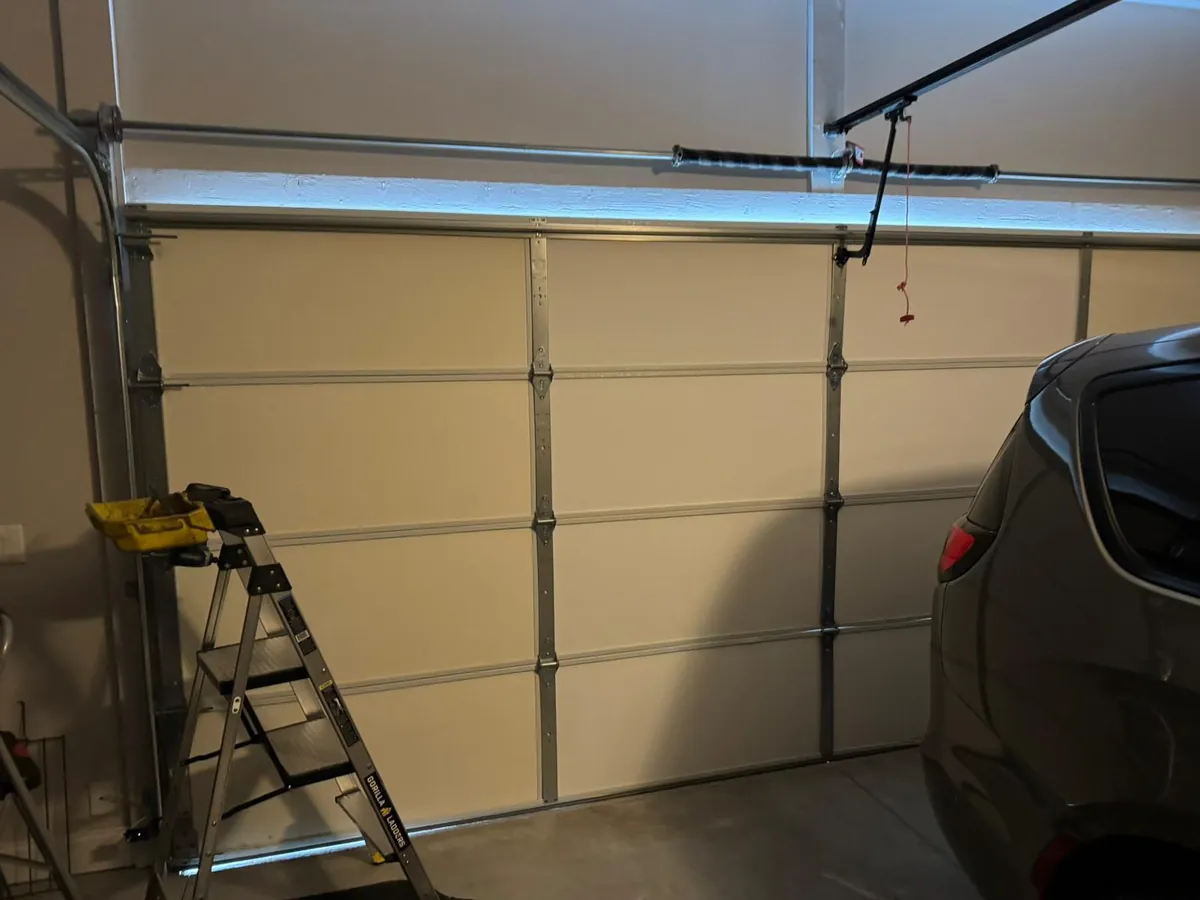
A freestanding garage stands in the wind and frost on every side, borrows no warmth from the house, and may be thirty paces from the kitchen door on a sleety night. Before you call, three looks from a careful distance tell you a lot:
- Over the header, a torsion coil with a clear break in it, or a sagging stretched coil beside one of the overhead rails.
- Down at each lower corner, a lift cable lying loose, or bunched unevenly on its grooved drum.
- Low on either side of the opening, the two photo eyes: a dark or winking lamp means the beam is broken.
Faults a repair visit covers
Snapped or worn-out springs
Coils across the header or stretched beside the rails. Once one parts, the door becomes a slab nobody can lift. More on spring repair in Cambridge.
Cables and drums
Steel lift cables that fray at the bottom fixing or unspool from their drum, leaving the door cocked at an angle.
Creased and split sections
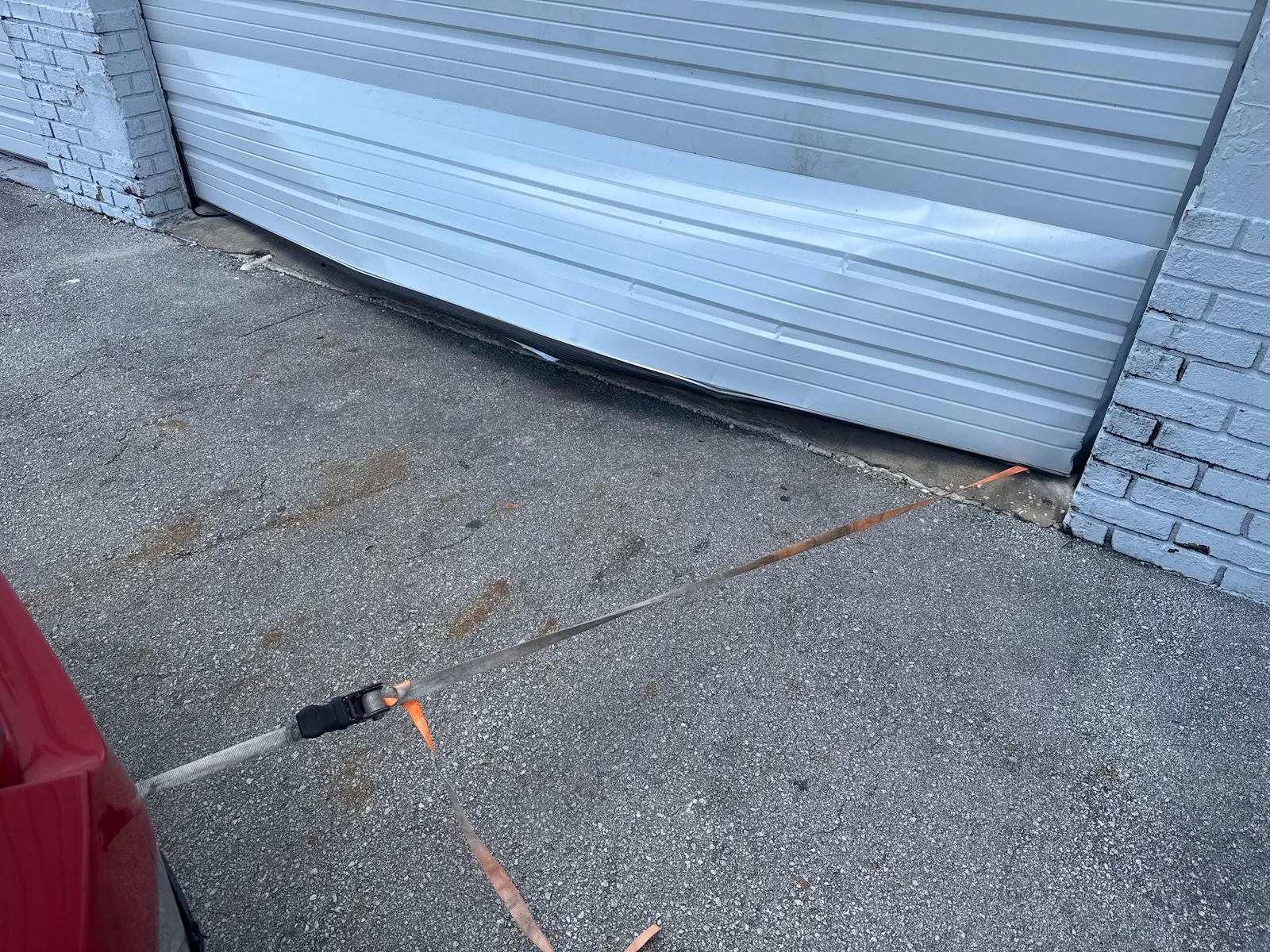
Panels folded inward by a bumper that misjudged the narrow approach, hinges cracked between sections, a weatherstrip chewed to shreds by grit and ice.
Openers, remotes and keypads
A motor that buzzes without moving anything, a remote that only answers from arm’s length, a keypad that has gone silent. See opener repair in Cambridge.
Rails, rollers and derailed doors
Kinked rails, wobbling brackets, rollers that have cracked or stopped turning, and doors that have popped out on one side.
The beam at floor level
Two small lenses near the slab whose invisible beam tells the opener to back off before the door lands on a bike, a recycling bin or somebody’s ankle.
Garages built for a different era
Plenty of doors we work on here hang in a building that was an afterthought to the house. Single bays behind triple-deckers and Victorians were often framed for narrower cars and plainer doors, and later fitted with a sectional door and a ceiling-mounted opener the structure never anticipated. That mismatch puts the hardware on a short leash.
Sideroom is the first squeeze. With a car pulled in, there can be little more than a hand’s span between mirror and wall, and that slim strip is precisely where the upright rail, the cable and, on many older doors, the stretched side spring run. A handlebar or wing mirror tapping the rail now and then is enough to walk it out of plumb. Overhead space is the second squeeze. Low rafters or a pitched roof leave a thin gap above the opening for a spring shaft and an opener rail, so wear that a roomier garage would absorb shows up sooner as rubbing, binding or a straining motor.
The slab matters as well. A little frame building on shallow footings rides the frost more than the house beside it, and a floor that has heaved or sunk leaves the door landing on one corner first. Each time that happens, the cable on the raised side slackens for a moment, and enough of those moments let it creep off its drum.
How springs, cables, rollers and the motor divide the job
The motor is the least important lifter in the garage. Most of the effort comes from the springs. On a torsion setup, a coil wrapped around a steel tube over the header stores energy as the door comes down; going up, that coil relaxes and spins a grooved drum at each end, and the drums reel in two cables fastened near the bottom corners. On an extension setup, common in cramped older bays, long springs stretch alongside the overhead rails and haul on the cables through pulleys.
Rollers bolted to each section track along the rails and let the door curl from upright to flat under the ceiling, hinged section by section. All the opener contributes is a nudge to a door the springs have already counterweighted, plus the instruction to reverse when the photo eyes report something in the way. Everything is linked, so trouble in one spot tends to surface in another: a tired spring overworks the motor, a seized roller files a groove into the rail, a fraying cable lets one side lag until rollers jam.
For that reason, a sound garage door repair in Cambridge examines the whole assembly rather than the single part mentioned on the phone. Swapping one noisy roller on a door whose rail is kinked buys a quiet week and little else.
Clues worth noting before you pick up the phone
Certain patterns lead to particular culprits, and passing them on helps.
- A gunshot-like crack out back, followed by a door that stays shut. A torsion coil has broken in nearly every case.
- The motor whirs, the door rises a hand’s width and quits. A broken spring or an unspooled cable, with the opener’s limit cutting in.
- One side of the door hangs lower. A cable has slipped or parted on that side, or rollers have escaped the rail.
- The door heads down, then bounces back up. The photo eyes, knocked askew, smeared, or blocked by whatever leans against the jamb.
- Scraping, grinding or a shuddering ride. Rollers worn flat or frozen, a dented stretch of rail, or a split hinge.
- Nothing from the remote, yet the wall button still runs it. The remote’s battery or its pairing with the opener, not the motor.
- A stripe of daylight down one edge when closed. A buckled section, a failed weatherstrip, or a rail pulling off the jamb.
No single clue settles it, but put together they shrink the list.
Derailed doors in narrow bays
A door that has jumped its rail is a frequent visitor in a cramped single garage and an awkward one. The usual triggers are a bumper or mirror clipping the upright rail, a cracked roller dropping out of its channel, or a slack cable letting one side of the door run ahead of the other. Once several rollers have escaped, the door twists and can jam itself across the opening.
Leave a derailed door exactly as it sits. Driving it with the opener bends the rail further and can fold the top section. Tugging it by hand is no better, since a twisted door may now be dangling from a single cable. The garage door repair Cambridge MA households need on these doors means relieving the load safely, coaxing the door back into line, straightening or renewing the bent rail, refitting the rollers and evening up the two cables. In a narrow bay the rails are also checked for how close they sit to a parked car, because a rail that has been clipped once will be clipped again unless something changes. Our page on off-track repair describes this work in more depth.
Bins, bikes and photo eyes
When parking is mostly by permit along the curb and the driveway barely swallows one car, a garage often becomes the place for bicycles, recycling bins, shovels and rakes, usually stacked right inside the opening for easy reach. The photo eyes suffer for it. They are mounted low on each jamb, and a bike tyre or a bin edge pressed against one bracket nudges it out of aim. Afterwards the door will not shut, or begins to close and leaps back up.
Before calling about a door that refuses to close, clear everything stored at floor level near the opening, polish each lens with a soft dry rag, and check the tiny lamps on each unit. If one is dim or blinking, ease its bracket by hand until the lamp glows steadily. Bent brackets, gnawed wiring or lamps that never light point to a fault for the visit.
Hands on, hands off
These checks are sensible for anyone:
- Unplug the motor if the door has stalled halfway, so it makes no further attempts.
- Shift anything resting against the door, the rails or the photo eyes.
- Fit a fresh battery in the remote, then try the wall button to see which one is at fault.
- Stand at the opening and sight up each rail for a dent or something wedged in it.
Leave the rest alone. A torsion coil is wound with dangerous tension in any door position, and a broken one can still hold a share of that energy. The winding cone and its set screws, the cables and the bottom fixings all carry that load, and backing off any of them can turn the stored force loose in an instant. Winding or releasing a torsion coil is not a DIY repair, however handy the toolbox. Once its spring has gone, the door is all dead weight; do not heave on it by hand and do not ask the motor to try.
Treat the red release cord with respect too. With the door fully closed, a pull disconnects the opener so a door with healthy springs can be shifted by hand. With the door open or halfway, a pull can send it crashing down.
What a visit involves
Every visit for garage door repair in Cambridge, MA starts with the door as a whole. Usually the opener is unhooked first so the technician can lift the door manually and judge how well it is counterweighted; a door with healthy springs hovers at waist height when let go. Springs and cables get a close look, every roller and hinge is checked for flats and cracks, each rail is sighted end to end for kinks and wobbly brackets, and the weatherstrip and lowest section are inspected for rot or rust. Afterwards the opener runs by itself and the photo eyes are tested.
Before any work begins, you are told what broke and the likely reason, plus anything else close to giving way. The fix might be a coil, a pair of cables, a set of rollers, a trued rail or an opener fault. With the failed parts sorted, the counterbalance is reset, the opener’s travel limits and force get retuned to match the mended door, and the reversing function is proven by lowering the door onto an object and watching it stop and rise.
In a tight freestanding garage, it helps if the strip along each wall beside the door is cleared ahead of time, since most of the hardware is mounted there. When booking, mention the route from the sidewalk to the building, whether the driveway is shared with a neighbour, and where a work van can pull over on the street.
A freestanding building in a New England winter
A bay on its own footing, with no house wall beside it, takes on whatever the night throws at it. In a deep freeze the bay sits at the outdoor temperature, springs grow brittle, and broken coils bunch together on the first raw mornings of the season. Grease in the rollers and hinges turns tacky, so a door that glided in October drags and groans by January, and the motor begins hitting its force limit.
Snow and ice take aim at the bottom edge. A weatherstrip frozen to the slab can be ripped clean off if the opener is asked to pull against it, and the strain can unseat a cable or burn out the motor. On a frozen morning, unplug the opener and let the seal let go on its own instead of forcing it. Slush and road salt brought in on tyres pool along the lowest section, eating at the bottom panel and at the brackets where the cables anchor. Those brackets are inspected on every job, because a corroded one can tear loose under load.
Summer in a small unventilated bay brings the reverse: wooden sections swell, older doors stick in their rails, and a force setting tuned in midwinter may be wrong for a door that now moves more freely.
Fix it, or fit a new door
Most door troubles end in a repair. Coils, cables, rollers, hinges, photo eyes and openers can each be renewed on their own, and a door that has been put right and rebalanced can carry on for many seasons. One failed component is seldom a reason to change the whole door.
A new door is worth talking about when the door itself is the weak link: steel panels perforated by rust at the foot, a wooden door that has drunk so much moisture over the years that it now outweighs what its springs can carry, or panels so buckled they no longer bend through the curve at the top of the rail. In an older freestanding garage, a door that has been patched over and over may also no longer suit a frame that has racked over the decades. If that is where things stand, you will hear so plainly, along with what each path would involve.
Related work in Cambridge
Many calls touch more than one fault. When the trouble is mainly a broken coil, the page on spring repair in Cambridge explains how a replacement is chosen and wound. When the motor, remote, keypad or photo eyes are at the root of it, opener repair in Cambridge goes into that side. When the door gives out at an awful hour with a car trapped inside, our urgent door help for Cambridge covers what to do in the meantime. The wider picture of our work across Greater Boston sits on the main door repair service page, and every local service is gathered on our Cambridge hub.
Booking a repair
A door that quits after midnight or halfway through a holiday weekend can be reported the moment it happens, because the phone never goes unanswered. Describe what you heard and saw, where the door is sitting, if a car is shut in, and the route from the curb to the garage. For garage door repair in Cambridge, call us or book online.
Questions from Cambridge
Our garage is a little freestanding building behind the house. Does that change anything?
The parts are the same, but the building shapes the job. Thin side clearances and low rafters limit where springs, rails and an opener can go, so replacements are picked to fit the room available. Clearing the strip beside each wall ahead of the visit helps.
The door keeps reversing before it closes. Where do I start?
Move whatever is stored at floor level by the opening, then look at the two photo eyes low on the jambs. Wipe their lenses and check that both lamps glow steadily. A bike or bin pressed against a bracket is a frequent cause.
The door is stuck halfway with the car inside. Can I drive out underneath?
Please do not. A door stopped partway may be hanging from one cable or a failing spring and can drop without warning. Unplug the opener, keep everyone out of the opening and call.
Is an old door on an old garage worth fixing?
Usually, yes. Coils, cables, rollers and hinges can each be renewed. A new door makes sense when sections are rusted through, wood has rotted or grown too heavy with moisture for the springs, or the opening itself has drifted out of square.
It ran fine in the autumn and labours now it is cold. Why?
A freestanding garage gets as cold as the yard. Grease stiffens, springs grow less forgiving, and ice can glue the weatherstrip to the slab. If the door is frozen down, pull the opener’s plug and let it thaw rather than forcing it.