
Why springs break in Cambridge’s little garages
The garages around Cambridgeport, North Cambridge and Porter are mostly modest single bays standing behind triple-deckers and Victorians, at the far end of driveways that barely clear a car’s mirrors. Because so many lots have no garage and most cars sleep on the street under a resident permit, the bays that do exist tend to be opened again and again through the day, for the car, the bikes, the bins and the tools. Every one of those trips is a cycle on the spring. Our garage door spring repair Cambridge MA work covers both designs those doors use: torsion coils wound around a shaft over the opening, and extension springs stretched beside the overhead rails. We replace broken springs, renew tired ones and rebalance the door around them.
A spring seldom fails with no hint at all. Three signs from recent weeks suggest one is near its last lift:
- The door feels heavier than it used to when raised by hand with the opener disconnected.
- The motor groans on the way up, slows near the top, or stops short and reverses.
- Let go at knee height, the door slides back to the slab instead of hovering.
Spring faults we put right
A torsion coil in two pieces
A sharp report out back, after which the door refuses to budge. Look up at the shaft: a gap a couple of finger widths wide between coils confirms it.
A coil that has lost its strength
Unbroken, yet no longer carrying its share, so the opener does the heavy lifting it was never designed for and wears out early.
A side spring that has parted
On doors with extension springs, one side has snapped or its hook has let go. Without a containment line through its middle, the broken piece can lash out sideways.
A mismatched pair
On a two-coil door, one weaker coil lifts the door off level and wears the cable on that side.
Springs sized for a lighter door
New insulation, a replacement section or a heavier weatherstrip changes what the springs must carry, and the old ones fall short.
Which kind of spring is on your door
It helps to know what you are looking at before you call, and you can tell from the floor without touching anything.
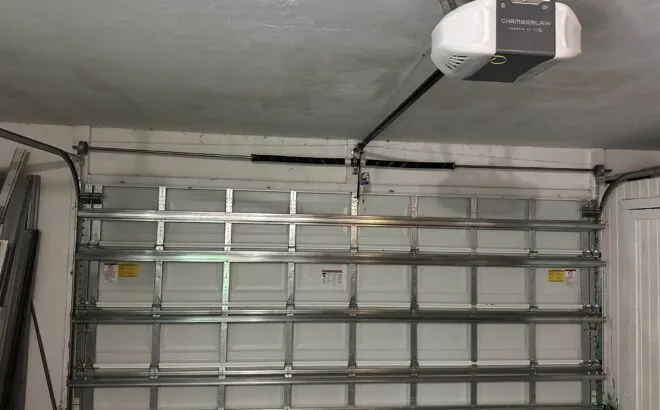
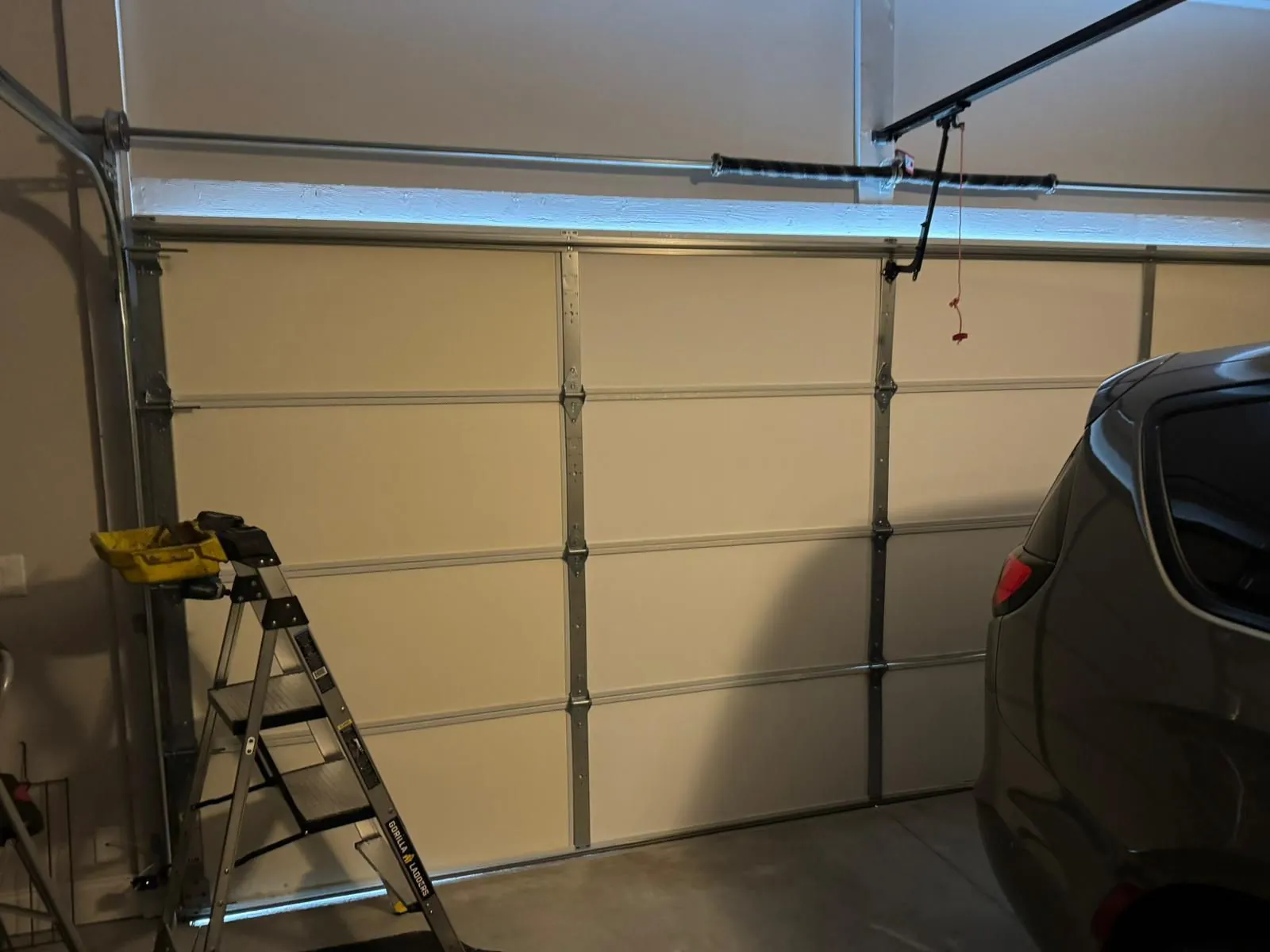
If there is a thick coiled spring, or a pair of them, sitting on a horizontal tube right above the top of the closed door, with a round grooved drum at each end of that tube, your door runs on torsion. The coil twists around the tube; it never stretches. When it breaks, you will usually see a clear gap partway along it, and the two halves may have spun apart slightly.
If instead there are long, thinner springs running parallel to the ceiling rails, one on each side, each connected to a pulley that the cable runs over, your door uses extension springs. These stretch out when the door goes down and shorten when it goes up. A broken one often hangs limp, or has dropped onto the rail, or is dangling from one hook.
Telling us which you have, and whether there is one coil or two over the opening, lets the right parts travel with the van. In the small older bays of this city both arrangements are common, and some doors that started life on extension springs were converted to torsion at some point, so it is worth a look.
A sectional door’s real weight
People are often surprised to learn how much a garage door weighs. Steel sections, hinges, rollers, struts and a bottom seal add up to something no one should try to hold overhead, and a wooden carriage-style door can be heavier still. The spring exists to cancel out that mass so a person, or a modest motor, can move the door with very little force.
Get the spring right and the door almost floats. Get it wrong, too weak or too strong, and the problems show up elsewhere: a weak spring makes the door crash down and the opener labour going up, while an overwound one lets the door creep upward on its own and slam into the stops at the top. Neither is safe, and both shorten the life of every other part on the door.
A spring’s life, counted in lifts
Each up-and-down trip is one cycle, and each spring is built for a finite number before metal fatigue finishes it. That is why springs do not fade gracefully; they carry their full load right up to the lift that cracks the wire. A garage door that doubles as the everyday entrance for bicycles, groceries and recycling clocks up those cycles at a ferocious rate, so its spring may reach its end long before one on a door opened only morning and evening.
Frost hurries things along. Steel grows less tolerant in deep cold, and a freestanding garage with no heated neighbour drops to the same temperature as the yard. A coil already near its last cycles tends to choose a raw, frozen morning early in the winter to break. Moisture adds pitting rust along the coils, and every pit is a starting point for a fatigue crack. Bays that sit at the low point of a lot, where meltwater drains toward the door and lingers on the slab, stay damp inside for months.
Springs that were undersized from the start also go early. The usual story is a door that was altered, with an insulation kit added, a section swapped or a thicker seal fitted, and nobody re-sized the springs to suit.
Garage door spring repair in Cambridge’s tight bays
Garage door spring repair in Cambridge is shaped by the buildings as much as by the springs. A single bay behind a triple-decker often has rafters hanging low over the opening, sometimes under a pitched roof that steals more height on one side. A standard torsion tube may simply not fit, so many of these doors run on extension springs, or on a low-headroom torsion kit mounted toward the back of the horizontal rails.
Width is just as tight. Where a parked car leaves only a sliver along each wall, the side springs, pulleys and cables share that sliver. Reaching them safely means the car has to be out and the walls cleared. When a car is trapped behind a door whose spring has broken, the order of work changes: the door is secured and supported first, then the spring is dealt with, and only then can the car leave.
The wood behind the hardware matters too. On a small older garage the header board and wall studs take the pull from the centre plate and end brackets of a torsion setup, or from the rail hangers on an extension setup. Punky or split framing behind those fixings gives a new spring nothing firm to work against, so the timber is checked before anything is wound.
Torsion springs are not a DIY job
Here it is without softening. That coil over your header stores dangerous tension, and swapping or rewinding that torsion coil is not a DIY repair, whatever a tutorial claims. The coil is loaded with the door open or closed, and a broken coil can leave part of its charge locked in the tube. The cone’s set screws, the cone, the drums and the lower fixings for the cables all sit inside that loaded system. Slackening any of them without proper bars and a practised sequence can let the energy go at once, and a bar that whips round in a cone can shatter bones.
Side springs carry a separate risk. When one snaps with no containment line through its middle, its hook and the loose end can fly across the garage. If one of yours has broken and nothing runs through its centre, keep everyone well back from the door.
While you wait:
- Keep the opener unplugged; it cannot lift a door with a dead spring and will grind its own gear trying.
- Leave the door where it stopped. If it is up and steady, resist the urge to pull it down.
- Keep children, pets and the car out of the doorway.
- Touch the red release handle only once the door is resting on the slab; with it raised, the door can drop the moment it is freed.
What a visit involves
The first job is making the door safe to work on. Whatever tension remains in a broken coil or its partner is unwound gradually with winding bars, never released by loosening set screws, and the door is clamped in its rails or propped so nothing moves while old parts come off.
Then the door is measured and assessed. Its width, height and build decide the spring it needs; the broken coil only hints at the answer, since it may never have suited the door. The new torsion coil is slid onto the tube and given a counted number of turns, or new side springs are hooked in at the correct pulley holes. Two-coil doors normally get both coils renewed together, because the partner has done identical work and is rarely far from failing itself.
Balance is what turns a new spring into a lasting repair. The cables are checked for even tension where they wrap each drum, and every drum’s grip on the tube is confirmed. The door is lifted by hand and let go at several heights. A door that drifts down needs a little more tension; one that rises unaided needs a little less. Rollers, hinges and rails are looked over in the same visit, since a stiff roller or a bent rail can make a well-sprung door feel wrong. Last, the opener is reconnected, run through a full trip, given force and travel settings to suit the newly balanced door, and its reversing function is tested.
Uneven slabs and lopsided doors
Small freestanding garages on shallow footings shift with frost, and many of their slabs have tilted or cracked over the years. Where the floor at the opening is out of level, the door touches down on one corner first. On the raised corner the cable loses its pull for an instant at each close, and on the following lift it can hop out of the groove on its drum. Where two coils share the work, the lean can also hide a failing spring, because the door already looked off.
Getting the cables right for the floor as it really is forms part of any garage door spring repair Cambridge MA owners of older slabs book with us. On torsion doors each drum is set so both cables tighten together at the instant of touchdown; on extension doors each spring is placed on its own pulley hole so both sides climb in step. The result should be a door that lifts off the slab level, without one corner leading the way.
When the opener is hiding a weak spring
Modern openers can haul an out-of-balance door for a long time, which is how a weak spring goes unnoticed. Hints that the motor is doing the spring’s job include slowing near the top, a drive chain that sags and snaps taut at every start, and a heavy thump onto the slab at the end of a close. A simple test: with the door fully closed, pull the release cord and lift by hand. Real effort, or a door that will not hold still at waist height, means the spring wants attention now, before it snaps and before the motor wears itself out with it. Openers that have already suffered are covered under opener repair in Cambridge.
A new spring, or a new door
One broken spring is rarely a reason to replace the whole door. In most cases the answer is a correctly sized coil or a matched pair, wound and balanced. The question shifts when the spring failed because the door has grown far heavier than intended, for instance a wooden door saturated by years of wet winters, or when the bottom sections have rusted through along the line where slush sits. A fresh spring will still work there, but the door it is lifting is close to finished, and you deserve to hear that before paying for parts.
When more than the spring has failed
Spring failures often bring company. A coil that breaks with the door half raised can unseat a cable or twist the door in its rails, which is general garage door repair in Cambridge work. A motor that strained for months against a fading spring may have stripped its drive gear. And a coil that snaps with the car shut in and an early appointment looming is what our urgent service for Cambridge doors exists for. The wider approach is described on our main spring repair page, cable faults on the cable repair page, and the city’s full list of services lives on our Cambridge hub.
Getting the garage ready for the visit
A few simple steps make spring work in a small bay go more smoothly. If the car is outside, leave it on the street rather than pulling it in. Move bikes, bins and boxes back from both side walls and from the area directly under the horizontal rails, because the technician needs to stand there and swing a winding bar with nothing in the way. If the only light is a single bulb on the opener, a work lamp or the beam from a phone is helpful during an early-morning or evening visit.
If the door is stuck open, put nothing beneath it. If it is stuck closed and the garage has a side door, make sure that door can be unlocked, since it may be the only way in until the spring is replaced. And if the driveway is shared with the next house, a quick word with the neighbour about a van stopping at the curb for a while saves an awkward moment later.
Booking spring work
The phone line never closes, so a coil that breaks before sunrise, on a weekend or on a holiday can be reported when it happens. Let us know if the springs are on a tube over the door or running beside the ceiling rails, how many coils there are, where the door stopped, and if a car is stuck inside. If garage door spring repair in Cambridge, MA is what the door needs, call us or book online.
Questions from Cambridge
There was a bang from our garage out back and now the door will not move. What happened?
Most likely a torsion coil broke. From the floor, look along the tube over the door for a split in the coil. Do not try the door again; pull the opener’s plug and ring us.
Our garage has very little space above the door. Can a new spring still go in?
Yes. Low-ceilinged bays often use extension springs or a low-headroom torsion kit at the back of the rails. The replacement is matched to the door’s weight and to the room available.
Only one of our two coils snapped. Why renew both?
Both have done the same number of lifts, so the survivor is usually near its own break. Mixing an old coil with a new partner also tilts the door as it climbs.
Can I keep using the opener on the coil that is left?
Please do not. A single coil sized as half of a pair cannot carry the door, so the motor does most of the lifting. It may get away with it once or twice before the door comes down hard.
Why do springs seem to break in the first cold weeks?
Cold makes the steel less forgiving, and a freestanding garage is as cold as the yard. Frost does not use up a spring by itself; it picks the morning a nearly spent one gives way.