
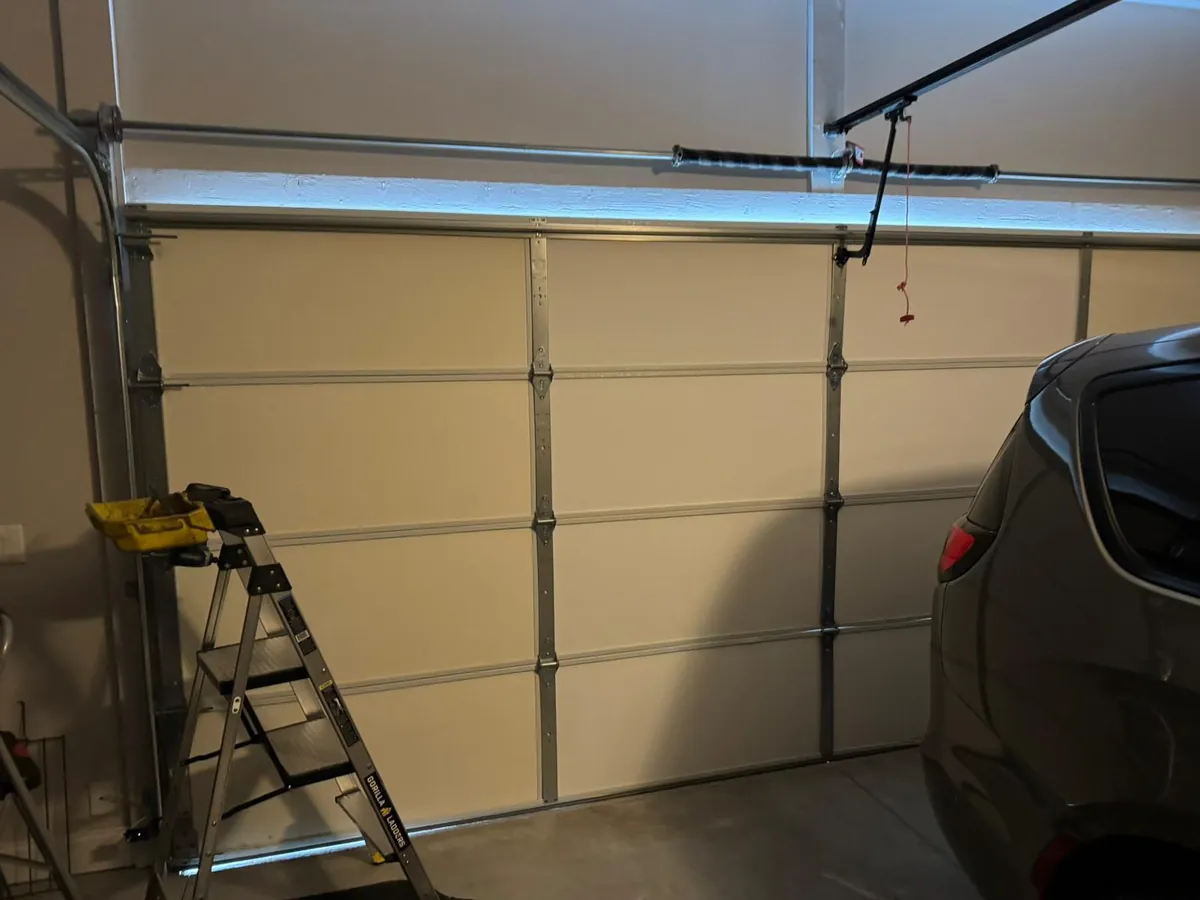
Why the garages behind Somerville’s triple-deckers wear out the way they do
Somerville is the densest city in New England, and its garages carry the marks of it. Most are single bays tucked in behind a triple-decker, reached by a driveway that is often barely one car deep, on a lot with hardly a spare foot of ground around the building. Garage door repair Somerville MA homeowners ask about nearly always begins in one of those squeezed back-lot garages, where the overhead door is the only way in for the car, the bikes and the recycling, and where the gap beside the jamb and above the header is measured in inches.
That shortage of room is the common thread through every job here. It decides where a stepladder can stand, where a winding bar can swing, how a kinked rail can be reached and whether an opener can come down without emptying the storage racks first. A cramped bay does not change which parts give out, but it does change how they wear and how the fix has to be carried out.
Three things are worth noting, from well back, before you pick up the phone:
- Does the door move at all, creep a little and quit, or hang crooked in the opening?
- Is either lift cable at the bottom corners slack, or unwound from its drum?
- Does the opener hum, click, run with no result, or stay silent?
What a Somerville repair call usually covers
Torsion and extension springs
A torsion spring across the header, or a pair of stretch springs running alongside the overhead rails, carries the door’s weight. Once one snaps, the door is a slab. More on spring repair in Somerville.
Lift cables and drums
Cables fray at the point where they wind onto the drums. A snapped or unspooled one leaves the door hanging lopsided.
Sections and hinges
Bottom sections creased by a bumper on a driveway with no room to straighten up, split centre hinges, and steel or wood eaten at the base by salt water.
Openers and controls
Motors that labour or go quiet, handheld remotes that no longer reach, and wall consoles that do nothing. See opener repair in Somerville.
Rails, rollers and derailed doors
Rails nudged out of plumb, rollers with flat spots or shattered wheels, and doors that have come clean out of their channels.
Photo eye sensors
The low pair of beams either side of the opening. In a crowded bay they are the first thing a bin or a bike wheel knocks sideways.
When the garage is barely wider than the car
Much of the difficulty in a city this tightly built has nothing to do with the failed component. It is about reaching it. Plenty of the single garages behind triple-deckers were framed around smaller cars and narrower openings, and the space between the jamb and the side wall can be no more than a hand’s width. Shelving, bikes hanging from hooks and the overflow of a household with no basement space left use up the rest.
None of that is a reason to put a repair off, but it does help to know before a visit. A clear strip down both sides of the door, and a patch of open floor in the middle for a ladder, lets the springs, the drums, the rail brackets and the opener carriage all be reached. If the car is inside, it usually needs to come out; if it cannot, because the door is jammed down, say so when you call.
The same tightness plays out in front of the door. With a driveway barely a car deep, the overhead door is often the last barrier between the street side of the lot and everything stored inside. A door jammed up leaves the bay open to anyone passing the end of the drive; a door jammed down leaves the car shut in with no second exit. Either way, it is rarely something that can wait for a quieter week.
How one door’s parts lean on each other
A sectional door runs as a counterbalanced system, and the motor is the least important part of it. The springs do the heavy work. In a torsion arrangement, the coil is threaded over a steel tube running the width of the header; lowering the door winds it tighter, raising the door lets it unwind, and that motion turns the cable drums fixed at either end of the tube. Cables run down from the drums to the bottom fixtures, so the stored energy draws both lower corners upward at the same rate. In an extension arrangement, a long coil beside each overhead rail is drawn out as the door descends and hauls it back up by way of a sheave.
Each section carries rollers that ride first in the upright rails flanking the opening and then in the overhead rails under the ceiling joists. Hinges let the sections fold around the radius where those rails meet. The opener, hung from the joists on its own rail, should only be guiding a door that is already nearly weightless, and it should halt and back off the moment the photo eyes report something in the opening.
Because of that balance, one tired component hands extra strain to all the others. A coil that has lost its wind makes the motor drag more weight on every trip. A cable worn thin on one side lets the door tilt, and the tilt grinds the rollers on the low corner. A seized roller wears a channel into its rail. Sound garage door repair in Somerville therefore looks beyond whatever part was named on the phone and watches the whole door travel.
Creased sections, split hinges and a rusting base
On a driveway a single car deep, the panels get knocked far more often than on a long suburban approach. A car reversing out has no room to straighten before it reaches the opening, and the lowest sections sit right at bumper height. Where a matching profile is still made, one creased section can be swapped by itself; a door with damage across several sections usually makes more sense to replace whole.
Centre hinges fail without much warning. A cracked hinge lets two sections flex apart as they round the radius at the top of the opening, which shows as a bow across the middle, a jolt at the same point every trip, or a scraping sound. Catching it early saves the sections either side.
Winter is hardest on the base. Tires bring salt and slush in, it pools along the weatherstrip and the lowest section, and on a small lot with little fall there is nowhere for it to drain away. Over a few winters that softens a wooden bottom rail or rusts out a steel one, crushes the rubber seal, and corrodes the bottom fixtures where the cables anchor. A flattened seal is minor; corroded cable anchors are not, because they are holding back the whole pull of the spring.
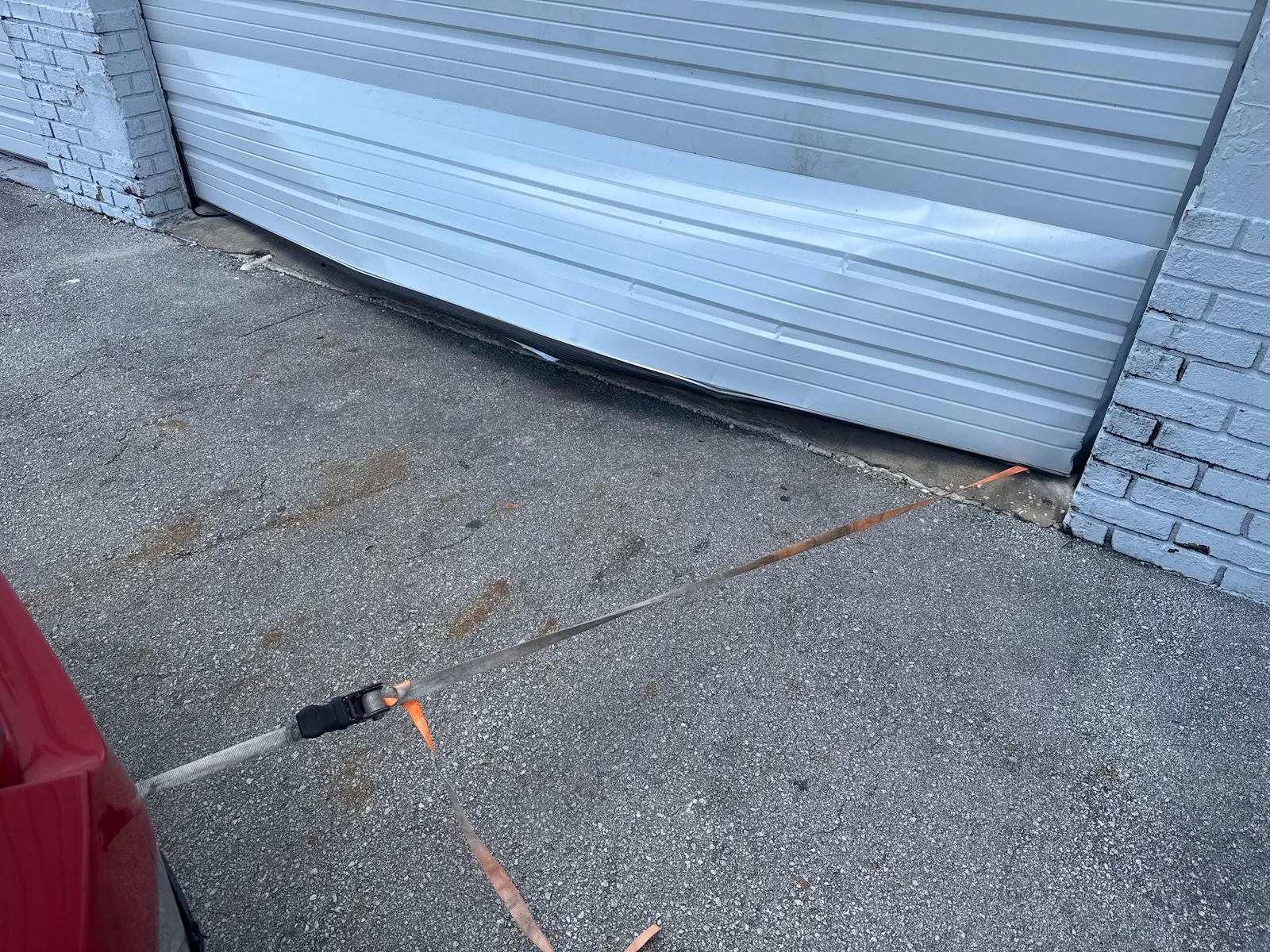
Rails, rollers and doors that jump out of line
In a bay where everything is packed close, the rails get bumped. A bin dragged in past the opening, a bicycle propped on an upright rail, or a car door swung into it can push the rail slightly out of plumb, and slightly is enough to make the rollers bind. The lag screws holding the overhead rails to the ceiling framing can also back out as the door cycles through the seasons.
Once a rail is far enough out, or a cable lets go on one side, the door can leave its rails. It usually ends up skewed in the opening with one or two rollers sitting outside the channel. A derailed door is unstable and liable to come down, so cut power to the motor and let the door sit exactly as it is. Setting it right involves securing the door’s weight, coaxing the rollers back, truing or replacing the kinked rail, matching the two cables, and only after all that letting the door travel again.
What a repair visit in Somerville involves
The order of work is the same on each call, adapted to how much room the bay gives:
- The opener is uncoupled from the door at the trolley, and the bay is looked over to find a safe footing for the ladder and somewhere to lay out tools.
- Balance is judged by raising the door to about waist height by hand and watching whether it stays, sinks or rises.
- Springs, cables, drums and the bottom fixtures are examined for breaks, broken strands and rust.
- Rollers, hinges and all four rails are sighted along their length for kinks, wear and backed-out fasteners.
- The opener is cycled by itself, its travel limits and force are reviewed, and both photo eyes get a beam test.
- Nothing gets swapped until you have heard which part let go and what caused it. Once the work is done the door’s balance is reset, the opener’s limits are tuned to the lighter or heavier load it now carries, and a block of wood laid across the threshold confirms that the door touches it and climbs away again.
In the narrowest garages, the first step matters more than it sounds. A winding bar needs an arc to swing through, a rail sometimes has to be reached from the side, and whoever is doing the work needs a place to stand clear of the door if anything lets go.
What a homeowner can safely look at, and what to leave
Some first moves carry no risk and save time later:
- Where the door has halted mid-travel, unplug the motor unit at the ceiling so nobody can trigger another try.
- Clean the little lenses on both photo eyes and clear whatever might be sitting in the path between them.
- Test the wall console as well as the handheld remote, and if only the remote has died, swap its battery.
- Run your eye along the rails for anything obvious, like a shovel handle or a pedal caught in the channel.
Other parts should be left strictly alone. The tension stored in a torsion spring is dangerous in every door position, and the cables and bottom fixtures carry that same load. Backing off a set screw, levering at a bracket, or trying to wind or unwind the coil can turn all of that energy loose in a split second. Torsion work is not a DIY repair, and inside a narrow garage there is even less room to get clear. Nor should a door with a snapped spring be raised by hand or by the motor, since nothing is supporting its weight any more.
Repair or replace
Most calls for garage door repair in Somerville finish with the old door back in service, not a new one ordered. New coils, matched cables, replacement rollers, a trued rail: on a door with sound sections, that list usually covers it. Replacement becomes the stronger option when several components are wearing out at the same moment, when the lowest sections are rusted or rotted past saving, when creases run across two or more sections, or when a wooden door has grown so waterlogged that no sensible coil could counter it.
On a tight lot there is one more factor. A heavy older door can be part of the reason the opener keeps struggling, and a lighter replacement takes load off every other part in the bay. Whichever way the door falls, you get a straight answer on repairing it versus replacing it, and when a new door is the honest advice our new garage doors page covers choosing, supplying and fitting the replacement.
Openers and photo eyes in a crowded bay
In single city garages the opener usually hangs tight under the joists, with storage racks built right up against its rail. That makes it easy to knock and awkward to work on. Typical faults are a motor that hums without turning, a stripped drive gear, a chain or belt that has stretched and slaps against the rail, and a control board that has stopped answering the wall console.
Photo eyes cause more return trips than almost anything else in a busy garage. Mounted a few inches off the slab at the foot of each jamb, they sit right where bins, bikes and boots end up, and the slightest knock pushes them out of alignment. Then the door starts down, gets part of the way and climbs back up, or will not start down at all. Re-aiming or replacing them is a small part of most visits, and the reverse is always proved before the door is handed back.
When the opener itself is the failure, the Somerville opener repair and replacement page goes much deeper into motors, remotes, wall consoles and photo eyes.
Springs, cables and a door that refuses to lift
The most frequent reason a Somerville door suddenly will not open is a snapped spring, and it tends to happen on the first properly cold mornings, when the steel is at its least forgiving. The opener raises the door a hand’s breadth and gives up, or the door feels anchored to the slab. A failed cable looks different: the door climbs unevenly, sits low on one side, or comes down at an angle.
Both call for the right tools and a safe working method; neither is a weekend project. The spring repair page for Somerville explains torsion and extension coils in full, and the broader garage door repair service page shows how each part of the door is handled across Greater Boston.
When the door gives out late at night
Doors rarely choose a convenient moment. A coil can snap in the small hours, a cable can let go as the car is backing out, and a door can jam up just as the light fades. Because somebody answers the line whatever the hour, on weekends and holidays included, a failure found at midnight can be logged at midnight. The Somerville emergency repair page walks through the hours between the breakdown and the visit, for doors stuck up, stuck down or hanging off their rails.
Booking your garage door repair Somerville MA visit
When you get in touch, tell us what the door does when you press the button, which pieces look snapped or bent, whether the car is stuck in the bay, and how much space there is around the opening and on the driveway. For garage door repair Somerville MA homeowners can call us or book online, and the Somerville town page brings together every service offered in the city.
Questions from Somerville
My garage is very tight. Can a repair still be done?
Almost always. Narrow bays and short driveways are routine here. Clearing a strip beside the door and a patch of floor in the middle helps, and so does moving the car out if the door will open. If it will not, mention it when you call and the job can be arranged with the car still parked inside.
The door rises a few inches and quits. Is the opener broken?
More often the spring has snapped. The motor starts to lift, meets the door’s full weight and its force limit cuts it off. Stop pressing the button, cut the motor’s power and study the coil over the header: a split between two windings confirms it.
Can I leave the door down with one cable gone?
Leave it shut, with the motor unplugged. With one cable missing, the door is held from a single corner and can twist in its rails if it moves. Do not run it or lift it until it has been put right.
Why does the door start down and then climb back up?
Usually the photo eyes. In a packed garage they are easily nudged out of aim, blocked by something on the floor or dimmed by grime. Clean the lenses and clear the path between them. If they check out, the door may be binding in a kinked rail, which the opener reads as an obstruction.
Do you work on doors set into the base of a building as well as detached garages?
Yes. Detached single garages behind triple-deckers are the most common, but doors built into the base of a building are repaired with the same parts and the same attention to clearance and to noise carrying into the rooms above.