
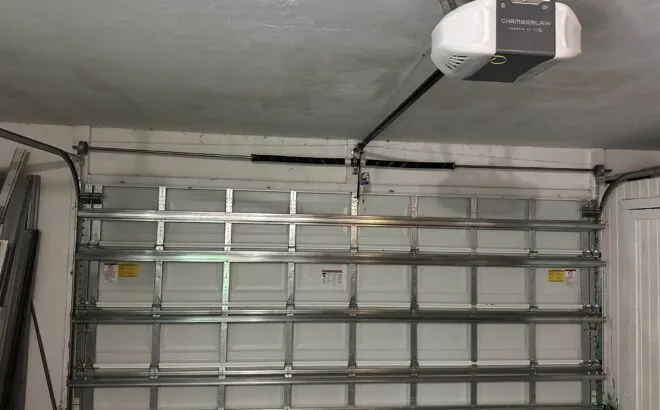
What a snapped spring means in a Somerville back-lot garage
In the densest city in New England, most garages are single bays wedged in behind a triple-decker, at the end of a driveway barely deep enough for one car. When the spring on one of those doors breaks, the car is usually trapped behind a door that now weighs as much as a small piano, and there is nowhere else to park it. Garage door spring repair Somerville MA homeowners need is, more than any other call, the one that cannot wait, and the cramped bay makes it a job that has to be planned with care.
Springs are what make a sectional door feel light. Without a working one, no opener and no pair of arms should be asked to raise the door, because nothing is holding it up any more. The break itself is often loud: a single crack like a dropped board, heard from inside the triple-decker in the middle of the night or on a freezing morning.
Signs you can spot without touching anything:
- A clear gap a couple of inches wide between two coils on the tube above the door.
- A motor that raises the door a short way, then quits and runs back down.
- A loose cable hanging beside the door, or the top section sitting lower than it should.
Spring problems we deal with in Somerville
Snapped torsion springs
The coil on the steel tube across the header has broken in two. By far the most common spring call in the city.
Worn or stretched extension springs
Long coils beside the overhead rails that have lost their pull, or snapped, often on older and lighter doors.
Missing containment cables
Extension springs should have a cable threaded through their centre, so a broken coil cannot whip across the bay. Many older setups are missing them.
Uneven or tired springs
A door that drifts down from halfway, or creeps up on its own, has springs set to the wrong tension for its weight.
Rusted spring hardware
Winding cones, centre bearing plates and end brackets corroded by damp air coming in under the door each winter.
Doors wrecked by a failed spring
Bent rails, a cable off its drum or a strained opener left behind when a door was run after the spring broke. The wider Somerville garage door repair page covers those parts.
Torsion and extension springs, side by side
Two spring systems are found on sectional doors in the city, and they behave quite differently when they fail.
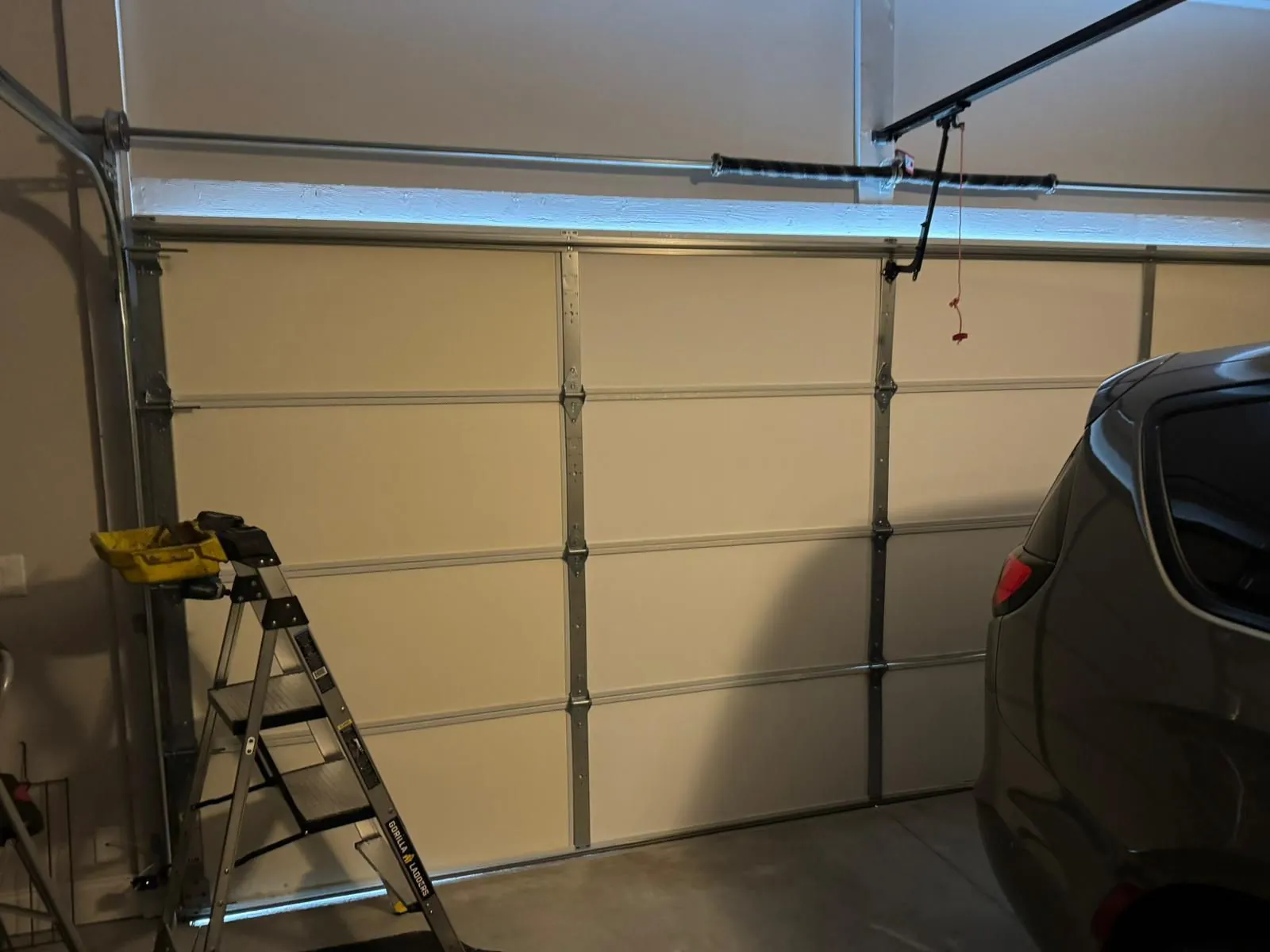
A torsion system mounts one or two heavy coils on a steel tube that spans the width of the opening just above the header. As the door comes down, cable unspools from a grooved drum on either end, and that rotation loads the coils with twist; on the way up, the coils relax, spinning the drums so the cable is reeled back into the grooves. When a torsion coil breaks, it usually stays on the tube, so the break is easy to see and the energy is mostly released into the coil itself. The door simply becomes too heavy to raise.
An extension system uses a long coil running parallel to each overhead rail, fixed near the rear end of the rail, and it reaches the door by way of a sheave and a cable. Closing the door stretches the coils; opening the door lets them contract and draw it upward. When an extension coil snaps without a containment cable through its middle, the broken halves can whip across the garage. In a bay crammed with bikes and storage, and sometimes with a person squeezing past the car, that is a real hazard.
Many older single garages still carry extension springs. Some doors have been converted to torsion over the life of the building. Either kind is replaced, and when an extension door is being worked on, a missing containment cable is pointed out.
Cables, drums and bearings: the spring’s partners
No coil does its job in isolation. On a torsion door, the force it stores reaches the door only through the two drums at the ends of the tube and the cables wrapped around them, and the tube itself turns in a centre bearing plate and two end bearings. When a coil snaps, the sudden release can spin the tube and throw a cable out of its drum groove, and a cable that has been rubbing against a rusty drum for a few winters may already be down to a handful of intact strands.
So every visit for garage door spring repair in Somerville includes a look at those partners. Cables are run through a gloved hand to feel for broken strands, drums are checked for cracks or a worn groove, and bearings are spun to hear whether they grind. In a damp back-lot garage, the bottom fixtures where each cable hooks to the lowest section get special attention, because salt water pools there and those small brackets carry the whole lifting force.
On extension doors the partners are the pulleys and the cables threaded through them. A pulley with a cracked wheel or a seized axle chews the cable, and a frayed cable on one side tips the door as it rises. Those are changed at the same time as the springs whenever they show wear.
The hands-off balance check
With an intact spring, you can learn a lot about its condition without touching any of the tensioned parts. Tug the red release handle dangling under the opener rail, lift the door with both hands until its bottom edge is level with your belt, and ease your grip off.
- A healthy, correctly set door stays roughly where it was left.
- A door that sinks back to the floor has springs that have lost their strength.
- A door that rises by itself has springs wound too tight for its weight.
If the door feels very heavy from the start, or will not stay up at all, stop and lower it carefully; that is a spring that has already failed or is close to it. Never do this test on a door where the coil is visibly broken.
Looking after new springs through a Somerville winter
New coils last longest when the rest of the door is kept in good order. Rollers that turn smoothly and rails that are clear of grit mean the springs are not fighting friction on every trip. Wiping the coils with a little door lubricant each autumn slows the surface rust that starts cracks. Keeping the bottom seal in good shape stops the slush that rides in on tires from turning the air in the bay into a steam bath every time the car comes home.
Why springs break, and why the cold makes it worse
Spring steel tolerates only so many trips up and down. Each trip flexes the steel, and over time the metal fatigues until one day a coil cracks right through. Where a garage is shared by more than one household in the building, its door may cycle many times a day and use up that life far sooner than a door opened twice a day.
Cold speeds the end along. Steel is less forgiving when it is frozen, so a coil that was close to its limit is most likely to go on the first truly bitter morning of the winter, often at the very first lift of the day. Moisture plays its part too. Salt-laden slush carried in on tires keeps the air in the bay damp, and rust on the coil surface creates small pits where cracks begin. Lubricating the coils helps them along, though even a pampered spring wears out in the end.
Imbalance is the third cause. If one spring on a two-spring door was replaced on its own in the past, the new and old coils pull unevenly, and the old one usually fails soon after. For that reason both springs on a two-spring door are normally replaced as a pair.
Why this is not a job to try yourself
Torsion coils store dangerous tension, and changing them is not a DIY repair: a loaded coil carries enough energy to snap a wrist or a jaw. Even after one coil has snapped and the door is sitting closed, any second coil, both cables and the bottom fixtures can still be loaded. Releasing that energy safely takes proper winding bars, a set procedure and a clear space to stand in, and the bay behind a triple-decker rarely leaves much of that space spare.
The usual home attempts are the dangerous ones: backing out the cone’s set screws, grabbing the tube with a pair of pliers, trying to wind a coil with screwdrivers in place of bars, or raising a springless door by hand and wedging a length of lumber under it. Any of those can let a heavy door drop or let a coil spin without warning.
The safe response is simple. Leave the door where it is, pull the motor’s plug at the ceiling outlet so a passing housemate cannot trigger it, keep children and dogs clear of the threshold, and book garage door spring repair Somerville MA homeowners can rely on.
How the cramped Somerville bay shapes the work
Changing a torsion spring needs room in two directions. The technician stands on a ladder in front of the coil and turns the winding bars through a short arc, a quarter turn at a time, so there has to be clear space below and to the side of the tube. In a garage where storage racks reach the ceiling a foot from the door, or where bikes hang from the joists, some of that has to move first.
Extension springs need room along the length of each overhead rail, since the coils and their pulleys run back toward the rear wall. Where the side of the rail is tight against a wall or a shelf, re-threading the cable and fitting a containment cable takes extra care.
Outside the garage, the short driveway matters as well. With room for one car at most, a van often parks across the end of the drive or on the street, and parts are carried down beside the triple-decker. None of this stops the repair; it just means the visit is shaped by whatever room the lot offers.
What a spring repair visit involves
- The motor is uncoupled at its trolley, and locking pliers clamped on the rail above a roller hold the door still while the springs are dealt with.
- Wire gauge, inside diameter, coil length and wind direction of the broken spring are measured, and the door’s construction is noted, so the new coil is matched to that particular door.
- Whatever load remains in the system is bled off with two steel bars, swapping hands at each notch of the cone.
- Old coils come off the tube. Cable strands, drum grooves and the end bearings are inspected while the shaft is bare, and any worn part is pointed out to you before more work is added.
- Fresh coils slide on, get wound to the count that door’s height and weight call for, and are locked with their set screws; cable tension is matched left and right.
- Raised by hand to waist level and let go, a well-sprung door hangs there. The opener is then reattached, its travel stops and its push setting get trimmed, and the reversing test is run again.
On extension systems, the routine is similar but the coils are swapped with the door raised and held, and the containment cables are threaded through each spring before the door is run.
Early warnings from a tiring spring
A coil near the end of its life usually gives hints. Look out for:
- A door that takes more effort to lift by hand, after pulling the release cord, than it once did.
- The door no longer staying put when stopped halfway, drifting down toward the floor.
- Visible gaps opening up between coils that used to be tightly packed, or rust building on the coil.
- The opener straining, slowing at the top of its travel, or stopping and reversing for no visible reason.
- A door that lifts unevenly, higher on one side, on a two-spring setup.
Catching a tired spring at this stage lets the repair be booked at a convenient time, rather than in the dark on a frozen morning with the car stuck inside.
New springs, or a new door?
Far more often than not, a broken spring is fixed with new springs and the door carries on for a long time. Replacing the whole door only makes sense when the spring failure is the last straw for a door that was failing anyway: bottom sections eaten through by rust, a timber door so waterlogged it needs a much heavier spring than its frame can bear, or multiple panels creased and split. If that is where a door is, you will be told plainly. The new garage doors page covers what a replacement involves.
A failed spring can also leave damage behind it. Pressing the button again and again after the break can chew the motor’s drive gear, bow its rail and let a slack cable spill off its drum. The Somerville opener repair page explains those faults in more detail.
When the spring goes in the middle of the night
Springs seem to break at the worst moment: late at night, on a holiday weekend, or at first light with a shift to get to. Somebody picks up the phone through the night, so you can ring about a snapped coil as soon as you hear it go. Our Somerville emergency repair page covers the hours before help arrives, and springs elsewhere in Greater Boston are on our garage door spring repair service page.
Booking garage door spring repair Somerville MA residents can schedule
Useful things to mention: where the broken coil sits, on the bar over the header or beside the ceiling rails; whether the car is shut in; and what is stacked near the door that may need shifting. For garage door spring repair Somerville MA residents can call us or book online. The Somerville town page lists every service available in the city.
Questions from Somerville
A sharp crack came from the garage overnight. Should I worry?
That noise is usually a coil letting go. Stand back near the house door and look for a split in the coil over the header, or a limp coil dangling beside a ceiling rail. Leave the door shut and cut power to the motor.
My car is behind a door with a snapped spring. Can I drive it out?
Not by heaving the door up. A springless door puts its entire mass on your back or on whatever prop is under it, and it can come down in an instant. The car stays put until new coils are on.
Only the left coil broke. Why change the right one as well?
Usually it does. Twin coils on one tube have lifted the door exactly as often as each other, so the survivor has used up roughly the same life, and pairing a fresh coil with a worn partner leaves the door pulling crooked.
My garage is very tight. Is there room to change the spring?
Usually, yes, once some space has been cleared. Winding bars need room to turn below and beside the tube, and a ladder needs firm floor in front of the door. Moving shelves, bikes or bins away from that area before the visit makes the job safer.
Are extension springs more dangerous than torsion springs?
They carry less energy, but a broken extension coil without a containment cable can fly across the garage. If your stretch springs have no steel line threaded down their centres, ask for one to be added at the next service.