
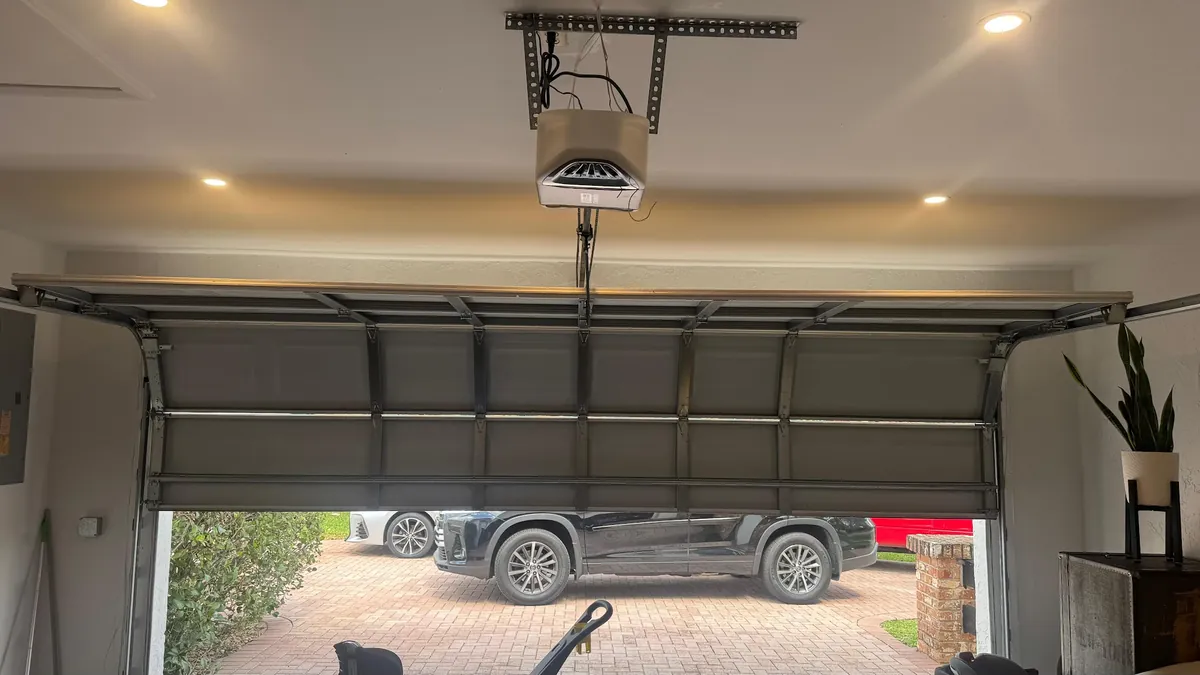
Motors, handsets and photo eyes in damp rear garages
Out back of a good many Chelsea two- and three-families, on lots squeezed tight near Broadway and Bellingham Square, there is a single-car garage with a motor bolted to its ceiling. That motor gets few easy days. It hangs under low joists, breathes moist air with a tang of salt from the creek, and trembles every time a loaded truck goes by. Garage door opener repair in Chelsea, MA deals with every piece of that setup: openers mended or swapped for new ones, handsets reprogrammed or renewed, wall buttons rewired, and safety sensors brought back into line.
Before ringing, three observations will narrow things down:
- Listen as you press. Is there a click, a hum, a whirr, or nothing whatsoever?
- Compare controls. Does the button by the side door succeed where the car handset fails?
- Crouch by the rails. Do both little sensor lamps glow solid, flicker, or stay unlit?
Opener parts we repair and replace
Motor and gears
The powerhead hanging from the joists. Inside it, a plastic drive gear can grind its teeth flat after season upon season of dragging an out-of-balance door.
Rail and trolley
The long track running from motor to door, and the carriage gliding along it towing the door arm. Chains slacken, belts fray, steel rails corrode.
Remotes
Car handsets that no longer reach the motor, forgot their pairing, or have buttons worn through from use.
Wall buttons
The push button near the side door, and the hair-thin wire snaking across the joists from it to the powerhead.
Safety sensors
A pair of photo eyes staring at one another across the opening, low by the floor. Interrupt or misalign them and closing is refused.
Limits and force
The stored settings telling the motor where up and down end, and how much push to allow before treating resistance as an obstacle.
How an opener makes up its mind
People picture an opener as brawn, but it is closer to a supervisor. Springs bear the weight; the motor merely starts the door rolling, guides it to the right stopping points and watches for trouble. Inside the powerhead, an electric motor spins a reduction gear, the gear turns a sprocket or pulley, and that drags the trolley along its rail. The trolley in turn is hooked to an arm fixed to the door’s uppermost section.
Two groups of settings rule its conduct. Travel limits mark how far to run each way, so the door kisses the floor at the bottom and clears the header at the top. Force settings mark how much drag to accept before deciding the door has met an obstacle and backing off. On top of those sit the photo eyes, an independent guard: while their unseen beam is whole the door may descend; cut it and the door halts and rises.
Almost every opener complaint is one of those systems misjudging the door. So proper garage door opener repair in Chelsea always begins with the door’s own condition, ahead of anything electrical on the ceiling.
Reading the symptoms
- Nothing at all from either control. Suspect power before anything else: a tripped breaker, a dead socket, or a plug knocked half out.
- A hum or a click, yet no motion. Frequently a gear stripped bare, a failed starting part in the motor, or a door wedged solid or grossly overweight.
- Motor whirring and carriage travelling, yet the door stays shut. The carriage has come unhooked from the door arm, nearly always after the red cord was pulled.
- The door sinks most of the way, then rebounds. Dirty or wandering photo eyes, an over-sensitive force setting, or a door catching in its rail just above the floor.
- Button by the door fine, car handset useless. A spent battery, a dropped pairing, or a handset that has simply had its day.
- The door halts a little shy of the floor or the header. Limits drifting, or the door snagging partway through its run.
Treat those as clues rather than verdicts. Several overlap with spring and rail faults, which is where an in-person look pays off.
Salt, damp and electronics by the creek
An opener is an electrical appliance kept in an unheated shed, and around Chelsea that shed inhales moist, briny air carried off the creek. Circuitry dislikes it. The screw terminals on the powerhead where sensor and button wires land can corrode until the signal comes and goes. The photo eyes ride lowest of all, nearest to puddles, slush and road salt dripping off tyres, so their mounting brackets and wire splices tend to deteriorate first.
The rail does not escape either. A chain drive kept in a humid bay rusts, stiffens and lengthens, and a corroded chain slapping its rail is one of the noisiest complaints we hear. Steel rails can corrode at the header bracket. Moisture inside the powerhead can creep onto the circuit board, leading to glitches that seem to appear and vanish with the forecast.
Keeping the garage as dry as you reasonably can helps, as does wiping the photo eye lenses and glancing at their wire joints every so often. Once corrosion has reached the board or the wiring is crumbling, a repair or a new opener becomes the practical route.
Truck shudder, opener mounts and sensor brackets
A surprising amount of garage door opener repair in Chelsea turns out to be about fixings rather than electronics. Chelsea’s heavy truck traffic feeds a persistent tremor into roadside garages, and an opener feels it at two points. The powerhead dangles from the joists on perforated steel straps, and the rail’s front end is pinned to a bracket on the header. Vibration slackens those fixings in time, and a powerhead that droops or sways knocks the rail off line, so the carriage drags and the door shudders.
Photo eyes are the second casualty. Each perches on a slim bracket near the floor, and very little movement is needed before the pair lose sight of one another. A door that will not shut one week and behaves perfectly the next, for no visible reason, frequently has a bracket that the shaking keeps nudging in and out of true. Fastening those brackets solidly, and sometimes relocating them onto firmer timber or masonry, ends the game of hide and seek.
Low ceilings in small rear garages
Plenty of rear garages on Chelsea’s cramped parcels give the door very little room overhead. A conventional ceiling-hung opener needs space for its rail to clear the raised door, plus room behind for the powerhead. Under low joists, or where a torsion tube already fills the space above the opening, fitting one calls for care. The rail might need trimming or a particular hanging arrangement, and in some bays a jackshaft opener, which sits on the side wall and turns the spring tube directly, suits better than anything on the ceiling.
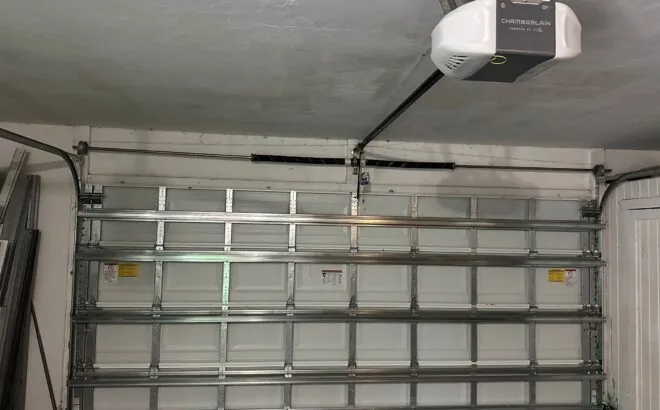
Any replacement is chosen to match the garage, the door and the joists above it, rather than a catalogue drawing. The goal is an opener that clears the door, the car roof and the heads of anyone walking underneath.
Wiring deserves a look in these garages too. Power usually reaches a detached rear garage along one lonely cable strung or buried from the main building, sometimes shared with a light and an outlet, and an opener that trips that circuit or loses power when another appliance starts can look faulty when it is not. Low-voltage wires to the sensors and wall button are frequently stapled along old timber that has shifted and split, pulling the staples through the insulation. Every opener visit traces those wires from end to end before blaming the motor.
Chain, belt or screw: which drive suits the garage
Openers move the trolley in a few different ways. A chain drive is rugged and simple but the noisiest of the three, with a rattle that carries through a ceiling. Belt-driven units swap the chain for a toothed, steel-cored band and run far more softly, which matters where a garage sits close to, or shares a wall with, rooms people sleep in. Screw-driven units spin a lengthy threaded shaft and keep moving parts to a minimum, though it can be sensitive to big temperature swings in an unheated building. Jackshaft openers avoid the rail altogether.
None of these is right for every garage. When a replacement is on the table, the choice is talked through against the door’s weight, the ceiling height, how close the garage is to living space and how often the door runs.
Checks you can safely make first
- Look for a lit indicator on the powerhead, then check the breaker and the socket it is plugged into.
- Test the wall button and the car handset one after the other to find out which is failing.
- Put a fresh battery in the handset.
- Clean the two photo eye lenses, shift whatever is parked in the gap, and look for a steady glow from each.
- If the door seems to have come away from the motor, lower it fully by hand before letting the opener re-engage it.
Hands off the spring, the cables and the bottom brackets. If the opener is labouring because the door is heavy, a worn spring is the probable reason, and a torsion spring holds dangerous tension that puts it firmly outside DIY territory. Avoid stabbing at the controls again and again while the door refuses to budge; that is how motors overheat and gears shred.
Why a new opener cannot cure a heavy door
A classic trap is swapping out an opener that keeps dying, only to watch its successor die as well. Where the springs are weak or snapped, the door is overweight, and whatever opener you hang on it is fighting a contest it was never built for. Gears grind down, motors cook, and the force adjustment gets cranked up until the safety reverse barely responds. The cure there is a spring, and the old opener frequently perks up once the door is back in balance. For that reason every opener visit includes testing the door’s balance by hand. The spring side is covered on the Chelsea spring repair page.
Mend the motor or start fresh
Many opener faults can be put right: a gear chewed smooth, a slack chain, a dud photo eye, a corroded wire splice, a handset needing pairing again. A new opener becomes the better choice when the motor or board has died outright on an elderly unit, when corrosion has invaded the electronics, when spares can no longer be had, or when the original was never a good match for the door and the garage. Some owners also opt for a new unit so it tucks in better under a low ceiling or runs more softly in a garage beside bedrooms.
We will say straight whether mending your unit makes sense. Among the motors we mend or exchange are LiftMaster openers, with more detail on the LiftMaster opener repair page. Openers of every kind are covered on the opener repair and replacement page.
Inside an opener visit
- The door arm is unhooked and the door raised by hand, to judge balance, smooth running, and the state of springs and cables.
- The motor is cycled with no door attached, and gear, rail and carriage are examined.
- Photo eyes, wall button, handsets and every wire joint, including those at the powerhead, are tested.
- The fault and the choices are set out for you before any part is touched.
- The fault is fixed, or a replacement unit goes up, sized to the joists and the door below them.
- Limits and force are dialled in, handsets paired, and the auto-reverse proven by lowering the door onto an offcut of timber lying across the threshold.
Nobody packs up until the door rises, lowers and reverses properly from every control you use.
Remotes and wall buttons
The handset clipped to a sun visor and the button beside the side door are the two parts of the system you touch every day, and they fail more often than the motor does. Handsets give up in more ways than a dead battery. Their pairing can vanish after a power cut, one fall too many cracks the case, and well-used buttons wear out. Most can be paired again or replaced on the spot, and extra handsets can be set up alongside. Some owners also like a second wall button at the back door of the house or a handset kept indoors, which is easy to add while someone is on site. Wall buttons are simple devices, yet the slender wire from button to powerhead is easily nicked by things stored against the wall or hung from the joists, and a corroded splice along it regularly explains a button that works only now and then.
Blackouts and the red cord
During a blackout the motor is helpless, and the red cord dangling from the carriage becomes your way in or out. Tugged while the door is fully down, it uncouples the carriage letting you hoist the door manually, provided its springs are in good shape. Tugging it with the door up is risky: with a weak spring, the door can plunge as soon as the coupling lets go. After the power returns, the opener usually reconnects with the door on its next full run. Handsets sometimes need pairing again afterwards.
Openers that fail after dark
An opener that dies at night leaves you with a door that will not open, or worse, a rear garage that will not close and sits exposed to the drive. Calls are taken at any hour of any day, so it can be reported right away, and our Chelsea emergency page has advice for the hours before a technician gets there. Other door faults are covered by our Chelsea door repair page, while the Chelsea hub gathers every service we offer locally.
Booking an opener repair
Useful details when you ring: what the motor does as you press, whether the wall button and the handset behave differently, what the sensor lamps show, and roughly how much space there is above the door. For garage door opener repair in Chelsea, from one new handset to a whole new opener, call us or book online.
Questions from Chelsea
I press the button, the motor drones, and the door sits there. Why?
Either the opener cannot shift the door or something inside the powerhead has given out. First confirm the door is not jammed and the spring is whole. If, once unhooked, the door glides freely by hand, a stripped gear or a failed motor part is the probable cause.
Halfway down, my door changes its mind and goes back up. What causes that?
The usual suspect is the pair of photo eyes. Clear the space between them, clean the lenses and look for a steady glow from each. Shaking from passing trucks can knock a bracket off line. When the eyes check out, the force setting, or a door that drags just above the floor, may be to blame.
The car remote is dead but the button inside works. Is the opener failing?
Unlikely. Start with a fresh battery in the handset. Should the new battery make no difference, the handset has probably lost its link to the motor or reached retirement; re-pairing or a replacement sorts it.
Is there an opener that fits under a really low ceiling?
Frequently, yes. The rail and its hangers can be arranged to suit, and in some garages a jackshaft opener on the side wall works better. Clearance is measured on the visit before anything is suggested.
Do you handle LiftMaster openers?
We do. LiftMaster openers are repaired and replaced as part of our opener work, and garage door opener repair in Chelsea covers other makes of opener too.