
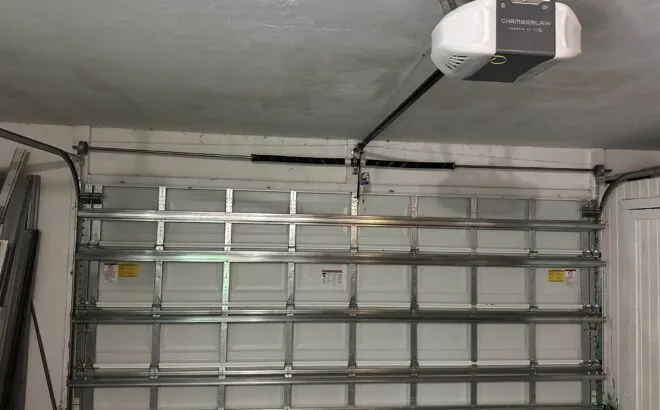
Springs on the older single-car doors of Everett’s detached garages
Behind the two-families and single-families on the streets either side of Broadway and Ferry Street, the garage is usually a separate building at the top of a proper driveway, and its door is usually a single-car door dating from the nineteen-fifties or sixties, or a later door hung in an opening of that age. That combination explains most of the calls we get for garage door spring repair in Everett MA. Doors from that era very often hang from two extension springs, one stretched above each overhead rail, while others have been converted to a torsion spring above the header at some point in their life. Both kinds wear out, and both tend to give up on a cold morning.
A spring does not fail politely. Most owners first learn about it from a loud crack in an empty garage, or from a motor that raises the bottom rail barely past the threshold before giving up.
From the driveway or the garage floor, without touching anything, look for:
- A torsion coil above the door with a clear gap somewhere along its length.
- An extension spring hanging slack, or missing from one side, beside a horizontal rail.
- A lift cable lying loose on the floor or dangling from a pulley.
Spring problems we deal with in Everett garages
Snapped torsion springs
The wound coil on the bar over the opening has fractured. The bar stops turning, the drums stop winding, and under the opener the bottom rail scarcely leaves the slab.
Broken or stretched extension springs
Common on single-car doors of the fifties and sixties. One spring breaks outright, or both have stretched so far that the door no longer stays up on its own.
No containment cable
Each extension spring ought to be threaded on a thin steel line, anchored at both ends, that catches the pieces if the coil fractures. Many older installations never had one.
Worn pulleys, hooks and clips
The sheave that the cable runs over, the S-hook at the rear hanger and the clevis at the front all wear. A seized pulley shreds the cable that passes over it.
A spring that no longer suits the door
Paint, added insulation, a replaced section or water-logged wood can make a door heavier than its springs were sized for. The door feels heavy even though nothing is broken.
What a spring is actually doing
A common belief is that the motor does the heavy lifting. In truth the coil carries the door and the motor merely steers it, so even a powerful unit stalls once that coil has snapped. When the door is down, the spring is loaded with enough energy to carry almost the full weight of the door. As the door rises, that energy is released at the same rate the door’s weight is transferred onto the horizontal rails, so the door feels nearly weightless all the way up.
On a torsion system, that energy is stored as twist. The coil sits around a steel bar over the opening, held still in the middle of the header and twisted from its outer end through a slotted cone. Lowering the door winds the coil tighter through the cables and drums. On an extension system, the energy is stored as stretch: each spring is pulled long as the door comes down and shortens as it goes up, working the cable through a pulley at the front.
A well-matched spring is what lets a door hang at half height without creeping up or sliding down. Once a spring weakens, that balance goes, and the cables, hinges, rollers and motor begin sharing a burden none of them was designed for.
Extension springs on doors from the fifties and sixties
A large share of the single-car doors behind Everett homes still run on extension springs. They were the usual choice for lighter residential doors of that era, and they suit a garage with modest headroom, since they sit beside the rails rather than over the opening.
Extension springs have a few habits of their own. They work in pairs, one per side, and if one is replaced and the other is left, the door lifts unevenly and the old spring soon fails as well. They rely on a run of small parts: the rear hook, the pulley, the cable and its front fastening. And on many older installations there is no containment cable through the coil. When an unrestrained extension spring breaks, the loose end and the hook can fly across the garage hard enough to break a window or dent a car. Fitting a safety cable through each spring is part of how we put them back.
Rust is the other enemy. A detached garage with no heated wall alongside it stays damp, and surface rust on a spring coil creates small pits where a crack can start. A spring that looks orange from end to end is close to the end of its working life even if it has not broken yet.
Torsion springs, and doors that were converted
Some older doors in the area have been upgraded to torsion springs, or were replaced at some point with a door that came with them. A torsion system spreads the lift more evenly and tends to run more smoothly, but it is also the system with the most dangerous stored energy.
Every torsion spring holds dangerous tension at any door position, and the winding cones, set screws and bottom brackets are all under that load. Releasing or adding tension needs proper winding bars and a known sequence; a screwdriver or a makeshift rod can spin out of the cone and hit the person turning it. It is not a DIY repair, full stop. If the coil overhead has cracked, the door should stay down, the motor should be unplugged, and every set screw should be left on the bar exactly as it is.
Warning signs before a spring lets go
Springs often give notice, though it is easy to miss in a garage that sits away from the house.
The door feels heavier by hand. Pull the release cord on a closed door only if the springs look intact, and lift it to waist height. A well-balanced door stays roughly where you leave it. One that drops back down has lost spring force.
The opener labours. A motor that slows near the top, or a chain that whips and slaps, is often working against a weak spring rather than failing on its own.
The door rises crooked. On an extension system, a door that lifts one side ahead of the other usually has one spring weaker than its partner.
A gap in the torsion coil. Even a narrow gap means the coil has fractured. The door may still move a little with the opener’s help, but it should not be used.
Visible stretching. Extension springs that hang with open gaps between their coils when the door is up have lost their pull.
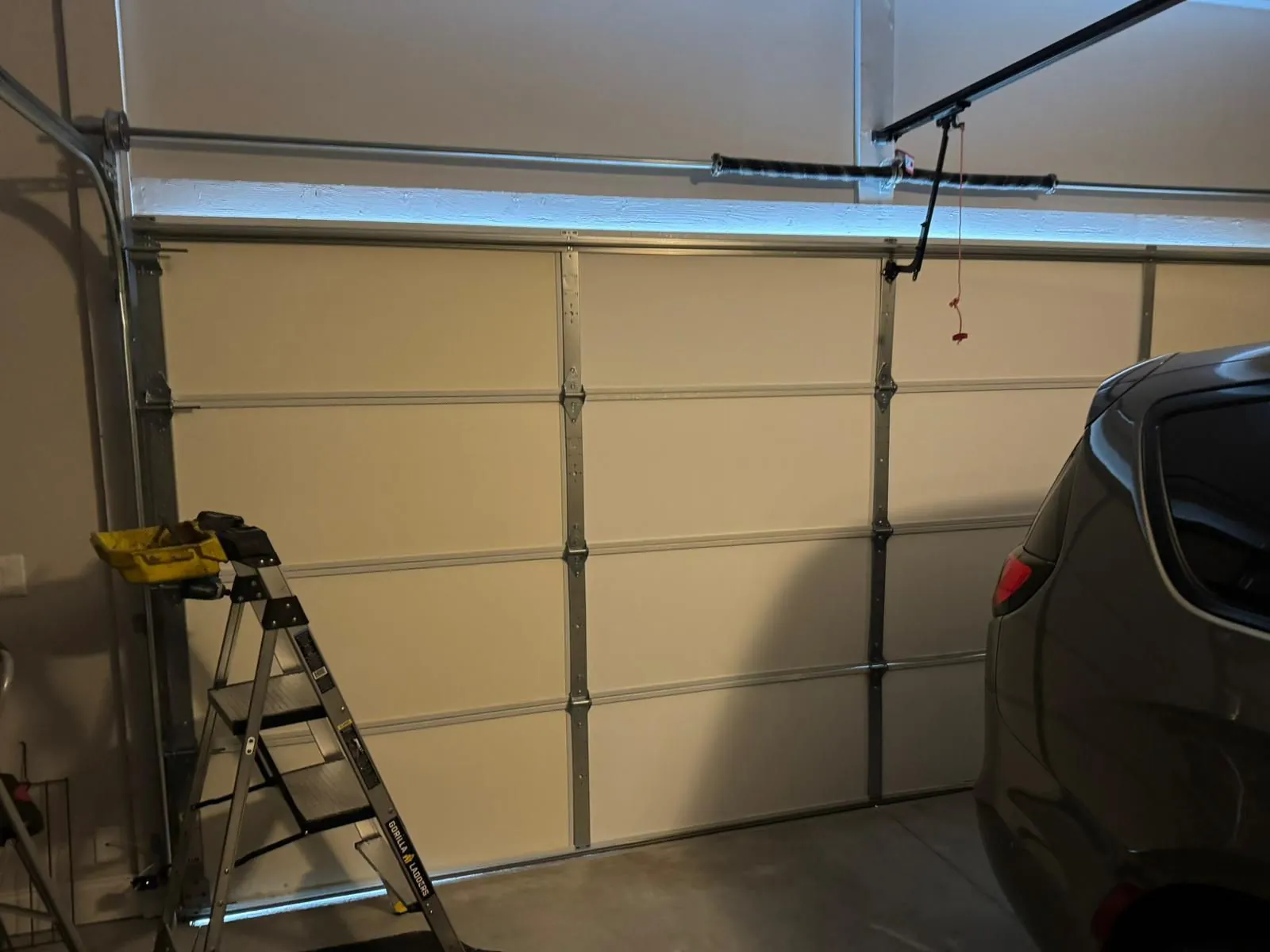
After the bang: what to do and what to avoid
If you heard the crack, the spring has probably broken, and the best thing you can do is very little.
- A shut door stays shut; a door caught open stays open.
- Pull the opener’s plug, which stops anyone reaching for a remote out of habit.
- Close the side door and keep the garage off limits to youngsters and animals for now.
- On a raised door, the red release cord stays untouched: with no spring above it, the door would come down like a dropped plank.
A broken spring rarely causes damage on its own. The damage comes afterwards, when the opener is run against a door it cannot lift, or when someone tries to raise it by hand and loses grip. Cables come off drums, the top section bends where the opener arm meets it, and the motor’s gears strip.
A spring visit, from start to finish
On most of these properties the driveway gives room to park right beside the garage, which makes the job straightforward.
- The door is secured, and the opener is disconnected from it.
- Every spring is identified: torsion or extension, wire size, length and, for torsion springs, the winding direction.
- The broken spring and its partner come off in a controlled order, with the tension released safely.
- Replacements are chosen for what the door weighs on the day, which may differ from whatever the old tags said.
- Cables, drums or pulleys, hooks and the bottom brackets are checked, because a spring failure often damages them too.
- Balance gets proved by hand first; only after that does the opener go back on, its limits retuned for the lighter feel.
Before anything is replaced, you are told which springs the door has, what has failed alongside them, and what we recommend.
Sizing springs to the door as it is today
A door that has been on a garage for half a century has usually changed. It may have been painted many times, had insulation glued to the back of its panels, had a section replaced with a heavier one, or simply soaked up years of damp if it is wood. Each of those adds weight. If new springs are simply copied from the old ones, the door can end up just as heavy and slow as before.
So the door’s weight and height decide the spring, not the old part number. For extension springs, that means choosing the right strength for the door’s weight; for torsion springs, the right wire, inside diameter and length for both the weight and the lift. A correctly sized spring makes the door easier to lift, takes strain off the opener and lasts longer.
Replacing in pairs
Of two springs on one door, the survivor has shared every lift with the one that snapped. Most garage door spring repair in Everett is therefore a pair job. Replacing only the broken one leaves an old spring and a new spring fighting over the same door, which pulls the door out of square and wears the cables unevenly. On extension systems both sides are replaced together; on doors with two torsion springs on the bar, the same applies. It costs a second visit to put off.
A door shared by two households
A spring’s life is counted in trips: each full open and close uses one up. On a single-family house, the garage door may make a couple of trips a day. Behind a two-family, where both flats may lean on one garage, for a car upstairs and bikes and boxes downstairs, it can make many more. More trips mean the springs reach the end of their life sooner, and the pair on a busy door often fails years ahead of an identical pair on a quiet one.
A door that works that hard deserves closer attention: notice when the opener starts to sound different, and test the balance by hand now and then. Garage door spring repair in Everett on a shared garage also tends to come round sooner than on a quiet one, so it is worth planning for rather than waiting for the crack.
The collateral damage around a broken spring
Springs seldom go down without taking something with them. On a torsion system, the moment the coil breaks, the drums stop holding tension on the cables, and a cable can jump off its drum or bunch up beside it. If the opener was then pressed again, the cable may have been chewed between the drum and the bracket. On an extension system, a broken spring drops its pulley, and the cable that ran over it can kink or fray where it lands on the track.
That is why spring work always includes a look at the cables, the drums or pulleys, and the bottom brackets. A cable with broken strands or a flattened section is replaced at the same time, because a new spring pulling on a damaged cable just moves the failure somewhere else.
Cold mornings and detached garages
Steel loses some of its toughness as it gets colder, so worn coils tend to fracture once the season’s hard frosts arrive. A detached garage gives no shelter from that: it sits at outdoor temperature overnight, and the spring takes its first, heaviest load of the day at the coldest hour.
Damp makes matters worse over time. Condensation settles on the coils whenever warm air meets cold steel, and in a building with no heat that happens often. Wiping the coils occasionally with a spray made for garage door hardware slows rust and quietens the spring, but it will not save a spring that is already pitted.
When a spring repair turns into something more
Usually, garage door spring repair in Everett is just that: new springs, a check of the hardware around them, and a door that works again. Occasionally the visit uncovers a door that is not worth new springs, because the bottom section has rotted, several panels are cracked, or the tracks are so out of line that the door binds whatever the springs do. You will hear that plainly, along with the option of repairing what can be repaired. Broader faults are covered on our Everett garage door repair page, and if a strained opener needs attention after a spring failure, the Everett opener repair page explains how that works.
Booking spring work
A coil can let go at dawn or near midnight, which is why a real person answers our line even in the dead of night or on a public holiday. When you ring about garage door spring repair in Everett, mention where the springs sit, over the header or beside the rails, plus the door’s position and whether the car is shut in behind it. If a broken spring has left the garage stuck open overnight, see the Everett urgent repair page. Spring work further afield is described on our Greater Boston spring repair page, while the Everett area page lists the other kinds of work we take on nearby. Call us or book online.
Questions from Everett
How can I tell which kind of spring my door has?
Look up. A coil wrapped around a horizontal bar above the opening is a torsion spring. Springs running front to back above each horizontal rail, with a pulley at the front end, are extension springs. Older single-car doors often have the second kind.
Is it all right to haul the door up by hand once a spring has gone?
Please don’t. Minus its spring, the door’s entire weight lands on your arms and on two thin cables, and a single-car door is heavier than it looks. Leave it closed if you can, and if it must be opened, wait until it can be done safely.
There is no wire threaded through my extension springs. Should there be?
There should. The containment cable is what stops a broken extension spring from flying loose. If yours have none, they should be added when the springs are next serviced or replaced.
Why replace both springs if only one has broken?
Both coils have lifted the same door through every trip it has made. The survivor is usually close to failing, and an old spring paired with a new one leaves the door lifting unevenly.
The door closed hard with a thump after a cold night. Is that a spring?
Quite possibly. A door that drops heavily in the last part of its travel is short of spring force. Look for a gap in the torsion coil or a slack extension spring, and stop using the door until it has been checked.