
Spring steel and the sea air around Winthrop
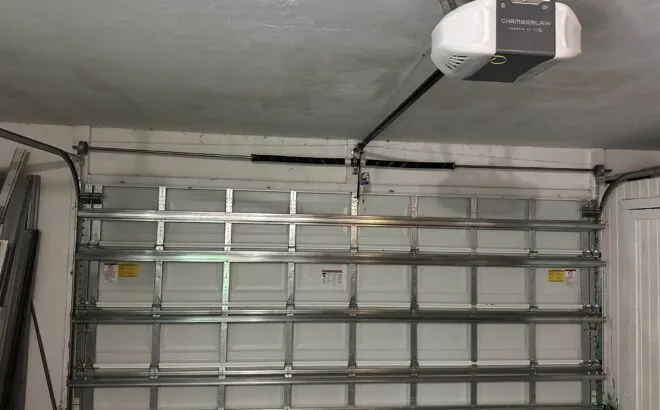
Every garage door in Winthrop is balanced by one spring or a pair of them, and on this peninsula those springs work in damp, salt-laden air on three sides. Spring steel is hard and highly stressed, which makes it unusually sensitive to corrosion: a little rust on its surface becomes the place a crack begins. That is why garage door spring repair in Winthrop, MA comes up so often on the garages beside the town’s close-set single- and two-family houses. We replace broken torsion and extension springs, swap out tired ones before they break, and set the door’s balance again so it rises evenly.
Clues that a spring has gone, all visible without going near the door:
- A break in the coil above the opening,, with two loose ends sitting apart on the shaft.
- A door that lifts a few inches under the opener and stops, with the motor straining.
- Coils covered in orange scale, or a dry grinding from above the opening every time the door moves.
What sits in a spring system
Torsion springs
Seated on a steel shaft across the header, twisting tighter with every descent. One spring on many single doors, a pair on heavier ones.
Extension springs
Long coils running beside each ceiling rail, stretching as the door lowers and drawing it back up over sheaves. Found mostly on older, lighter doors.
Containment cables
A safety line threaded inside each extension coil, there to catch the pieces if the coil snaps. Doors missing them should have them fitted.
Drums, bearings and shaft
The grooved drums that wind the cables, the bearings that carry the shaft and the shaft itself. Salt seizes bearings and roughens drum grooves.
Why a spring is doing the heavy lifting
Most people assume the opener raises the door. It does not. A sectional door weighs a good deal, and almost all of that load hangs from the springs. The motor merely guides a door whose weight has already been cancelled out.
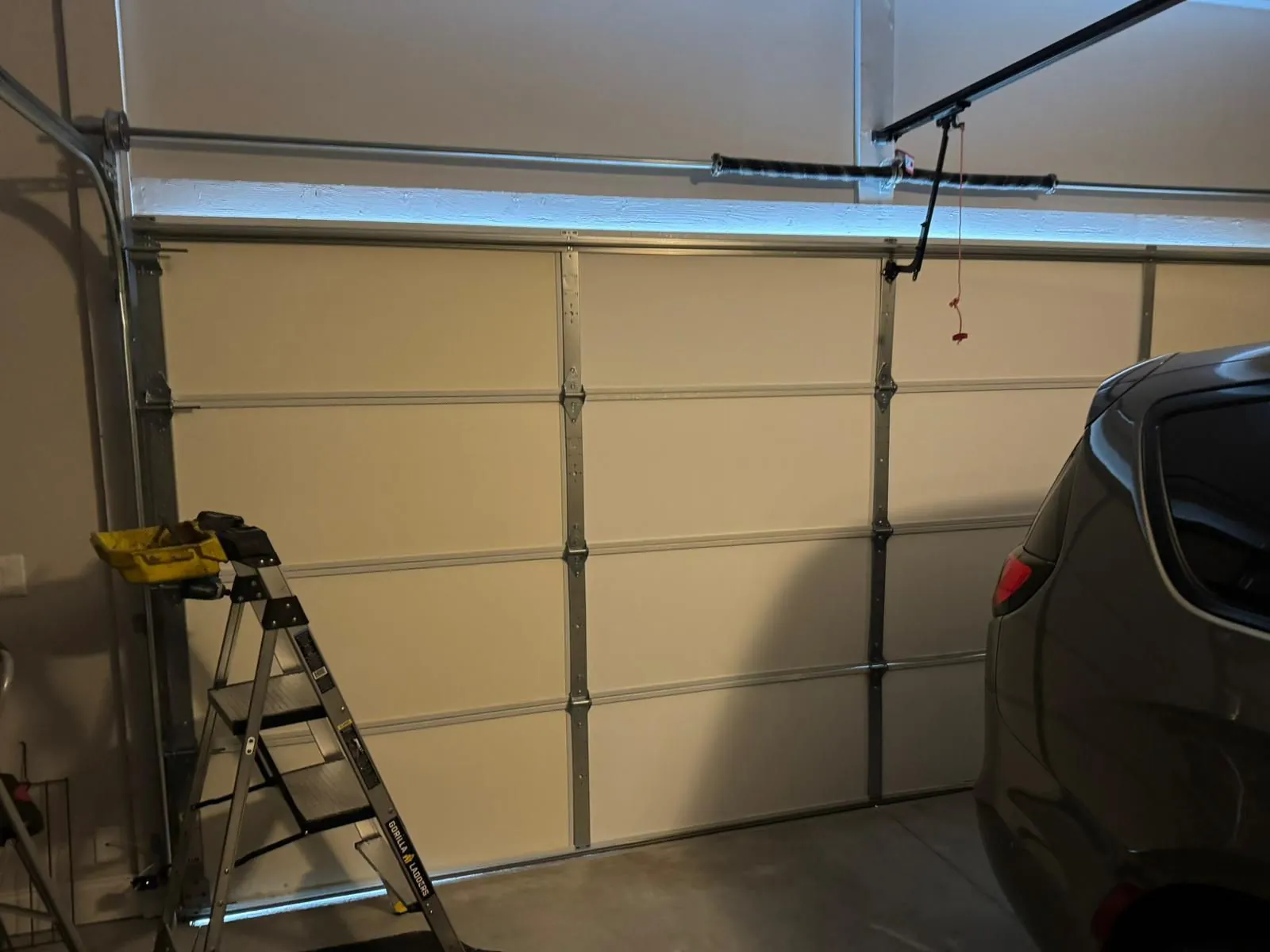
With a torsion setup, the coil wraps a shaft over the header. Each time the panels descend, cable pays out from the two drums on that shaft, and the coil twists further, banking energy. On the way up, that banked energy spins the drums back, winding cable onto their grooves and lifting both bottom corners together.
On an extension system, a spring runs alongside each horizontal rail toward the back of the garage. Closing the door draws the coils out; opening it lets them shorten again, hauling the panels upward over a pulley at each side.
In both cases a correctly set spring makes the door feel light. Lifted by hand to half height and released, a well-balanced door should drift very little. That feeling of lightness is the clearest test of spring health, and it disappears as springs weaken.
Garage door spring repair in Winthrop, MA and salt corrosion
Springs are made from high-carbon steel wire, wound into coils and then put under constant stress. That kind of steel is strong but has a poor tolerance for pitting. When salt-laden air settles on it, the surface corrodes in small, uneven pits, and each pit concentrates the stress at one point. Repeated cycles of opening and closing flex the wire across those pits until a crack forms and runs through the coil.
On the peninsula, that process runs faster than on a garage further inland, because the salt is in the air all year rather than only arriving on winter tyres. A spring here may show rust within a season or two of fitting, and a spring left unprotected tends to reach the end of its useful life sooner than its rating would suggest.
Corrosion also creates friction. The coils of a torsion spring brush along each other as it twists, and when that contact is between rough, rusted surfaces, the spring has to fight itself. That extra work adds to the wear. It is also the source of the scraping or creaking that many owners hear from the top of the door in the months before a break.
The shaft bearings and the drums suffer too. A bearing that has seized with salt makes the shaft drag, and a drum whose grooves have rusted can let the cable slip. A visit for a broken spring therefore looks at the whole assembly, not just the coil that snapped.
What a broken spring looks and sounds like
A spring break is usually loud. In a small garage the release of energy sounds like something heavy dropped on a metal floor, and it often happens when the door is closed and resting, especially on a cold morning, because that is when the spring is wound tightest and the steel is least forgiving.
After the bang, the clues are consistent:
- The opener runs but the door lifts only slightly, or not at all.
- The cables on one or both sides hang slack.
- The door is very heavy if anyone tries to raise it.
- On a torsion spring, there is a clear gap where the coil has parted.
- On an extension spring, one spring hangs loose or lies on the floor below its rail.
A door that was raised at the moment of the break may have dropped heavily. Leave it down until the new spring is in.
Why you should never touch a wound spring
A torsion spring stores dangerous tension in its coils, and that tension is there whether the door is up or down. Winding or unwinding one needs the right bars, the right technique and a firm understanding of which way the energy will go. A slipped tool or a loosened set screw can let the spring spin violently, and the result can be broken bones or worse. This is not a DIY repair, and kits sold for home use do not change that.
Extension springs carry similar risk in a different way. If one breaks without a containment cable through it, the pieces can be thrown across the garage with enough force to break a window or injure someone.
Safe steps while you wait:
- Unplug the opener so it cannot keep trying to lift the dead weight.
- Let the door stay in its current position, up or down.
- With the door raised, park on the street or driveway and keep people back from the opening.
- If the door is down and you need the car, it stays in until the spring is replaced.
What a spring replacement visit involves
Garage door spring repair in Winthrop begins with identifying the system. The type of spring, its wire size, its length and how it is wound all depend on the weight and height of the particular door, so the technician measures what is there rather than guessing from a photograph.
Clamps go on the rails so the panels stay put, and whatever tension in any unbroken spring is released under control. The broken spring is removed. Where there is a pair, both are normally changed at once: the survivor has made every trip its partner made, in the same salty air, and tends to go soon afterwards. New springs are fitted and wound to suit the door.
The cables are inspected while they are slack, because a spring break often coincides with frayed strands at the bottom brackets or a cable that has jumped a drum. Bearings, drums and the shaft are checked for corrosion. Then the door is tested by hand for balance, the opener is reconnected and run through full cycles, and the travel and force settings are adjusted so the opener is not working harder than it needs to.
You are shown what failed and what else showed wear before any additional part is fitted.
Reading the rust on your own spring
Not every rusted spring is about to fail, and not every clean-looking spring is healthy. Some general guides help when you look up at the coil from the floor.
A thin, even orange tint that wipes off on a cloth is surface rust. It is a warning to start lubricating, not a reason for alarm. Scale that flakes away, leaving dark pits, means the wire has lost some of its section and the spring is weaker than it was. A coil with a visible crack line, or a spot where rust has formed a ridge across the wire, is the place a break is likely to start.
Look at the ends too. The cones that grip each end of a torsion spring, and the hooks at the ends of an extension spring, are points of high stress. Rust concentrated there is more serious than rust along the middle of the coil.
Sound tells you as much as sight. A spring that pings, creaks or grinds as it winds is rubbing rough coil against rough coil. Combine that with a door that feels heavier when lifted, or one that sinks when left half open, and the coil has little service left in it. A replacement planned at that point is calmer than one forced by a break at the worst possible moment.
Cold mornings and spring breaks
Steel becomes less forgiving as it gets colder, and the springs in an unheated garage on the peninsula sit at outdoor temperature through the winter. A spring already weakened by pitting is most likely to give way on the first very cold mornings of the season, often during the first lift of the day, when the coil is wound tight and has been still all night.
There is nothing an owner can do about the temperature, but knowing the pattern helps. If a spring has been creaking through the autumn, or the door has started to feel heavy, it is better looked at before the cold arrives than after it has stranded a car behind a closed door.
Torsion or extension: which suits your garage
Many garages on the peninsula are compact, with limited room above the door and close walls to either side. That shapes the choice of spring system.
Torsion springs need space above the opening for the shaft and drums, but they keep the ceiling rails clear and make for a quieter, steadier lift. They are the usual choice for heavier doors and are less likely to whip if they break, because they stay on the shaft.
Extension springs need room along the ceiling beside each rail. They suit some lighter, older doors, but without containment cables they are a real hazard when they fail. Where a garage has extension springs and the headroom allows, converting to torsion can make sense. Where it does not, fitting new extension springs with containment cables is the safe route.
On a visit you are told which system you have, whether it suits the door, and what the options are.
Getting more life from new springs on the peninsula
Salt air cannot be avoided here, but a spring can be protected:
- Mist the coils of a torsion spring with a garage door spray lubricant a few times a year, then wipe off the surplus so dust does not stick.
- After winter, rinse the lower track brackets and the bottom of the door with fresh water to remove road salt, and leave the door open to dry.
- Keep the door balanced. Panels that hang heavier on one side, or sink when released, put uneven stress on the spring and makes the opener work harder.
- Listen for change. A spring that starts to creak, grind or ping is telling you its surface has roughened.
Avoid thick grease on springs, which traps grit and salt, and never paint a spring, because paint hides cracks and adds friction between the coils.
Short driveways and a door that will not lift
Many houses here have short driveways, with the car parked close to the garage or inside it. When a spring breaks with the door down, the car is stuck in or out until the spring is replaced. It explains why a snapped spring tops the list of urgent calls on the peninsula and everywhere else. The door cannot be raised safely by hand, and the opener cannot do it either.
If the car is inside and you need it, do not try to lift the door with a jack or a bar. Phone, say what you heard and what you can see, and leave the panels alone. Where the panels are jammed up and the garage is left unsecured, our emergency page for Winthrop explains what to do in the meantime.
Matching the spring to the door
No spring fits every door. Its wire thickness, inside diameter and length are chosen for the weight and height of one door, and the number of turns it is wound determines how much lift it gives. Oversized coils send the panels racing upward and resist the motor on the descent; undersized ones leave the panels sluggish and hand the motor a job it was never built for.
Older garages often carry the history of earlier repairs. It is common to find a pair of torsion springs that do not match, because one was replaced on its own years apart from the other, or extension springs of different strengths on each side, which makes the door rise crooked and wears one cable faster than the other. Doors that have had a heavier bottom section or extra insulation added may also have outgrown their original springs.
That is why the door is measured and weighed up on the visit, rather than simply copying whatever spring is hanging there. The aim is a door that feels light, rises square and stays where it is left, with a pair of springs that match each other and the door.
Where the old springs were wrong for the door, you are told so, and the replacement is chosen for the door as it is now.
When a spring is not the only problem
A broken spring often exposes other worn parts. Cables may have frayed. The opener may have been straining for months against a weakening spring and its gears may be worn. Rollers may have seized in salt-crusted bearings. A full garage door repair visit in this town covers those parts, and our opener repair page for Winthrop covers motors, remotes and sensors.
For how springs work on every door we see across Greater Boston, see our garage door spring repair service page, or the Winthrop town page for every service in one place.
Book garage door spring repair in Winthrop
A broken spring does not fix itself, and a rusted one is not getting stronger. Tell us what you heard, where the door came to rest and which kind of spring hangs above or beside it, and the right parts can be planned for the visit. For garage door spring repair in Winthrop, MA, call us or book online.
Questions from Winthrop
Why do springs break more often near the water?
Salt in the air pits the surface of spring steel. Those pits concentrate stress, and every cycle of the door flexes the coil across them until a crack forms. Garages on the peninsula breathe salt air all year, so springs tend to wear out sooner than on garages inland.
If only one of my two springs broke, should both be replaced?
Usually, yes. The second spring has matched the first trip for trip, in the same damp air, and is rarely far behind. Fitting a matched new pair keeps the lift even and saves a second visit for the same fault.
The car is behind the door and the spring has snapped. Can I raise it anyway?
It is not safe. With no spring holding it, the door can fall without warning, and the opener can strip its gears trying. Keep clear and phone instead.
My extension springs have no cable running through them. Is that a problem?
Yes. A containment cable through each extension spring stops the pieces flying across the garage if the spring breaks. Doors without them should have them fitted, and new springs are installed with them.
Can I lubricate my springs to stop them rusting?
Yes. A thin film of spray lubricant on the coils several times a year, wiped back afterwards, slows corrosion and quietens the spring. It will not restore a spring that is already heavily rusted or pitted.