
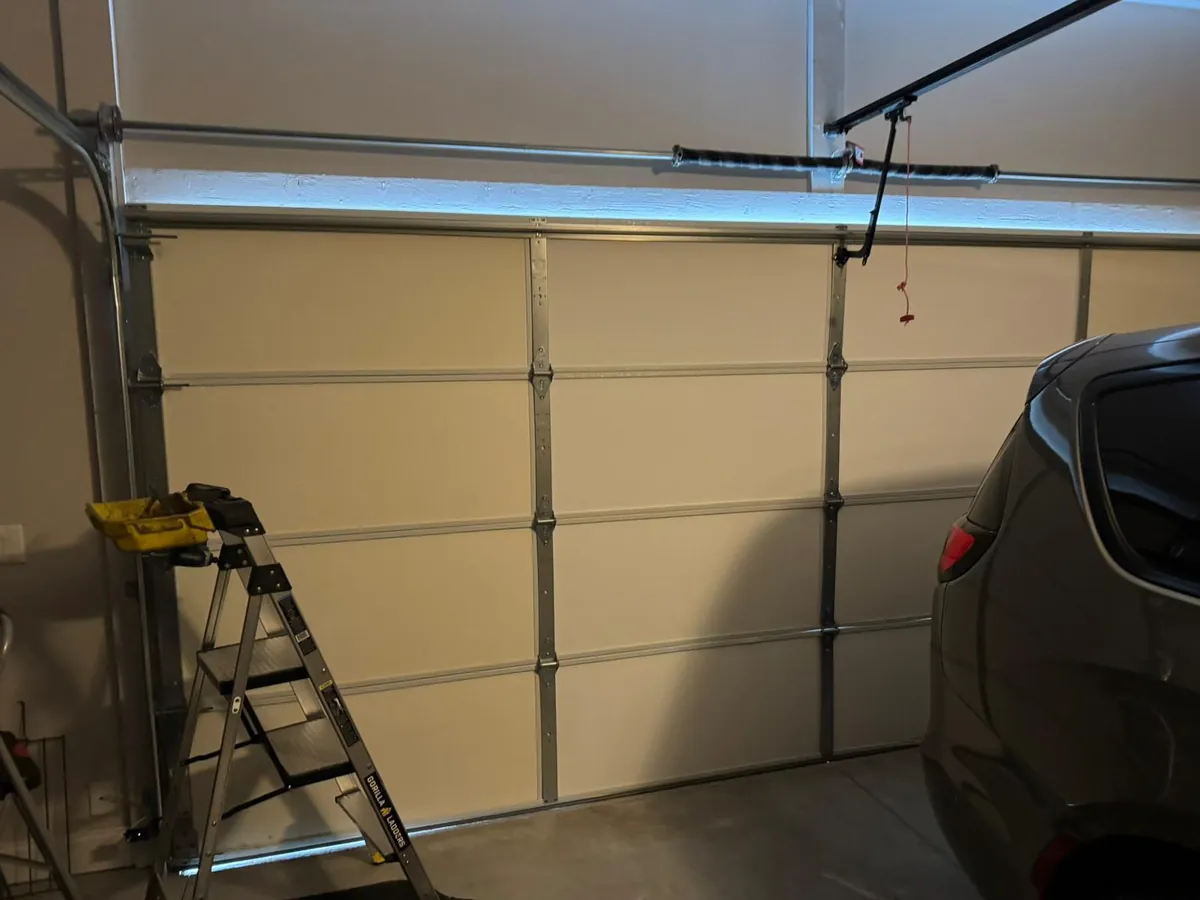
Why the old garages off Mount Auburn Street wear out their doors
Walk down almost any side street off Mount Auburn Street and the garages sit well back from the road, at the end of driveways that run the full depth of the lot beside a single-family or a two-family house from the Nineteen-twenties. Many of those garages still carry the wood doors they were fitted with decades ago. That pairing, an old timber door in a freestanding building a long way from the kitchen, explains most of the garage door repair Watertown MA homeowners ask us about: wood that has drunk in years of rain and snow, hardware screwed into soft framing, and a door that nobody sees misbehaving until it finally refuses to move.
A wood door is a living material. It swells in a wet spring, shrinks back in a dry winter and grows heavier as the bottom rail soaks up water from the driveway. Each change shifts the load on the springs, cables and opener that were set up for the door as it once was.
From the end of the driveway, without touching anything, three things are worth noticing:
- Whether the door hangs level in its opening or has dropped lower on one side.
- Whether the bottom rail is dark, soft or split where it meets the concrete.
- Whether the coiled spring over the header has parted, leaving a gap.
Parts a Watertown repair can deal with
Springs, torsion and extension
The spring over the opening, or the pair stretched beside the horizontal tracks, does the real lifting. A heavy wood door works them hard. More on the spring repair page for Watertown.
Lift cables and drums
Cables that have frayed against a bracket or slipped off a drum, leaving the door hanging at a slant.
Wood panels and sections
Split stiles, rotted bottom rails, loose joints and hinges whose screws have pulled out of tired timber.
Openers, remotes and wall buttons
Motors labouring under a door that has put on weight, remotes that will not reach the far end of the drive, and dead wall buttons. See opener repair in Watertown.
Tracks, rollers and off-track doors
Kinked rails, flat-spotted rollers, brackets backing out of old framing and doors that have jumped out of line.
Safety sensors
Two small photo eyes at ankle height; in a crowded single bay they are easily nudged until they no longer face each other.
The original wood door and what it does to the hardware
Nothing about a timber garage door is wrong in itself. Plenty of the painted raised-panel doors on these streets have outlasted several openers. What makes them different from a modern insulated steel door is that they never stay the same weight. Paint wears off the bottom rail first, water wicks up the end grain from the driveway, and after a few seasons the lowest section can be noticeably heavier than the ones above it. The springs were wound for a lighter door, so the balance drifts and the motor takes on lifting the springs once handled.
The joints matter too. Each section of a wood door is a frame of stiles and rails holding panels, glued and pinned together. When a joint opens up, the section racks slightly out of square, and the hinges and rollers fixed to it no longer line up with the track. The door may still run, but it rubs at the same point on every trip, and that rubbing wears grooves into rollers and flattens the curve of the track.
Hinge and bracket screws are the third weak point. Driven into old timber that has dried and wetted many times over, a screw slowly loosens until the hinge rocks. A repair on a door like this is often as much about re-fixing hardware into sound wood, with longer screws, through-bolts or a backing plate, as it is about replacing a broken part. Our garage door repair Watertown MA visits take that into account from the start, because a new roller on a loose hinge will be back to rattling within weeks.
Signs that a wood door is ageing in ways the hardware can feel:
- The door halts shy of the concrete, or drops hard over its final stretch.
- The opener sounds as if it is labouring, or stops and reverses halfway up.
- Daylight shows through an open joint or along a gap at one side.
- Paint has lifted along the bottom rail and the wood beneath feels soft.
Distance between the back door and the garage
The distance between the house and a detached garage changes how a door gets used and how faults get noticed. Nobody indoors hears a spring let go out in that back building, and a door that has started to grind is easy to ignore when the only time you are near it is while getting into a car. Problems tend to be found late, often when the door simply will not open on the way out in the morning.
The driveway itself also takes a toll. A long run of concrete or asphalt laid many decades ago rarely meets the garage floor perfectly flat. Where the slab has heaved or settled at the threshold, the door’s lowest edge meets a slope, which wears the seal unevenly and lets water collect against one corner of the bottom rail. Snow piled up during shovelling sits against the door for weeks. Both feed the rot that shows up on so many original doors here.
Reaching the garage matters on the day of a visit. Every tool, ladder and spring goes down the drive on foot, and on a two-family lot the drive may be shared with the other unit’s cars. Clearing a way to the door, and leaving room to stand just inside it, makes the work quicker and safer for everybody.
How the moving parts share the load
Understanding how the pieces depend on one another makes it easier to describe the fault when you call. The springs carry the door’s weight; on most doors that means one torsion coil wound around a shaft above the header, and on many older conversions two stretched springs lying beside the ceiling rails, each with a safety cable threaded through it. The spring’s pull reaches the bottom corners of the door through lift cables, which wind onto drums on a torsion system or run over pulleys on an extension system.
Rollers set into hinges and end brackets carry each section along the vertical rails at the sides of the opening and then back along the horizontal rails under the ceiling. The opener, mounted on a rail down the middle, does no lifting of its own when the door is balanced; it only pushes and pulls. The safety sensors keep watch across the opening and signal the motor to halt and back up whenever something crosses their beam.
When one part fails, the strain moves to its neighbours. A weak spring makes the opener heave. A frayed cable lets one side drop, twisting the door against its tracks. A seized roller drags at a hinge until the hinge cracks. Proper garage door repair in Watertown MA means following that chain back to the part that started it, so the fix lasts.
What a visit involves
Each garage door repair Watertown MA call-out begins with the door, not whatever part was named during the call. A tug on the release cord parts the trolley from the door, which is then lifted by hand to judge its balance: a well-set door raised to about waist height stays roughly where it is left, while a door with a failing spring drops or fights back.
After that comes the hardware, piece by piece. Springs and cables get a close look along their length, rollers are spun for flat spots, hinges are rocked to find cracks or play, and each rail is sighted for kinks. On a wood door, the sections get extra attention: the bottom rail is probed for soft timber, the joints are checked for movement, and each hinge and bracket is tested to see whether it is still holding in sound wood.
No part is swapped until you know what broke, what caused it and which other pieces are wearing thin. With the agreed work finished, the spring tension is trimmed so the door hangs evenly, the motor’s open and close stops and its force setting are matched to the door it now drives, and a block of timber laid across the threshold proves that the descending door touches it, stops and rises again.
Winter on a freestanding, unheated garage
A freestanding garage borrows no heat from the house, so its door and hardware live at whatever temperature the night brings. That has a few predictable effects. Grease on the rollers and hinges thickens, so a door that runs smoothly in October can sound rough and feel sluggish in January. Steel springs are more likely to snap on the first very cold mornings, when a spring that is already tired is asked to unwind under load. The opener, working against stiff hardware, is more likely to reach its force limit and reverse.
Wood doors add one more winter problem. Meltwater runs down the face of the door and pools at the threshold, then freezes overnight and bonds the bottom rail and seal to the concrete. Hitting the button while the door is iced to the slab can strip the opener’s gear, tear the seal off the rail or pull the bottom bracket loose. When ice holds the door down, quit pressing, unplug the opener and look at the bottom edge. Ice can be loosened with gentle warmth along the seal; prying at it with a shovel tends to split the timber.
Small habits help through the season. Keep the snow you shovel away from the face of the door, clear slush from the threshold before it freezes, and pay attention whenever the door starts to sound different on its way up. A new grinding note or a hesitation on the way up is worth a call before the coldest weeks arrive.
Cables, rollers and doors that leave the track
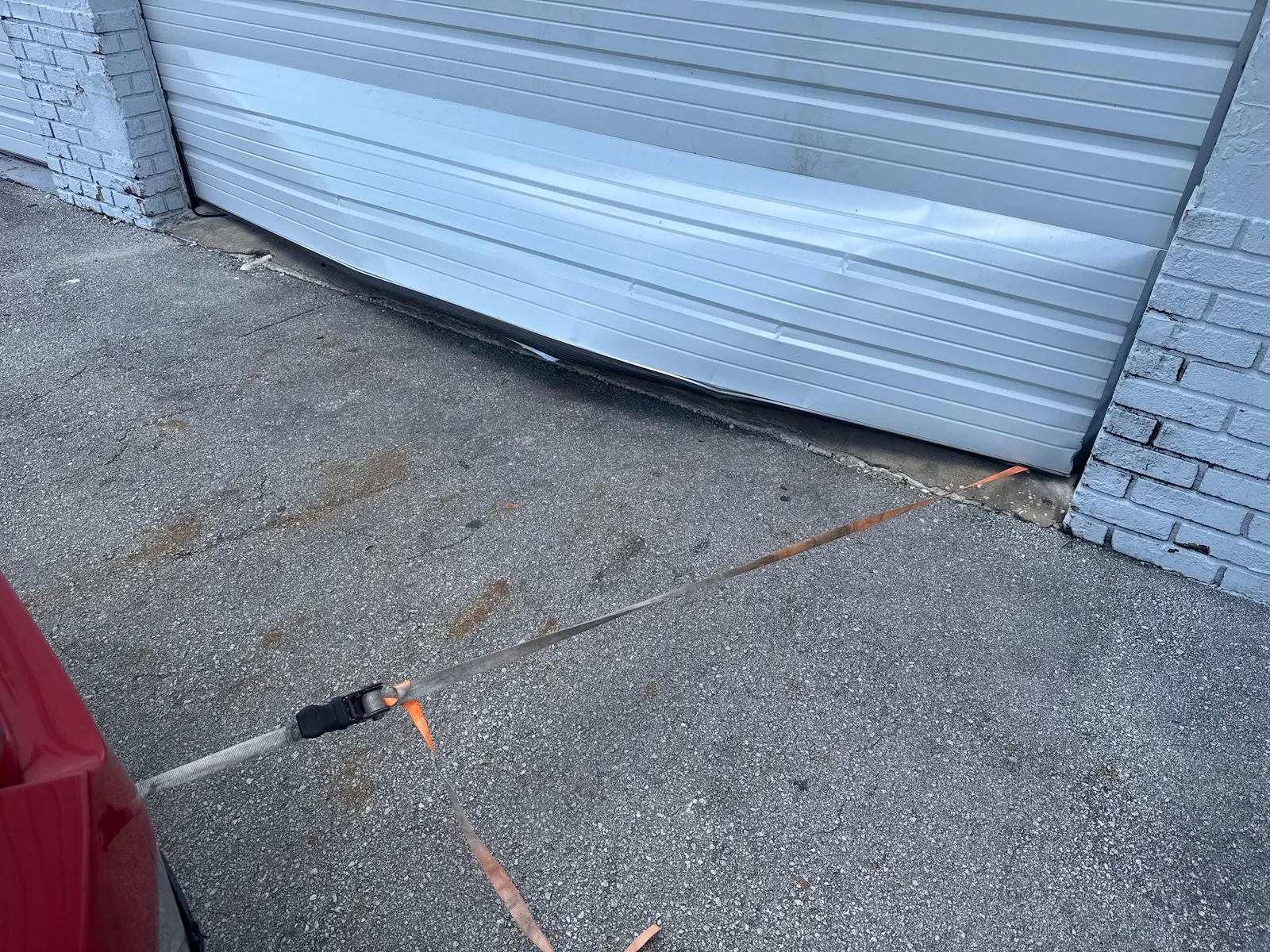
Off-track doors and broken cables are common partners. When one cable parts, its corner sags, the whole door skews, and the rollers on the high side climb out of the rail. On a detached garage, the same thing can happen when a car brushes the door while turning in a narrow drive, or when a gust catches a door left partly raised.
Left like that, the door may drop at any moment. Keep the motor off it and keep hands off it too. The fix involves clamping the door so nothing shifts, coaxing every roller back into its channel, trueing or swapping any kinked track, replacing the failed cable and setting both cables to equal tension before the door moves again. More detail sits with our off-track garage door repair service.
Harmless checks, and the parts to keep away from
These take a minute, carry no danger and make the phone call shorter:
- With the door halted partway, pull the motor’s plug from its socket so it makes no further attempt.
- Check the two little sensors by the floor. In a tight single bay a mower, a bike or stacked boxes often block them; move whatever is in the way and give each lens a wipe.
- Compare the remote with the button by the side door. When the button runs the door and the handset will not, suspect the handset or its battery.
- Glance up both rails for a stored shovel, rake or ladder pressed against them.
Anything bearing the door’s weight stays untouched. A torsion spring holds dangerous tension, raised or lowered, as do both lift cables and the bottom corner fittings. Backing off one set screw or one bolt on those fittings lets the stored energy go in an instant, so this is not a DIY repair for springs or cables. With its spring gone, the door weighs much more than you would guess, so do not try to raise it by hand or with the opener.
Repair or replace
For most of the original wood doors on these streets, repair is the sensible first answer. Coils, cables, rollers and hinges all wear by design, and renewing them keeps a sound door working. A door that has hung in the same opening for decades has also settled into that opening, which is a reason to keep it while the timber is good.
The case for replacement builds when the wood itself is failing. Signs include a bottom rail that has rotted through, several panels split or loose in their frames, joints opening on more than one section, or a door that has absorbed so much water it is too heavy to balance with any sensible spring. A visit for garage door repair Watertown MA homes need ends with a straight answer about whether your door still deserves its parts. When a new door is the wiser spend, our new garage doors service supplies and fits one.
When the door fails after dark
Doors seldom choose a convenient moment. A back-lot garage that stays open overnight leaves everything in it open to the street, and one that stays shut at breakfast keeps the car prisoner. Calls are taken at any hour, holidays too, meaning nobody has to wait for office hours to report the trouble. What to do while you wait is set out on the emergency repair page for Watertown. This service across Greater Boston has its own garage door repair page, while the Watertown page brings together all our work in town.
Booking a repair
Tell us on the call whether the door is wood or steel, whether it uses one spring above the door or two along the tracks, what it is doing, anything that looks broken, and whether the car is inside. Mention if the driveway is shared or the garage is reached another way. With those details ready, call us or book online.
Questions from Watertown
Our old wood door has started to feel heavy when we lift it by hand. Is that a spring problem?
Possibly, though with a timber door it can also be the door itself. A spring loses strength as it ages, and a timber door gains weight as it absorbs water. Either way the balance has drifted. Stop using the opener until the door has been checked, because an unbalanced door wears the opener out quickly.
The door stops a few inches short of the concrete. Why?
On these garages the floor at the threshold has often settled or heaved, so the opener’s down limit no longer matches where the floor is. A swollen bottom rail or a torn seal can do the same. The limit can be reset and the seal renewed once the cause is clear.
Can rotten wood at the bottom of the door be repaired without replacing the whole door?
Sometimes. If the decay stays within the lowest section while everything above it is solid, that section may be repaired or replaced on its own. If rot has spread into several sections or the joints are failing throughout, replacing the door is usually the better option.
The garage is a long walk from the house. Is it a problem if we cannot be there for the whole visit?
Someone needs to be on hand at the start to show the door and say what has been happening, and at the end to see it working and agree what was done. In between, it helps if the driveway is clear and the garage is unlocked.
The door has begun jerking as it rises. Can we keep running it meanwhile?
It is better not to. A jerk usually means a roller is binding, a hinge is loose or a cable is fraying, and running the door makes each of those worse. Leave it closed if you can and have it looked at before a small fault turns into a door off its track.