
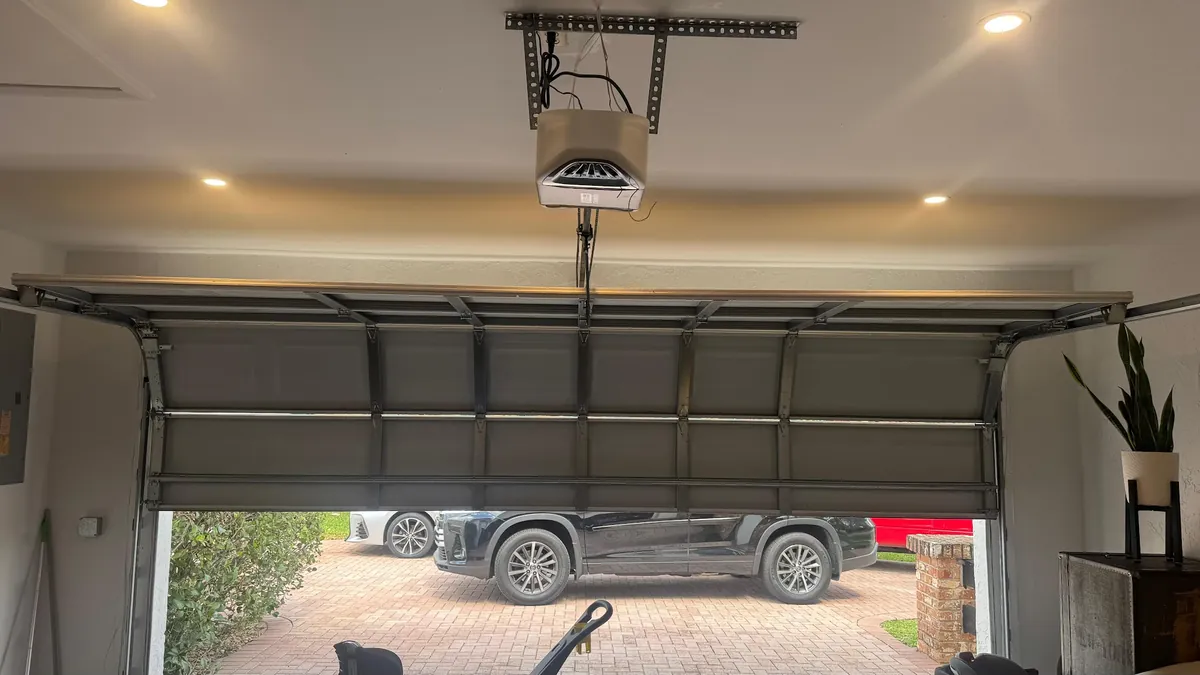
When the motor, not the door, is the trouble
Press the button and nothing happens, or the motor whirs while the door stays put, or the door sets off and changes its mind halfway. Each of those can be the opener, and each can just as easily be something the opener is reacting to. Garage door opener repair Medford MA homeowners call us about takes in openers repaired and installed, the remotes and wall buttons that command them, and the safety sensors that keep a closing door from landing on anything. In Wellington, West Medford and the Lawrence Estates the single- and two-family houses have garages built onto the house and garages standing on their own, and because the plots are broader than nearer the city, a fair share of them have one double-wide door spanning two cars. Each of those layouts asks something different of an opener.
Before calling, three quick looks narrow it down:
- The light on the motor housing: no glow at all suggests a power problem; a light blinking in a repeating sequence is usually a coded fault message.
- The pair of small eyes aimed at each other at ankle height across the opening: if either indicator is dark or flickering, the beam is interrupted.
- The red release handle hanging from the rail: if it has been tugged, the motor runs but is no longer coupled to the door.
Opener trouble we sort out in Medford
Motor runs, door does not move
A stripped drive gear, a worn sprocket or a trolley that has come off the rail. Sometimes the release has simply been pulled.
Door reverses or stops short
An interrupted sensor beam, travel limits out of adjustment, or a door that is binding and tripping the opener’s force setting.
Remotes that have stopped
Flat batteries, a remote that has dropped its programming, interference or a damaged aerial on the motor housing.
Wall buttons and keypads
A wall button that does nothing, an outdoor keypad that no longer opens the door, or a frayed wire running along the garage wall.
Safety sensors
Eyes knocked out of line, grimy lenses, loose wiring or low sun glaring straight into one of them at certain times of day.
Worn-out openers replaced
When an opener is beyond sensible repair, or lacks modern safety reversing, a new one is installed and set up to the door.
What an opener actually does
It is natural to think of the opener as the thing that lifts the door. It is not. The springs counterbalance the door’s weight, so a sound door can be raised with one hand. The motor turns a chain, belt or screw that carries a trolley along the rail, and the trolley drags and shoves the door through a bent arm fixed to its uppermost panel. Mechanically, that is the whole of it: the opener moves a door that is already balanced.
Everything else is control and protection. Limit settings define where fully up and fully down sit. A force setting caps the effort the motor may use before concluding that something is wrong. The low-mounted photo eyes report whether the opening is clear, and should anything cut their beam as the door descends, the opener must halt and go back up. Remotes, the wall button and any keypad do nothing more than send it instructions.
Hence the pattern we see again and again: the opener gets the blame for a door fault. A broken spring, a seized roller or a door that has begun to bind makes the door heavier or stiffer, the opener senses the extra resistance, and it stops or reverses exactly as designed. Garage door opener repair in Medford therefore begins by making sure the door glides easily by hand.
Openers over double-wide doors
The broader Medford plots leave room for double doors that tighter streets nearer the city cannot fit, and a wide door makes particular demands on its opener. The door is heavier and longer, and while the springs still carry its weight, the top panel absorbs all of the opener’s push and pull through a single bracket at its centre. Over the years that point flexes. A wide door without a proper stiffening strut along its top panel can bow as the opener drives it, and eventually the panel splits around the bracket or the bracket tears away.
A wide door also exaggerates any imbalance. If one of its two springs has weakened, the opener is hauling a door that wants to tilt, and the strain shows up as noise, sluggish travel and reversals with no obvious cause. When a double-wide door has opener trouble, we look at the springs, the top panel and its strut together with the opener, because a motor fix on its own would not hold.
Attached garages: noise, power and the door into the house
On an attached garage, the opener sits beneath or beside living space. A chain-drive unit clattering over the door carries into a bedroom above the garage or a kitchen next to it. Belt-drive units are far quieter, and when an old chain opener is being changed on an attached garage, the sound it sends through the house is often worth weighing.
The wall button in an attached garage usually sits beside the door into the house, with a thin wire running along the wall and up to the motor. When the button fails but the remotes still work, that wire or the button itself is the first suspect. An attached garage that cannot be closed also leaves the house exposed, which makes a dead opener there more pressing than it would be on a stand-alone building.
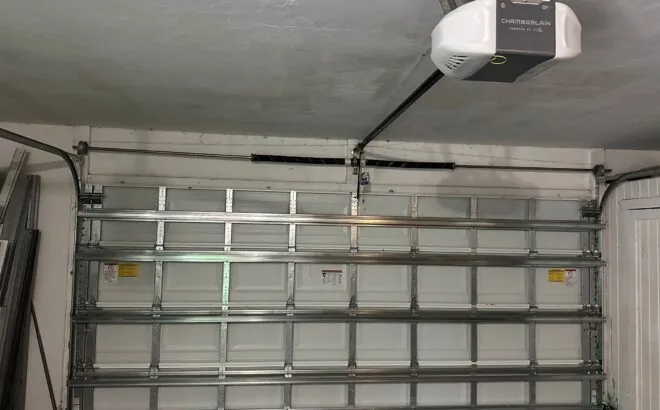
Detached garages: range, power and weather
A stand-alone garage is also where the opener is most likely to be one of several things sharing the building. Shelving, a workbench, a spare fridge or garden tools often end up along the walls, and anything stored near the track or under the rail can foul the door or the trolley. Before garage door opener repair Medford MA owners book for a detached garage, clearing a path to the opener and both sensors makes the visit quicker and safer.
A stand-alone garage toward the rear of a Medford lot puts the opener a long way from where the driver usually presses the remote. A remote that works from the drive but not from the street often just has a weak battery, yet the cause can also be a damaged aerial dangling from the motor housing, or the house itself blocking the signal. Checking the aerial and how it is routed is part of any remote complaint on a detached garage.
Power is the other usual suspect. Many detached garages are fed by one circuit from the house, often shared with the lights and a socket. A tripped breaker, a worn socket the opener plugs into, or a ground-fault outlet that has tripped in wet weather will all leave the opener dead. Cold and damp hit a detached garage harder as well: grease stiffens, the door gets heavier to move and the opener’s force limit trips more readily on a frosty morning.
Remotes, keypads and two households
At a two-family house, the garage the households share may have two openers side by side for two doors, or one double-wide door with remotes for both households. Remotes get mislaid, lent out and replaced, and keeping a tally of which ones are programmed is sensible. When one disappears, the opener’s stored codes can be wiped and the remotes still in hand programmed afresh, so the missing one stops working.
An outdoor keypad gives each household a code without needing extra remotes. When a keypad fails, it is most often the battery, next a code that has been reset, and only occasionally the keypad itself. Two openers mounted next to each other sometimes answer each other’s remotes if they were set up carelessly. That gets sorted out during the visit.
Safety sensors and the reversing test
The sensors matter more for safety than any other part of an opener, and they also generate the most nuisance calls. One eye projects an invisible beam across the opening to its partner, just above the floor. Anything crossing that beam during a descent sends the door back up.
They stop working when one gets knocked out of line by a bike, a bin or a boot, when a lens is grimy or webbed over by a spider, when the wire along the track gets nicked, or when low sun shines straight into the receiving eye at a certain hour. The door then refuses to close, or closes only while someone keeps a finger on the wall button. Cleaning and realigning the eyes, and tidying the wiring so nothing can snag it, cures most of these.
The other safety feature is force reversal: a closing door that meets something should stop and rise again. Every opener visit includes testing that reversal. An opener that keeps pushing when it meets resistance is a hazard to children, pets and cars, and if it cannot be adjusted to reverse properly, we recommend replacing it.
Lights, timers and small irritations
Not every opener fault stops the door. The light on the motor housing that no longer comes on, or stays on, is often a bulb, a lens clip or a setting in the opener rather than anything serious, but in a garage without a window it is the only light many people have when they pull in after dark. Some openers also carry a timer that closes the door after a set delay, and a sensor that is slightly out of line can make that timer misbehave. A door that opens by itself is worth a call too; it can come from a remote stuck in a pocket or a car, a keypad button that has jammed, or a fault in the wall control. These small faults are usually quick to put right, and they are often found while the visit is dealing with something bigger.
Blackouts and the red release cord
Every opener has a release: a red-handled cord dropping from the trolley. A firm tug disengages the trolley, so the door can then be lifted manually. It is how a car gets out during a power cut, and it is also one of the most common reasons an opener seems broken: someone pulled the cord, the motor now runs the trolley up and down the rail, and the door does not follow.
Using the release is safe on a door that is balanced and closed. With a snapped spring it is a different story: once the trolley lets go, nothing but your arms is holding the door, and a double-wide door outweighs anybody’s grip by a wide margin. Never pull the release with the door open and a spring broken, and never stand under a door you have just released. To reconnect, the trolley usually re-engages when the opener next runs, or when the door is moved until the trolley clicks back on.
What an opener visit involves
The sequence matters, because the door has to be sound before the opener can be judged.
- With the trolley disengaged, we lift the door ourselves to feel its balance and look over the springs, rollers and tracks.
- The power supply is checked, along with the socket or circuit feeding the opener.
- The drive, gear, trolley and rail are inspected, and any fault code the opener is flashing is read.
- Remotes, the wall button and any keypad are tried, with remotes reprogrammed where needed.
- The eyes are cleaned and aligned, and their wiring is checked end to end.
- Limits and force get fine-tuned, and we prove the reversal works before leaving.
Nothing goes ahead until you have heard our findings and our view on mending versus renewing. LiftMaster units get repaired or replaced by us, as do the other makes hanging over Medford doors.
Is the old unit worth saving?
Plenty of opener faults are cured with a single part: a gear, a sprocket, a trolley, a logic board, a sensor or a wall button. An opener that has been running for a great many years, struggles with a door that is otherwise balanced, or needs a major part that is hard to source may be better replaced. So may an opener old enough to predate safety sensors; it may still raise the door, but it protects nobody standing beneath it.
Choosing a replacement for a Medford garage
A new opener has to suit the door it will drive: its weight and size, whether it is single or double-wide, and the headroom above it. A double-wide door needs an opener with the strength to move it smoothly, a rail long enough for its travel and a properly braced top panel. On an attached garage, a quieter belt drive is often the right choice, and where the opener is under a bedroom, mounting it with vibration in mind helps too. On a detached garage, how the remote signal will reach the building from the street is part of the plan, as is whether the circuit feeding it is up to the job.
Some households also want a keypad by the door, a wall control with a light switch or lock-out button, or the ability to check whether the door is shut. Those are worth raising when the new opener is chosen, rather than added afterwards. For trouble with the door itself, head to Medford garage door repair; a snapped spring has its own Medford spring page.
Getting the opener working again
If an attached garage is stuck wide open, or the car is boxed in by a door refusing to move, the Medford emergency repair page sets out the first steps. The opener repair and replacement page covers this service across Greater Boston, and the Medford page gathers every service we provide in town. Phone lines are open at any hour, every day.
For garage door opener repair Medford MA homes can lean on, it helps to know if the garage adjoins the house or stands alone, how wide its door is, and what the opener, the remotes and the sensor lights are doing. Then call us or book online.
Questions from Medford
The motor whirs but the door stays where it is. What has gone wrong?
Often the opener is fine and the door is at fault, most commonly through a broken spring. Uncouple the opener and inspect the spring over the door from a few steps away. If the spring is intact, the opener’s gear or trolley may have failed. Either way, stop pressing the button and ring us.
Our door drops a little way, then climbs straight back up. Why?
Usually the safety eyes. One has been knocked, has a dirty lens or has sun shining into it. Look for two steady indicator lights. When both glow steadily yet the door still reverses, it may be binding, and the opener is responding to that drag.
Can you reprogram our remotes after one was lost?
Yes. The opener’s stored codes can be wiped and the remotes you still have, plus any keypad, set up again, so the lost remote no longer opens the door.
Can you fix a LiftMaster opener?
We can. Repairs and replacements on LiftMaster units are a routine part of our opener work, just as they are for the other openers on home garages.
Is it worth repairing an old opener?
That depends on what has failed and how old the unit is. One worn part is usually worth replacing. An opener with no safety sensors, one needing a major part, or one that keeps failing is often better replaced, and we will say which we recommend when you book garage door opener repair Medford MA households trust.