
Broad doors, long driveways: how Milton garages wear
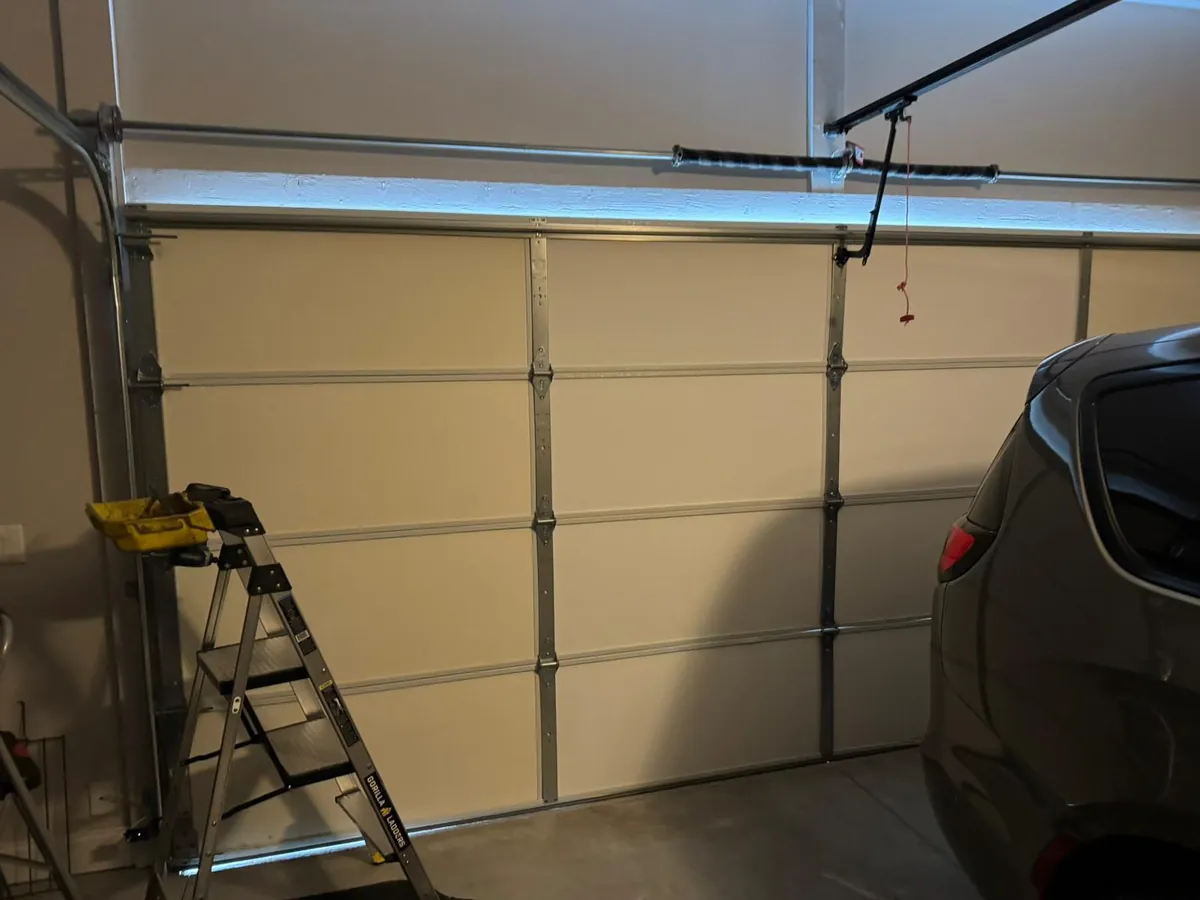
Around Milton Village and on the roads running up toward the Blue Hills, the usual garage is built into a larger single-family house rather than set apart at the back of the lot. It tends to have one double-width door in place of two narrow ones, and it faces a long driveway. Our garage door repair Milton MA work begins from that picture: a broad, weighty door that is part of the house, opened and closed many times a day and often sheltering more than one car.
Width changes how faults show themselves. Weight is spread along a long torsion shaft and two widely spaced rails, so a tired part on one side soon tells on the other. One corner settles lower than its partner. A roller on the far end begins to grind. The motor labours on the way up and the panels pause near the header.
Three things can be judged from a sensible distance, standing on the slab inside the garage:
- Does the bottom edge meet the floor evenly from one jamb to the other, or does it slope?
- Is the coil on the shaft above the opening continuous, or split by a visible gap?
- Are the little indicator lights on both floor-level eyes lit and steady?
Parts we put right on Milton doors
Torsion and extension springs
These carry the load. A double-width door is heavy, and one snapped coil stops it dead. There is more on our Milton spring page.
Lift cables and drums
Steel cables coil onto grooved drums at the shaft’s ends and anchor at the lower corners. One frayed strand on a broad door leaves it slanted.
Sections, hinges and seals
Dented or split panels, cracked hinges between sections, and a bottom weatherstrip crushed by seasons of meeting a driveway full of grit and slush.
Openers, remotes and wall buttons
A unit that drones without budging the door, a handset that only answers close to the house, or a push button beside the mudroom door that has gone dead. See the Milton opener page.
Tracks and rollers
Kinked uprights, loose jamb brackets, rollers worn flat or snapped at the stem, and doors that have jumped clear of their rails.
Safety sensors
Twin photo eyes mounted low on each jamb, which send the door back up when a car bumper, a bike or a child crosses the opening.
How the pieces share the weight
People often assume the motor on the ceiling hauls the door up. It does not; the springs do. A sectional door is a stack of horizontal panels linked by hinges, and when everything is in balance it should feel close to weightless if lifted by hand from the middle. Most attached garages use a torsion arrangement: a coiled spring sleeved over a steel shaft just above the header. Lowering the door twists the coil tighter; raising it lets the coil relax, which rotates the drums, which gather in the cables tied to the lower corners.
Some lighter or older doors rely on extension springs instead. Those stretch out above each horizontal rail and pull the door upward through pulleys. The principle is the same and so is the hazard: with the door down, either kind is storing a large amount of energy.
Along each edge of every panel, rollers ride in a channel that turns from upright to level as the door travels back under the ceiling. The motor, hung centrally, drives a trolley along its rail and simply nudges a door the springs are already carrying. The low-mounted eyes watch the doorway and instruct the motor to halt and go back up if the beam is interrupted.
A double-width door asks more of every one of those parts. Its shaft spans further and can deflect. Its rails sit far apart, so a small twist at one jamb has real leverage over the whole curtain. Many wide doors also carry a matched pair of torsion coils; once one lets go, its partner is left holding a load it was never chosen to hold alone, and it tends to follow before long.
Early warnings worth noticing
Doors seldom quit without some notice. These are the habits that usually come first:
- Travel slows toward the top, or the motor sounds as if it is straining.
- One corner lands before the other, leaving a wedge of daylight.
- A click or grind repeats at the same height every time.
- Movement turns jerky instead of smooth.
- Rain, leaves or meltwater creep in under the weatherstrip.
- The door bounces back up on its way down for no visible reason.
- A handset works inside the garage but is ignored from the foot of the driveway.
Each of these points somewhere specific. Slowing near the top hints at a weakening spring. A wedge of light at one corner usually comes from a cable or drum. A repeating click often means a cracked hinge or a roller bearing that has broken up. An unprompted reversal is frequently a sensor nudged off line, or a panel catching in its channel. Jotting down which signs you have seen, and roughly when they began, makes the first phone call far more useful.
Garage door repair Milton MA households can check first
With a large attached garage, the door is part of daily life, so it pays to know which checks are sensible and which parts to leave strictly alone.
Reasonable things anyone can do:
- Halted halfway? Pull the opener’s plug so the motor stops having another go.
- Clean both sensor lenses with a soft cloth, and move whatever might be blocking the beam: a bin, a bicycle wheel, a heap of leaves blown in off the driveway.
- Put a new battery in a silent handset, then try the wall button; if that works, the handset is the culprit, not the motor.
- Walk each rail and look for something leaning on it, or a jamb bracket that has worked loose.
The spring system is another matter. Understand this plainly: a torsion spring holds dangerous tension every moment the door is shut, and the cables plus their corner brackets share that strain. Turning a set screw on a winding cone, levering at a corner bracket or trying to adjust the coil can let all of that energy go at once. It is not a DIY repair under any circumstances. And a broad door with a broken spring weighs far more than it looks; nobody should try hoisting it, and the motor should not be left to wrestle with it.
What a technician does on site
A Milton visit takes in the entire door rather than the single fault mentioned on the phone. First the trolley is disconnected by its red cord, so the technician can lift it unaided and judge how evenly it hangs. If it sinks or climbs when let go at about waist height, the spring setting is off. Each coil is examined end to end, the cables are inspected for broken strands near the corner brackets and the drums, and every roller is checked for flat spots, wobble and a worn stem.
The rails are sighted along their length. On a wide opening, an upright pushed slightly out of plumb by a bumper or a snow blower is often enough to make the door stick. Hinges get checked for hairline cracks, and the weatherstrip and lowest panel are looked over for salt damage and the effects of standing water.
Nothing gets swapped until the cause has been explained to you, along with the work needed. Afterward the door is rebalanced, the motor’s limits are reset for its new weight, and the auto-reverse gets proved by closing onto an offcut of lumber set on the slab and watching the panels climb back.
Panels, hinges and the weatherstrip
Broad doors flex more than narrow ones. Each hinge between panels carries part of that flexing every trip, and once a hinge cracks the door bows slightly in the middle as it rounds the curve of the rails. You may hear it as a dull knock at one height, or see a panel edge rubbing paint off its neighbour. Replacing a cracked hinge, and the screws that have worked loose in the panel’s end stile, usually stops the knocking and takes strain off the rollers too.
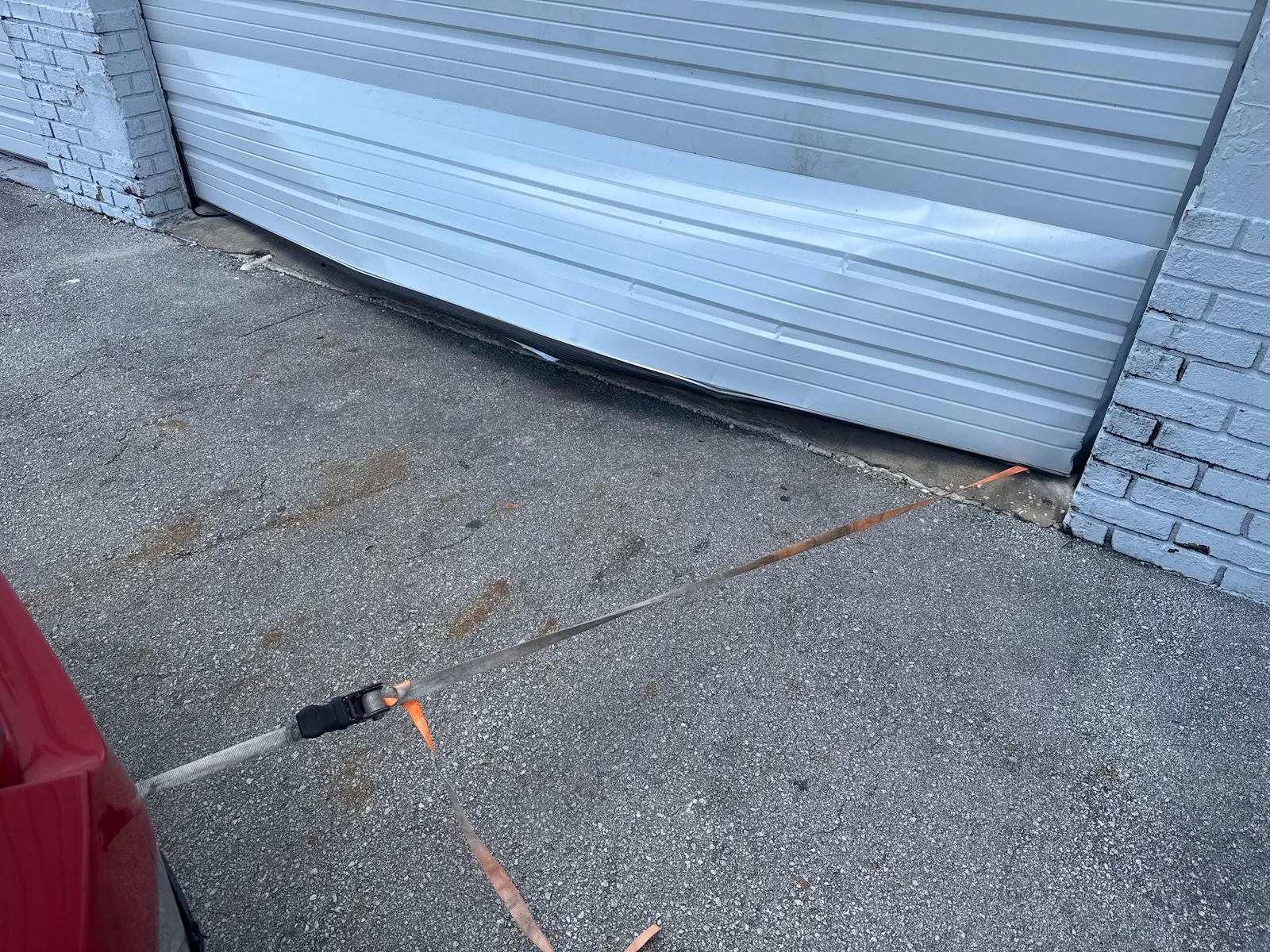
Panel damage on a long driveway is most often a reversing bumper, a trailer hitch or a basketball rather than weather. A single dented panel can sometimes be swapped if a match for its profile and colour can be found; when the door is older and several panels show wear, that is where the replace-or-repair question begins. The weatherstrip along the bottom is the easiest part to overlook and one of the worst to leave: once it splits, water reaches the bottom panel and the corner brackets, and corrosion begins exactly where the cables are anchored. Garage door repair Milton MA homeowners ask for often starts with a split bottom seal that let a winter’s worth of meltwater in.
Snow, salt and the threshold
The long driveways leading up to many houses here shape how a door ages. Snow pushed uphill by a plough or a blower piles against the bottom panel, and meltwater collects along the threshold before freezing again after dark. Closing a door onto an icy seal can tear the rubber, and a motor straining to lift a door glued to the slab can strip a gear or trip its force limit.
The lowest panel also takes most of the salt and grit carried in on tyres. Over the years that eats into the bottom hinges, the corner brackets where the cables anchor, and the foot of each upright rail. It matters, because a corroded corner bracket is one of the commonest places for a cable to let go. Garage door repair Milton MA visits booked in late autumn or early spring regularly turn up rust at the base of a door well before it causes a breakdown.
A few habits help: keep the threshold clear of packed snow, let a frozen door thaw instead of running the motor against it, and hose salt off the bottom panel when a mild spell arrives.
When the garage is part of the house
An attached garage makes the door one of the home’s outer walls. A door stuck partly open leaves the house exposed overnight, and a door stuck shut can strand the car on a school morning. Many attached garages also have a finished room above. A rattling motor or a chattering roller travels straight up through the joists, and a door that thumps down hard at the end of its travel can be felt in the floor overhead.
The connecting door into the kitchen or mudroom is usually where the push button is mounted, and it is the door most families use every day. A button that ignores the first press, or only works after several, is often the earliest sign of a wiring or motor fault. Keeping that button reliable is part of keeping the garage useful as the main way in.
These garages also tend to hold far more than cars: workbenches, bikes, garden gear, chest freezers. Things stacked along the walls can lean on an upright rail or knock a sensor out of line without anyone noticing, so part of a visit is often simply pointing out where clearance is needed.
Fixing the door or starting fresh
Here, replacing the entire door is more common than swapping a single part, which fits what broad doors on larger houses tend to show with age. A double-width door that has done many years of service often has several things wearing out together: both coils tired, cables frayed at the corners, rollers worn flat, and a bottom panel corroded or rotted up to the snow line.
Plenty of doors are still worth fixing. One broken coil on an otherwise sound door, a single frayed cable, a set of worn rollers, or a rail bent in a minor bump can all be dealt with and leave a good door working. A new door starts to look like the better answer when:
- More than one panel is cracked, rusted through or soft with rot.
- The same parts keep failing despite repeated work.
- A timber door has drunk in so much moisture that its weight now outruns whatever coil could sensibly carry it.
- The door no longer suits the house, or the family wants better insulation between the garage and the room above.
You get a straight answer on which way a particular door leans. Where new beats mended, the new garage doors page describes how replacement doors are supplied and fitted and the old one removed.
When rollers leave the rail
Once a door has jumped its rails it hangs askew, rollers poking out of the channel on one or both sides. On a broad door it often follows a car clipping one end, a cable parting on one side, or the opener pressing on after the panels had wedged. In that state the door can come down without warning, so it should be left still: no button presses and no attempts to shove it back by hand.
Putting it right means supporting the door’s weight, coaxing every roller home into its channel, truing or renewing kinked lengths of rail, and making sure both cables sit evenly on their drums before the door moves again. More detail is on the off-track repair page.
Other help in Milton
For a door that refuses to move at an awkward hour, the Milton emergency page sets out sensible steps for the hours before help arrives. An overview of everything offered locally sits on the Milton garage doors page, and our Greater Boston overview of garage door repair covers how this work runs everywhere we go.
Reporting a fault
Calls are taken at any hour, Sundays as much as Mondays, so a door that gives out late at night or before sunrise can be reported the moment it happens. To book garage door repair Milton MA homeowners can count on, tell us what the panels are doing, any part that looks snapped or bent, and whether a car is stuck inside. Pass that on before anyone tries the button again: call us or book online.
Questions from Milton
Our wide door rises lopsided, one side trailing. Why?
Usually a cable has stretched, frayed or slipped on its drum, so that side has less support. A worn roller or a kinked rail on one side can cause the same tilt. Stop running it and have it looked at, because a tilted door can twist out of its channels.
The motor whirs but the door hardly moves. Has the opener died?
Probably not. When a coil snaps, the motor is suddenly trying to lift the full weight by itself; it manages a few inches and gives up. Pull the plug, leave the door where it sits, and from below see whether the coil on the shaft has parted.
Can one damaged panel be swapped on its own?
Often it can, provided a matching panel is available in the door’s style and finish. Where damage runs across several panels, or the door is plainly worn out, a whole new door is usually better value, and that is explained before you decide anything.
The door has frozen to the driveway apron. What now?
Stop pressing the button. Unplug the motor, chip away packed snow and ice from the threshold, and let the weatherstrip thaw before trying again. If the motor was already run against the frozen door, ask for the motor and the bottom seal to be checked.
Do you work on the bigger houses near the Blue Hills?
Yes. Springs, cables, panels, motors, handsets, rails, rollers and sensors are all repaired on attached garages across the town, including the double-width doors common on larger single-family homes.