
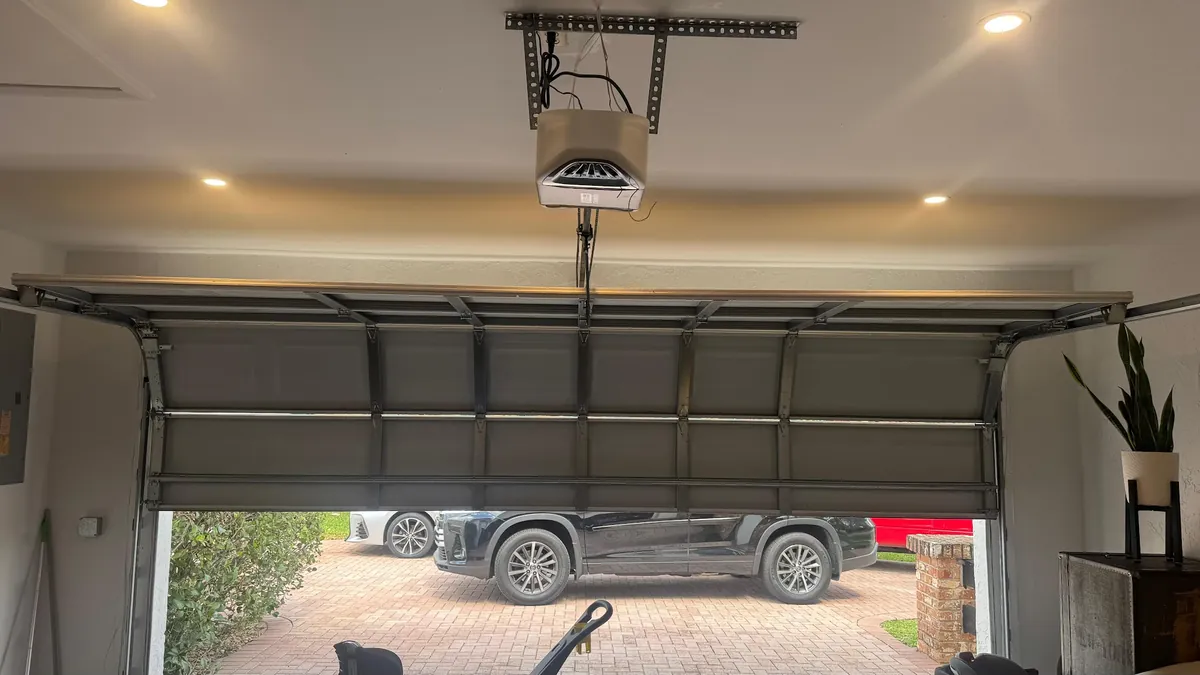
Openers on Milton’s broad attached garages
Larger single-families around Milton Village and against the Blue Hills usually pair an attached garage with one broad door and a long, climbing approach from the road. The opener on the ceiling of that garage is one of the most-used machines in the house: it is triggered from the car while still halfway up the drive, from the button by the kitchen or mudroom door, and sometimes several times an hour on a busy weekend. Our garage door opener repair Milton MA work covers the whole chain of control: the motor unit, its rail and trolley, the handsets in the cars, the button on the wall and the pair of sensors at the bottom of the opening.
A wide door is a big ask for any opener. Even when the springs are doing their share, the motor has more mass to start and stop and a longer door to steer, so any slack in the drive or weakness in the springs shows up as strain at the motor end first.
When the door stops responding, three simple observations narrow it down quickly:
- Press a control and watch the ceiling unit: if its bulb stays dark, suspect the power supply first.
- Does the wall button work while the handset does not? Then the fault is probably the handset or its pairing.
- Does the door start down, then climb back up? Check the floor sensors’ lights for a blink.
Controls and parts covered
The motor unit
The head mounted on the ceiling: motor, gears, logic board, limit settings and light. Units that hum, click, run briefly or do nothing at all.
Rail, trolley and drive
The chain, belt or screw that carries the trolley along the rail, and the arm linking the trolley to the top panel of the door.
Remotes
Handsets that have stopped working, only work at short range, or need re-pairing after a battery change or a replacement unit.
Wall buttons
The control by the house door, usually in a mudroom or kitchen entry. Dead buttons, buttons that need several presses, and broken wiring.
Safety sensors
The two photo eyes low on either side of the opening. Misaligned, dirty, damaged or badly wired sensors that keep the door from closing.
Replacement openers
A new unit fitted once mending stops being sensible. That includes LiftMaster units, mended or exchanged.
Motor, rail and door: a division of labour
An opener does not lift the weight of a garage door. The springs above the opening balance that weight, so that a healthy door rises under the light push of a single hand. The opener’s job is to push and pull an already-balanced door along its tracks, to stop it at the top and the bottom in the right places, and to reverse it if something gets in the way.
Inside the motor unit, an electric motor drives a gear set which turns a sprocket or pulley. That moves a chain, a belt or a long threaded screw along a rail, and a trolley riding on the rail is connected by a curved arm to a bracket on the door’s top panel. When the trolley is pulled toward the motor, the door rises and rolls back under the ceiling; when the trolley is pushed away, the door comes down.
Two settings govern each trip. Travel limits mark where the motor should treat the door as fully up and as fully down. Force sets the amount of push-back the unit tolerates before concluding something is in the way. If either is off, the door may stop short, slam down, or reverse at random. A door that has had new springs fitted, or has grown heavier with age and weather, often needs these settings adjusted to suit.
Finally, the sensors. Two small units face each other across the bottom of the opening, one sending an invisible beam and the other receiving it. Break that beam mid-descent and the unit stops at once and lifts the panels clear. Each sensor carries a small indicator light, which is the first thing to look at when a door refuses to close.
Symptoms, and where they usually lead
- Nothing at all happens. No light, no sound. Often the outlet, a tripped circuit or a loose plug. If power is present, the logic board or a wiring fault may be to blame.
- A hum but no movement. The motor is getting power but the door does not move. Usually a stripped gear, a capacitor fault, a door held by a broken spring, or a frozen bottom seal.
- The door starts, then reverses. A sensor out of alignment, a dirty lens, or a force setting too sensitive for a door that binds in its tracks.
- It halts before reaching the slab or the header. Limits that have wandered, or a door that has changed weight.
- The handset works only near the house. A weak battery, aerial trouble at the motor unit, or interference from nearby electronics.
- The wall button needs several presses. A failing button, a damaged wire run, or a loose terminal at the motor.
- Grinding, rattling or a chain slapping the rail. A slack chain or belt, worn sprockets, or loose rail mounting.
Each of these has a different fix, and some point back to the door rather than the opener. Part of any garage door opener repair Milton MA homeowners book is deciding where the real fault lies before replacing anything.
Long driveways and remote range
Many Milton houses sit well back from the road, so the remote tends to be pressed early, from some way down the driveway, with the door expected to be open on arrival. A handset that only answers from close to the garage is more than an irritation in that situation: it means stopping in the drive, or sitting with the engine running while the door catches up.
Short range has several common causes. The handset battery may be weak even if its light still glows. The aerial wire hanging from the motor unit may have been bent up against the ceiling, tucked out of the way or damaged. New lighting, especially some types of LED bulb fitted in or near the opener, can interfere with the signal. And older handsets can simply wear out internally. The fix might be a battery, a repositioned or replaced aerial, a change of bulb, re-pairing, or a new handset paired to the unit.
A long driveway also means more snow to clear in winter. Plough and blower piles against the bottom of the door can freeze the seal to the slab. An opener asked to lift a door frozen to the ground may strip its drive gear or trip its force limit and refuse to try again. If the door will not open on a cold morning, it is worth checking for ice at the threshold before assuming the opener has failed.
Noise through the joists
With the garage built into the house, the opener effectively hangs from the home’s own framing. Where there is a bedroom, office or family room above the garage, every trip of the door can be heard and felt in that room. Chain drives are naturally louder than belt drives, but a lot of opener noise comes from wear: a slack chain slapping the rail, dry or worn rollers on the door, loose mounting straps that let the motor unit vibrate against the joists.
Quieting an opener usually starts with the door itself, because a door that runs smoothly by hand puts far less load and noise through the opener. After that, the drive can be tensioned, the rail and motor mountings tightened, and worn parts replaced. Where a chain-drive unit is near the end of its life anyway, replacing it with a quieter drive type is an option worth weighing, especially below a bedroom.
The wall button sits at the connecting door for the same reason the garage is attached: it is how the household comes and goes. A button that has gone dead, or a run of wire that has been nicked by shelving or a stray staple, makes that entrance awkward. Wall buttons and their wiring are repaired and replaced as part of opener work.
Sensors at a wide opening
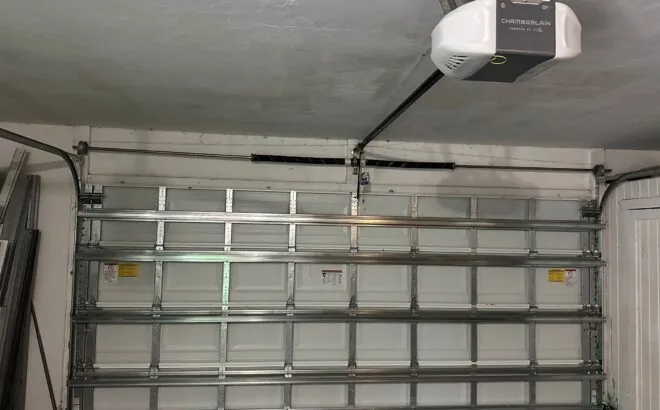
On a double-width door, the two sensors sit further apart than on a single door, so the beam crosses a wider span and there is more scope for one side to be nudged out of line. Common culprits are a car bumper, a bicycle, a recycling bin or a pile of firewood stacked too close to the jamb. Leaves and snow blown into the corner by the door can block the beam just as effectively.
Low sun is another cause. On some sites, the early or late sun shines straight into the receiving sensor at certain times of year, and the opener treats the glare as an obstruction. Turning the sensors so the receiver faces away from the sun usually solves it.
If cleaning the lenses and clearing the opening does not bring both sensor lights back to steady, the problem may be alignment, a damaged bracket or wiring. Wires running along the bottom of the wall are easily damaged by tools and garden equipment. A sensor that has been tampered with or disabled leaves the door without its most important safety feature, so it is always put right rather than bypassed.
Matching an opener to a heavy, wide door
A double-width door on a larger house puts different demands on its opener than a single-car door does. The springs still carry the weight, but the motor must start and stop a broader, heavier curtain of panels, and it does so through a single arm fixed at the centre of the top panel. Any stiffness at either end of a wide door is magnified at that one connection point. That is why an opener that coped well with a light single door can struggle when moved to, or left on, a big two-car door.
When choosing a replacement, several practical questions come up:
- Drive type. Chain units are robust and common; belt units run more quietly, which suits garages with a room overhead; screw drives get by with fewer moving parts.
- Motor strength. A unit rated comfortably for the door’s size and material, rather than one working at its limit, tends to last longer and run more smoothly.
- Rail length. Taller doors need a longer rail so the door can open fully and clear the car roof.
- Ceiling clearance. Some attached garages have a low ceiling or a beam in the way, which affects where the unit can hang.
- Handsets. How many cars use the garage, and whether a handset is wanted for each.
None of this involves guesswork on site: the door is measured, its balance is checked and the ceiling is looked at before any unit is suggested. Garage door opener repair Milton MA households ask for often turns into this conversation when an old unit has finally had its day, and the right answer depends on the door it will be driving.
Garage door opener repair Milton MA: fix or replace?
Most opener faults can be fixed: a stripped gear, a failed capacitor, a worn sprocket, a dead logic board, a broken sensor or a lost handset. Repair makes sense when the unit is otherwise sound and parts are available for it.
Replacement is often the better choice when:
- Spares for that model have become scarce, or one fault keeps coming back.
- The unit predates photo-eye sensors and auto-reverse, or cannot work with them.
- The door has been replaced, or is being replaced, and the existing opener is not suited to the new door’s weight and size.
- A quieter drive is wanted below a living space.
The same thinking applies to the door. Full door replacements are more common here than single-part repairs, and a new double-width door often deserves an opener suited to it. When a new door is part of the plan, the new garage doors page describes supply, fitting and removal of the old door. A LiftMaster head, or one of another make, can be mended or exchanged in the same way.
The visit
A visit begins by separating the door from the opener. The release cord is used to disconnect the trolley, and the technician runs the door manually to feel for balance and any snag along the rails. Heavy, sticky or lopsided panels get sorted out before anything else; a motor coupled to a reluctant door never behaves.
Next the unit gets examined by itself: power, motor, gears, drive, rail, light, travel limits and force settings. The handsets and wall button are tried, the sensors’ alignment and wiring are checked, and the beam is tested with an object in the opening. With the culprit identified, you hear the diagnosis, what the fix entails, and whether a new unit would serve better.
After the repair, the trolley is coupled up again, limits and force are dialled in for the panels it now drives, and the auto-reverse is proved against a length of timber laid across the slab. The handsets are tested from the driveway, not only from inside the garage, so a long approach is covered.
More services in Milton
If the opener hums while the door stays put, the cause may be a broken spring; the Milton spring repair page explains that fault. For dents, cables, tracks and rollers, see garage door repair in Milton, and for a door that fails late at night, the Milton emergency page. All local services are listed on the Milton garage doors page, while our Greater Boston opener repair and replacement overview sets out how this work is done elsewhere.
Arrange opener work
Openers tend to quit at awkward moments, often with the car parked behind a door that will not move. Because a person picks up the line at any hour on any day, the breakdown can be reported while it is fresh. Booking garage door opener repair Milton MA homeowners need is simplest if you can say what the opener does when pressed, whether the light comes on, and whether the panels glide when lifted manually. Call us or book online.
Questions from Milton
The power went out and our car is inside. How do we get the door open?
Provided the springs are intact, give the red trolley cord a firm tug while the door is shut, then raise the panels manually; they ought to go up with little effort. If it feels very heavy, stop, because a broken spring may be the real problem, and lifting a wide door with no spring support is dangerous.
Our handset is ignored until we are almost at the garage. Why?
Often a tired battery, a damaged or folded aerial on the motor unit, or interference from a nearby bulb or device. A new battery is the first thing to try; if that does not help, the aerial and the unit’s receiver are checked on a visit.
Why does the door go down halfway and then go back up?
Most often the sensors: one has been knocked out of line, the lenses are dirty, or sunlight is shining into the receiver. It can also be a force setting that is too sensitive for a door that drags in its tracks.
Can you make our opener quieter? There is a bedroom above the garage.
Usually, yes. Tightening the drive and mountings, replacing worn rollers on the door and servicing the unit can make a large difference. If the unit is nearly worn out, switching it for a hushed belt model could be sensible.
Is a LiftMaster unit something you handle?
Yes. LiftMaster units get repaired or replaced like any other opener, together with their handsets, wall controls and sensors.