
Why springs give out early near the water
Think of the usual single bay off Broadway, or a few blocks inland from the beach: a slim garage, an apron hardly longer than a sedan, and a door that cycles several times between breakfast and bedtime. One or two coils of steel do nearly all of that lifting, and the moist, briny breeze off the ocean settles on them in every month of the year. Garage door spring repair in Revere, MA is the job of swapping out those torsion or extension springs, plus the bearings, cones and pulleys that work with them, once salt and constant cycling have worn them through.
Springs seldom fail quietly. If a crack like a cap gun went off in the garage, check these three things from the floor, keeping your hands to yourself:
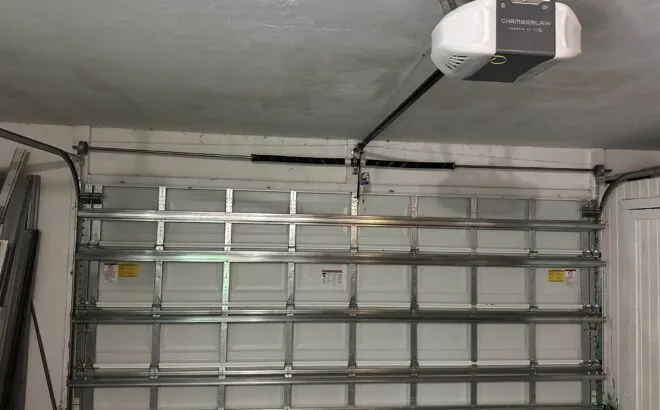
- The shaft spanning the top of the opening: look for a coil parted in two, with daylight showing at the break.
- The ceiling rails, on a door with side springs: one spring dangling, or longer and slacker than its partner.
- The motor: a door that rises a hand’s width and quits, or an opener that groans and labours.
The spring trouble we handle
A torsion coil split clean through
The call we get most. A crack begins at one corroded pit in the wire, deepens a little with each cycle, and the coil parts with a bang that carries through the house.
Side springs sagging or snapped
The long springs alongside the overhead rails go slack with age or break outright, so the door tilts or stays on the floor.
A door that will not hold its place
Tired springs, or a mismatched pair, let a door slide down or rise by itself when you let go of it at mid-height.
The hardware the springs ride on
Winding cones, the centre bracket, the end bearing plates, pulleys and containment cables, which rust and crack right along with the coils.
Torsion and extension: how each one breaks
Garages around here use one of two spring layouts, and telling us which one you have makes the phone call quicker.
Torsion. A steel bar runs above the header, carrying one or two coils. Lift cables wrap around a grooved drum at either end of that bar. As the door lowers, the cables pay out, the bar rotates, and the coils wind tighter and hold that energy. Opening reverses the process, as the coils relax, spin the drums and gather the cable back into the grooves. A single-car door might carry one coil or a pair. A broken torsion coil typically splits at a single point, leaving a gap you can spot from below.
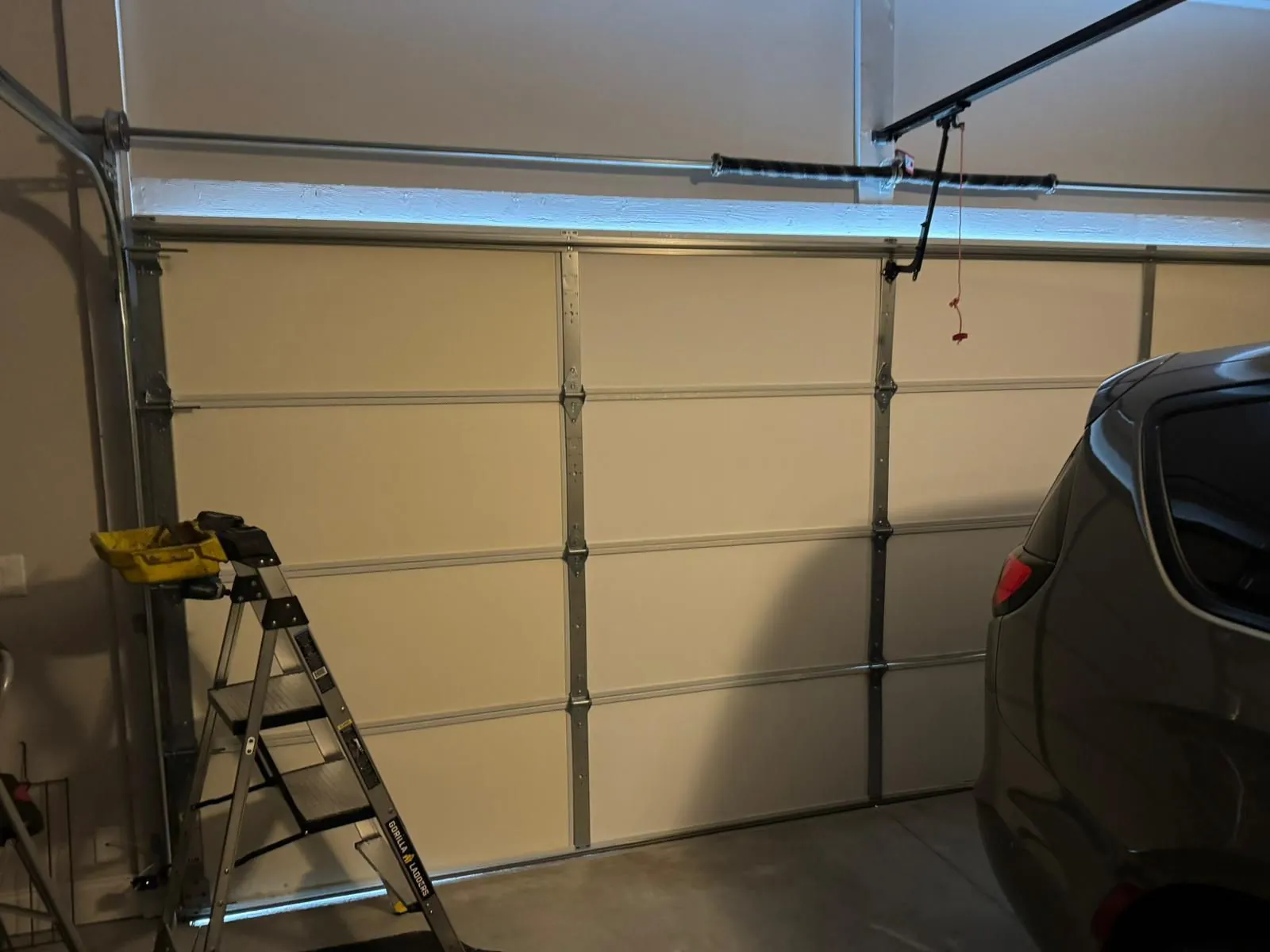
Extension. On these doors a long spring hangs beside each overhead rail, anchored to the rear hanger behind the rail while its front end works a pulley that a cable runs over. Closing the door stretches them; opening lets them contract and haul the door upward. You see this layout on older doors and in bays with tight ceilings. An extension spring can snap, but it can also just weaken, so that one side of the door trails behind the other.
With the door down, either type carries its full load. That stored force is what lets a heavy door feel almost weightless in your hand, and it is exactly why spring work is hazardous.
Salt, spring wire and fatigue
Spring wire is hardened and tempered so it can twist or stretch an enormous number of times without losing its shape. Its weakness is the skin of the wire. Air coming off the ocean deposits a fine film of salt, the salt pulls moisture out of the air, and rust gets going. Shallow pits form, and with every cycle, stress concentrates at the base of those pits until one of them grows a crack that runs through the coil.
So a coil hanging in a humid bay that catches the sea breeze usually wears out ahead of an identical one in a dry inland bay. The crack itself stays hidden, but the clues do not: a rusty orange haze on the coils, scaling, dark pocks in the steel, or a door that has slowly got harder to lift by hand with the opener released.
Wiping the coils with a door-specific spray lubricant every spring and autumn helps by sealing the surface against moisture and salt. It buys time; it cannot make a coil immortal.
Low ceilings and narrow bays
The small garages here often dictate which spring system is fitted. With only a sliver of wall between the opening and the joists, there may be no room for a torsion bar in the standard spot. Doors like that usually depend on side springs, or else a low-headroom torsion layout that mounts the bar further back or lower down. Your existing setup is measured exactly as it stands before replacement springs are chosen, so what goes back in suits your bay rather than an average one.
The short drive matters as well. Lots of garages here open nearly onto the sidewalk, so a door that slams down when a coil lets go can land right where people are walking past. That is another good reason never to cycle a door with a broken spring, and to keep the apron in front of it clear until the work is finished.
Doors that open many times a day
Every coil has a rated lifespan measured in open-and-close cycles. A door used twice a day spends those cycles slowly. A door on a two-family serving more than one set of comings and goings, or one that serves as the household’s everyday entrance, can burn through the same number of cycles in a much shorter time. Its springs reach the end sooner, and its rollers and cables wear out alongside them.
If your door gets that kind of use, say so when you ring. Higher-cycle springs can be fitted to a busy door, so the replacement set is not running near its limit from the first day. Asking about this is a sensible part of any garage door spring repair in Revere where the bay is in constant use.
Inside a spring replacement visit
Our garage door spring repair in Revere runs through the same deliberate steps on every door, with one goal: new springs sized to your door’s real weight, so it balances on its own and the motor never has to fight it.
- Lock the door down. Clamps bite onto the rails just above a roller, holding the door still, and the motor’s arm is released.
- Unload what is left. On a two-coil door with one broken, the survivor is still wound. It is let off a quarter-turn at a time using proper winding bars, never a screwdriver.
- Take measurements. Wire size, inside coil diameter, overall length and whether the coil is wound left or right all go into choosing the replacement, along with the door’s height and weight.
- Fit the new coils. Where a door has two, both are usually renewed, since the unbroken one has lived the same life and is rarely far behind.
- Inspect what the springs drive. Cables are checked strand by strand, drums for grooves worn sharp, and the bearings at the centre and ends of the bar for rust and wobble.
- Wind, then test by hand. Turns are counted onto each coil to match how tall the door stands. Then the door is lifted to waist height and let go. A balanced door hovers.
- Reconnect the motor. Force and travel get readjusted to the lighter-feeling door, and a block on the floor confirms the door still reverses on contact.
Side-spring doors follow a similar path, with a twist: the door is run fully open first, which relaxes the springs, then the old ones come off their hangers and pulleys, and the containment cable threaded through each spring is checked or renewed. That cable is what keeps a snapped spring from flying around the garage.
Why springs are a job for us
A torsion spring holds dangerous tension, and nothing about it is a DIY repair, whether you mean a small adjustment or a full replacement. The coil stores enough force to lift a heavy door, and if that force escapes suddenly, through a bar that slips from a winding cone, a set screw backed out in the wrong order or a tool that does not fit, the bar can spin and strike with frightening speed. People are badly hurt this way.
Side springs carry their own risk. Stretched along their length, they hold plenty of energy, and one without a containment cable that snaps or unhooks can lash across the bay. Lift cables, and the corner brackets where they fasten, carry the same load, so those are not for loosening either.
While you wait for us, these are safe and useful:
- Leave the motor off and unplug it at the socket overhead.
- Keep kids, pets and passers-by well back from the door and its apron.
- Resist lifting the door yourself; with no working spring it weighs far more than you expect.
- If it is stuck open, leave it open and phone; forcing it down can bring it crashing to the floor.
Cables and drums after a break
A spring rarely fails alone. When a torsion coil snaps, the bar it was turning suddenly loses its load, and the cables on the drums can go slack, slip out of their grooves or jump off the drum altogether. If anyone pressed the button after the break, the motor may have dragged the door up unevenly, so one cable ends up tight and the other loose and tangled. On a side-spring door, the cable that ran over the broken spring’s pulley often ends up kinked or chafed.
For that reason, a broken spring is never treated as just a spring. The cables are unwound and looked at along their full length, the drums are checked for cracks and burrs that would cut a new cable, and each cable’s lower loop, where it hooks onto its corner bracket, gets a close look for rust. Cables that have frayed, kinked or rusted are replaced in the same visit, as a pair, so both sides of the door lift together.
Why the right spring matters
Springs are not one-size-fits-all. Undersized coils leave a door that feels like lead, a motor that grunts, and a door that slides back to the slab whenever it is halted mid-way. Oversized ones send it leaping upward, unwilling to sit closed, while overloading the cables and that uppermost section. Either mistake shortens the life of everything connected to it.
That is why every garage door spring repair in Revere starts with careful measurement rather than a guess based on what is on the van. Doors in this area have often had parts changed over the years, sometimes with springs that never quite suited them, and a door that has always felt heavy may simply never have had the right springs fitted. Getting the size right is what lets the door glide, keeps the opener working lightly and gives the new springs their full life.
Early warnings before a break
Coils usually hint that they are failing. Look out for:
- More effort needed to raise the door by hand with the opener released.
- A door that sinks or climbs once released at mid-height.
- Coils on the torsion bar sitting unevenly, or with gaps opening between them.
- Rust bloom, scaling or pocked steel on the springs.
- One side spring visibly longer or looser than the other.
- A jerky lift, or one side of the door leading the other.
- The opener sounding louder or more strained than it did last season.
Spotting any of these and booking a visit is far easier than waiting for the bang, when the door is jammed and the car is trapped.
Frost and failing springs
Breaks cluster when the cold arrives. Low temperatures make spring steel less forgiving, and a coil already pitted by salt is more likely to give way on an icy morning, often on that first lift of the day. Ice adds to it: when the bottom rubber freezes to the slab, the motor heaves against the ice and loads the springs and cables beyond their normal work. If the door seems glued down on a frosty morning, loosen the seal from the ground before pressing the button again.
New springs, or time for a new door
As a rule, a spring visit closes out with fresh coils and a door that runs as it should. Now and then the springs are only part of the problem. A door whose lower sections have rusted through, with damaged panels or bent rails, or one that has grown much heavier than it was built to be, can be balanced with new springs, but the door itself may be close to finished. When that is the case you will hear it plainly, with the reasons, and new garage doors can be supplied and installed instead.
Other Revere pages
This page belongs under our main garage door spring repair service, which covers spring work across Greater Boston. For cables, panels, rails and rollers, go to garage door repair for Revere. Motor, handset and wall button faults are on the Revere opener page, and a coil that breaks at midnight is the subject of emergency repair in Revere. The Revere town page brings every local service together.
Booking new springs
A snapped spring almost always leaves the door shut and, often, a car stuck inside. The phone gets answered whatever the hour, on weekends as on weekdays, so ring as soon as you hear the crack. It helps to hear where the broken coil is mounted, overhead or alongside the rails, which position the door ended up in, and if a vehicle is parked inside. For garage door spring repair in Revere, call us or book online.
Questions from Revere
Something went off like a gunshot in our garage and the door is stuck. A spring?
Almost certainly. A breaking torsion coil makes a sharp report, and afterwards the door stays put or rises a little and stops. Look up for a parted coil on the bar, unplug the motor, and do not try hauling the door up by hand.
Only one of our two springs broke. Do both need replacing?
Usually, yes. They have made the same number of cycles in the same salty air, so the survivor is seldom far from its own break. Renewing the pair keeps the door evenly balanced.
There is hardly any room above our garage door. Can the springs still be done?
Yes. Tight bays with little headroom commonly use side springs or a low-headroom torsion layout. The arrangement you have is measured first, and the new springs are chosen to suit that space.
Can the opener lift the door until the spring is fixed?
Please do not try. An opener only steers a balanced door; it was never built to haul the whole weight. Running it now can strip its drive gear or burn out its motor, and the door can drop without warning.
Will being close to the ocean shorten the life of our springs?
Often it does. Salt and damp rust the skin of the wire, and those rust pits are where fatigue cracks begin. Coils near the water frequently fail ahead of inland ones, and lubricating them twice a year slows the process.