
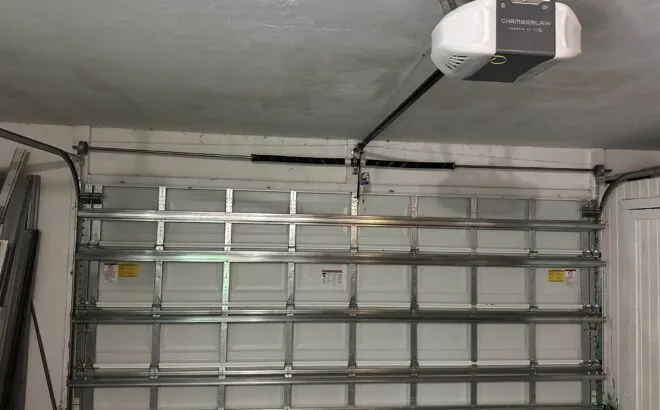
What wears out the springs in Malden’s backyard garages
Most requests for garage door spring repair Malden MA homeowners send us begin the same way: a loud crack from the garage at the end of the drive, then a door that will not budge. Across Maplewood and Edgeworth, those garages tend to stand on their own behind a two-family or a single-family, reached along a driveway two households share. The spring inside is out of sight, out in the cold, and easy to forget about until the day it gives way.
A spring does not fail at random. Every opening and closing winds and relaxes the coil once, and after enough of them the metal tires, a hairline fracture opens, and one day the coil parts. When one garage serves both floors of a two-family, the door gets worked by two sets of comings and goings, and its spring uses up its life that much faster.
If you suspect the spring, these three things can be judged by eye, with the door left alone:
- A space a few fingers wide between two turns of the coil on the bar over the opening.
- On doors with side-mounted springs, one hanging slack, pulled out of shape or lying in pieces on the slab.
- The opener lifting the door a hand’s width, then giving up and reversing.
Spring faults we replace
Torsion spring snapped in two
The coil over the header has split, so the drums no longer turn and the opener cannot raise the weight alone.
Extension spring broken or sagging
On lighter and older doors, a spring running alongside each overhead rail. A break there leaves one side heavier and the door skewed.
A weakened, not yet broken, spring
The door drops when let go at waist height, or crashes the last foot. The spring has lost the strength to hold it.
Rusted coils in a damp garage
Coils glued together with rust grind against each other on every cycle, wear faster and squeal as the door moves.
Pairs replaced together
A matched set on doors with two springs, so the lift stays even from side to side and the second spring is not left to fail on its own.
Torsion and extension springs, and how to tell them apart
From inside the garage, with the door down, tip your head back. A horizontal rod spanning the opening at header height, carrying one or two fat coils, means torsion springs. Those coils put a twist into the rod, the rod spins the cable drums at its ends, and the cables wound on them carry the door from its lowest corners.
If instead there is a long spring running alongside each horizontal track, stretching back towards the rear wall, the door has extension springs. Each one hauls on a pulley, and the pulley on a cable tied to the door’s lower corner. They are common on older doors and lighter doors, and plenty of them are still at work in Malden’s detached garages.
The two types fail differently. A torsion spring usually breaks with a single bang and a clean gap, and the door stays shut. An extension spring can snap outright, but it may also lose its pull gradually, so the door starts to sit unevenly long before anything breaks. A properly fitted extension spring has a thin containment cable running down its centre, so that a spring breaking under load stays threaded on that line rather than lashing out at whoever is nearby. If you see an extension spring with no cable through it, mention it when you ring.
Why springs in a detached, unheated garage have a harder life
A garage that stands away from the house shares nothing with the heated rooms. In a Malden winter its inside follows the temperature outside, and spring steel is less forgiving in deep cold. A spring that has done most of its working life often lets go when the first real freeze of the season arrives, when it is asked to wind up as the door closes overnight and then release its load at breakfast.
Damp is the other enemy. Outbuildings at the rear of these lots often sit low, with the driveway falling towards them, and moisture settles inside. Surface rust builds between the coils of a torsion spring and on the hooks and eyes of an extension spring. Corroded turns scrape on each other every time the door moves, and that friction eats into the steel. Where the rust is only on the surface, the coils are cleaned and oiled during the visit; where it has pitted the steel, the spring is renewed.
Neither problem is unusual. They simply mean that a spring in a cold, detached garage will rarely last as long as an identical spring in a dry, attached one, and it is worth knowing the signs before it fails.
One door, two households
Across Maplewood and Edgeworth, a two-family often shares one detached garage, or a single garage is reached past the neighbour’s house on a drive both properties use. That matters for springs in a simple way: spring life is measured in cycles, and a door opened by two households, or used every day for bikes, bins and tools as well as a car, racks up cycles quickly.
When a spring on that kind of door is replaced, it is worth talking about the spring chosen. Springs are made for different numbers of cycles, and a door in near-constant use may justify a longer-life spring. The right choice depends on the door’s weight and how often it moves, so it is settled in the garage, with the door in front of us, rather than guessed at on a call.
A shared garage also raises a practical point when a spring breaks. If the door is stuck shut, both households may be locked out of what is inside. Let us know whose car is in there and whether either household needs it soon, and we will plan the visit around that.
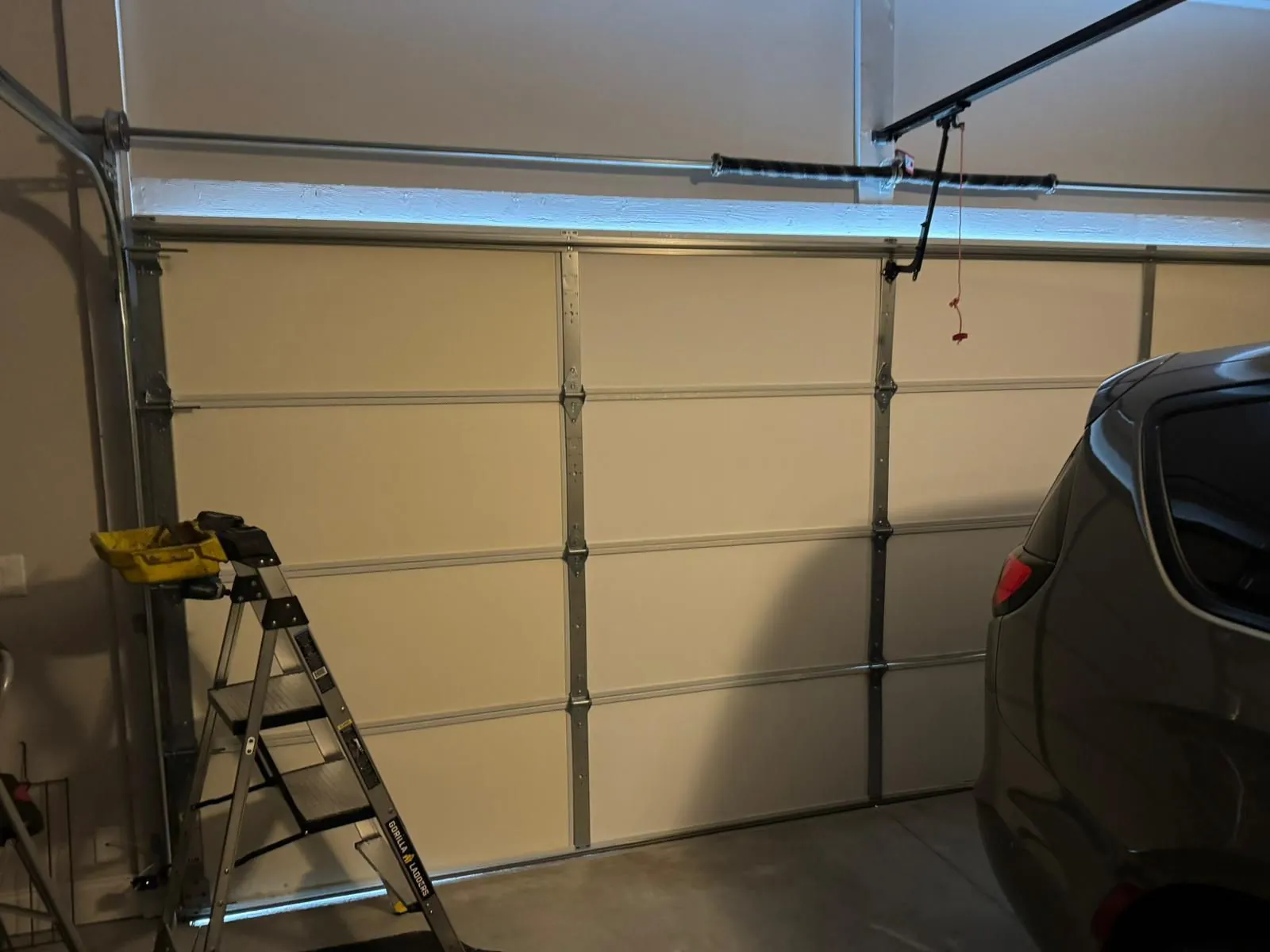
Leave the spring to someone with winding bars
A wound torsion spring holds dangerous tension. It is that stored energy, released a little at a time, which lets an opener lift a door far heavier than it could manage alone. To fit or remove one, the stored energy has to be wound in or let out with proper winding bars, one controlled quarter turn after another, with the person doing it standing clear of the line the bar would travel if it slipped. A screwdriver, a pair of pliers or the wrong size of bar can slip from the cone and spin with enough force to break a wrist or worse.
The cables and the bottom brackets are under the same load. A bracket loosened at the bottom corner of a door with a sound spring can fly off. This is why the advice on every spring call is the same: look from a distance, unplug the opener, keep the door as it is and leave the spring alone. A garage door spring repair Malden MA homes rely on starts with that, and the spring work itself is done by a technician with the right tools.
Extension springs are not much safer to tackle. Their tension is lower when the door is open, which is why some people try to change them with the door raised, but a door propped open with a broken spring can drop. Leave them to us as well.
What a spring repair visit involves
The visit begins with the door shut and the opener disconnected. The broken spring is identified, and the surviving spring, if there is one, is checked for wear. The door’s weight and the size of the opening are taken into account, because a replacement spring has to match the door it will lift, not just the spring that broke. If the door has been altered over the years, for example with added panels or a replaced bottom section, its weight may no longer match the original spring.
The old spring is unwound safely, removed and replaced. On a torsion door, the new spring is wound to the right number of turns, the set screws are tightened, and both cables are checked to see they sit evenly on their drums. On an extension door, the springs, pulleys and cables are replaced as needed and the safety cables are fitted or refitted.
Then the door has to prove itself. Still off the opener, it is lifted by hand to around waist height and let go; a door that hovers there, neither sinking nor climbing, is balanced. Only then does the opener go back on, with its limits and push strength reset for a door that is now much lighter to move, followed by a check that it backs off when it meets an obstruction. Before leaving, the technician shows you what was changed and points out any other part that looks close to the end of its life.
Early warnings from a tiring spring
A spring rarely fails without some warning, and in an outbuilding beyond a shared drive those warnings are easy to miss. Watch the door as it moves. If it starts to look lopsided on the way up, or one corner of the bottom edge reaches the floor before the other, the springs or the cables they feed may be out of step. If the opener now groans, crawls over the final stretch of travel, or turns back halfway without anything in the way, it may be compensating for a spring that has lost some of its strength.
The hand test tells you more. Only while the door is all the way down, free the trolley with the emergency release cord and lift the door by hand, gently, to about knee height. A balanced door feels light and steady. A door that resists like a sack of cement, or that falls quickly when you let go, has springs that are no longer doing their share. Should it fight you, ease it back to the floor at once instead of straining. Pull the release only with the door fully closed, never with it raised or stuck partway.
Sound is the third clue. A spring that squeals or creaks through every cycle may simply need lubricating, but a new grinding or clicking from the bar above the door can mean a coil has started to crack or rust has bound the turns together. Any of these signs is a reason to book garage door spring repair Malden MA visits can handle before the spring breaks, rather than waiting for the bang. A spring replaced on your timetable is far less disruptive than one that fails while your car is locked in.
Low ceilings and tight corners inside small garages
Many of the detached garages behind Malden’s houses are small, and some have little room above the opening before the roof framing begins. That space decides which kind of spring will fit. A standard torsion arrangement needs a certain clearance above the door; where that clearance is short, a low-headroom setup or extension springs may be the better answer. Either can be fitted, and the choice is made on site after the space has been measured.
Space at the sides matters too. Extension springs run alongside the overhead rails and need clear room to stretch, so shelving or stored items mounted close to the tracks can get in their way. Clearing those before the visit helps.
The approach to the garage plays a part as well. Narrow access between houses is normal here, and torsion bars, ladders and springs are carried down the driveway by hand. A drive kept clear of cars on the day saves time.
The surviving spring of a pair
Where a door has twin torsion springs, the unbroken one has counted exactly the same openings as its partner. It tends to fail soon after, and pairing a brand-new spring with a worn partner can leave the door pulling unevenly. Changing the pair in one visit keeps the two sides matched and spares you a repeat call a few weeks later. The same is true of a pair of extension springs.
On a door with a single torsion spring, a heavier door may be better served by converting to two springs, which shares the load. That is something that can be discussed during garage door spring repair Malden MA visits once the door’s weight is known.
Collateral damage after a spring lets go
Of all the urgent calls about doors, a snapped spring comes up most often, and it rarely arrives alone. An opener that has spent weeks dragging a door the spring could no longer carry may have stripped gears or an overworked motor; the Malden opener repair page covers that work. Cables that were under load when the spring snapped can fray or come off the drums. Rollers and hinges that have been forced by an unbalanced door may need replacing. Those faults are covered under garage door repair in Malden.
Sometimes the door itself is the problem. A timber door that has absorbed water for years, or a steel door rusted through at its lower sections, may weigh more than any reasonable spring can balance for long. In that case, you will be told so honestly. Our wider garage door spring repair page describes this work across Greater Boston.
A spring that breaks at night
Springs usually break under load, which means mid-cycle: as the door is being raised before work, or lowered after a late shift. The phone is answered at any hour, so a spring that snaps after dark can be reported straight away. If the car you need is shut in behind a door that has lost its spring, the emergency garage door page for Malden explains what to do and what to avoid until help arrives.
Getting the spring replaced
For garage door spring repair Malden MA homes can arrange, it helps to tell us whether the door has torsion or extension springs, if you can tell from the floor, whether the door is shut or stuck partway, whether the garage is shared, and whether the driveway will be clear. Our Malden page gathers every service in this town in one place. With those answers in mind, call us or book online.
Questions from Malden
We heard a bang from the garage and now the opener will not lift the door. What happened?
Almost certainly a broken spring. A torsion spring snaps with a sharp report, and without it the opener cannot lift the door’s weight. Unplug the opener, keep the door down, and from a few steps back check the rod over the opening for a split in the coil.
Can I replace the torsion spring myself with a kit?
We would strongly advise against it. The energy wound into that coil can fling a winding bar or a loosened fitting hard enough to hurt someone badly, so it is not a homeowner job. Leave the spring, the cables and the bottom fixings untouched and let a technician do it with proper tools.
Our garage is shared by both units of a two-family. Does that change anything?
It can. A door opened by two households wears its springs faster, and it may be worth choosing springs made for more cycles. If the door is stuck shut, tell us whose car is inside and whether either unit needs it soon.
The spring over our door is covered in rust. Is that a problem?
Rust adds friction between the coils and wears the spring faster, and it is common in damp, unheated garages. A lightly rusted spring can be lubricated; a badly corroded one is better replaced before it snaps.
Is there enough room above our door for a torsion spring?
Many small detached garages have limited space above the opening. A low-headroom arrangement or extension springs can work where a standard torsion setup will not. The space is measured on site and the right option explained.