
Why the attached garages of Belmont wear the way they do
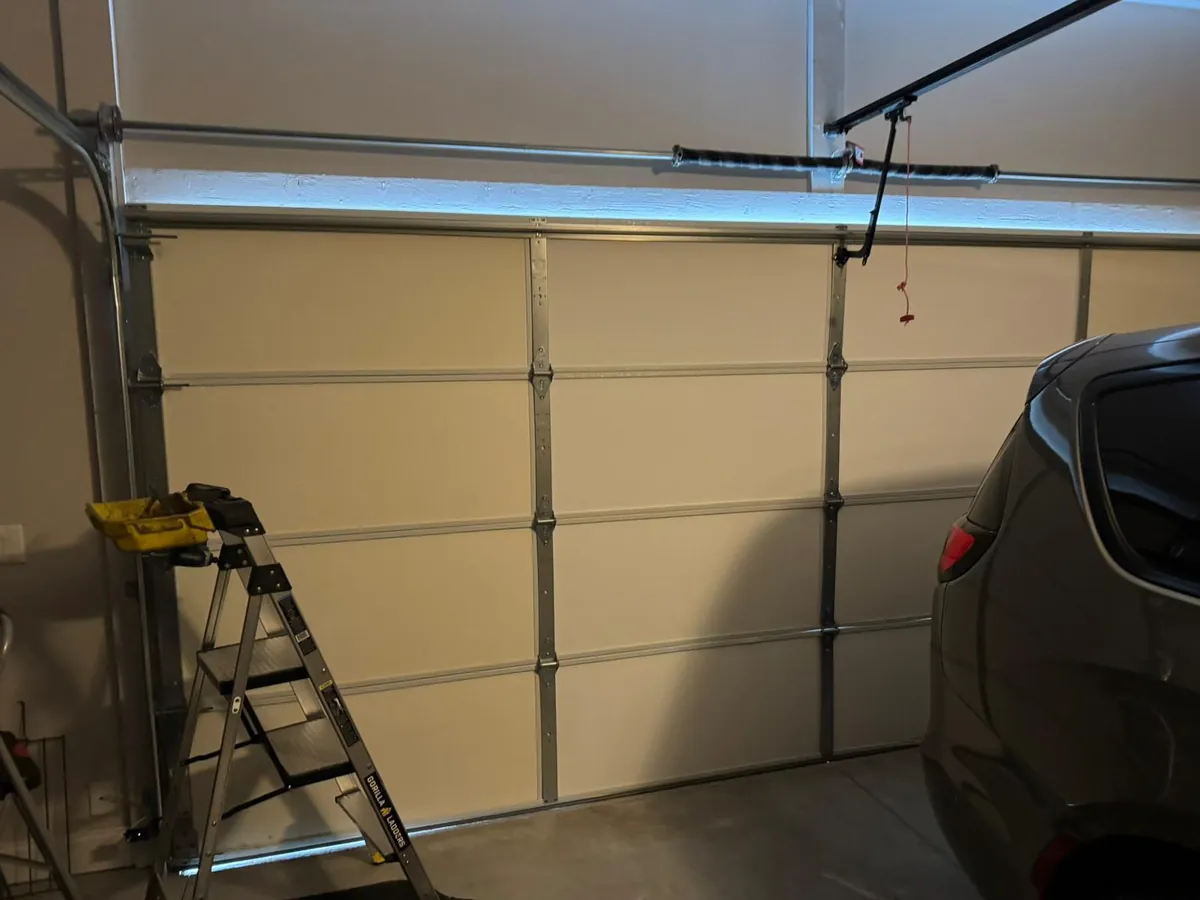
Garages in Belmont are mostly part of the house. On Belmont Hill and down in Waverley the usual arrangement is a single-family home with the garage built into or onto it and a wide driveway out front, which makes the overhead door one of the biggest openings in the whole outer wall. When we take on garage door repair Belmont MA homeowners call about, that is the door in question: a broad sectional curtain, a spring bar over the opening, an opener hung from the ceiling, and a wall the garage shares with the rooms next door.
The ground matters as much as the building. Lots on the hill sit on steeper grades than the flat streets below, and that slope changes how a door ages. Put plainly, hill lots load springs harder. A door closing onto a sloping slab, sealing against a driveway that falls away, or catching wind on an exposed rise asks more of its hardware than the same door on level ground.
Three things you can judge from the driveway, without touching a thing:
- Is there a visible break somewhere along the coil of the spring bar above the opening?
- Are both lift cables snug at the lower corners, or is one hanging in a loop?
- Does the bottom rail rest evenly on the slab, or is one end higher than the other?
Parts a Belmont repair visit can take on
Torsion and extension springs
These carry the weight, and the opener only steers. With a snapped coil the door turns into a slab of steel nobody should lift. Spring work in this town has its own page: spring repair in Belmont.
Lift cables and drums
Two steel cables wind onto grooved drums at the ends of the spring shaft and hook to the bottom fixtures. If one strand bundle parts, that side sags and the curtain racks sideways.
Panels and sections
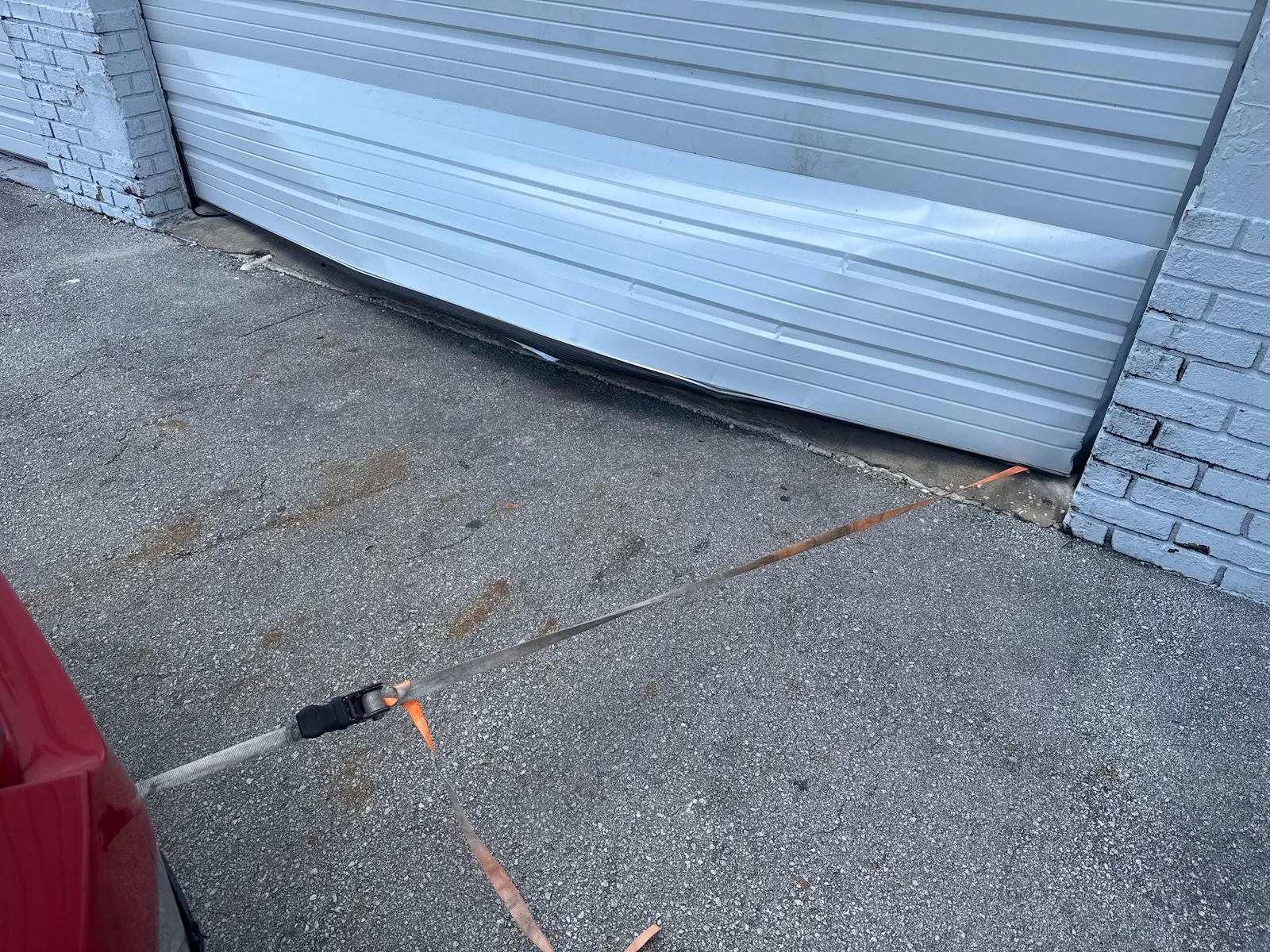
A wide door has long sections, and a long section flexes. Dents from a car or a bin, split hinges and a crushed bottom seal are all repairable on a sound door.
Openers, remotes and wall buttons
A ceiling unit that buzzes but never move the door, handheld transmitters with dead buttons, a wall control that seems to be ignored. See opener repair in Belmont.
Tracks and rollers
Rollers that grind or have cracked, tracks knocked out of line, loose brackets, and doors that have left the track altogether.
Safety sensors
Two small eyes mounted a few inches up each jamb, aimed at one another; break their beam and a closing door is supposed to reverse. Grime or a nudge out of aim keeps a door from shutting.
How the parts of a sectional door divide the load
Think of a residential sectional door as a stack of hinged panels hanging from springs, with rollers keeping it in two channels. On most attached garages around town the spring sits on a shaft right above the header, and it is wound tighter each time the door comes down. Going up, the coil relaxes, the shaft turns, and the drums at its ends reel in the cables tied to the lowest panel, so both sides rise together. A minority of doors, usually the lighter or older ones, hang from extension springs instead: a pair of long coils stretched out beside the ceiling rails, each paying its pull through a sheave to the cable.
The opener does far less than most people assume. Its motor nudges along a curtain that the springs have counterweighted to almost nothing, and its logic board listens to the sensors and reverses travel when the beam is broken. A healthy motor still cannot haul a door whose spring has gone, and plenty of motors burn out after a season of dragging a door with a spring that was quietly losing strength.
Everything is linked. A weak coil makes the motor labour. A roller with a seized bearing scrapes the rail rather than rolling along it. A cable losing strands lets one side lag, and a door running at a slant jams. Proper garage door repair in Belmont, as anywhere, means tracing the trouble back to whichever part failed first, rather than only replacing the last thing to break.
Hill lots and flat streets: what the ground does to a door
The difference between Belmont Hill and the flatter streets of Waverley shows up in the repairs. On a level lot the garage slab is usually flat and square to the opening, the door closes onto an even floor, and the springs carry a load that stays the same from year to year.
On a hillside lot the picture changes. A slab poured to follow the grade, or a driveway that drops away from the opening, leaves the bottom of the door meeting the floor at a slight angle. The rubber astragal squashes flat at one end and lifts clear at the other. To close that gap, an opener’s down travel is often set further than it should be, so the door drives into the floor on every cycle, which strains the hinges in the lowest section and the opener’s gears. Water from the driveway runs toward the threshold after rain and snowmelt, rusting the corner fixtures and the foot of each vertical rail, exactly where the cables are tied off.
Exposure plays a part as well. A wide door facing down a slope catches wind that a sheltered door on a lower street never feels, and the push and pull on a broad door works at the track brackets and the hinges between sections. Over time that is how the springs end up carrying more than their share, which is why hill lots wear springs faster than the flat streets below.
Attached garages and the house beside them
With the garage built into the home, a door problem is rarely only a garage problem. A curtain stuck a foot off the slab leaves the house open to the street until someone deals with it. A torn astragal lets cold air, leaves and rainwater reach the floor right by the step up into the kitchen or mudroom. A rattling roller or a loud opener carries through the shared wall into whatever room sits next to the garage or above it.
The control for the opener usually sits by the house entry door, and thin low-voltage wire runs from it, and from both sensor eyes, along the garage walls to the motor. On an attached garage those wires get knocked by bikes, tools and storage shelving more often than people expect. A sensor lead crushed behind a shelving unit will make a door bounce back up every time it gets near the slab.
Safe things to try, and the hardware that bites
These are harmless to try, and now and then they solve the problem outright:
- Door jammed partway? Unplug the motor at its ceiling socket, so the door is not driven again.
- Clean the lens on each sensor eye with a dry cloth, then see whether their indicator lights glow without blinking.
- Put a new battery in the handheld transmitter, then test the wall control on its own. A wall control that works points to the transmitter.
- Walk the length of both tracks and look for anything leaning against them, such as a ladder, a bike or a recycling bin.
Then there is the hardware that bites. The spring bar stores dangerous tension, open or shut, and the same load runs down each cable into the corner fixtures at the floor. A drum set screw backed off, a corner fixture levered loose or a winding bar slipping out of its cone can unleash all of it before a hand can move. This is not a DIY repair for a homeowner, whatever an online video suggests. And a curtain whose spring has snapped weighs a great deal more than it looks; with nothing counterbalancing it, nobody should try to raise it by hand, and the opener should stay unplugged.
What a repair visit involves
The technician starts with the whole door, whatever the phone call was about. Pulling the opener’s release lets the curtain be raised and lowered by hand, and the first test is balance: stop it at waist height and let go. If it holds there, the springs are right; if it sinks, they are weak; if it climbs, they are wound too far. After that, the coils and cables get a close look, each roller and hinge is checked for play, and both tracks are sighted for kinks, loose lag bolts or a roller riding loose in its channel.
Where the opener or sensors are suspect, each is tried separately. Nothing is changed until you have been told what broke and what caused it. When the faulty parts are sorted, the curtain is rebalanced, the motor’s open and close limits and its force setting are reset to suit the repaired curtain, and the auto-reverse is proven with an object on the slab under the closing door. On a sloping slab, setting the down limit carefully is part of the job, so the door seals without pounding the floor.
When a door leaves its tracks
A door out of its rails sits skewed in the opening, usually with a roller or two hanging loose of the channel. In an attached garage that tends to follow a bumper catching the lowest panel, one cable parting, or a motor still shoving against a curtain that had stuck. A skewed curtain can drop without warning, so nobody should press the button again or try to shove it back into line by hand. The fix involves relieving the spring load first, coaxing the rollers back into the channels, straightening or swapping any kinked rail, and making sure both cables wind identically before the door is trusted again. More on this lives on the off-track garage door repair page.
Cables and drums on a broad door
Wide doors put long spans between their two lift points, and a cable that frays on one side shows itself quickly: the door rises with a lean, or one end touches down before the other. Loose strands sticking out near the floor fixture mean the door should be left alone from then on. Cables always go in as a matched set, so the two sides pay out at the same rate, and the drum grooves get checked for wear at the same visit. Rust at the corner fixtures, common where driveway water reaches the threshold, gets a careful look, because that small piece of steel is all that ties the cable to the door. The cable repair page explains the work in full.
Panels, hinges and the rubber along the floor
Most panel damage is a knock rather than a failure: a bumper that misjudged the turn into the garage, a bin blown against the door, a gust catching a door that was left half up. One crumpled panel is often replaceable by itself, provided the maker still offers that ribbing in that colour. Hinges between sections crack under the flexing of a wide door, and the sign is a curtain that bows outward in the middle or catches at one spot on its way up. The rubber along the floor takes the most wear of all, and on a sloping floor it wears unevenly. Once it has split or gone flat, draughts and rain come straight in at whichever corner sits nearest the house.
Mend the old door, or order a new one?
Usually the door itself is sound, and repair wins. Fresh coils, cables or rollers, or one panel swapped, give it a long second life. Replacement earns its place once failures stack up together, once the bottom panels are rusted or rotted clean through, once more than a single panel is past rescue, or once a wooden door is so waterlogged that no spring that fits the shaft can balance it. You get a straight answer about where yours stands. When starting again is the right call, our new garage doors page walks through supplying and hanging the replacement.
Winter on a Belmont driveway
Cold weather is when most spring breaks happen. Steel grows more brittle as the temperature drops, so a coil that has been fatiguing quietly for years tends to choose a frosty dawn to let go. Ice can bond the rubber strip to the concrete, and a motor straining against a curtain frozen down can shred its drive gear or kink the top panel. On a sloping driveway, meltwater runs to the door and refreezes along the threshold overnight. When a door refuses to rise on a freezing morning, take your finger off the button and look for ice along the floor before blaming the motor.
Before you call
It helps to know a few things before the phone rings: how the door behaves when the button is pressed, whether anyone heard a sharp bang from the garage, whether any spring or cable looks visibly broken, and whether a vehicle is stuck behind the door. That description makes the first conversation useful and means the technician arrives expecting the right fault. For garage door repair in Belmont, MA and beyond, the main garage door repair page is the hub, and all the work in this town, from springs to openers, is gathered on the Belmont page.
Booking garage door repair in Belmont, MA
Someone picks up whatever the hour, weekends included, so a door that quits at midnight or before the morning commute need not wait for office hours to be reported. Explain how the door is behaving and which parts look damaged, and garage door repair in Belmont is arranged from there. If it is the small hours and the door is stuck open, the emergency repair in Belmont page sets out what is sensible to do in the meantime. For anything else, call us or book online.
Questions from Belmont
Why does my door lift a few inches and then quit?
Almost always, a snapped spring. The motor gets the door moving, senses it is carrying the whole weight unaided, and its overload cutoff halts it. Leave the button alone, unplug the motor, then check the spring bar overhead for a split in the coil.
Our driveway slopes and daylight shows beneath one end of the closed door. Is that fixable?
Often it can. The rubber strip can be replaced, and the door’s level and the opener’s down limit can be adjusted so the door closes evenly without slamming into the high side of the slab. Where the slab itself slopes a long way, you will be told what can and cannot be corrected at the door.
The door gets almost to the floor, then goes back up. Why?
Most often the sensor eyes are the culprit. Clear anything sitting in their line, wipe both lenses and check their indicator lights. On an attached garage, an eye knocked sideways by a bicycle or a lead pinched behind shelving is a familiar cause. A curtain dragging in a tight spot of track can fool the motor into reversing as well.
Is it possible to raise the door manually when the opener has died?
Only when the springs and cables are whole. Tug the red release handle hanging from the opener rail, then raise the door slowly with both hands. If it is a struggle to lift, or it drifts back toward the slab once released, treat the spring as broken and leave the door closed.
Do you also repair the opener and remotes?
Yes. Motors, handheld transmitters, wall controls and sensor eyes all fall within a repair visit, and a worn-out opener can be swapped for a new one when fixing it no longer makes sense. LiftMaster openers are included in that work, both repaired and replaced.