
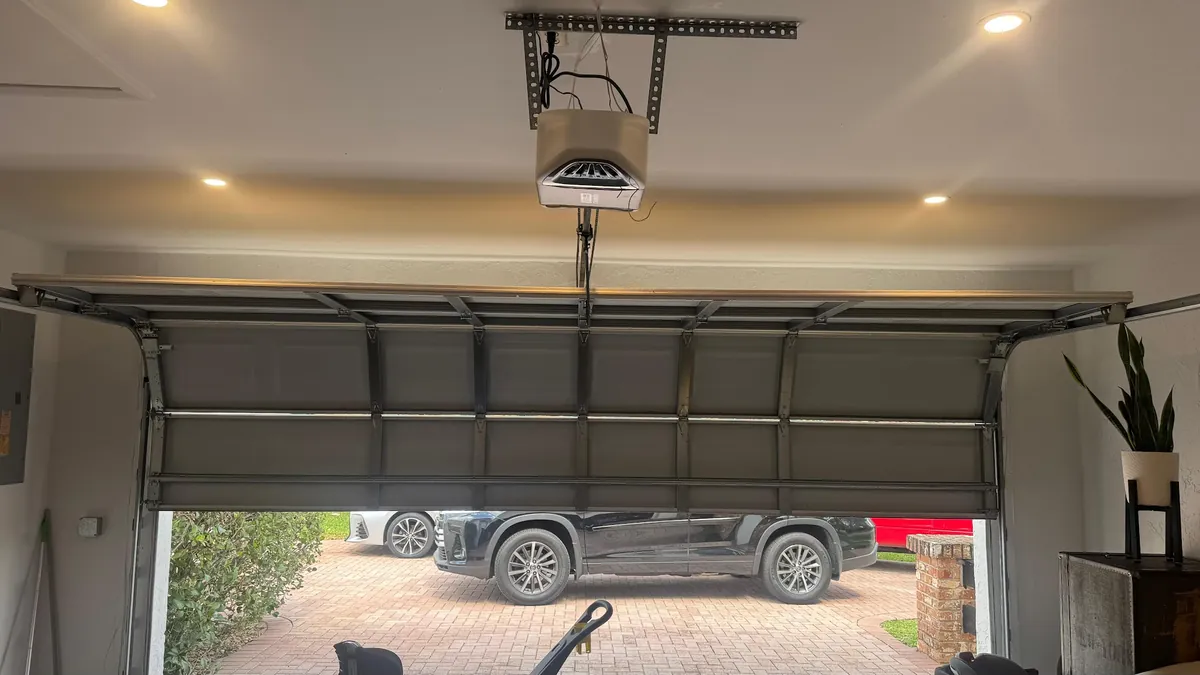
Openers on attached garages, from Belmont Hill to Waverley
On a house with an attached garage, the opener is the front door that most of the household actually uses. Across Belmont Hill and Waverley, where single-family homes sit behind wide driveways with the garage built onto the house, the motor on the garage ceiling is pressed several times a day and expected to work in every season. Our garage door opener repair Belmont MA visits deal with that equipment: the motor unit and its rail, the handheld remotes, the control by the door into the house, and the two photo eyes guarding the threshold.
An opener is also only as healthy as the door it moves. Springs on Belmont’s steep hillside lots work under more strain than those on the level ground of Waverley, and an opener paired with a heavy, wide, poorly balanced door is the one that wears out first. A good opener visit checks the door as well as the motor.
Before calling, try these three things from the garage floor:
- Is the motor’s light coming on when the wall control is pressed? No light at all points to power.
- Does the wall control work while the handheld remote does not? Then the remote, not the motor, is the likely culprit.
- Are the little indicator lamps on both sensor eyes steady, or is one blinking or dark?
What an opener visit in Belmont can cover
Motor units that hum or go silent
A motor that buzzes without moving, clicks and does nothing, or has no response at all. Stripped drive gears, failed capacitors, burnt logic boards and tripped power are the usual suspects.
Remotes and wall controls
Transmitters that have lost their pairing or their range, and wall controls whose wiring has been pinched along the garage wall. Remotes are reprogrammed or replaced, and wall controls rewired.
Safety sensors
Sensor eyes knocked out of aim, lenses fogged with grime, or wires cut by a careless shelf bracket. Without both eyes working, the door will refuse to close on the button.
New openers installed
If a worn-out motor no longer justifies the parts, a new opener is supplied and installed, matched to the size and weight of the door. Among the units handled, LiftMaster openers are both mended and swapped out.
How an opener actually moves a garage door
Knowing where the motor’s job ends saves a lot of confusion. Springs do the lifting on a sectional door, and the motor merely steers a curtain they have made nearly weightless. A motor in the unit turns a drive, which may be a roller chain, a reinforced rubber belt or a long threaded rod in the rail, and that drive slides a trolley along the rail. A bent steel arm connects that carriage to a plate fixed high on the uppermost section. As the trolley moves, the door goes with it.
Under the motor’s cover sit two travel limits, marking the points where the door should halt when fully raised and when shut, and a force setting, which tells it how hard to push before it decides something is wrong. A circuit board listens for signals from every transmitter, from the button on the wall and from the beam between the eyes. If the eyes see their beam broken while the door is closing, the board stops the door and sends it back up.
Some attached garages have a wall-mounted unit beside the door instead of a ceiling rail, which turns the spring shaft directly. The parts differ, but the jobs are the same: move a balanced door, stop at the right places, and reverse when something is in the way.
Attached garages: noise, security and the house entry
With the garage under the same roof as bedrooms and kitchens, a motor’s manners matter indoors. A chain drive that slaps and rattles carries through framing into the room beside or above the garage. A motor that starts with a heavy clunk can be heard through a shared wall late at night. Worn rollers and a dry door add to the racket, and the opener often gets the blame. Quieter operation can come from tightening a slack chain, replacing worn rollers on the door, or, where the motor is tired, fitting a quieter drive.
Security is the other side. The opener and the door together are what keep the house closed when the garage is the main way in. A curtain that bounces back and stays up, a lost transmitter, or a wall control that sometimes fires on its own are all problems that leave the house exposed. A missing transmitter can be wiped from the board’s stored codes, so that only the handsets still in the house will open the door.
Sloping slabs and the down limit
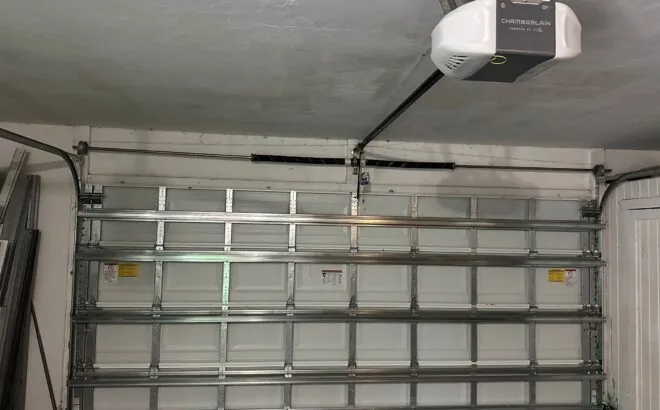
The hill lots raise a problem that openers in particular feel. Where a garage slab follows the lot’s grade, the door’s bottom rail meets the floor high at one end and low at the other. The common workaround is to push the opener’s down limit further, so the door is driven into the concrete until the low end seals. That makes every close a small collision: the opener strains, the top panel flexes at the opener arm, and the force setting gets turned up to stop the door reversing. Turn the force up far enough and the safety reverse stops doing its job.
A better result comes from treating the door and the opener together. The bottom seal is renewed to fill the gap where it can, the door is levelled in its tracks, and only then are the limits and force set, as gently as the door allows. The sensor eyes are checked to make sure they still face each other squarely, because on an uneven floor one bracket is easily bent off line by a mower or a bin.
Garage door opener repair in Belmont when the door is heavy
Wide driveways lead to broad doors, and broad doors weigh more. The motor on a heavy door is working nearer its limit, so anything that makes the door harder to lift shows up as opener trouble first. A weakening spring is the classic case: the door feels fine for months because the opener is quietly carrying the extra weight, until the gears strip or the force limit trips halfway up. When garage door opener repair in Belmont turns up a tired spring, the spring is dealt with first, because a new motor on an unbalanced door will only wear out in its turn. The spring repair in Belmont page covers that work.
Things you can safely check yourself
Openers are one area of the garage where a homeowner can rule out a few causes without any risk:
- Confirm the motor’s cord is seated in its socket and that the socket is live; a tripped breaker or ground-fault outlet in the garage is a common cause of a dead opener.
- Fit a new cell in the handset, then try it from just inside the garage.
- Give each eye’s lens a gentle wipe, then look along the line between them for anything blocking it: a recycling bin, a boot, a bag of salt.
- Check the lock button on the wall control, which on many models stops the remotes from working while still letting the wall control operate.
- If the door has been disconnected from the trolley, the red cord has been pulled; the door can be reconnected by running the opener until the trolley catches the arm again.
Stay away from the spring bar, the cables and the corner fixtures at the floor. A torsion spring holds dangerous tension, and anything involving it is not a DIY repair. Where the motor checks out but the door will not lift by hand, the problem is the spring, not the motor.
What an opener repair visit involves
Each visit starts by separating the door from the opener. Once the carriage is unhooked, the technician raises the curtain manually, feeling for its balance point and for any tight spots in the rails. Any heaviness or stiffness gets written down first, because no opener setting will make up for it.
Only after that does the motor get its own examination. Supply voltage is confirmed at the outlet and at the unit, the motor is run, and the drive is examined: chain or belt tension, the trolley, the sprocket and the drive gear. The logic board’s responses to the wall control, the remotes and the sensor eyes are each tried. The sensor wiring is followed along the wall to find any pinch or break.
You are told what has failed before work starts, whether that is a stripped gear, a burnt board, a broken sensor or a remote that has simply lost its pairing. With the faulty part dealt with, travel and force get dialled in to suit this particular curtain, the remotes are programmed, and a scrap of timber goes under the descending curtain to prove the reversing function trips.
Remotes, wall controls and sensor eyes
A surprising share of so-called opener faults sit in the small peripherals, not the motor. Handsets forget their codes when the power blinks or a cell is changed, and they crack when dropped on the slab. Wall controls fail at the button or along the wire, which on an attached garage often runs behind storage shelving and gets crushed or stapled through. Sensor eyes are mounted low, where they get kicked, splashed with slush from the car, or turned by a bike handlebar.
Each of these is a small job, but they matter because a door that will not close reliably cannot be left. On a wide double door the two eyes sit far apart across the opening, so a bracket only slightly twisted at one jamb is enough to lose the beam. Rewiring a crushed sensor lead, remounting a bent bracket at the correct height and re-aiming the pair until both lamps glow steadily is routine work, and it is often the whole of the repair. Sensor eyes facing a driveway can also be dazzled by low sun at certain times of day, which makes a door refuse to close only in the morning or evening; slight repositioning sometimes cures it.
Fixing an old motor versus fitting a new one
Plenty of faults can be put right with a single part: a drive gear, a capacitor, a sensor, a limit switch, a wall control. Repair makes sense when the motor is sound and parts are available. A new unit becomes the stronger option once an ageing motor is failing in several places at once, when parts for that model are no longer obtainable, when a chain drive is too noisy for a room above the garage, or when the opener is simply too small for the weight of a wide door. In that case a new opener is supplied and installed, matched to the door, with the remotes and wall control set up and the safety reverse tested. LiftMaster openers are one of the makes worked on, both repaired and replaced; the LiftMaster opener repair page has more.
Choosing a replacement opener for a wide door
When an opener is replaced on one of the broad doors common behind Belmont’s wide driveways, the new unit is matched to the door rather than picked off a shelf. A heavier door needs a motor with enough reserve that it is not running at its limit every cycle. The drive type is chosen with the house in mind: a belt drive runs more quietly where a bedroom or family room shares the garage wall, while a chain drive is a sturdy choice where noise matters less. The rail length must suit the door’s height, and on a garage with little room above the header a wall-mounted unit beside the door may fit where a ceiling rail would not.
Installation includes mounting the motor securely to the ceiling framing, fitting the door bracket to a reinforced point on the top section, wiring the wall control by the house entry, positioning the photo eyes squarely, and pairing the handsets. The limits and force are then set to the door, and the auto-reverse is tested before anyone is shown how it works. If the door itself needed attention first, that work is done before the new opener goes up, so garage door opener repair in Belmont does not end with a new motor straining against an old fault.
Openers in a Belmont winter
Frost reaches openers in several ways. Lubricant along the drive thickens, so the motor pulls more current to get moving. Rubber at the foot of the door can weld itself to the concrete overnight, and a motor heaving against that bond may chew its gear teeth or crease the uppermost panel at the arm bracket. Where the driveway pitches toward the garage, slush drains to the opening and sets hard by morning. If the door will not rise on a freezing morning, stop and look at the bottom seal before pressing the button again; a frozen seal is easier to deal with than a stripped gear.
Faults that only look like opener trouble
Plenty of motors get blamed for someone else’s failure. A fractured spring, a cable unwound from its drum, a roller wedged in a dented rail, or a curtain that has left its channels will all make an opener stall, reverse or hum. Those are covered on the garage door repair in Belmont page, and the broader opener services page explains the work across Greater Boston. Everything available in this town is gathered on the Belmont page.
Arranging an opener repair
The line is answered whatever the hour, every day, so an opener that dies late in the evening with the car inside can be reported then. If the door is stuck open overnight and you cannot close it, the emergency repair in Belmont page explains the safe options. For garage door opener repair in Belmont, MA, a new remote, or a sensor that will not behave, call us or book online.
Questions from Belmont
The motor drones away but the curtain sits still. What gives?
Usually one of a pair of faults: teeth gone from the drive gear inside, or a curtain far too heavy for the motor because its spring has failed. Unplug the unit; if the coil overhead looks whole, pull the release cord and raise the door manually. Light and easy means the motor needs attention; heavy as lead means the spring does.
Why does the door close from the wall control but not from the remote?
The remote is the likely cause: a flat battery, a lost pairing, or the lock function switched on at the wall control. Replace the battery first, then check the lock. If it still will not respond, the remote can be reprogrammed or replaced.
The door reverses as soon as it touches our sloping floor. Is the opener faulty?
Not necessarily. On a pitched slab the door meets the high side early, and the opener reads that as an obstruction. The answer is usually adjustment of the door and the seal along with the opener’s limits and force, rather than turning the force up.
Can a new opener be installed on our existing door?
Usually, yes, provided the door is in good shape and properly balanced. The door is checked first; if a spring or rollers need attention, that is dealt with so the new opener starts on a door that moves freely.
Can you look at our LiftMaster?
Certainly. Those motors are mended or swapped like any other opener we see, and their handsets, wall buttons and photo eyes are covered too.