
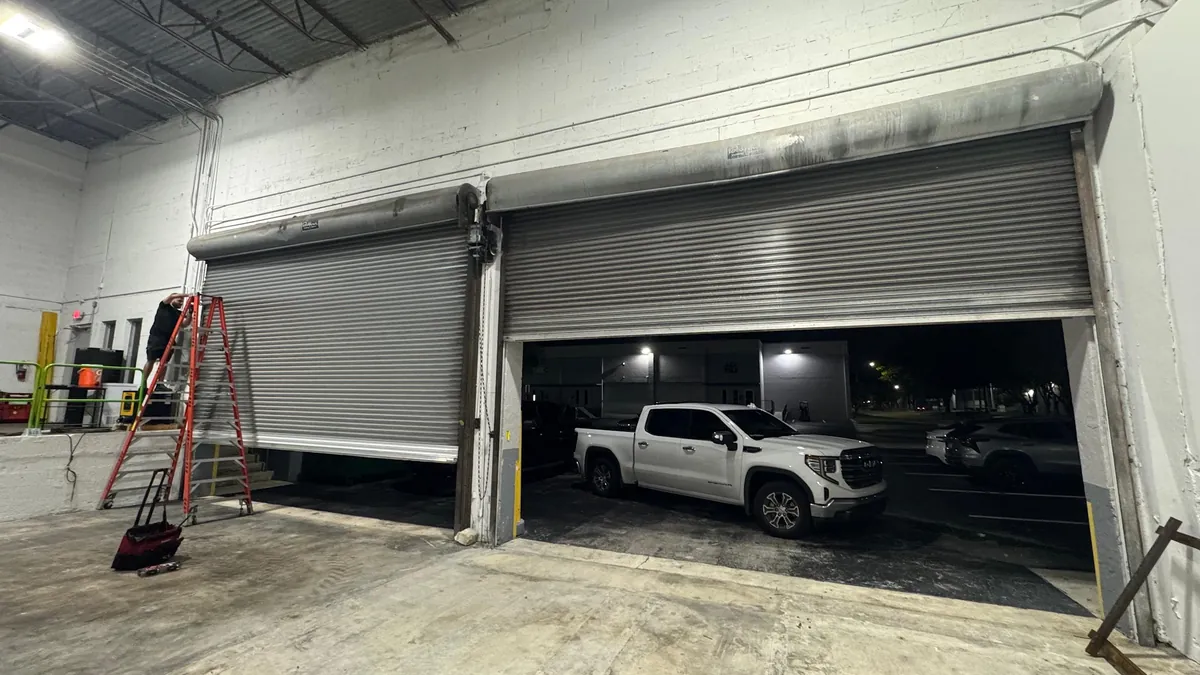
When an attached garage in Belmont will not shut
In much of Belmont the garage is built into the house itself. That is true of the single-family homes on Belmont Hill and of those on the flatter streets down in Waverley, where wide driveways run up to garages attached to the living space. So when the overhead door jams open at night, the house is effectively open with it. Our emergency garage door repair Belmont MA line exists for exactly that moment, with someone picking up through the night and across the weekend, whether the trouble is a curtain refusing to come down, a spring that has just snapped, or a curtain hanging crooked out of its rails.
Nothing on this page is a promise about arrival times. What it offers is a line that someone answers in the small hours, honest advice about what is safe while you wait, and a repair that starts with making the door safe.
Before you call, take a quick look from a distance and note:
- the curtain’s position (fully raised, fully lowered, or caught partway) and whether its bottom rail is level;
- whether a car is shut inside, or a car is outside that cannot get in;
- whether you heard a bang, or saw a cable or spring that looks broken.
Breakdowns that count as urgent
A door that will not close
The house is exposed through the garage until it is shut. Typical culprits: a photo eye out of aim, a fractured coil, or a curtain that has jumped a rail.
A door that will not open
A car is trapped inside before work or a hospital trip. Usually a snapped spring, sometimes an opener that has died or a cable off its drum.
A spring that has just let go
The loud crack from the garage overnight. With the counterbalance gone, the door should not be moved by anyone.
A door off its tracks
One or more wheels have escaped the rails, leaving the curtain hanging skewed. It can drop, and it should not be run or forced back.
What makes a garage door problem an emergency
Quite a few faults are happy to wait for daylight. A remote with a flat battery, a door that is noisy, or a ding in one section will keep for a daytime booking. The calls that should not wait share a pattern: the door cannot be secured, a vehicle is needed and cannot get out, or the door is in a state where it might fall.
On an attached garage, the first of those matters most. An open garage door on an attached garage is an open way into the house, past the cars, the tools and the bikes, to the door into the kitchen or mudroom. After dark, a curtain jammed in the raised position stops being a hardware nuisance and becomes a question of who can walk in. A door that is stuck shut with the car inside is a different kind of problem, but just as real if someone has to be somewhere early.
The third pattern, a door that might fall, is the dangerous one. A door with a broken spring, a broken cable or rollers out of the track is no longer held up by its hardware, and anyone standing under it or trying to lift it is at risk.
In the meantime: helpful moves and hazards
These are worth doing straight away:
- With the overhead door jammed up, turn the key in the interior door between the garage and the house. That keeps the house secure even while the garage is not.
- Unplug the opener, so no one presses the button by habit and drives the door further out of line.
- Keep children, pets and cars out of the space directly beneath the door.
- Turn on the garage and driveway lights, so the door and any loose parts are visible.
- If the door is shut and the car is outside, park it somewhere it will not block the driveway for a repair.
And some things should be left alone:
- Leave every spring exactly as it is. The coil over the header holds dangerous tension; winding or slackening it is not a DIY repair, at midnight or at noon, and stays a job for a technician with proper winding bars.
- With the curtain raised and its spring snapped, the red cord stays untouched; at that point the motor’s grip on the trolley could be all that keeps the door aloft.
- Resist heaving up a curtain whose spring has gone, or shouldering a derailed one back toward its channels.
- Do not loosen the bottom brackets where the cables attach; they carry the spring’s force too.
Emergency garage door repair in Belmont on hillside lots
Belmont Hill and the streets below it behave differently: the steeper hill lots put more load on their springs. That has a direct bearing on the urgent calls. A spring that has been carrying extra load on a sloping lot is the one most likely to break suddenly, and a broad door on a hillside garage is heavy when it does.
The slope also changes what an off-track door does. Where the slab follows the grade, a door that has come out of one track tends to lean toward the low side, and a heavy, wide door hanging at an angle is more likely to keep moving if it is disturbed. Exposure plays a part too. A garage facing down the hill catches wind at night that a sheltered garage on a level street does not, and a door that is partly open or loose in its tracks can be pushed further out of line by gusts. On those lots especially, emergency garage door repair in Belmont starts with stabilising the door before anything is fixed.
Garages with rooms above or beside them
Attached garages bring a particular set of night-time worries. A spring that breaks in a garage beneath a bedroom wakes the household with a sound like a gunshot through the floor. A curtain that has left its rails can swing into the side wall or a storage shelf as it goes, and things stored on high racks can be knocked loose. Before anyone goes into the garage after a loud bang, turn the lights on from the house side and look in from the doorway first. Check for anything hanging, anything fallen, and whether the door itself has moved. If a car is parked close to a damaged door, leave it there rather than trying to back it out under a curtain that might shift. The garage can wait to be tidied; nobody should be reaching past a damaged door in the dark to move boxes or bikes.
The flat streets of Waverley
Down on the level streets the urgent calls are just as likely, but they tend to be simpler to make safe. A door that closes onto a level slab sits evenly when it is down, and when a spring breaks the door usually stays where it is. The more common late-night problems there are a door that will not close because a sensor has been knocked out of line, an opener that has died with the car inside, or a lift cable that has unspooled at one corner. Each of these is still worth calling about at night when the garage cannot be secured.
How the phone call goes
A person answers. Expect questions about how the curtain is behaving, any noise or visible damage, whether a person, pet or vehicle is shut in, and whether this garage shares walls with the house. That conversation also covers what is safe to do in the meantime, using the same guidance as above, and arranges the visit. You will not be quoted an arrival estimate here, nor a guess over the phone before the situation is understood.
Describing the door clearly helps the visit go well. A broken torsion spring, a cable hanging loose, a door tilted in its rails, a sensor light blinking: each of those points toward different parts and a different first step.
What an emergency visit involves
The first priority on arrival is making the door safe. If the door is open and unstable, it is clamped in its tracks so it cannot move. If a spring is broken, the remaining tension is dealt with under control. A derailed curtain has its load supported before a single bolt is loosened. The opener stays disconnected while this is done.
Then the cause is found. Every piece of the system, from coil and cables to the rails and the motor on the ceiling, gets inspected, and the diagnosis is explained to you in plain words before any repair begins. If the van carries what the job needs, the fix goes in there and then, the curtain is rebalanced, the motor recalibrated and its reversing function proven. If something has to be ordered, the priority becomes getting the curtain down and locked so the house is sealed for the night, and the remaining work is booked for later.
Keeping the house secure when the garage cannot be closed
On an attached garage the connecting door into the house becomes the real front line once the overhead door is stuck open. Check that it locks, and if it has a bolt, use it. Bring keys, bags and anything valuable in from the cars. Leave an outside light on over the driveway. If the opener is still powered but the door will not close, unplug it, because a door that keeps reversing at night can wear its motor and drift further out of line with each attempt.
When the door cannot be closed because a sensor is misbehaving, there is sometimes a way to close it by holding the wall control down continuously, which overrides the sensors on many openers. Watch the door the whole way and let go if anything is underneath. Skip this trick entirely on a derailed curtain or one with a snapped coil; those stay exactly as found.
Doors that creep down or will not stay up
When a raised curtain sinks back by itself, or only stays up while someone holds it, its counterbalance has failed, most often through a tired coil or a cable that has slipped on its drum. On a heavy door that is a real hazard: it can close on a car bonnet or on a person walking under it. Prop nothing under it, keep everyone out from underneath, and, provided the motor still runs it smoothly, bring it fully down. Then call, because emergency garage door repair in Belmont of this kind is about stopping a falling door before it hurts someone.
A broken spring after dark
Of all the late-night calls, snapped springs top the list, and it often happens in cold weather, when steel is at its least forgiving. The sound is loud and sudden. If the door was closed, it will now refuse to open, and the opener may strain for a few inches before stopping. If the door was open, it may be held only by the opener. In either case, leave it where it is and call. Spring replacement is described in detail on the spring repair in Belmont page.
Doors off their tracks
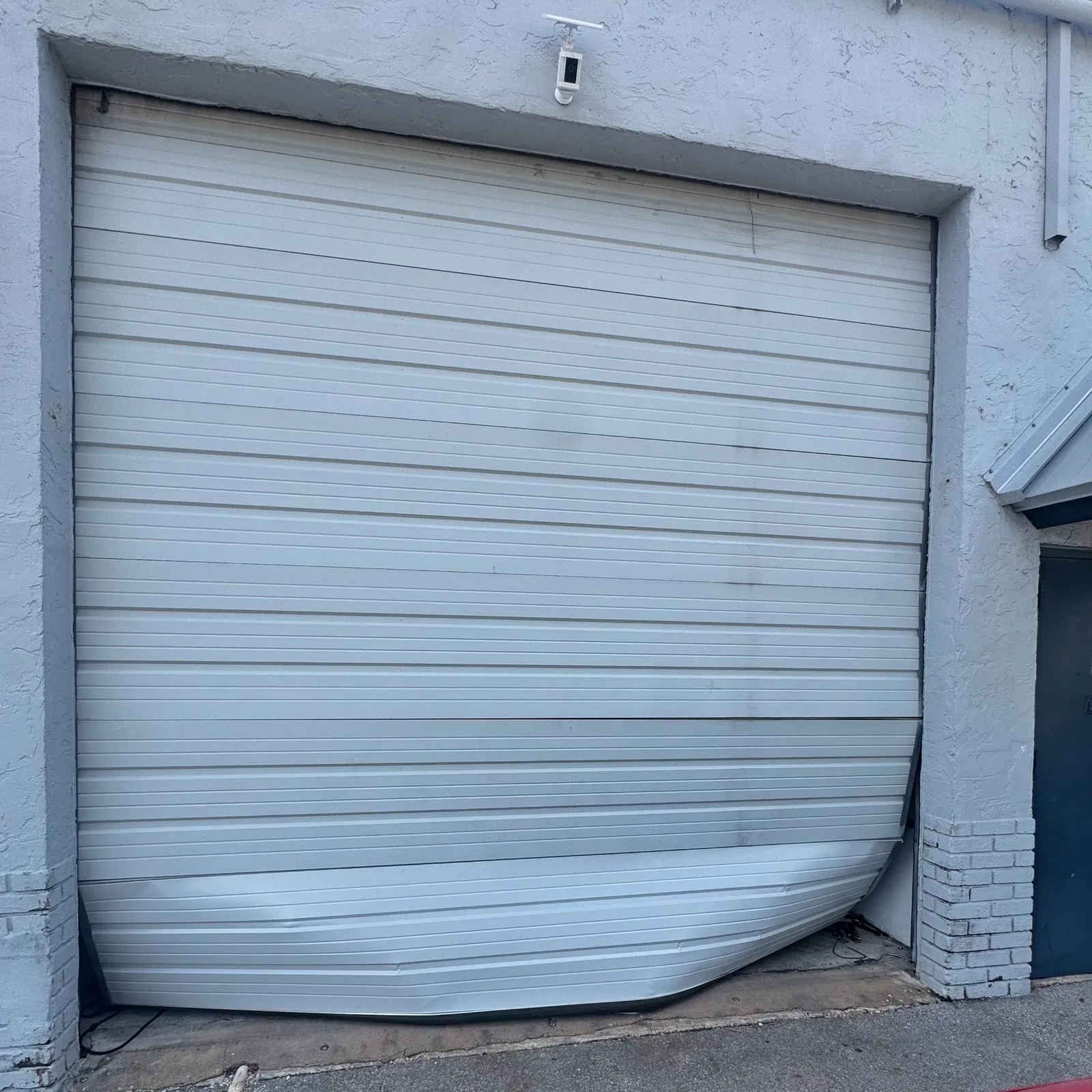
A door can come out of its track when a car catches the bottom section, when a cable fails on one side, or when a motor carries on pushing against a curtain that has already caught. The rollers come out of the channel, the door leans, and the whole curtain is now held only partly by its hardware. An off-track door should not be run or forced. In an emergency visit it is stabilised first, then the rollers are worked back in, bent track is straightened or replaced, and both cables are checked before the door moves again. The off-track garage door repair page explains this in more depth.
A dead motor with the car still inside
Now and then the curtain is perfectly sound and only the motor has quit: a dead motor, a burnt board, a stripped gear or a tripped outlet. Provided the coil and both cables look whole, tugging the red cord frees the curtain from the trolley so it can be raised by hand, often enough to get the car away. If it feels leaden, or slides back down once released, stop there; that means the spring is involved. The opener repair in Belmont page covers opener faults and replacement.
Winter nights and frozen doors
Cold brings its own urgent calls. A bottom seal frozen to the slab can stop a door opening at all, and a motor that keeps heaving at it risks chewing its gear or creasing the uppermost panel. On a hillside driveway, meltwater that runs to the threshold in the afternoon freezes there overnight. On a freezing morning, before ringing about a curtain that will not lift, crouch and check the rubber strip along the slab. Should the strip be iced to the concrete, leave the wall control alone until it thaws or is eased loose. If the rubber is clear of ice yet nothing happens, suspect the coil or the motor, and a call makes sense.
Once the night is over
With the curtain secure and running again, ask what caused the breakdown and whether anything else is close to failing. A spring that broke on a two-spring door often means the other is near its end. A cable that came off its drum may point to a worn drum or a bent track. A door that jumped its track after an impact may have damaged sections. You will be told about any of these, so a second night-time call can be avoided. For daytime fixes, see garage door repair in Belmont; for the after-hours service across Greater Boston, the emergency repair hub; and for everything offered locally, the town’s own Belmont overview.
Reaching us at any hour
Because the phone line never closes, a curtain that jams at midnight gets reported at midnight rather than the next morning. Mention how it is behaving, that the garage joins the house if it does, and any vehicle stuck behind it. For emergency garage door repair in Belmont, MA, call us or book online.
Questions from Belmont
Our attached garage will not shut. Can it stay open till morning?
Better avoided, though if it must, bolt the connecting door into the house, keep lights on, and call. The house itself stays secure that way, even while the garage is open.
The bumper nudged the bottom panel and now the door hangs at a slant. Should I shove it straight?
No. A door off its tracks is no longer properly supported and can fall. Stand well back, cut power to the motor, and ring us so it can be stabilised and refitted safely.
Spring gone, car inside: any way out?
Hauling the curtain up yourself is not a safe option; with no counterbalance it is extremely heavy and can drop back without warning. Tell us on the phone if the vehicle has to leave soon.
Will you give an arrival time when I call?
This page makes no timing promise. The call covers the safe steps for tonight, then the visit is booked from there.
Which details help most on the phone?
The curtain’s behaviour and position, whether you heard a bang or see a broken part, whether the garage is attached to the house, and whether a car is inside. That points the visit toward the right parts from the start.