
Why Newton’s wide garage doors need a careful hand
Most calls for garage door repair Newton MA homes need start with one big door. Across the villages, the typical house is a large single-family with an attached two-car garage, and very often both bays sit behind a single double-width door rather than two narrow ones. That door is long, heavy and carried by a spring assembly sized for its weight, and when one part slips out of step the whole span feels it.
Higher-specification doors are common here too: insulated sections, decorative overlays, rows of glazing along the top. They look settled and solid, but every extra layer adds weight that the springs, cables and rollers have to manage on every lift. A small fault on a light door can be ignored for a while. On a heavy double door it tends to grow.
Three things you can look at without touching anything:
- Whether the bottom edge meets the floor evenly across the whole width, or leaves a wedge of daylight at one end.
- Whether both lift cables at the lower corners are taut, or one hangs slack.
- Whether the door rises smoothly or shudders and pauses partway up.
The faults behind most Newton call-outs
Springs that have let go
A wide door usually rides on a pair of torsion springs over the header. Once one snaps, the whole door hangs on the remaining one and barely moves. See spring repair for Newton homes.
Cables and drums
Each lift cable is coiled on its own drum, one at either end of the shaft. Fraying or unspooling lets one corner drop and drags the door crooked.
Panels and sections
A cracked section, a hinge that has pulled loose between panels, or a bottom seal flattened and torn after years of winters.
Openers and their controls
Motors that hum without driving the trolley, remotes that only respond from a few steps away, and dead wall controls. See opener repair in the villages.
Tracks and rollers
Rollers worn flat or seized on their stems, brackets loosened by vibration, and doors pushed out of their tracks on one side.
Safety sensors
A pair of photo eyes mounted low on the tracks. Knock one out of line and the door reverses on its way down, or will not close at all.
How a double-width door carries its weight
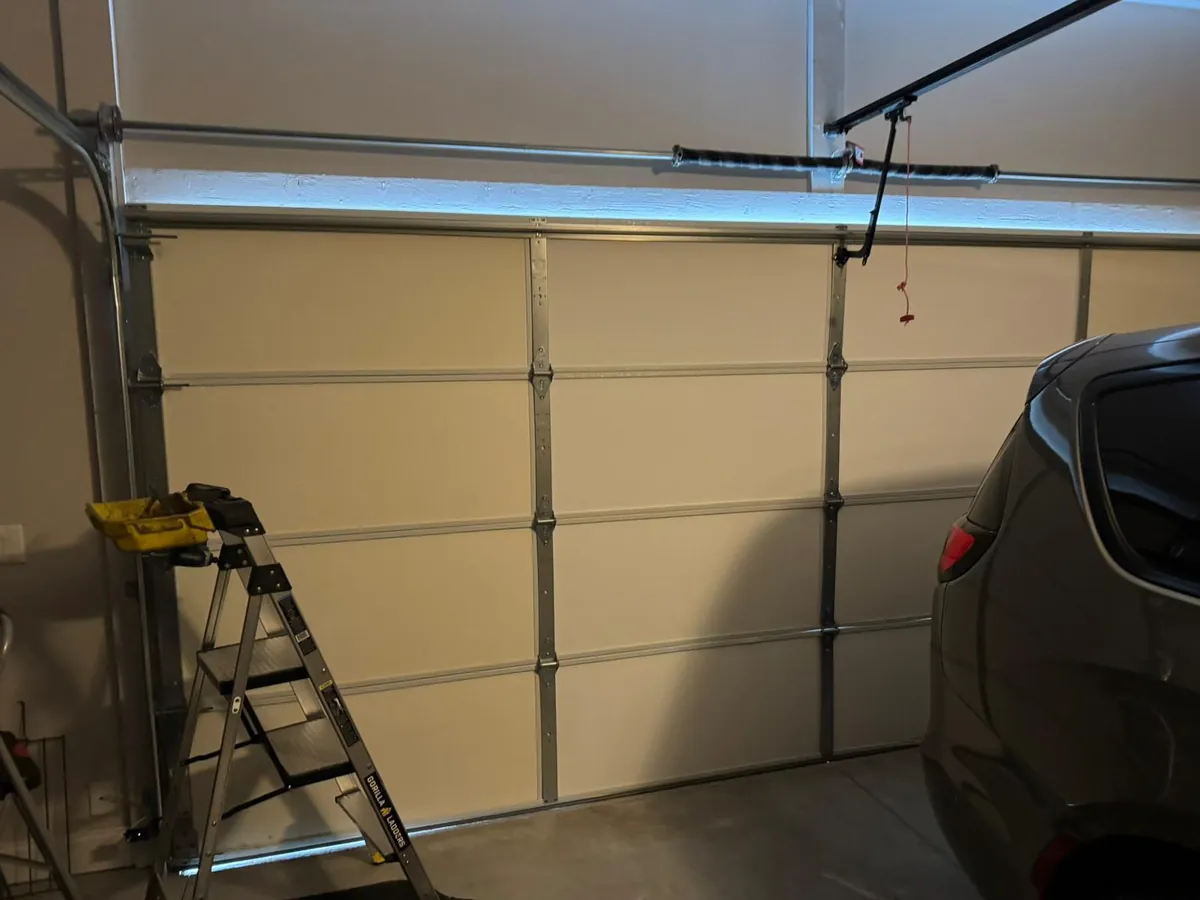
A sectional door that spans both bays of a two-car garage is not lifted by the opener. The opener only guides it. The real work is done by the springs, which store energy as the door comes down and give it back as the door goes up. On a wide door that energy is shared between two torsion springs mounted on a steel shaft over the header, with a drum fixed near either end. From each drum a steel cable drops to the bracket on the matching lower corner.
That arrangement only works if both sides stay matched. When the springs are balanced and both cables are wound evenly, the door rises level and stays put if you stop it halfway. When one side loses tension, through a broken spring, a slipping cable or a drum that has moved on its shaft, the door starts to rise at an angle. The rollers on the high side climb ahead of the rollers on the low side, the sections twist slightly against their hinges, and the opener strains to drag the whole thing along.
A wide door also flexes along its length in a way a narrow one does not. Manufacturers fit horizontal reinforcing struts to longer doors to keep the sections from sagging in the middle, and an opener arm attached to a top section with no strut behind it can slowly bend that panel. When we look at a long door, the struts and the opener bracket are part of the check, not an afterthought.
All of this is why a repair on a two-car door is a matter of balance across the full span. Fixing the part that failed is the start. Making sure both ends of the door are carrying the same load again is what stops the fault from coming back.
Small signs that a big door needs attention
Heavy doors rarely fail without warning. Before anything snaps, there are usually weeks of hints that are easy to talk yourself out of:
- A new grinding or popping sound from the top of the door, often loudest in cold weather.
- A door that drifts down on its own when stopped partway, instead of holding its place.
- Daylight showing at one end of the bottom seal but not the other.
- The opener taking longer to lift the door than it used to, or stopping and reversing for no clear reason.
- A roller that wobbles in the track or a hinge with a crack along its leaf.
- One section bowing outward or inward when the door is closed.
Any one of these deserves a phone call while the door still moves. A slight imbalance today puts extra strain on the opener and the other spring tomorrow, and on a door this size the bill for waiting tends to be the second part that fails.
What you can check yourself, and where to stop
Some looking and testing is safe, and it helps us on the phone. With the door shut, you can look up from inside at the springs and see whether a gap has opened between the coils. You can look at the cables at the lower corners and see whether either has gone slack. You can check that both sensor lights near the floor are lit and steady, and give each lens a gentle wipe. You can make sure nothing is leaning against the tracks.
Where to stop is just as important. A torsion spring on a double-width door holds dangerous tension, and a slip with a hand tool can send that force straight into a wrist or a face. It is not a DIY repair, and neither is loosening the set screws on the drums or the brackets at the bottom corners, which are under the same load. Do not try to wind a spring with screwdrivers or rods, and do not cut or unhook a cable that still looks tight.
If the door is stuck and a spring has gone, leave the opener off. Running the motor against a door it cannot lift strips its gears or bends the top section where the arm attaches. The red release cord is risky too when a spring has gone: with nothing holding it up, a heavy door can drop hard the moment the trolley lets go.
Attached garages: when the door is part of the house
Joined to the house, the garage works as a room as much as a parking bay. On most homes here, a door from the garage opens into a mudroom, a kitchen hall or a back entry, and the big overhead door is the outer wall of that room. When it misbehaves, the whole house feels it.
A wide door stuck partway up leaves the garage open to the street and, through the inner door, close to the rest of the house. A bottom seal that has torn lets in cold air, rain and leaves, and in winter lets a draft run straight into whatever room shares the wall. An insulated door with a broken section loses much of the reason it was fitted.
Noise travels the same way. A rattling door, a roller grinding in a dry track or a chain drive thumping on its rail can be heard in a bedroom over the garage, which is a common layout on larger homes. Many repairs here are as much about quieting the door as about making it move: new rollers, lubricated hinges, tightened track brackets and, where the opener is the source, an adjustment or a change of drive.
Higher-specification doors and the weight they bring
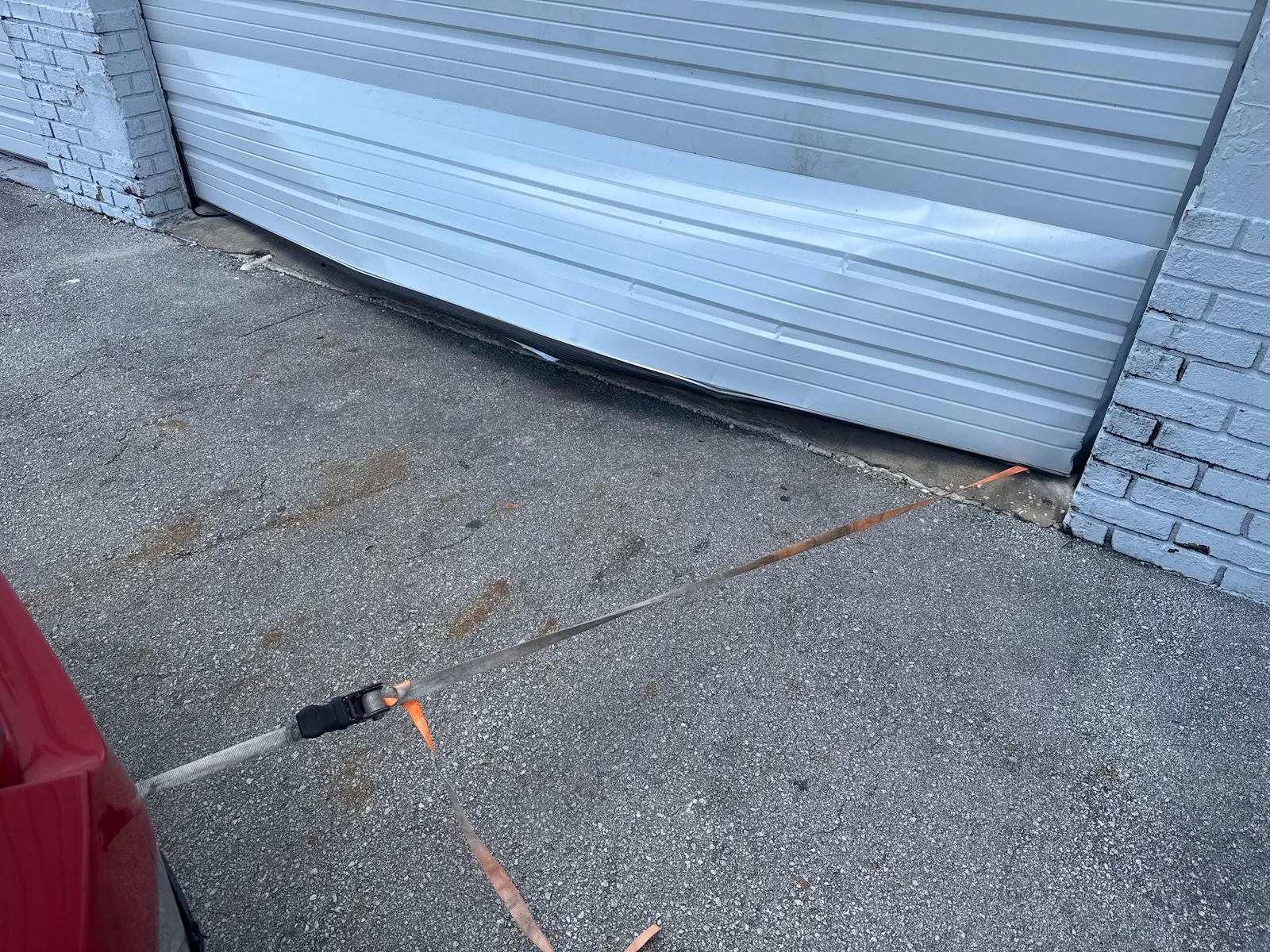
The doors fitted to Newton’s larger homes are often a step above a basic steel panel. Insulated sections with a foam core, carriage-house styling with applied overlays, wood-look finishes, and top sections glazed with a row of windows are all common. Each choice changes how the door behaves and what a repair has to respect.
Weight is the first thing. An insulated, overlaid door of the same width can weigh a good deal more than a plain one, and the springs must be sized to that weight, not to the width alone. A spring replaced with the wrong strength leaves the door either heavy, so the opener labours, or light, so the door flies up and will not stay closed. Getting the size right starts with weighing or carefully assessing the door that is actually there.
Glazed sections need care too. A section with windows is stiffer in some places and weaker in others, and a bent track or a seized roller that twists the door can put stress on the glass. Panels with decorative trim can hide a cracked stile until it gives way. When a door like this is damaged, we look at whether a single section can be replaced to match, or whether the damage is spread wide enough that a new door makes more sense.
What a repair visit involves
For garage door repair in Newton, each visit runs in a fixed order, so nothing on a heavy door gets missed:
- We hear what happened. A bang from the garage, a door that stopped halfway, a remote that gave out: the story narrows down where to look first.
- We look before we touch. Springs, cables, drums, rollers, tracks, hinges, struts, sensors and the opener are checked with the door closed and safe.
- The balance gets tested. Once the opener is unhooked and the door secure, we lift it by hand to see how well the springs are carrying it.
- You hear the findings. What failed, why it went, and which other parts look near the end of their life, explained plainly before any work starts.
- The repair is made. Broken parts are replaced, the springs are set for the door’s weight, cables are wound evenly, and the tracks are aligned.
- The door is run and adjusted. We open and close it several times, set the opener’s force and limits, and check that the sensors reverse the door as they should.
The aim is a door that rises level across its full width, holds its position when stopped, and closes against the floor without a gap at either end.
Repair it, or replace it?
Most calls about garage door repair in Newton end in a repair, not a new door. Rollers, hinges, cables, springs, sensors and openers each age at their own pace, and renewing them puts a sound door back into good order. A door with straight sections, a solid frame and no rust along the bottom edge is worth keeping.
Replacement starts to make sense in a few situations. A door with several cracked or badly dented sections, especially a style where matching sections are hard to find, can cost more to patch than to swap. A door whose bottom section has rotted or rusted through has usually let water work into the rest. An old, uninsulated door on an attached garage that shares a wall with living space may be worth replacing on comfort grounds alone. And some homeowners simply want a door that suits the house better.
Because higher-specification replacements make up much of the work here, we can talk through new door options on the same visit if repair is not the right answer. We also supply and install new doors, so a broken door does not have to mean starting over with someone else. We will tell you honestly which way we would go and why.
One wide door or two single doors
Not every two-car garage in town uses one big door. Some have two single doors side by side, with a post between them. That layout changes the repair picture.
Two single doors mean two sets of springs, two pairs of cables, two openers or a single opener on one side only, and two sets of sensors. The doors share a building but not their hardware, so one can fail while the other runs perfectly. Owners of two-door garages often find that the door used every day wears out years ahead of the one that holds the second car or the lawn equipment. When we repair one door, we look at its twin too, because the two were usually installed together and the quieter one may be closer to trouble than it looks.
A single double-width door has the reverse problem: everything rides on one assembly, so a fault stops both bays at once. That is a good reason to deal with the early signs on a wide door instead of waiting for it to fail on a winter evening with both cars inside.
Winters, long driveways and the bottom of the door
Newton’s generous driveways keep cars well back from the garage, which spares many doors the bumper dents seen on tighter city lots. What the driveways do bring is exposure, and winter accounts for a fair share of garage door repair Newton MA homes need. A wide, open apron catches snow, slush and salt, and the bottom of the door sits right at the edge of it all winter.
The rubber seal along the bottom edge suffers most. In freezing weather, meltwater can refreeze under the door and glue the rubber to the concrete. Press the button on a door stuck that way and the motor may rip the seal, wrench the bottom bracket or overload the cable on one side. After a hard frost, inspect the seal line for ice before trying the button again.
Cold also stiffens old lubricant on rollers and hinges, so a door that runs fine in summer may stutter and groan in January. Salt carried in on tyres settles on the lowest section and the brackets at the foot of each track, which is where rust starts first. A repair visit before or after winter can replace a worn seal, clean and lubricate the moving parts, and check the lower brackets that hold the cables.
Getting your door working again
Whatever the fault, start with a phone call or a booking. Describe how the door is behaving and we will talk you through what is safe to leave and what needs a visit. The full range of garage door repair we do is the same across Greater Boston; here it is shaped around wide doors on attached garages. For a door that has stopped at an awkward hour, see our after-hours service for Newton, and for everything we offer in town, the Newton garage doors page.
For garage door repair in Newton, MA, call us or book online, whatever the hour.
Questions from Newton
Why does my two-car door rise crooked?
One side is carrying less load than the other. Typical culprits: a broken spring on a two-spring shaft, a cable that has slipped or frayed on one drum, or a drum that has moved on the shaft. Stop using the opener and call, because a door lifting at an angle can bind in its tracks and come out of them.
Is it worth repairing an older insulated door?
Usually, yes. If the sections are straight and the bottom edge is sound, worn springs, rollers, cables and seals can all be replaced. If several sections are cracked or the bottom has rusted through, we will say so and talk through replacement.
Can you match a damaged section on a decorative door?
Sometimes. It depends on whether matching sections for that style can still be found. We will look at the door, tell you whether a single section can be replaced, and if not, explain what the options are.
My door works but it is very loud. Is that a repair?
Often it is. Dry or worn rollers, loose hinges and track brackets, and a worn opener drive are common causes, and in an attached garage the noise carries into the house. We can find the source and quiet it down.
Do you also work on garage doors for businesses?
Yes. Alongside the homes, we repair and install commercial roll-up and sectional doors. Tell us about the door when you call.