
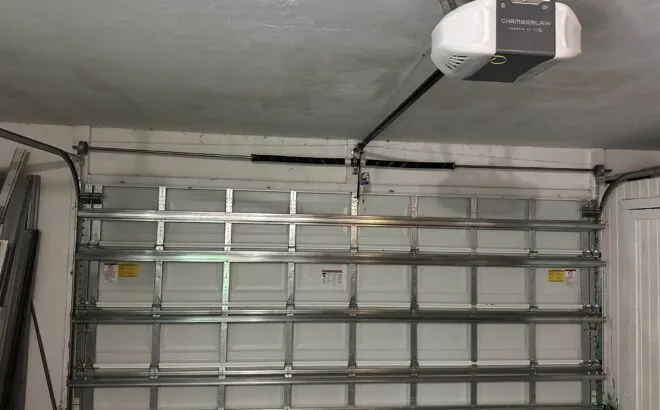
What the springs over a two-car door are up against
A crack like a dropped plank behind the mudroom wall, and afterwards a door frozen at the floor: plenty of calls for garage door spring repair Newton MA homeowners place open with that story. The houses across the villages are mostly large single-families with attached two-car garages, and many of those garages close with one broad door rather than a pair of narrow ones. A door that wide, often insulated and dressed with overlays or glazing, puts a heavy, steady load on the steel coils that lift it.
Springs do not fail because something hit them. They fail because steel tires. Every lift twists the coil tighter or looser, and over countless repetitions the metal fatigues, cracks and parts. On a family’s main entrance, used several times a day by cars, bikes and people carrying groceries, that point comes around sooner than most expect.
A failed spring tends to give itself away from across the garage:
- Glance at the shaft over the door: a parted torsion coil leaves a hand-wide gap in the middle.
- On older doors with springs beside the ceiling tracks, one spring hangs limp or stretched longer than its partner.
- The motor starts, the door creeps up a few inches, and the opener gives up or reverses.
Spring problems on Newton doors
A snapped spring in a pair
Most double-width doors carry two torsion springs. When one breaks, the survivor cannot hold the door, and lifting it puts both the opener and the remaining coil at risk.
Extension springs on older garages
Some garages still have springs that stretch along the horizontal tracks. They need a safety cable running through each coil to stop a broken piece flying across the garage.
Springs undersized for the door
A replacement door heavier than the one before it, or added insulation and trim, can leave the old springs too weak for the weight. The door feels heavy and the opener labours.
Tired springs that have not broken
A door that creeps back down when stopped halfway, or slams the last stretch, has springs that are losing their strength.
A door stuck open
A spring can break with the door up. The door is then held by the opener alone and must not be released by hand.
A full matched set
New springs measured and wound for the door’s actual weight, fitted together so the shaft turns true from end to end.
How a spring holds up a heavy door
As a sectional door comes down, its own weight unreels the cables from the drums and rotates the shaft over the opening. That turning winds the torsion springs tighter, storing energy. When the door opens, the springs unwind and give that energy back, turning the drums and reeling the cables in so the door rises. Set correctly, the springs hold almost the full weight of the door, which is why a balanced door can be lifted by hand with modest effort and will stay where it is left at mid-height.
On a two-car door the shaft is long and the load is large, so it is usually split between two springs, one on each side of a centre bracket. Both have to carry their share. If one weakens or breaks, the shaft tries to turn unevenly, the cable on the weak side slackens, and the door starts to rise at a tilt.
Extension springs reach the same result by stretching rather than twisting. They lie beside the overhead tracks, connected to the bottom corners of the door through pulleys and cables, and they lengthen as the door closes. They are more common on older or lighter doors, and in some garages they are still the original system.
Either type wears out. Every spring is made for a finite number of trips, and each opening spends a little of that allowance. A garage used as the family’s front door, opened every morning and evening and several times in between, uses that life faster than one that houses a second car driven only at weekends.
Leave the torsion spring to us
This is the plainest rule on the page. A torsion spring holds dangerous tension, and on a heavy double door that tension is considerable. Fitting one means turning the cone at its end, bit by bit, with solid steel bars, all while the coil fights back. If a bar slips or the wrong tool is used, the cone spins with enough force to break a hand, fracture a jaw or throw the tool across the garage.
The same danger sits in parts that look harmless. The set screws that hold the springs to the shaft, the drums at each end, and the bottom-corner brackets holding the cable ends all carry load for as long as the springs are wound. Loosening any of them can release the tension suddenly.
What you can do safely is look, listen and leave the door alone:
- Do not run the opener on a door with a broken spring. It was not built to lift the full weight.
- Do not pull the red release cord if the door is up and a spring has broken; the door may drop hard.
- Keep cars, children and pets clear of the opening until the door is secured.
- Leave the car where it is rather than heaving the door up by hand.
Then call. A short description of what you see and hear tells us most of what we need before anyone arrives.
Sizing springs for heavier doors
The higher-specification doors common on larger Newton homes are where spring sizing matters most. A foam-insulated steel door weighs more than an uninsulated one of the same size. Carriage-house overlays, thicker skins and a glazed top section each add more. When a home trades a plain door for a heavier one, or when a door has had extra material added, the springs on the shaft may have been chosen for a door that is no longer there.
Three measurements decide what a spring can lift: how thick its wire is, how wide the coil is inside, and how long it runs. Alter any one and the lifting force shifts. Oversized springs make a door leap upward and resist staying shut; undersized ones leave it leaden, so the opener strains on every trip and its gears and drive wear out early.
Any spring replacement starts from the door in front of us: how much it weighs, how tall it stands, which drums it uses and how much cable it needs. The new springs are chosen to match that load, wound the right number of turns, and checked by hand once fitted. If a pair of springs on your door have both been heavy for years, the opener may be due a look as well.
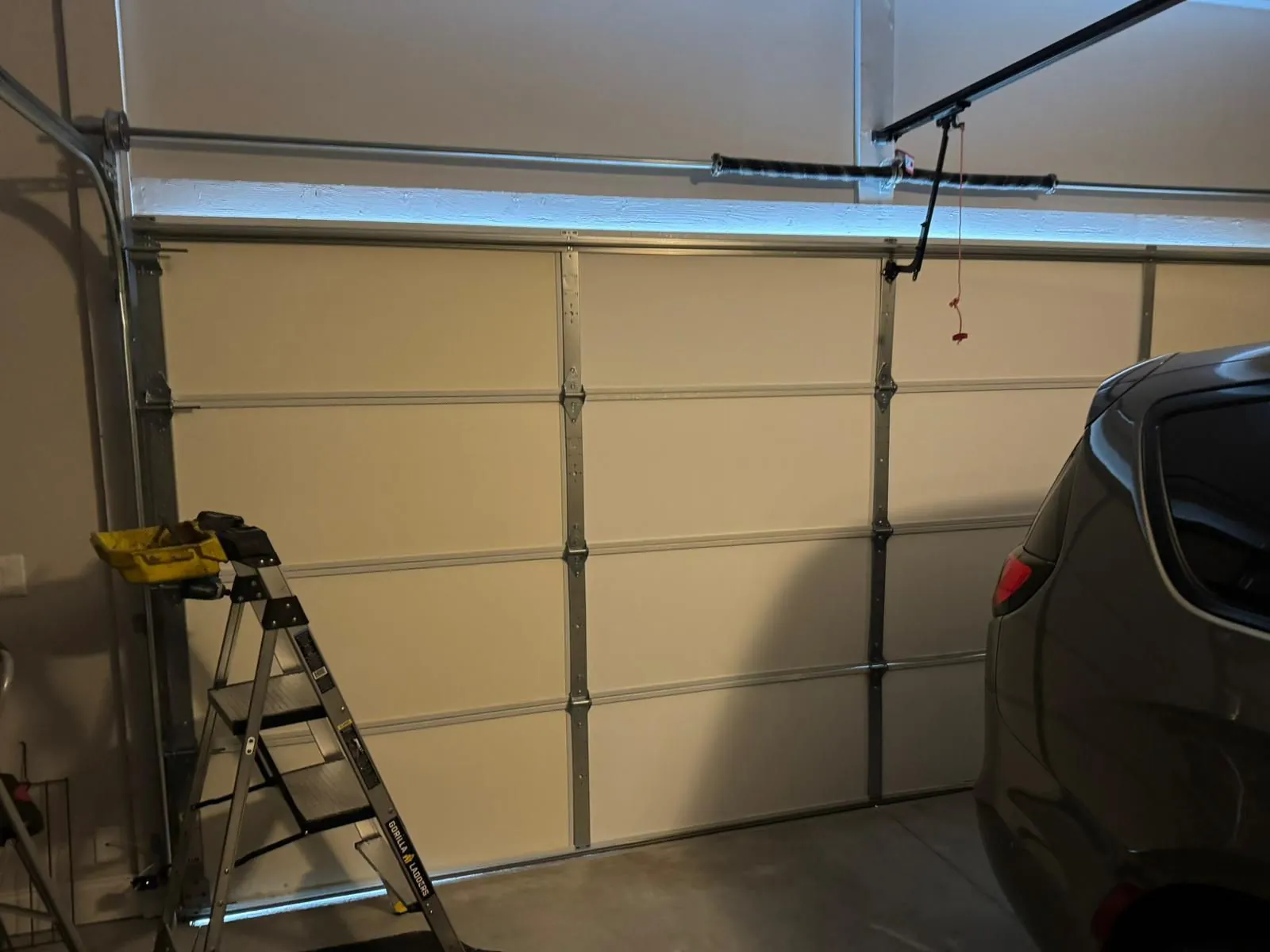
The sound of a break in an attached garage
With the garage sharing a wall with the kitchen or mudroom, a snapped coil is hard to miss anywhere in the house. A torsion spring that parts under load lets go with a sharp crack, often heard through the house wall or from a bedroom above the garage, and it tends to happen when the steel is most stressed: as the door begins to open, or on a cold night when the metal is less forgiving.
If you heard that bang and the door has not moved since, a few things can be checked without stepping under it. Has the door settled on the floor, or stalled somewhere above it? Is there a gap in one of the springs over the door? Are both cables still tight, or is one hanging loose? Are there any pieces of spring or cable on the floor? Those answers help us know whether the door is safe as it sits.
A door with a broken spring that is closed is usually stable. A door with a broken spring that is open, or partly open, is the one to be careful around, because only the opener or the cables are holding it up.
Garage door spring repair in Newton: how the visit goes
Each call for garage door spring repair in Newton follows the same sequence, whether the door has one spring or two:
- The door is secured. If it is up, it is clamped in the tracks before anything is loosened.
- The old springs are unwound. The remaining tension is released slowly with the right bars, one quarter turn at a time.
- The door is measured. Weight, height, drum size and cable length decide the springs that go on.
- New springs are fitted and wound. Both sides of a pair are replaced together so they wear evenly from here on.
- The cables are checked. A spring break often shocks the cables and drums, so they are inspected and replaced if frayed or kinked.
- The door is balanced and tested. It is lifted by hand to mid-height to confirm it holds still, then run on the opener with the force and travel limits set.
You see what failed and why, and nothing is replaced without your say.
Why both springs are replaced together
On a wide door the two coils share a single shaft, and they share a fate as well.
If a door has two springs and only one has broken, it is tempting to replace just that one. On most doors we recommend changing both.
The two springs were fitted at the same time and have made exactly the same number of trips. When one wears through, the other is usually close behind. A new spring paired with a tired one does not share the load evenly, so the door lifts at a slight tilt and the old spring breaks soon after, which means a second visit and a second time the door is out of use.
Replacing the pair also lets both be wound to one specification that suits the door it now lifts. That counts for most on a door that put on weight through a replacement or added insulation, since the old pair may never have suited it.
Extension springs and their safety cables
Garages that still run on extension springs need a different kind of care. Each spring stretches beside one of the ceiling tracks, and when it breaks, the two halves can whip loose with real force. The fix is a containment cable run down the middle of every coil and tied off at each end, which keeps the broken pieces captive rather than letting them cross the garage.
On older systems those safety cables are sometimes missing, or were removed during a past repair and never put back. When we replace extension springs, we fit the safety cables too and check the pulleys, which wear and crack, and the cables that run over them. On a heavy door, the condition of those pulleys has as much to do with a smooth lift as the springs themselves.
Some homeowners choose to convert from extension springs to a torsion system, particularly on a wide, heavy door, where a torsion shaft spreads the load more evenly. If your garage has the headroom and the door warrants it, we can talk through that change on the visit.
When the opener takes the blame
A broken spring often shows up first as an opener fault. The remote is pressed, the motor hums or the trolley jerks, and the door rises a few inches before the opener’s safety system decides the load is wrong and stops. It is natural to assume the opener has died. More often the motor is behaving as designed and balking at dead weight beyond its job.
The reverse happens too. A pair of springs that have been slowly weakening hand more and more of the lift to the opener, which works harder on every trip until a gear strips or a drive belt stretches. By the time the opener fails, the springs are the real cause, and a new opener on old springs will meet the same end.
So whenever we come for the springs we glance over the opener too, and whenever we come for the opener we raise the door by hand and feel how evenly it is carried. On a wide, heavy door in an attached garage, the two systems are tied together. If both need attention, we will show you which failed first and why, so the fix holds.
Two-door garages add another wrinkle. Each door has its own springs and often its own opener, and the door used every day will usually wear its springs out well before its twin. When one breaks, it is worth asking us to look at the other while we are there.
Cold weather and spring failures
Spring breaks tend to cluster in the cold months. Cold steel gives less, and a coil with few trips left in it is more likely to crack the moment it is put under strain. Attached garages are often warmer than detached ones, but a garage door is still an outside wall, and the springs over it feel the cold.
Winter also adds load in quieter ways. Ice can bind the bottom seal to the driveway, so the springs and the opener pull against a door that is held down. Dried, stiff lubricant makes every turn harder work. And with snow piled along a long driveway, a jammed door can keep a car shut in the garage, or out of it, overnight.
A worn spring seldom announces itself, but the hints are there. A door grown heavier under your hand, a shaft that creaks as it turns, or rust showing along the coils all point to springs worth replacing before the cold arrives.
Getting the door moving again
With a broken spring, the best move is to keep away from the door and let us deal with the stored tension. Garage door spring repair Newton MA homes call us for covers both torsion and extension systems, on single doors and double ones. You can read more about our garage door spring work across Greater Boston, see the garage door repair service for Newton for other faults, look at opener repair for Newton garages if the motor took the strain, or see the Newton garage doors page for everything else.
For garage door spring repair in Newton, our phones are answered even when a spring snaps at midnight: call us or book online.
Questions from Newton
How do I know whether my door has torsion or extension springs?
Look above the door from inside the garage. Coils wrapped around a horizontal bar over the opening are torsion springs. If the coils run alongside the two tracks near the ceiling, those are extension springs.
A spring broke with my car inside. Can I lift the door myself?
Please don’t. With the spring gone, whoever lifts the door takes all of its weight, and an opener can be damaged trying. Leave it closed and call; we will tell you on the phone what is safe while you wait.
Why does my new door feel heavier than my old one did?
It may be heavier, and the springs may not have been sized for it. Insulated and decorative doors weigh more than plain ones, and springs must be matched to the actual weight. We can check the balance and re-size the springs.
My door has one broken spring. Do both need replacing?
On a door with two springs, we usually recommend it. The unbroken one has made every trip its partner made and rarely lasts much longer, and a matched pair keeps the door level.
Do you replace springs on commercial doors as well?
Yes. We work on commercial roll-up and sectional doors as well as home garages. Mention the kind of door on the phone so we come prepared.