
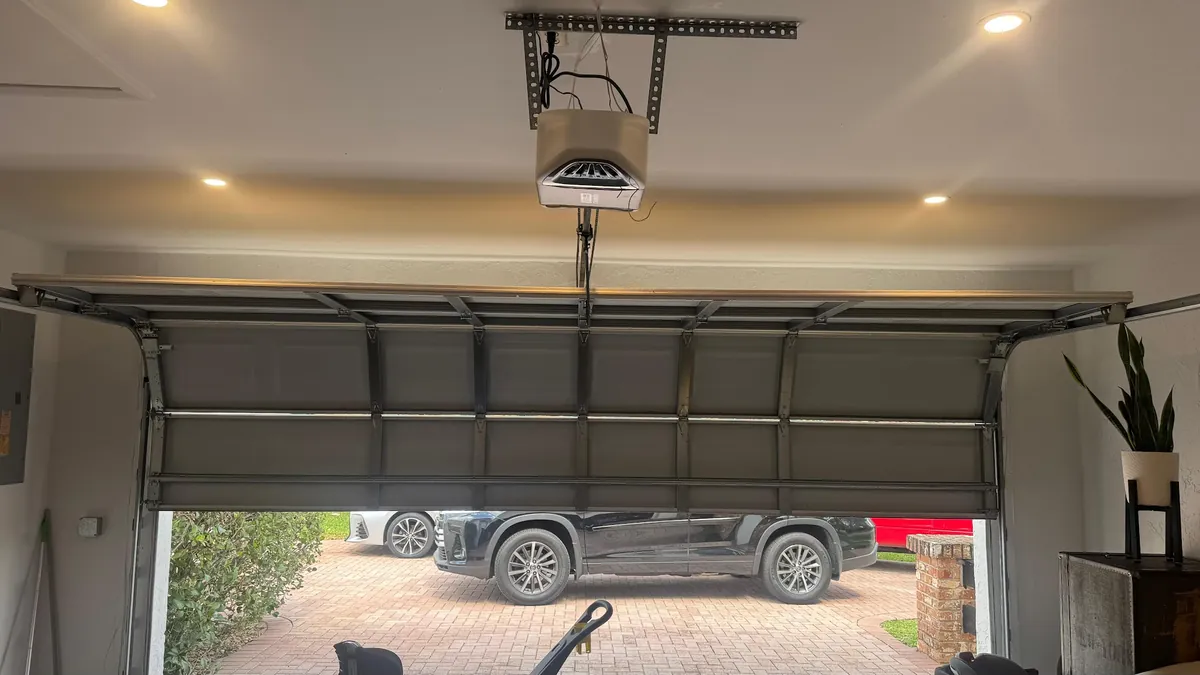
Openers on Newton’s double doors earn their keep
In a house where the garage is the everyday way in, the opener is pressed more often than the front doorbell, and that is the backdrop to most garage door opener repair Newton MA homes call about. Across the villages, houses tend to be big single-families whose two-car garages are built onto the house, and one broad door often spans both bays. A wide, often insulated door is a lot for a motor to steer, and the remotes, wall controls and sensors that go with it get used morning, evening and every trip in between.
When an opener fails, it rarely stops all at once. Remotes start to need a second press. The door hesitates at the top. A grinding note creeps into the motor. In an attached garage with a bedroom or family room beside or above it, each of those changes is easy to hear from inside the house.
Before you call, three quick checks are worth making:
- Is the opener’s light coming on when you press the wall control? If not, the unit may have lost power.
- Look at the two little lamps on the sensors by the floor: steady on both, or is one flashing or out?
- Does the door move when the opener is disconnected and lifted by hand? Only test this if the springs look intact.
Opener faults we handle in Newton garages
Humming, but no movement
You hear the unit working but the trolley sits still. Stripped drive gears, a slipping belt or chain, or a jammed trolley are common culprits.
Remotes that have lost their reach
Car remotes that only work right in front of the door, or not at all. Batteries, programming, a weak receiver or a damaged antenna can all be the cause.
Dead or flickering wall controls
The button by the inner door does nothing, or works only now and then. Worn buttons and damaged low-voltage wiring are the usual causes.
Sensors that will not let the door close
The door starts down, then reverses or refuses to move. One photo eye is usually knocked out of line, dirty, or has a broken wire.
A door that reverses before the floor
The opener thinks it has hit something. Often the force or travel settings need adjusting, or the door itself has become harder to move.
Openers that need replacing
Old units without modern safety features, or ones too light for a heavy double door, are replaced and set up to suit the door.
What an opener does, and what it leaves to the springs
It is easy to think the opener lifts the door. On a properly balanced sectional door it does not. The springs on the shaft above the opening carry almost the entire weight, and the motor merely steers a load the coils have already offset. A trolley riding on a rail is connected to the top section through an arm, and the motor drives the trolley along the rail with a chain, a belt or a screw.
That division of labour matters on the big doors here. A double-width insulated door with decorative overlays can be heavy, and if its springs are weak or mis-sized, the opener ends up doing work it was never built for. Gears wear, belts stretch, and the motor runs hot. Many opener failures start as spring problems that went unnoticed.
The opener also carries the door’s safety systems. It watches the sensors near the floor and reverses if their beam is broken. It senses resistance as the door travels and reverses if the door meets something. It stops at set upper and lower limits. When any of those settings drift, or the door becomes harder to move, the opener starts behaving oddly even when its motor is healthy.
Because of that, an opener repair always starts with the door. We disconnect the opener and lift the door by hand to check its balance before we judge the opener itself.
Remotes, long driveways and the drive up
The generous driveways that go with many Newton homes have one quiet effect on openers: people press the remote from further away. A car turning in from the street may be a good distance back when the button is pressed, and a remote that worked fine from the end of a short city driveway can seem to fail here when it is only reaching the edge of its range.
When a remote stops working, the causes are usually simple:
- A weak battery in the remote.
- A remote that has lost its programming, which can happen after a power cut or a battery change.
- A receiver antenna on the opener that is bent, damaged or hanging inside a metal enclosure.
- Interference from other electronics near the opener, including some types of lighting.
- A receiver board that is starting to fail.
We test the remote and the receiver, reprogramme remotes to the opener, and where the receiver or logic board is at fault, repair or replace it. If a household has several drivers, each car’s remote can be checked and paired on the same visit.
Wall controls and the door into the house
In an attached garage the wall control almost always sits beside the inner door, the one into the mudroom or back hall. It gets pressed on the way out with keys in one hand and bags in the other, and on the way in by anyone who has just parked.
Thin bell-style wire links that button to the motor unit, usually stapled along the studs and joists. Wire pinched by a staple, nicked by a shelf bracket or chewed near the ceiling can make the control work some days and not others. Newer openers often have a lighted or multi-function control that communicates with the opener, and those can fail inside the unit as well.
A dead wall button with remotes that still work points to the control or its wire. A dead wall button with dead remotes too points to the opener, its power supply or its logic board. Either way, it is a straightforward thing to trace on a visit.
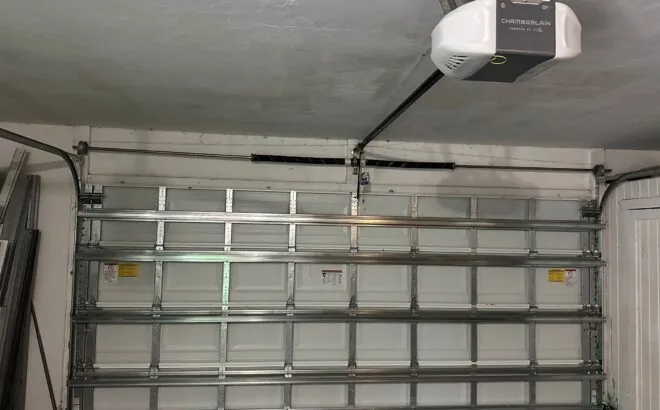
Safety sensors and why the door will not close
Those two little photo eyes bolted low on the tracks are the most common reason a working opener refuses to close the door. One eye sends an invisible beam across the opening and the other receives it. Interrupt the beam, or tip one eye so the pair lose sight of each other, and the motor either refuses to start the door down or sends it back up mid-travel.
In a busy two-car garage the sensors take a beating. A bike handlebar, a recycling bin or a car bumper can nudge one out of line. Low winter sun shining straight into the receiving eye can blind it for part of the day. Dust and cobwebs on the lens weaken the beam. And the wires that run from each sensor back to the opener can be damaged in the same ways as the wall control’s wire.
You can safely check that both sensor lights are on and steady, clean the lenses gently, and move anything parked in the beam’s path. If a light is blinking or off after that, a bracket, a wire or the sensor itself is at fault, and that is where we come in. The sensors are a safety device, so they are repaired or replaced, never bypassed.
Garage door opener repair in Newton: the visit, start to finish
Each appointment for garage door opener repair in Newton runs through the same checks, because opener symptoms so often trace back to something else:
- The door is checked first. With the opener disconnected, the door is lifted by hand to confirm the springs are carrying it and the rollers move freely.
- The opener is powered and observed. We watch the motor, the drive and the trolley through a full cycle and listen for strain.
- Controls and remotes are tested. The wall control, each remote and their wiring are checked.
- The sensors are aligned and tested. Both eyes are lined up, their wiring checked, and the reversing function tested with an object in the beam.
- The fault is explained. Before a screw is turned, you learn what has gone wrong and whether we would fix the unit or swap it.
- The work is done and the opener tuned. Force and travel limits are adjusted to the door, and the door is run several times to confirm it opens, closes and reverses correctly.
Keep the old opener running, or start fresh?
A good share of openers deserve a repair. Drive gears, belts, chains, trolleys, sensors, wall controls, remotes and logic boards can all be replaced, and a unit that is otherwise sound can go on working for a long time after a repair.
A new unit earns its place in a few situations:
- The opener lacks working safety sensors or reliable auto-reverse, which older units sometimes do.
- It has been repaired several times and the next failure is just a matter of when.
- It was never sized for the door it now drives, especially after a lighter door was replaced with a heavier, insulated one.
- Parts for that model are no longer easy to get.
- The household wants features the old unit cannot give, such as a quieter drive or a battery that keeps the door working through a power cut.
LiftMaster openers are part of our everyday work, both mending them and swapping them out, alongside the other makes hanging in local garages. A new opener we install is chosen for the size and weight of the door it will drive. If we think the money is better spent on a new unit than on a repair, we will say so and explain why.
Mounting an opener in a finished garage
Attached garages on larger homes are often finished inside: drywalled walls, a plastered or boarded ceiling, sometimes a bonus room or bedroom overhead. That changes how an opener should be hung. A rail and motor need solid fixing into framing, not just into the ceiling surface, and the hanging straps that carry the back of the rail have to land on joists. An opener bolted loosely to drywall will shake itself free over time, and the vibration will show up as cracks around the mounting points and a rattle in the room above.
The front of the rail is fixed to a header bracket on the wall above the door. On a wide door that bracket takes the push and pull of every cycle, and if it is fixed into a weak spot it can work loose and let the rail sag, which throws off the trolley’s travel and the opener’s limit settings. The arm that joins the trolley to the door connects to the top section, and on a broad door that section needs a reinforcing strut behind the bracket, or the arm will slowly bow the panel.
High ceilings bring the opposite challenge. Where the ceiling sits well above the door, the rail may need extended hangers, or the better answer may be a wall-mounted unit beside the door that turns the torsion shaft and leaves the ceiling clear. When we replace an opener, we look at the mounting as carefully as the unit, because a well-chosen opener on a poor mount will never run as well as it should.
Quieter openers for attached garages
With living space on the other side of the garage wall, or directly above it, opener noise is one of the most common complaints we hear in larger homes. The drive type makes a real difference. Chain drives are hard-wearing but carry vibration and clatter through the rail and into the ceiling. Belt drives run noticeably quieter. Wall-mounted units that turn the torsion shaft directly, instead of pulling a trolley along a rail, take the motor off the ceiling altogether and can suit garages with high ceilings or a room above.
Not every noise means a new opener, though. A loose rail mount, a dry chain, worn door rollers or springs that no longer balance the load can make a decent opener sound worn out. Tightening the mounts, lubricating the right parts and fixing the door’s balance often quiets things more than expected. When a replacement is the right move, choosing a drive type with the room above the garage in mind is worth the conversation.
Two doors, two openers, and power cuts
Where a two-car garage has two single doors rather than one wide door, there are usually two openers, two sets of sensors and separate remotes or buttons for each. The doors and their openers age at different rates, depending on which bay is used most. When one opener fails, we check the other while we are there, since they were often installed together.
Power cuts are the other situation that brings opener calls. Without power, the opener cannot move the door, and the way out is the manual release: the cord, usually red, that dangles from the trolley. With the door shut and the springs intact, pulling it lets you raise the door by hand. Never pull it with the door open, and never use it if you suspect a broken spring, because the door can drop suddenly. After power returns, the opener may need its limits reset and remotes reprogrammed. Some newer openers include a backup battery so the door keeps working when the power goes out, which can be a good fit for a house where the garage is the main entrance.
Getting the door opening and closing again
If the opener is humming, the remotes have gone quiet or the door keeps reversing, describe it to us and we will tell you what is safe to try in the meantime. Garage door opener repair Newton MA homeowners ask for usually comes down to a handful of parts. You can read more about our opener repair and replacement across Greater Boston, see Newton spring repair if a broken spring is behind the trouble, the broader repair service for Newton homes for tracks, cables and panels, or the Newton garage doors page for everything we do in town.
For garage door opener repair in Newton, the line never closes: call us or book online.
Questions from Newton
Why does my car remote only reach the door from a few feet away?
The usual reasons are a weak remote battery, a damaged or poorly placed antenna on the opener, or interference near the receiver. Swap in a fresh battery first; when range stays short after that, the receiver or antenna is due a check.
Why does my door come down and then head straight back up?
Usually a safety sensor is out of line or something is breaking the beam. If the sensors are fine, the opener’s force or travel settings may need adjusting, or the door itself may have become harder to move.
Can you work on my LiftMaster opener?
We can. Mending LiftMaster units is routine for us, and when one is beyond saving we fit a replacement.
Can a new opener be quieter than my current one?
Yes, in most cases. Belt drives and wall-mounted units are much quieter than older chain drives, which matters when there is a room next to or above the garage.
When can I pull the emergency release?
When the door is fully down and the springs are whole. With the door open, or if a spring may be broken, do not pull it, because the door can fall.