
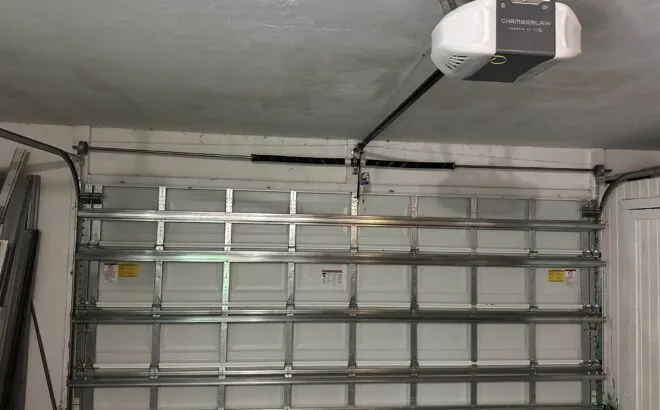
Why springs give out early in Quincy garages
Think of the spring as a battery made of steel wire, wound or stretched every time the door comes down and released every time it goes up. Wire tolerates a finite number of those cycles and then cracks, and the stand-alone garages behind single- and two-family houses in Wollaston, North Quincy and Squantum give their springs an especially hard life. The coils sit in an unheated building, they chill hard on winter nights, and the closer a garage is to Squantum, the more salt settles on them. Our garage door spring repair in Quincy, MA deals with both kinds of spring, torsion and extension, whether one has snapped outright or both are tired and need replacing as a set.
Without going near the spring, you can usually tell if it is the culprit:
- Look at the shaft above the door. A gap of a few fingers between two turns of a coil means it has broken.
- Watch the door when the opener runs. If it rises a hand’s width and stops, the motor is fighting the full weight alone.
- Look along the ceiling tracks on an older door. A stretched spring hanging limp, or a dangling safety cable, means an extension spring has failed.
Spring faults on Quincy doors
Snapped torsion coils
The call we take most: a report like a gunshot from out back, and afterwards a door glued to the slab. On a two-spring shaft, the surviving coil is usually close behind.
Worn extension springs
Older single-car doors often hang from a pair of long springs beside the ceiling tracks. Once one stretches out or breaks, the door rises unevenly or not at all.
Rust-pitted coils near the shore
Salt eats small pits into the wire surface, and each pit becomes a weak point. Coils by the water can fail well before their expected cycle life.
Doors that feel too heavy
A door that slams on the way down, or will not stay put halfway, has springs that have lost tension. That strains the opener every single day.
Mismatched springs
A previous repair may have left two coils of different sizes, or a spring that was never right for the door. The door then runs crooked and wears its cables.
No containment cable
Each extension spring needs a steel line passed through its coils so that a break cannot whip across the garage. On plenty of older doors it was never fitted.
Torsion and extension: two ways of storing the same energy
A torsion system mounts one or two coils on a steel bar fixed just above the header. One end of each coil is anchored to a stationary plate mid-shaft; the far end grips the bar through a winding cone. Lowering the door makes the cables rotate the drums, which turns the bar and screws the coils tighter. When it opens, the coils unwind and do the lifting. Because the energy is stored as twist, a torsion system feels smooth and balanced, and it is the arrangement found on most sectional doors fitted in recent decades.
An extension system works by stretch instead. Two long springs run alongside the horizontal tracks, one on each side, hooked to the ceiling framing at the rear and tied to the bottom of the door by a cable reeved over a sheave. As the door comes down, the springs lengthen; as it goes up, they contract and draw it along. You still see this setup on plenty of older single-car doors in detached garages, partly because it needs very little headroom above the opening.
Both types do the same job: they counterbalance the weight of the door so that the opener, or a person, only has to move a door that already feels nearly weightless. The difference that matters most to an owner is how they fail. A torsion coil usually breaks in one place and stays on its bar. An extension spring that breaks without a safety cable can fly loose across the garage, which is why those cables matter so much.
What shoreline air does to spring steel
Coastal exposure out toward Squantum is hard on hardware, and springs are the hardware with the least margin for it. A coil is under constant stress, and corrosion concentrates that stress. Salt and moisture settle into the tiny gaps between the turns of a torsion coil and on the surface of an extension spring, rust forms small pits, and each pit is a point where the steel is thinner than the rest. Cycle after cycle, a crack starts at the deepest pit and works its way through the wire.
Practically, that means two things for a garage close to the water. Springs there tend to break sooner than the same springs inland, and when one breaks, the other on the same door is often pitted just as badly. Oiling the coils lightly holds the rust back somewhat, and we look for that film during a visit, yet no oil can heal a pit once it has formed. When we carry out garage door spring repair in Quincy, MA near the shore, we also talk through how the unbroken spring, both cables and the lowest brackets are holding up, because salt works on all of them at once.
Cold nights in a building nobody heats
With no heat and no shared wall, a stand-alone garage is as cold inside as the yard around it. Steel turns less forgiving as it chills, so a coil with little life left often chooses the first bitter night of winter to quit, typically at the first lift of a frozen morning. The door may also have frozen to the slab overnight, and an opener straining against a door stuck to the ground adds sudden load to springs and cables alike.
On these mornings, the safest thing is not to keep pressing the button. If the door will not lift and you can see no break, check whether the bottom seal is frozen down before you try again. If you can see a break, leave the door closed and call.
Keep your hands off a wound spring
There is no gentle way to say this. A torsion spring holds dangerous tension. It keeps that tension constantly, not only when the door is moving. That tension sits in the coil, in the winding cone, in the set screws that lock the cone to the bar, and in the cables and bottom brackets at the base of the door. Loosening any of those, or trying to wind a coil with screwdrivers or improvised bars, can unleash the stored energy faster than anyone can react. The injuries can be severe. It is not a DIY repair, no matter what a parts catalogue implies.
Extension springs carry their own risk. Under tension they are long, and should one snap, or be unhooked, with nothing threaded through it, the loose end or its pulley can be thrown hard across the garage. Leave its hooks and eyebolt alone, and never heave a door upward once its spring has gone. Without a working counterbalance, every pound of steel rests on your grip alone, and a slip is all it takes.
How a spring repair is carried out
On every garage door spring repair in Quincy, MA, the door gets clamped in its tracks before any spring is touched. The broken coil is examined to confirm how it failed, and the surviving spring is checked for pitting, gaps and stretch. The door’s balance and weight are assessed, because the replacement must suit the door rather than simply copy whatever was there before; a previous repair may have left the wrong spring in place.
The old springs come off and new ones go on. On a torsion system, the coils are wound to the correct number of turns with proper winding bars, the cones are locked to the bar, and the two cables are matched so neither side sags. On an extension system, the new springs are hooked to the correct holes for the door’s height, and safety cables are fitted through them if they were missing. The bearings, drums and cables get a look while everything is open, and anything badly frayed or rusted is pointed out.
Then the door is tested. It should lift smoothly by hand, stay put when let go about halfway, and come back down without slamming. Only then is the opener re-engaged. Its limits are reset to suit the door’s new balance, and a test block on the slab proves the door reverses on contact. Every garage door spring repair in Quincy, MA ends with the door running under the opener in front of you.
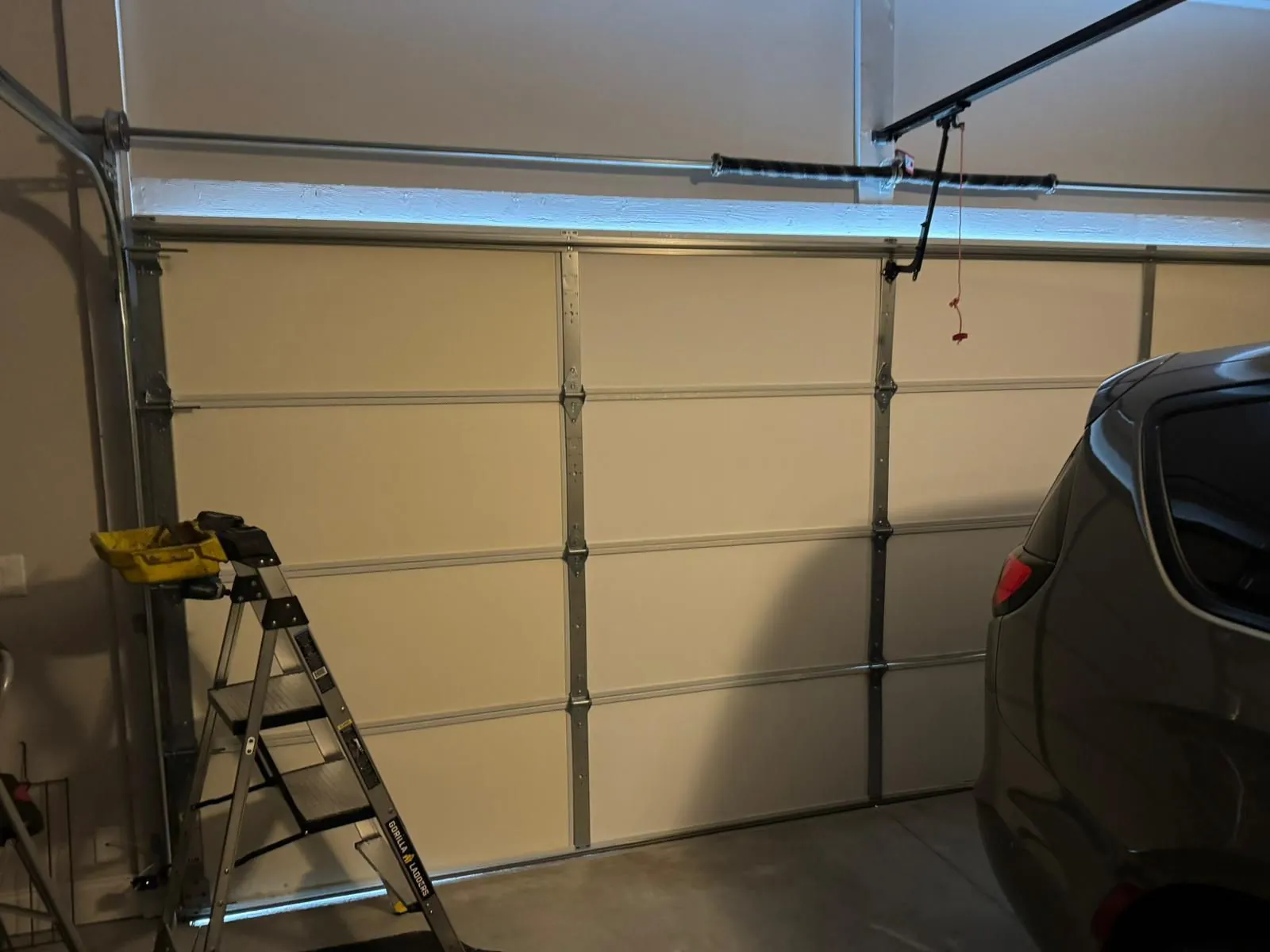
Matching a spring to the door it lifts
A spring is not a generic part. Wire gauge, inside diameter and coil length work together to set the load it can counter and the number of openings it will last, and the right combination depends on the door’s own weight and height. A door that has gained weight over the years, from a bolted-on reinforcing strut, an added window section or a timber door that has drunk in seasons of damp, may need a stronger spring than the one it left the factory with. Fitting a coil that is too weak leaves the opener doing the lifting; an oversized coil sends the door leaping upward and stops it sitting firmly on the slab. That is why the door, and not just the broken part, is measured and weighed up before anything new is wound on.
Why both springs are usually replaced together
On a door with two torsion coils, or with a pair of extension springs, the springs were normally fitted at the same time and have lived through an identical count of openings. Lose one, and its twin carries the same wear and the same exposure, and in a shoreline garage the same pitting. Replacing only the broken one leaves the door running on a new spring and an old spring of different strength, which can pull the door crooked and wear the cables unevenly, and it often means a second callout not long afterwards. Fitting two fresh springs together restores an even balance and puts both springs back to the start of their lives.
There are exceptions, and if the surviving spring is genuinely in good condition, you will be told so. The choice is yours.
Springs, cables and the opener: a connected failure
A broken spring rarely stays a spring problem. When the coil goes, the cables lose tension and can jump off their drums, especially if the opener tries to run the door. An opener that has been lifting a heavy, poorly balanced door for months may already have worn gears or a strained motor by the time the spring finally gives up. And a door that came down hard when the spring broke may have bent a bottom bracket or a track.
That is why spring work is never done in isolation. If the cables need replacing, the garage door repair page for Quincy covers the wider range of fixes, and if the opener has suffered, the opener repair page for Quincy explains what can be done. That includes LiftMaster openers, which we fix or swap out.
Signs a spring is near the end
Springs often give a warning before they break, if anyone is listening. On a detached garage nobody is, most of the time, but these are worth noticing whenever you are out there:
- With the opener disengaged, lifting the door takes noticeably more effort than it used to.
- It drifts down on its own when left partly open, or shoots up too quickly.
- You can see rust on the coils, or gaps opening between turns that used to sit together.
- The opener strains, slows near the top, or reverses for no obvious reason.
- A corner lags as the door goes up, so the bottom edge tilts.
None of these is an emergency in itself, but each one means the springs are being asked to do more than they can. A visit before the spring breaks is easier on the door, the opener and your morning.
Replacing a spring or replacing the door
Snapping a coil seldom justifies a whole new door. Springs are designed to be replaced; they are the part of the door that wears out by design. That debate only begins when the door around the spring is failing too: lower sections eaten through by rust at the bottom, a timber door so sodden that no reasonable spring can carry it, or panels caved in beyond repair. There, putting the money toward a new door can make more sense, and our new garage doors page describes how replacements are chosen and fitted. Otherwise, a new pair of springs is the fix.
Booking spring work
Springs tend to break while the door is closing or just as it starts to open, so a lot of breaks come to light on the way out to work, or on arriving home after dark. Since someone answers whatever the hour, you can ring the moment you discover a break; with a car trapped or a door jammed wide, our Quincy emergency page sets out how to keep things safe in the meantime. Spring work across the wider region is described on our spring service page, and the Quincy area page brings together every service here. Useful details to have ready: where the broken spring sits (over the header or beside the ceiling tracks), what position the door was left in, and if a vehicle is stuck behind it. Booking garage door spring repair in Quincy takes one step: call us or book online.
Questions from Quincy
The coil over our door has split in two. What now?
Keep the door shut, pull the opener’s power cord out so the button cannot be used, and keep children and pets clear. Resist lifting it yourself. Then call us; the spring and its partner will be replaced and the door rebalanced.
Can I drive out if the spring has broken but the door is up?
If the door is fully open and stays there, you may be able to back the car out carefully, but do not try to close the door afterwards with the opener or by hand. It is likely to come down hard. Unplug the opener and leave it open until the spring is replaced.
Our coils have gone orange with rust, and the garage is near the water. Is it worth waiting?
Rust on the coils means the steel is pitting, which shortens its life. Waiting is your choice, but a spring that breaks with the door half open, or with a car inside, causes more trouble than one replaced on your schedule. A light lubricant slows further rust but cannot undo pitting already there.
My door has springs along the ceiling tracks, not above the door. Is that a problem?
No, those are extension springs, common on older single-car doors. They work well, though every one needs a containment cable down its core. Where those are absent, they go in alongside the new springs.
Why replace both springs when only one is broken?
The pair went in together and have carried the door through every season since. The surviving spring is usually close to breaking too, and pairing a new spring with an old one can leave the door unbalanced. If the surviving spring is genuinely sound, you will be told and can choose.