
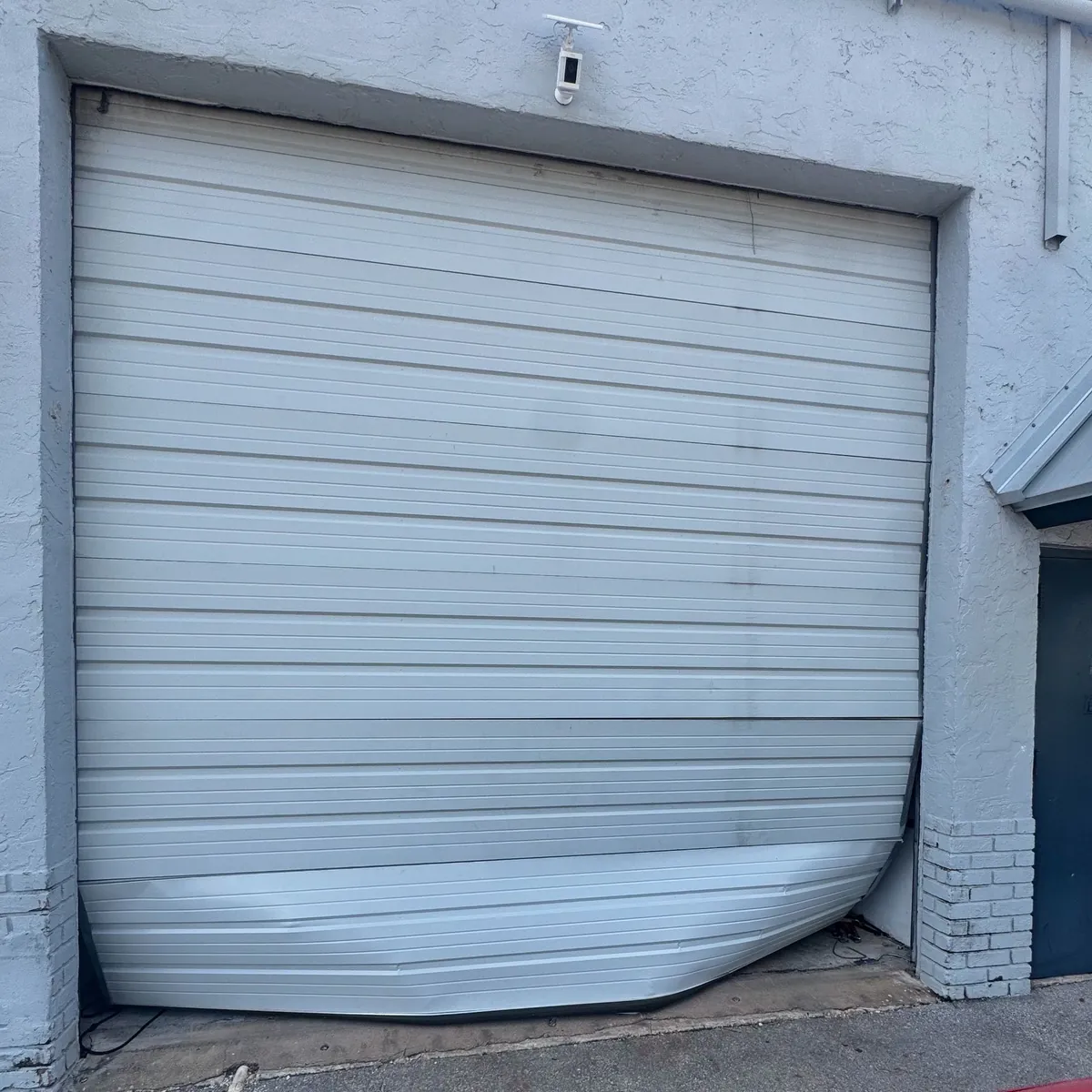
Rear garages, carriage houses and the climb up from the street
Around Coolidge Corner and Washington Square, the houses are big and the garages are hidden. Large Victorians sit forward on their lots with the garage pushed to the back, detached and often reached along the side of the house. Brick apartment buildings have their own rear garages or rows of bays behind them. Here and there a carriage house survives from the days of horses, now holding a car behind an overhead door that went in long after the building did.
Getting to the garage is half the story. Many driveways off Beacon Street leave the road and climb steeply, so the car, the delivery and the technician all go uphill before they reach the door. A garage set high above the street, with a door facing down the slope, lives with water, ice and gravity in ways a level garage does not.
Three kinds of trouble come up again and again on these lots:
- Springs on old, heavy doors that finally give way, often on a cold morning.
- Openers and sensors in detached garages with long, sometimes tired wiring runs back to the house.
- Doors and tracks pulled out of true by frames that have settled over a long life.
Our services in Brookline
Each service we offer for garage doors Brookline MA owners use has its own page for this town, and the detached and carriage house garages here touch all of them. A door that sticks, sags, grinds or will not seal is covered by garage door repair for Brookline. A coil that has parted over a weighty old door is a matter for Brookline spring repair. Handsets, keypads, push buttons, safety beams and the drive unit itself come under Brookline opener repair and replacement. And a door stuck open behind the house at night, with the car exposed and the garage open, belongs to our emergency service in Brookline.
Next door, the hubs for Allston, Brighton and Jamaica Plain cover their own garages, and the rest of the map is on the service areas page.
A replacement door is not on Brookline’s local list of pages, but new doors are still supplied and installed here when a repair no longer makes sense; that is covered further down.
A garage at the back of a big lot
A detached garage at the rear of a Victorian lot is a separate small building, and it is wired and built as one. Power often reaches it along a cable buried under the side yard or strung from the house. The frame is usually wood, sometimes resting on an old slab or a perimeter of stones that has heaved and settled with the frost over a great many winters.
Those details matter to the door. A frame that has racked a little leaves the opening out of square, and the door then rubs at one top corner or leaves a wedge of daylight under one side. Track brackets fixed into old studs work loose as the timber dries and shrinks. A slab that has dropped at one end changes where the door meets the floor.
None of that is unusual, and none of it means the garage is failing. It does mean a repair has to respect the building. Re-fixing a bracket into sound wood, plumbing a track to the opening as it actually is, and setting the bottom seal to suit an uneven floor are all part of making an old garage’s door run well.
The carriage houses
A few Brookline lots still have a carriage house, larger and more decorative than a plain garage, with an arched or wide opening meant originally for a carriage and a pair of hinged doors. Many now hold a sectional overhead door instead.
Those openings are rarely a standard size, and the ceiling inside may be high in the middle and low at the sides, or crossed by old beams and a loft floor. The tracks, the spring shaft and the opener have to be planned around whatever is there. When parts are renewed, they are chosen and set to fit that particular building, not a typical garage.
Owners of carriage houses often care about the look of the door as much as its function. Repairs aim to keep panels, hardware and trim consistent with what is already there, and any decision about a whole new door is talked through with that in mind.
Steep driveways off Beacon Street
A garage at the top of a steep drive changes the work around the door.
Water is the first issue. Rain and snowmelt run down a slope, but when the garage sits at the top with a flat apron, puddles can still collect at the threshold, freeze overnight and glue the bottom seal to the concrete. When the opener next tries to lift, it can tear the seal or strain the bottom panel. A door that faces down the hill also catches wind-blown rain against its face.
Access is the second. A steep drive is harder to carry parts up, and a long spring shaft, a set of tracks or a full door has to be brought up carefully. In ice or snow the drive may not be passable for a vehicle at all, which affects when larger work can be done.
The third is the car itself. A driver nosing up a steep slope cannot always see the bottom of the door, and a bumper tap on a lowered door is more common on a climb than on the flat. A creased bottom panel, or a vertical rail bowed inward at knee height, is what such a tap leaves behind.
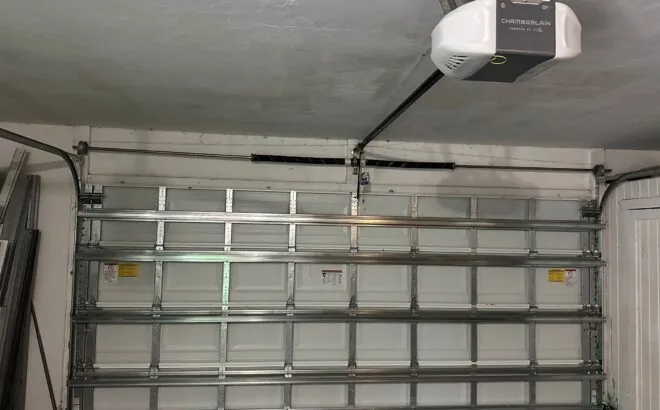
Springs on an old heavy door
Many doors on Brookline’s older garages are solid, heavy and long in service, and the spring is what makes such a door move at all. Whether it is one torsion coil on a bar across the lintel or a pair of stretched extension springs alongside the ceiling rails, the counterbalance stores enough energy to balance that weight so the door feels light in the hand.
When a spring breaks, the change is sudden. The door that rose easily yesterday will not budge, or the motor groans and gives up after a few inches. There is often a sharp report from the garage when it happens, easy to miss from inside a big house at the far end of a long lot.
Here is the safety line, and it is not negotiable: a torsion spring holds dangerous tension, and it is no DIY repair for a Sunday afternoon. The bars, the sequence and the care needed to wind or release one are not things to improvise on a ladder in an old garage. Leave the door down, switch off or unplug the opener, and phone.
On an old door with two springs, the remaining spring is usually renewed alongside the broken one. Old Brookline doors have often been braced or re-panelled somewhere along the way, so the replacement coils are matched to a weighing of the door as it hangs today, not to a figure on a faded sticker.
Openers in a detached garage
Spare a thought for the motor unit in an outbuilding at the bottom of a Victorian garden. It may sit in an unheated building through long cold spells, its wiring runs a long way, and the people using it press the remote from a car halfway up a slope rather than standing next to the door.
Faults we see in these garages:
- The remote works from the top of the drive but not from the bottom, which is often range, battery or the angle of the garage.
- The door closes, touches the frozen apron and bounces back up, usually the force or limit setting reacting to ice or a changed floor.
- Nothing happens at all, sometimes because the power to the garage has tripped somewhere along the line from the house.
- Partway through closing, the panels reverse and rise once more, because a lawn tractor or a stack of firewood has shifted one of the safety beams.
We repair and replace openers, among them LiftMaster units, and adjust each to its door, its building and the conditions it works in.
When the door is stuck open after dark
An outbuilding garage gaping open all night puts the car, the bikes and the garden tools on show to anyone cutting across the back of the lot, and in some houses the garage also gives access to a back garden or a side door.
There is a person on our line at any hour, so nobody has to sit on the problem until office hours. Describe the scene: any loud crack beforehand, a door sitting square or slumped to one side, a cable or roller dangling, and how steep the climb up to the garage is. Those answers help us tell you the safest way to leave it.
Should the spring fail with the door raised, leave the door up rather than wrestling it down. Kill the opener’s power, keep people out from under it and secure the house’s own doors for the night.
Cables, rollers and racked frames
On an old frame that has moved, the door’s cables and rollers often show wear first. A door that runs slightly crooked puts more strain on one cable, which frays sooner, and on the rollers along one side, which wear flat. When a cable lets go, one corner drops and the door hangs at an angle; when a roller jumps out of the track, the door may jam or tip.
Leave a door like that exactly where it is and call. Trying to force it back can bend the track or drop the door. The cables are replaced in pairs, the rollers renewed and the tracks reset to the opening so the door runs true again.
What to check yourself, safely
A few checks are fine for anyone:
- Find the pair of safety beams fixed low on the jambs, polish their lenses with a soft cloth and clear any rake, pot or log resting in their path.
- Change the handset’s battery and compare it against the push button mounted on the garage wall.
- Check that the garage still has power, by trying the light or a socket, and look at the breaker in the house that feeds it.
- With the door shut, look along the tracks for leaves, grit or anything else lodged in them.
The coils, lift cables, drums and corner brackets are permanently loaded and should be left alone; those are our side of the job.
Leaves, roots and the garden around the garage
Many rear garages here sit among mature trees and planting, at the far end of a long garden. That is pleasant to look at and hard on a door. Leaves pile against the threshold and into the bottom of the tracks every autumn. Pine needles and seed pods lodge in the rollers. Roots lift the edge of an old apron, so the floor in front of the door is no longer flat, and the bottom rubber presses down at one jamb while daylight shows under the far one.
Damp from shade and soil sits against the lower panels and the bottom bracket, where rust and rot start first. A wooden door left in shade for long stretches can swell, so it binds in the opening through a wet spring and frees up again in a dry summer.
The cure is mostly attention. Keep the threshold and the bottom of the tracks swept, and mention trees and damp when you book, so the bottom panel, seal and brackets get a close look. Among the garage doors Brookline MA gardens surround, the bottom panel and its seal are usually where trouble starts.
Apartment buildings and their garages
Brick apartment buildings near Coolidge Corner and Washington Square have their own garage setups, often a row of bays behind the building or a shared garage underneath. These are used by several households, so the doors run more often and wear faster than a single-family garage door.
Repairs on a building’s garage are agreed with whoever manages it. If you live in the building and the door has failed, it helps to tell management what you saw: any crack or thud, a tilt in the door, a car that may have clipped it. They can then pass that on when they call us.
Repair or replace an older door
Plenty of the garage doors Brookline MA owners have inherited with an old house are worth keeping and repairing: new springs, cables, rollers and opener work can restore them to good running for a long time. In other cases a door may have reached the stage where repair is no longer sensible:
- Several panels are cracked, rotting or badly dented, with no matching replacements.
- The door has been patched, braced and adjusted so often that it still does not run well.
- Coil, cables, wheels and motor unit are all wearing out together.
- The door does little to keep weather out of the garage.
A replacement door is made up to the opening the garage really has, and on an old outbuilding or carriage house that starts with patient measuring of every edge. Our new door installation page explains what that involves, and the spring repair page covers the counterbalance in more depth.
What happens on a visit
The visit starts at the garage, whether that means a short walk past the house or a climb up the drive. The door is looked at in full: springs, cables, drums, rollers, tracks, hinges, panels, seals, opener and sensors. We walk you through the failed parts, the tiring ones and the healthy ones, and nothing is touched until you agree. When the fix is in, the door’s counterbalance is set, it is cycled from sill to full height a few times, and the motor’s stopping points and auto-reverse are proved.
For garage doors Brookline MA houses keep at the back of long lots, that last test matters most. A door that is balanced and correctly set will run well even when the frame around it is a little out of true.
Book a visit
Tell us whether the garage is detached, a carriage house or part of a building, how steep the drive is and what the door is doing. With the garage doors Brookline MA lots have, those details shape the whole visit. Snapped coil, sulking motor or an outbuilding left gaping at dusk: call us or book online.
Questions from Brookline
Our garage is at the top of a steep drive. Is that a problem for a repair?
Not for most repairs. Parts and tools are carried up as needed. Larger work, such as fitting long spring shafts or a full door, is planned around the drive and the weather, since ice or snow can make a steep drive hard to use.
The door freezes to the ground in winter. What can be done?
Water collecting at the threshold is usually the cause. A new bottom seal, a check that the door meets the floor evenly, and adjusted opener settings can stop the door from tearing its seal or straining when it is frozen down.
Can you work on a carriage house door with an unusual opening?
Yes. The tracks, springs and opener are planned around the opening and the ceiling as they actually are, and repairs aim to keep the door’s look consistent with the building.
Our opener works from the top of the drive but not the bottom. Why?
Distance, a weakening battery and the angle from a car tilted on the slope all play a part. Begin by renewing the handset’s cell; failing that, we can look at the motor unit’s aerial and receiver.
We live in an apartment building. Who should call about the garage door?
You can call to tell us what is happening, and that helps. The work itself is agreed with the building’s manager, so let them know too.