
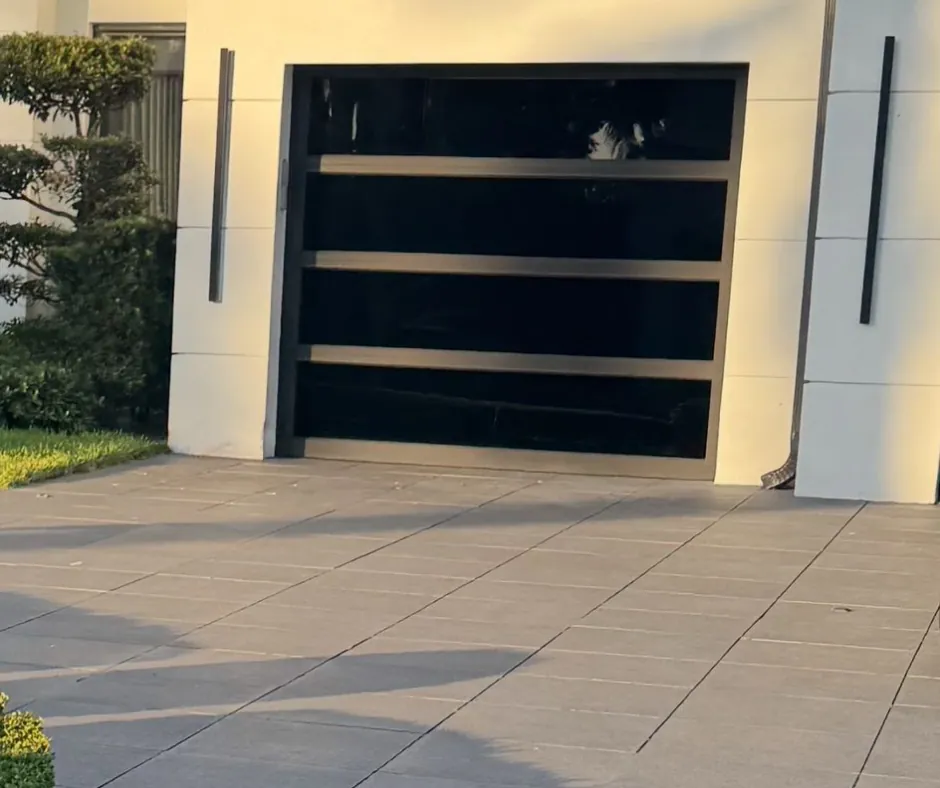
Short driveways, tucked-in garages and very little elbow room
On a typical Somerville lot the triple-decker fills most of the ground, the driveway runs alongside it for barely the length of one car, and the garage sits tucked in behind, often hard against a fence or the next building. Looking after garage doors in Somerville MA is shaped by that squeeze more than by anything else. A door with a car parked a foot from its face, a side wall that almost touches the track, a ceiling joist just above the spring: every repair here starts by working out where a person can stand.
Tight quarters also cause a share of the faults. A bumper nudges the bottom section because there was nowhere else to stop. A bin or a bike leans against the track because there was nowhere else to keep it. A door that sticks gets pushed by hand because nobody can get round it to see what jammed.
Three things worth noting before you call, all from where you stand:
- How close the nearest car, fence or wall is to the outside face of the door.
- Whether the door is fully shut, stuck partway, or hanging crooked in the opening.
- Whether anything is leaning on the vertical tracks or blocking the floor inside.
Working room: why it matters on every visit
A garage door has parts on both faces and above. The springs sit over the opening on the inside, the cables run down each side, the tracks curve back along the ceiling, and the bottom seal and the outside face of the bottom section can only be seen properly from the driveway. In a roomy suburban garage none of that is hard to get at. Behind a triple-decker it can be.
The usual pinch points are easy to list. A car parked close in front of the door means the door cannot be fully opened for testing, and the outside face cannot be inspected without moving it. A side wall within a hand’s width of a vertical track leaves no space to reach the track bolts or to swing a wrench. Shelving and storage hung from the ceiling crowd the horizontal tracks and the spring bar, and sometimes sit right where a ladder needs to go.
None of these stop a repair. They decide the order it is done in and how long it takes. A track bracket that cannot be reached from beside the door may be reached from above with the door raised and clamped; a bottom section that cannot be seen from outside may be inspected from inside with the door raised a little and blocked. What helps most is knowing about the space before arriving, so mention it when you call.
The doors you find behind the triple-deckers
Most garage doors in Somerville sit in single openings sized for one car, and many of those openings were framed long before the door now hanging in them. Some garages started life with hinged or sliding doors and had an overhead sectional door fitted later. Others have had two or three overhead doors over the years, each one hung on the brackets and shims left by the last.
That history matters when something goes wrong. A jamb that has been packed out more than once may not hold a fresh lag screw. A header lowered to take an earlier door may leave less headroom than a replacement spring would like. A bottom section that has been swapped before may not match its neighbours exactly, so the hinges between them carry an uneven load.
The surface of the door tells you something too. Steel doors in these back lots tend to rust first along the bottom edge, where snow is piled and rain splashes off a driveway that often slopes toward the garage. Wooden doors swell in wet weather and shrink in dry spells, and timber that has drunk in rain for years ends up outweighing the springs first set to carry it.
None of this means an old door is a bad door. It means the person repairing it has to read the garage as well as the hardware, and treat a stripped screw hole or a shimmed jamb as part of the fault rather than an afterthought. When garage doors Somerville MA owners call about are looked at this way, the repair holds instead of coming loose again a few months later.
Springs on a door that cannot be walked around
All the lifting comes from the spring. Most sectional doors have a torsion spring on a steel shaft above the opening; some older and lighter doors use a pair of extension springs that stretch along the horizontal tracks. Either way, a snapped spring hands its share of the load to the opener, a motor sized for guiding rather than hauling.
A torsion spring holds dangerous tension. It is wound tight with the door down, and the winding cone and set screws that hold it are under that load the whole time. Releasing or winding one takes proper winding bars and a clear area around the shaft, which in a cramped Somerville garage means moving whatever is stored under the spring before anything else happens. It is not a DIY repair, whatever a video makes it look like.
When the space above the opening is shallow, the spring arrangement has to fit what is there. That can affect which replacement suits the door and how it is mounted. Extension springs on older doors need a restraining cable threaded through each coil, so a snapped spring stays put instead of whipping across the garage, and in a narrow garage that whip would have very little room to spend itself.
Our Somerville spring repair page covers broken springs in more detail, including what a snapped spring sounds like and what to do while you wait.
Cables, drums and the corners that drop
Each bottom corner of the door is lifted by a steel cable. Torsion setups reel the cables onto grooved drums fixed to the spring shaft; extension setups loop them over pulleys. When a cable frays, slips off its drum or snaps, the corner it held drops and the door tilts in the opening.
Tight spaces make cable trouble more likely than you might expect. A door clipped by a car, even lightly, can jump a cable off its drum. A door pushed up by hand when the opener is not working can let a slack cable overlap itself on the drum. And a side wall close to the track makes it hard for anyone to notice a fraying cable until it lets go.
A slack or broken cable is a stop-everything fault. The door can drop further or twist out of its tracks, and the remaining cable and spring are still loaded. Both cables get renewed together, the drums are inspected for grooves and burrs, and the balance is reset before the opener goes back on.
Openers, remotes and safety sensors
An opener in a Somerville garage is often working harder than it should. Short driveways mean drivers press the remote while still turning in, the door starts and stops repeatedly, and several units may share the garage with several remotes. A door that is slightly out of balance makes the motor strain on every trip.
The common complaints are familiar ones. A motor humming away over a motionless door. A door that rises fine and then bounces back on the way down. A remote that has quit while its twin still works. A wall button that has gone dead. Each has a short list of likely causes: a disconnected trolley, a misaligned or blocked photo eye, a worn drive gear, a dead remote battery, or a wiring fault at the wall button.
The safety sensors deserve a special mention here. Mounted near ankle height on both jambs, in a narrow Somerville garage they live within reach of every handlebar and bin lid. Nudge one slightly askew and the beam stops lining up, so downward travel is refused. Before you phone about a door stuck in the raised position, check that both small lights on the sensors are lit and that nothing is in the beam.
For motors, handsets, wall controls and photo eyes in more depth, see Somerville opener repair; we also fix or swap out LiftMaster units.
Tracks and rollers on old framing
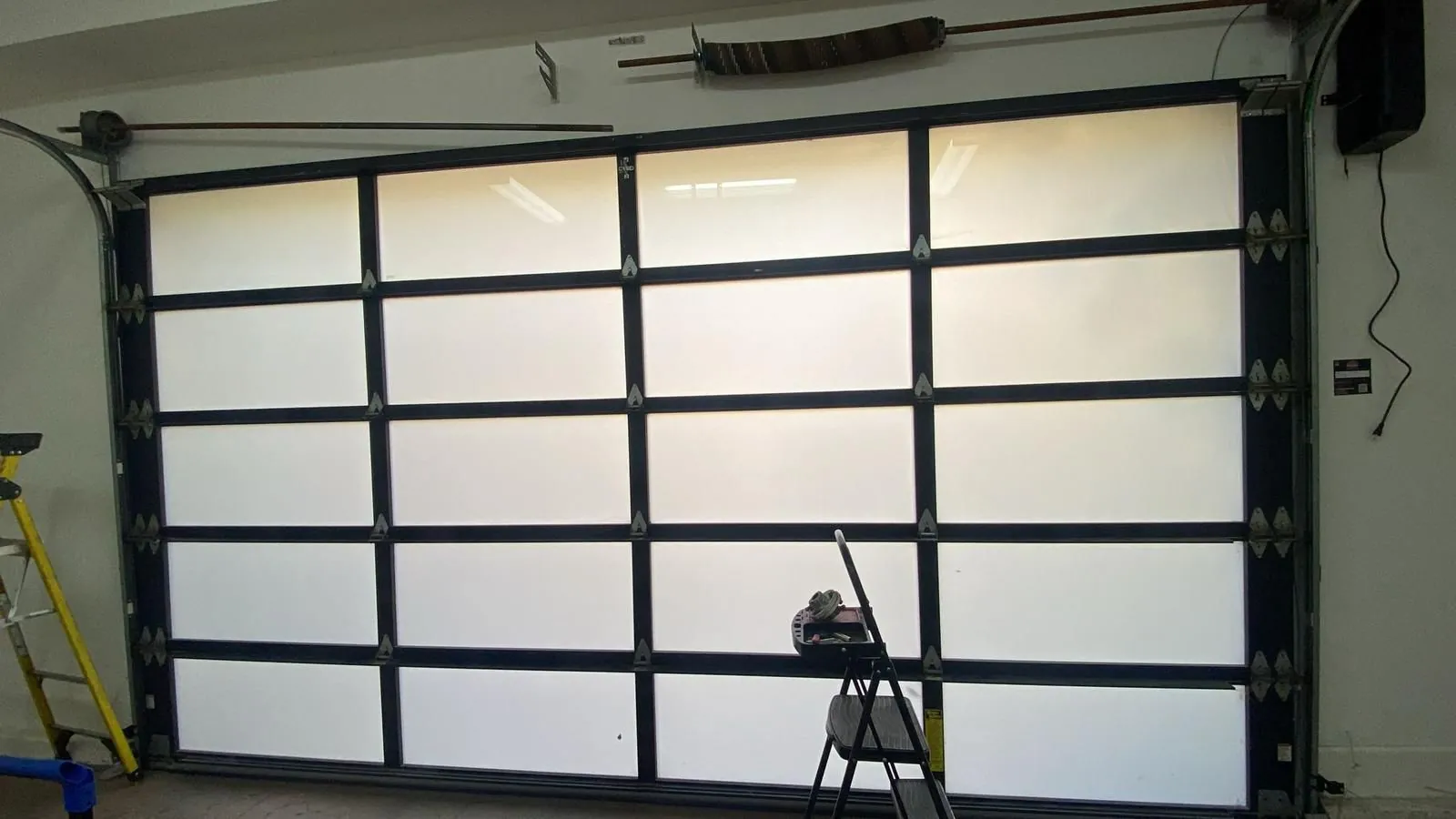
Many of the garages behind Somerville triple-deckers are older wood-framed buildings. Over the years the framing settles, the jambs shift, and the rails bolted to them wander. Once the two rails stop running parallel, the door binds at one point in its travel, rubs, or jerks.
Rollers wear out on their own schedule. A worn roller wobbles in the track, a seized one slides instead of turning, and a cracked one can catch and stop the door. On a door used by several households, rollers and hinges go sooner than they would on a single-family garage.
A door hanging out of its rails altogether should stay exactly where it is: nothing is carrying it properly, yet its springs and cables remain wound up. Resetting it involves propping the weight, easing each roller home, straightening or swapping any kinked rail, and testing cable tension before anything moves. Behind a triple-decker, nearly all of that happens from inside. There is more on the off-track garage door repair page.
Urgent calls at any hour
A door stuck open at night leaves the garage open to anyone walking past. A door jammed shut with the car behind it can wreck a morning. Somebody picks up our line whatever the hour, seven days running, so you can ring the moment the trouble starts instead of waiting for daylight.
Until help arrives, a few things are safe and sensible. Cut the opener’s power where it plugs in overhead, so nobody upstairs or downstairs tries the button again. Keep children and pets back from any door hanging askew or half raised. Leave a spring-broken door down rather than heaving it up, and leave a derailed one where it sits. Should the door be jammed open with no safe way to shut it, move valuables out of the garage or lock the internal door to the house.
The Somerville emergency repair page goes through the common urgent faults one by one.
How a Somerville visit unfolds
The space comes first. Before anything is taken apart, the area around the door is checked: what is in front of it, what is stored beside the tracks and under the spring, and whether a ladder can be set up safely. If a car has to move, that is the first request.
Then comes the balance test: with the trolley unhooked, the door is raised partway by hand and let go. If it hovers, the springs are doing their job; if it sinks or fights back, they are not. After that each spring, cable, drum, roller, hinge, rail and bracket gets its own look, and the motor, handsets, wall control and photo eyes are tried one by one.
Nothing goes ahead until you have heard which part failed, the likely reason, and which neighbouring parts are getting tired. Afterwards the balance is set for the repaired door, the opener’s stopping points and closing force are adjusted, and the auto-reverse earns its keep in a final test, with a scrap of timber set beneath the descending door. Where several units share the garage, pass on to the others what was replaced and which signs to look out for.
Repair or replace in a cramped garage
Most doors behind Somerville houses deserve a repair before anyone talks about replacing them. The moving hardware, from springs and cables through to hinges, rollers and the opener, is consumable by design, and swapping them gives a structurally healthy door a long second life.
The argument shifts toward a new door once the panels are what is giving out: steel eaten through along the base, wooden panels split or rotting, or a door so heavily patched over the years that it will not run straight any more. A door badly bent by a car can also be past saving if several sections are damaged.
In a tight garage, a new door has to suit the opening and the space behind it, not just the hole in the wall. Headroom above the opening, the distance from the opening to the back wall and the room beside each jamb all affect which door and track arrangement will fit. We supply and fit new garage doors, measured against the actual garage rather than an idealised one.
Making the next visit easier
A few habits keep doors working longer in a dense neighbourhood, and they cost nothing but attention.
- Leave a clear strip on the floor inside the door and keep stored items off the tracks.
- Park so the bumper stops short of the door, not against it.
- Tell everyone who shares the garage where the opener’s plug is, so a misbehaving door can be stopped.
- Listen for change. A door that grows louder, slower or jerkier is warning you before it stops.
When garage doors in Somerville MA start to show any of those signs, an early look is usually a smaller job than a breakdown. Our garage door repair service covers the full range of faults, and Somerville garage door repair narrows that down to this city’s crowded lots.
Neighbouring towns and the wider area
Elite Boston Garage Door Repair & Supply works across Greater Boston, and the triple-decker pattern carries on over the city lines. Similar narrow lots and tucked-in garages turn up in Cambridge and Medford. Every other town on our list appears on the service areas page.
Booking a door in around the space
Garage doors in Somerville MA tend to fail in the gap between one car leaving and the next arriving, and it is never a good time. When you get in touch, tell us how much room there is in front of the door and beside the tracks, whether the door is open, shut or stuck between, and anything that looks visibly broken. Knowing the clearances early means the job is worked out before the van parks. Customers have rated us 5.0 on Google, and our phone keeps ringing through to a person after dark, so a door that quits late gets reported late rather than tomorrow. Call us or book online.
Questions from Somerville
Our driveway is barely a car long. Do I need to move the car for a repair?
Usually, yes. A car parked close in front of the door stops it opening fully for testing and blocks the outside face. If the car cannot be moved, say so when you call and the visit will be planned from inside the garage as far as it can be.
The garage is shared by three units. Who should call?
Anyone who uses it can call. It helps if one person is the point of contact and can tell the others to leave the door alone until the visit, and if that person knows which remotes are in use.
Can a spring be changed when there is a shelf right under it?
The shelf will need to be cleared first. Winding a torsion spring takes clear space around the shaft, and anything stored underneath is in the way and at risk. Clearing it before the visit saves time.
The door hits the car parked behind it when it opens. Is that the door’s fault?
Not usually. An overhead door should rise straight up into the garage and not swing outward. If yours moves outward as it opens, it may be an older swing-up design or a sectional door whose bottom is catching, and either is worth a look.
Our door has started jerking on the way up. Can we keep using it?
Better not. Jerky travel usually traces back to a tired roller, a loose hinge, a fraying cable or a spring on its last legs, and every extra trip adds strain. Unplug the opener and arrange a visit.