
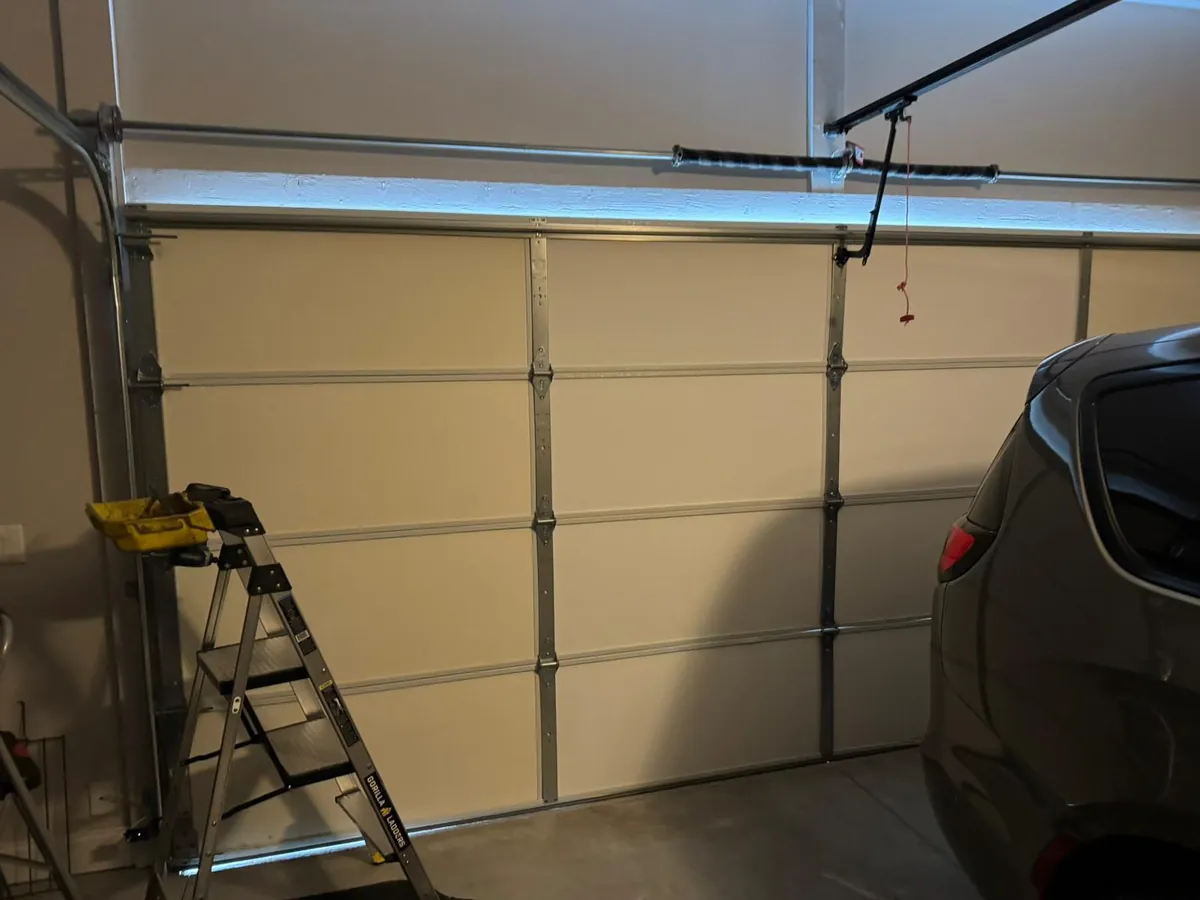
Salt, grit and small rear garages
Off Broadway and in the streets around Bellingham Square, two- and three-family houses stand on tight lots, and the garage, where there is one, is a small building at the rear. Those rear garages take a beating that a garage a few miles inland is spared. Salt air drifts in off the creek, and the constant flow of trucks on the main roads throws up grit and shakes the ground. For garage doors Chelsea MA owners rely on, that combination means springs, cables, rollers and track hardware age faster than their years would suggest.
Wear like this is gradual. A spring picks up a coat of rust. A roller starts to grind. A track bracket works loose a quarter turn at a time. The door keeps running, a little rougher each month, until one part gives out and takes another with it.
From a safe distance, look for:
- Orange rust on the spring coils, or rust dust on the floor below them.
- Broken strands sticking out from either lift cable near its bottom bracket.
- A rattle or shudder in the door as it moves, or a bracket that has visibly shifted on the wall.
Two kinds of wear, working together
Most door hardware is plain steel with a protective coating. The coating is what keeps it working, and both of the conditions in this city attack it.
Salt air is the slow one. Moist, salty air settles on every exposed metal surface inside a garage, and a rear garage with gaps around its door gets plenty of it. Once the coating thins, rust starts at the points that move or rub: the spring coils, each cable where it wraps onto its drum, the roller bearings and the screw holes in the brackets.
Truck traffic is the steady one. Heavy vehicles on Broadway and the routes nearby send a low vibration through the ground and the buildings, and road grit rides the air. Vibration loosens fasteners over time, especially in older wood framing. Grit settles in the tracks and on the rollers, and grinds away at anything that turns or slides.
Put together, the two make each other worse. A bracket loosened by vibration lets water into its screw holes, which rust and loosen further. A roller with a gritty bearing drags, the drag puts more load on the spring and the opener, and a rusted spring is the part least able to take it.
What that means in practice is that a door off Broadway rarely has a single fault. A visit for a snapped spring tends to turn up a gritty roller or two, a bracket that has crept, and a cable showing its first broken strands. Dealing with those on the same visit, where you agree to it, saves the door from limping on to the next breakdown a few weeks later. It also means a new spring is not left straining against a door that still drags.
Rear garages on two- and three-family lots
A two- or three-family house on a tight lot leaves little ground to spare, so the garage behind it is usually compact: one bay, a modest opening, sometimes a low roof. On a lot near Bellingham Square the garage may be squeezed between the back of the house and the rear fence, with a strip of paving barely wide enough to turn into. Garage doors Chelsea MA homeowners have on these lots are often the second or third door the opening has carried, fitted to framing that has been adjusted more than once.
The household pattern matters as much as the building. With two or three units on one lot, a single rear garage may be shared, split between parking and storage, or used by one family while another keeps bikes in it. Every extra user means more trips a day, more remotes in circulation, and more chances that somebody keeps working a door already halfway to failing. A spring that would last years on a single-family garage wears through sooner when the door cycles for a whole building.
It helps if one person on the lot keeps a list of the remotes and is the one the others go to when the door misbehaves. Shared doors are where a new rattle gets ignored the longest, because each user assumes somebody else mentioned it.
Panels, seals and the bottom edge
The bottom section of the door takes the most punishment. Snow cleared off a tight lot often ends up piled against it, slush from the road is tracked in on tyres, and water pools where the paving meets the threshold. On a steel door that is where rust starts, along the bottom edge and up the inside of the lowest panel. On a wooden door it is where rot starts.
The rubber seal along the bottom wears out too. Torn or squashed flat, it lets puddle water and road grit drive in under the door, and the bottom brackets that anchor the cables sit in the wet. That is one reason cables fail at the bottom first. A fresh seal is a quick fix, and it shields every bracket above it.
Where a matching panel can still be sourced, a dented or rusted bottom section is swapped by itself. The hinges on either side get looked at too, because a cracked hinge makes the whole door bow in its travel.
Springs: the part that breaks first
The springs do the real lifting. On most modern sectional doors that is a torsion spring on a shaft over the opening; on older and lighter doors it is a pair of extension springs running beside the horizontal tracks. Lose one and the opener finds itself hauling dead weight: it may raise the bottom edge a hand’s width before quitting, or refuse outright.
Rust shortens a spring’s life. Corrosion pits the wire and creates weak points, and a spring that has been rusting quietly is more likely to snap suddenly, often on a cold morning. If the household hears one sharp crack out back and finds the garage empty, the spring is the first suspect.
Torsion springs hold dangerous tension, carried every minute by the anchoring cones and set screws. Undo things in the wrong sequence and a winding bar or bracket can be flung across the garage, so treat it as strictly not a DIY repair. Extension springs want a containment cable through their middle; older doors here sometimes lack them, and fitting them is worthwhile.
The Chelsea spring repair page goes into spring faults in more detail.
Cables and drums under corrosion
The lift cables transfer spring power to the lowest corners of the door, and corrosion eats them from the core outward. Brackish moisture seeps between strands, the hidden inner wires go first, and only later do the outer wires begin parting one by one beside the bottom bracket, the soggiest spot on the whole door.
A cable that has started to fray should be treated as a cable about to break. When it goes, that corner sags, the door racks sideways, and rollers may pop out of the rail. Cables are always replaced as a pair, the drums are checked for wear and rust, and the door is rebalanced afterwards.
Rollers, tracks and loosened brackets
Grit is hard on rollers. A roller whose bearing has filled with road dust stops spinning freely and starts to slide, which wears a flat on it and drags on the track. You hear it as a grinding or scraping, often at the same point in every trip.
Brackets are where the vibration from Broadway shows up. Screws in old timber framing gradually work loose, and a bracket that has crept even slightly lets its rail lean. Rails that lean apart pinch the door at one spot, and in bad cases a roller jumps out completely.
A derailed door is a hands-off door. Its springs and cables stay wound, yet nothing is holding it properly. Restoring it takes clamps to pin the weight, coaxing each roller back home, swapping any kinked rail, and screwing the brackets into fresh timber, with cable tension confirmed before it moves. The off-track garage door repair page has more on this.
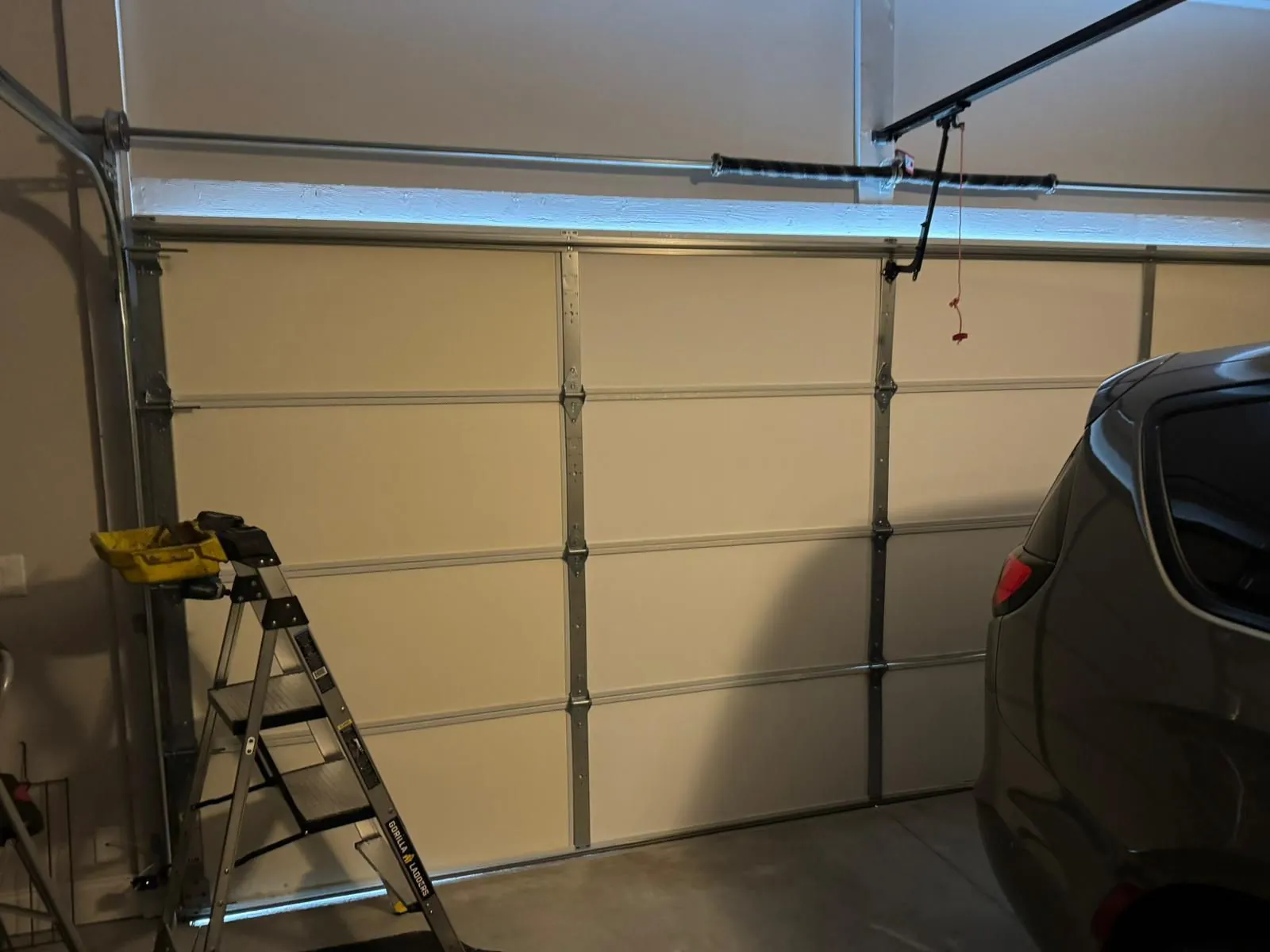
Openers, remotes, wall buttons and sensors
The opener is designed to move a balanced door, not to lift a heavy one. When rust and grit make the door harder to move, the opener works harder on every cycle, and its drive gear and motor wear faster as a result. Many opener faults in rear garages here are really door faults showing up at the motor.
Typical complaints include a motor that runs without the door moving, a door that reverses before it shuts, a remote that has stopped working and a wall button that does nothing. Before calling, run through the basics: power to the opener, both photo-eye lights glowing, nothing breaking the beam, and whether the wall control responds while the handset stays dead.
Sensors in a small rear garage live close to the floor, close to the bins and close to the grit. Road dust on a lens, or a bracket bumped out of line, keeps the opener from lowering the door. A soft dry rag over both lenses is harmless and frequently all it takes.
Openers get repaired or replaced here, LiftMaster models included, right down to the handsets and photo eyes; Chelsea opener repair has the specifics.
When it cannot wait
A door that will not close leaves a garage open to the street. A door jammed down can trap a work van just when it is needed. Whatever the clock says, a person answers when you ring us, any day you ring, so report the trouble as soon as you find it.
Before help gets there:
- Pull the opener’s plug and tell the other units on the lot not to touch the button.
- Keep children well back from a door that sits lopsided or halfway.
- A door with a snapped spring stays put; nobody hauls on it.
- Never shove a derailed door toward its rails.
Chelsea emergency repair goes through each urgent fault in turn.
Getting in and out of a tight lot
Reaching a rear garage on a tight lot is part of the job. Ladders, springs, track sections and tools are carried in from the street, often past the house and along a narrow side passage or a shared driveway. Cars parked in that passage, or bins lined up along it, make the carry longer.
Inside, small rear garages are often used for storage as much as parking. Boxes against the walls and items hung from the ceiling can sit right beside the tracks or under the spring shaft. Shifting those boxes back from the jambs, and freeing the floor under the spring shaft, means tools come out the moment the door is reached.
Where the only route in is through a gate or across a neighbour’s paving, mention it on the phone and have the gate unlocked.
What happens on the day
First the opener is uncoupled, so the door can be moved manually; that alone reveals whether the springs still balance it and at which point it drags. Then every part of the hardware is looked at in turn: both springs, both cables and drums, each roller and hinge, the tracks along their length and every bracket where it meets the wall. Rust is noted wherever it is found, because a rusted part that is still working today may be the next to fail.
The opener is checked separately: the motor and drive with the door disconnected, then the remotes, the wall button and the photo eyes.
Before a spanner turns, you get the diagnosis: the failed part, the reason, and any other part running out of road. Once the work is done the springs are trimmed to the door, the opener’s end points and closing force are dialled in, and reversal is confirmed by bringing the door down on a short length of board.
Repair, or a new door
Most of the time, garage doors Chelsea MA homes have behind them can be repaired. Hardware is meant to be swapped as it wears, and sound panels outlast several rounds of it.
Sometimes, though, the panels are what has failed. Bottom sections rusted into holes, a skin split by a reversing truck or car, or a door so laden with corrosion and old patches that it never moves cleanly: those are the cases for starting over. A rear garage on a tight lot gets a door sized to its own opening, its headroom and the gap beside each jamb. We supply and fit new garage doors, hauling the old one away on the same visit.
Keeping hardware going longer
A few simple habits slow the wear down, and none of them means going near anything wound under tension.
- Shovel snow away from the bottom section rather than toward it, and sweep out puddles.
- Sweep grit away from the floor along the tracks.
- Wipe the sensor lenses now and then.
- Pay attention to new noises. A grind, a squeal or a thump mid-travel deserves a phone call while it is still only a noise.
When garage doors in Chelsea MA start making a new noise, some part is usually on its way out. Our broad garage door repair service handles the lot, while Chelsea garage door repair zooms in on this city.
Across the creek and beyond
Our work reaches right across Greater Boston, including the cities on Chelsea’s borders, Everett and Revere. The rest are gathered on our service areas page.
Getting it sorted
Garage doors Chelsea MA owners call about are usually stuck at the worst time, and the call goes better with a few details. Say how the rear garage is reached from the street, how the door is behaving, any rust or dangling cable you have spotted, and whether a vehicle is shut in. Google reviewers give us 5.0, and a real voice answers at every hour, even long after Bellingham Square has gone quiet. Call us or book online.
Questions from Chelsea
The spring looks rusty but the door still works. Should I wait?
It is worth having it looked at. Rust pits the spring wire and makes a sudden break more likely, and a break usually comes at an awkward moment. A check now costs less disruption than a door stuck shut later.
Why does my door grind more than it used to?
Grit in the roller bearings or a roller worn flat is the most common cause, especially in a garage near busy roads. A loose bracket letting the track drift can also make a door grind at one point in its travel.
Can I oil the rusty parts myself?
Wiping the sensor lenses and sweeping grit from the floor are safe. Spraying or prodding the springs, cables or bottom brackets is a different matter; all three stay under serious tension, and that is where garage injuries happen.
Our garage is reached through a narrow passage beside the house. Is that a problem?
No, but it helps to know in advance. Parts and ladders are carried in by hand, so clearing bins or bikes from the passage and opening any gate before the visit saves time.
The door closed halfway and went back up. What does that mean?
Usually the safety sensors saw something, or the opener felt resistance and reversed. Make sure the beam is unobstructed and both little sensor lamps are lit. If it keeps happening with the beam clear, the door may be binding or out of balance.