
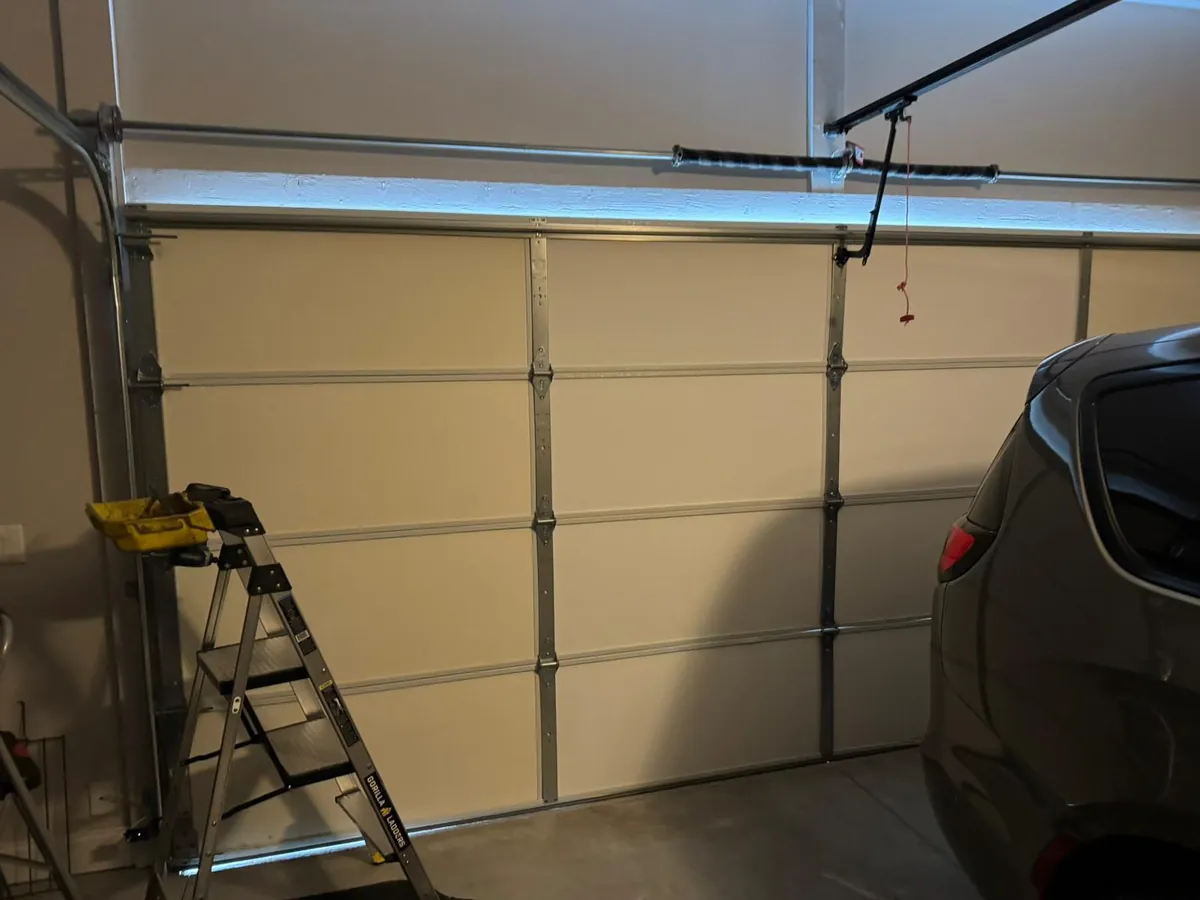
Mid-century two-car openings on colonials and capes
Around Dedham Square and through Oakdale, the house is usually a colonial or a cape, the garage is joined to it, and a full driveway runs up to the door. Many of those openings date from the nineteen-fifties, when a two-car bay was framed around the cars and hardware of its day. That age is where most work on garage doors Dedham MA homeowners ask about begins: the carpentry is mid-century even where the door hanging in it is far younger.
A bay of that vintage may have started life with a pair of hinged leaves or a one-piece tilting panel and only later gained a sectional door. Each swap leaves fingerprints on the jambs and header: extra blocking, plugged holes, shims tucked in to bring the opening back toward square. A door hung inside carpentry like that can run sweetly, but its rails are only ever as steady as the timber they are screwed into.
Before you pick up the phone, glance over these:
- A rail bracket drifting off the jamb, or a lag screw that spins without biting.
- Sections brushing one side of the opening, or a wedge of daylight under one end once shut.
- A visible split somewhere along the coil above the opening, or a lift cable lying limp.
Garage door services in Dedham
Garage door repair
Sagging sections, split hinges, rollers grinding in their rails, panels creased by a car reversed out at a slant. On a mid-century jamb, re-seating loose brackets is often part of the job. See garage door repair.
Spring repair
Once a coil parts, a two-car door turns into a slab nobody can raise. Torsion and extension types are both renewed, each matched to what the door on the day weighs. See garage door springs.
Openers, remotes and sensors
Drive units that hum and sit idle, handsets that have forgotten their pairing, keypads, wall buttons and the photo eyes guarding the threshold. See opener repair and replacement.
Calls at any hour
Someone picks up whatever the clock says, weekends too, when a bay is stuck open or a car is boxed in. See emergency garage door repair.
Lift cables and drums
Frayed wire rope, cables that have hopped their drums, and the corner brackets those cables pull on. See garage door cable repair.
Off-track doors and new doors
Rollers shoved out of their rails, kinked track straightened or renewed, and a fresh door supplied and hung once the old one has had its day. See off-track repair and new garage door installation.
The carpentry behind the door
Every overhead door is half steel and half surround. The surround is the jambs either side, the header over the top and the framing above that header where a torsion coil is anchored. In a bay framed in the nineteen-fifties, the surround has outlived several doors, decades of freeze and thaw, and usually a renovation or two.
Timber shifts. A jamb can twist as it seasons, a header can drop a fraction, and screw holes that served one generation of brackets end up serving the next until they can grip nothing. Where a newer garage just needs a lag screw snugged up, a Dedham bay from that era may have a screw rotating uselessly in wood already chewed out twice. The cure there is relocating the bracket onto solid stock, or bolting a steel plate behind it to spread the load.
Headroom is the second legacy. Some bays of the period were framed with a lower ceiling than builders use now, which governs where a torsion bar can mount and how much clearance an opener rail has. Replacement hardware is picked to fit the room that really exists over the opening, not the clearance a brochure drawing assumes.
None of that makes an older bay a headache. It simply means a technician on a Dedham job inspects the wood with the same care as the springs, and expects an opening that has been adapted more than once.
When the coil gives out
Spring failures lead the list of urgent calls, and on a two-car door the result is blunt: yesterday the door glided, today it will not shift, or the opener manages a hand’s breadth before stalling. Many owners recall a loud crack from the garage hours before they noticed anything wrong.
Plenty of doors on these colonials and capes hang from a torsion coil over the header, and wider doors often from two coils sharing one bar. Older or lighter doors may instead rely on extension springs drawn out beside the overhead rails. Let there be no doubt here: a torsion spring holds dangerous tension, and renewing one is not a DIY repair on any Dedham driveway. Its cones, set screws and bar are all loaded with the door down, and a slipped winding bar becomes a missile. Extension springs want a safety line run down the middle of each one, so a snapped coil stays captive; where those cables are absent, they get added.
Coils are sized to the door’s true weight. A door that has gained struts, new skins or heavier sections since it first went up can outweigh the springs that came with it, and that mismatch alone is enough to grind an opener down.
Wire rope, drums and corner brackets
Cables carry the spring’s pull to the foot of the door. On a torsion setup each one wraps a drum at the end of the bar and drops to an anchor at the lower corner of the door. Set right, the pair share the load equally and the door rises flat. Once one frays, slips or unspools, that end droops, the sections rack sideways, and the door may wedge or crash down.
Wire rope wears for ordinary reasons: chafing on a sharp bracket, rust in a damp bay, or months of use while another part was already failing. A cable leaping its drum usually follows the door landing on something left in its path, or a spring snapping and suddenly unloading everything. Whatever the cause, the pair is renewed at one sitting so neither end lags, and the corner anchors are inspected alongside them. Nobody should loosen an anchor still under load before the spring has been safely let down.
Openers on a colonial or cape
An attached bay on these houses is frequently how the household comes and goes, so a dead opener is a real nuisance. The drive unit may also be bolted beneath a bedroom or den, carrying hum and vibration indoors.
Opener faults tend to sort themselves into families. Sections that start down and then rise again usually point to a photo eye that is smudged, knocked askew or blocked, or to a closing force that was never re-tuned after earlier work. A drive that whirs while nothing moves hints at worn gearing or a trolley left disengaged. A fob that works only once you are almost under the door may want a battery, or the antenna on the unit may be bent. And a door that has grown noisier month on month is usually complaining about its wheels and hinges rather than the motor.
Balance is checked before any drive unit is condemned, since a door too heavy for its springs will wear out whatever opener pulls it. Where a new opener really is the answer, it is picked to suit both how heavy the door is and how much ceiling there is. LiftMaster openers are among the units we mend or replace on Dedham ceilings.
A visit, start to finish
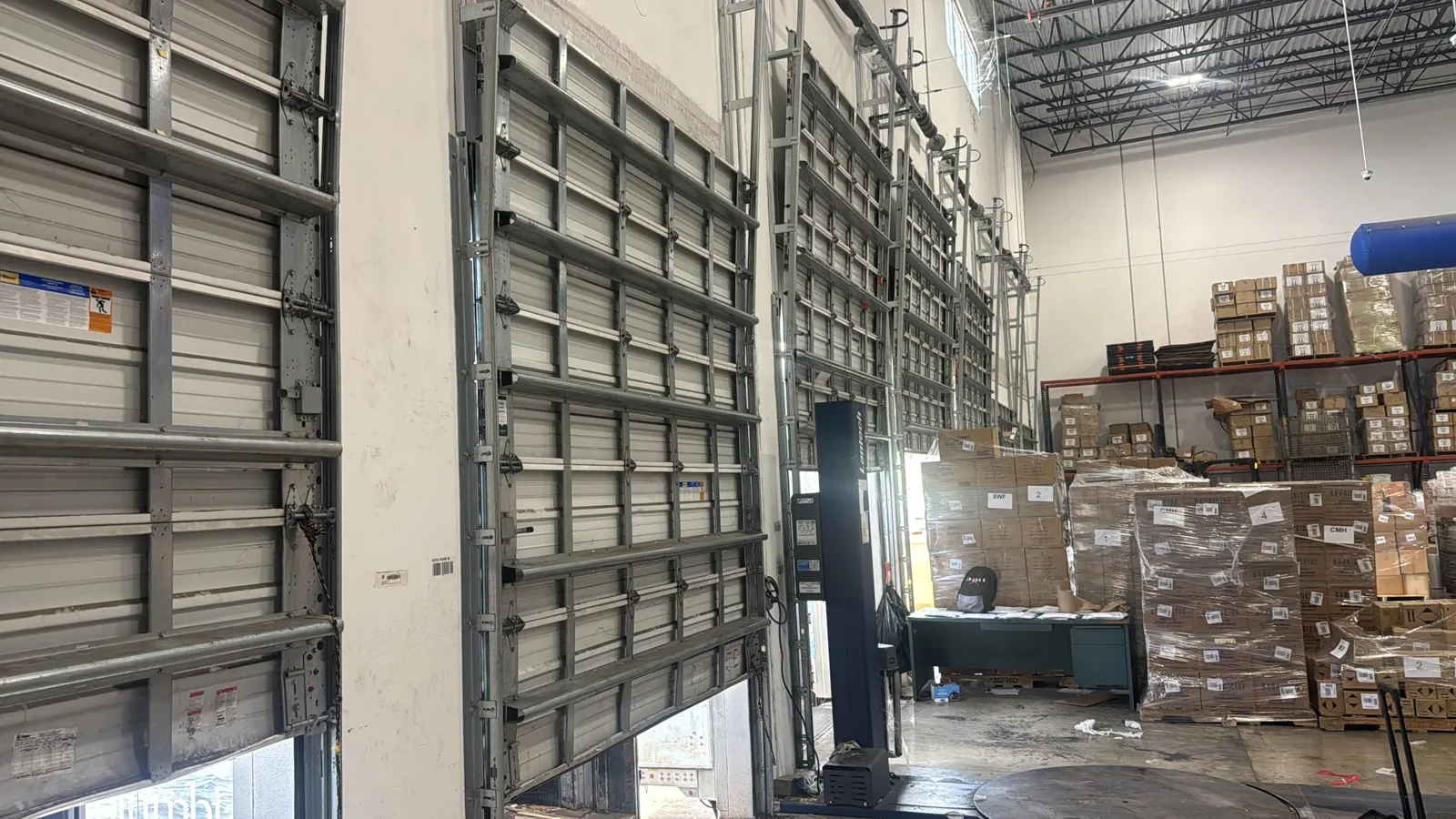
The technician begins on the driveway with the door down: is the gap along the slab even, are the sections true, does the door sit square in the frame? Indoors, the release cord comes out and the door is raised by hand. Sound balance means it can be parked at half height; a door that slumps or refuses to rise has a spring or cable fault.
From there, part by part: the coils and their bar; each cable and drum; every wheel and hinge across the span; vertical and overhead rails and the brackets pinning them to jambs and joists, with a hard look at the wood under each one. The opener then runs solo, each fob and the push button get their turn, and the eyes are tested.
You get a straight account of what broke, what caused it and what else is worn thin, and work begins only with your go-ahead. Afterwards the springs are trimmed for balance, the opener’s travel and force are re-taught, and the auto-reverse is proved against an obstruction left on the slab.
Whatever the hour
Doors pick awkward moments. Coils favour cold mornings, when the steel is stiff and loaded hardest. A bay jammed open after dark leaves an attached garage, and often the house beyond, wide open. Calls reach a real person day or night, weekends and holidays too, so a problem found late can be logged straight away.
Meanwhile, pull the opener’s plug so the door cannot be cycled. Usher everyone away from a door hanging askew or dropped at one corner. If the bay is stuck open, lock the inner door that leads into the house. Never heave a spring-broken door upward or prop it on something, and leave the coils, cables and corner anchors untouched.
Out of its rails
A full driveway with room to turn makes bumper strikes rarer than on a cramped city lot, yet they still occur: a door that had not finished rising, a misjudged mirror, or a door coming down onto a roof rack the eyes never saw. With one or more wheels out of the rail, the door hangs unevenly and could fall.
Driving it home with the opener, or shoving it straight by hand, usually bends things further. Unplug, stand clear, and ring us. The repair means clamping the door so its weight leaves the wheels, straightening or replacing kinked rail, easing each wheel back in, and confirming both cables pull equally before anything moves.
Mend it or replace it
Most doors earn a repair. Coils, cables, wheels and hinges are consumables, and sections in good order run on for years once those are renewed. Replacement starts to pay when the sections themselves are finished: steel eaten through along the foot, timber panels split or spongy, or a door so patched it no longer tracks true.
On a nineteen-fifties two-car bay, replacement doubles as a chance to sort the surround. Jambs can be repaired or re-faced, the header assessed, and the new door, rails and springs set to the opening as it now stands. Some owners take the moment to choose a style that suits the colonial or cape it fronts. We supply and hang the new door and take the retired one away. Whether to replace any of the garage doors Dedham MA households have used for decades stays your call, made after an honest look at both the door and its frame.
Single wide door or a pair
A mid-century two-car opening may be closed by one broad door or split by a centre post into two narrower ones. Each layout has its quirks. One broad door is a heavy, long piece balanced on a single spring assembly; its sections need struts to stay straight across the span, and any cable stretch shows up as a door that lands lopsided. Two narrower doors halve the load on each set of hardware, but they double the parts count, and one door nearly always gets used far more than its twin, so wear is rarely even between them.
Converting from a pair to one broad door, or the other way round, is possible on some bays and not on others. It depends on whether the centre post carries load from above and on how the header was built. That is assessed on site, never assumed. For garage doors in Dedham MA where a pair already works well, there is seldom a reason to change the layout just for the sake of it.
Seals, drafts and a bay joined to the house
Because the garage on a colonial or cape shares a wall with the house, its door is part of the building’s outer skin. A bottom seal that has gone flat or torn lets cold air, rain and leaves drift under the door and pile against that shared wall. Gaps down the jambs let drafts into a space that may sit right beside a kitchen or mudroom. On a mid-century bay, the slab beneath the door has often settled unevenly over the years, so a new seal that looks fine at one end can still leave daylight at the other.
Replacing a worn bottom seal and resetting the stops along each jamb so the sections seat tightly along both sides is a modest job with an obvious payoff, especially through a Dedham winter. Where the slab dips, the seal is chosen and set to follow it, and the cables are checked so the door lands on both corners together instead of rocking onto one.
It is also worth looking at the weatherstrip across the header. On a door hung in an older opening, that strip is often a later addition nailed to a header that has moved since, and it can rub the top section on every trip. A door that squeals at the very end of its travel is frequently catching there. Small fixes like these are part of keeping garage doors Dedham MA houses rely on quiet, tight and easy to run.
Readying the driveway
A full driveway gives elbow room, which makes the day easier than on a cramped lot. Moving cars out of the bay and back from the door, clearing a strip along each inside wall beneath the rails, and leaving the opener’s socket reachable all speed things up. Where the house alarm has a sensor on the garage door, say so when booking.
Nearby
Dedham neighbours Westwood and Needham, both towns we serve, and borders West Roxbury on the Boston side. The full roster sits on our service areas page.
Getting started
When you reach out about garage doors in Dedham MA homes depend on, let us know if the bay has one broad door or two, roughly how old the opening is if you know, what the sections are doing, and whether a car is stuck inside. Photos of the coil over the header and of both lower corners are a real help. The line is staffed whatever the hour; once you have that much, call us or book online.
Questions from Dedham
Why does a rail bracket on our older opening keep working loose?
On a bay of that age, the screws are often biting into wood that has carried several sets of brackets already. Re-tightening buys a little time; the lasting cure is moving the bracket onto solid timber or adding a backing plate.
Our two-car door suddenly weighs a ton. Is the opener to blame?
Seldom. A door that has turned heavy overnight nearly always has a snapped or tired spring. Stop pressing the button, unplug the unit, and look above the header for a split in the coils.
Can a new door go into a nineteen-fifties opening?
Yes. The opening is checked first, any tired jamb or header is put right, and then the new door, rails and springs are fitted to suit it.
A cable has unwound from its drum. May I rewind it?
Please do not. Spring force keeps that cable loaded and can let go in an instant. Leave everything as it hangs, unplug the opener, stand clear, and ring us.
Can the door and the opener both be dealt with on one visit?
Yes. They work as a pair, so both are looked at whenever we come out, and anything you approve can be done together.