
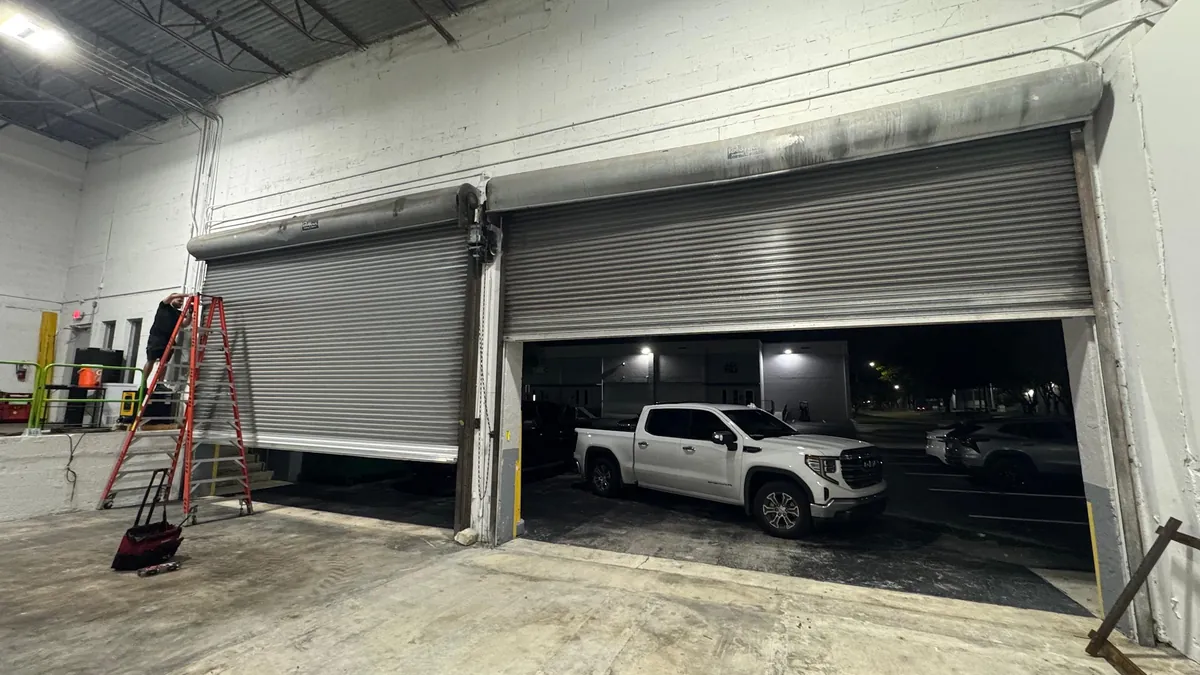
One-car garages below the street on Stoneham’s sloping lots
On the streets around Spot Pond, a great many houses are capes and ranches with a one-car garage built onto the house, and a good number of them sit below the road, so the driveway runs downhill from the kerb to the door. That combination, a single door at the low point of the lot, explains much of what goes wrong with the garage doors Stoneham MA homeowners depend on.
Gravity is the theme. Rain and meltwater follow the slope of the driveway and arrive at the threshold. Grit, leaves and road salt wash down after them. In winter the low point is where slush refreezes, so the bottom of the door can end up sealed to the slab by a ridge of ice. And because the slab and the driveway meet at an angle, the floor under the door is rarely as flat as a door designer would like.
A single attached garage also means there is only one door in or out for the car. When it jams, the car is going nowhere. Three quick things to note before calling:
- Does the bottom rubber meet the concrete along its whole length, or is there a wedge of daylight at one end?
- Is the door frozen down, or does it simply refuse to move?
- Are both springs and both cables intact when you look up from inside?
Garage door services in Stoneham
Every kind of work below is done here, and each card leads up to the main page for that service. Whatever is wrong with the garage doors Stoneham MA capes and ranches carry, it usually falls under one of these.
General repairs on single doors
Sticking, scraping, a bottom section warped by standing water, a hinge cracked from years of use. The main garage door repair page lays out the full range.
Torsion and extension springs
Single doors here run on either a torsion spring above the header or by stretched extension springs alongside the overhead rails. Either can snap without warning; the spring repair page explains both.
Openers on a single bay
An opener that strains on an icy morning, a remote with a short range, a photo eye splashed with mud. We repair and replace openers, LiftMaster ones among them, as described under opener services.
A door that fails after dark
With one bay and one door, a failure can leave the only car shut in. Our phone is staffed through every night of the week; emergency garage door repair covers the first steps.
Frayed and slipped cables
Salt and damp at the foot of a driveway are hard on the bottom brackets where the cables attach. Read about cable repair on the main page.
Doors pulled off their tracks
A door closing onto an ice ridge or a sloping floor can twist enough to pop a roller. See off-track garage door repair for what happens next.
Fitting a new door
When the sections are rotted or rusted through, a new door is supplied and installed in the same opening. More under new garage door installation.
Runoff, slush and the lowest door section
A driveway that falls toward the house delivers everything downhill to one place, and on a single attached garage that place is the bottom section of the door. It is the part of the door we replace most often on these lots, and it is worth understanding why.
The bottom section sits in the splash zone. Every rainstorm sends a sheet of water down the driveway, and a door with a worn or flattened bottom seal lets that water under and across the garage floor. Steel bottom sections rust from the inside edge outward, where the seal retainer traps moisture. Wooden doors soak it up through the end grain and swell, then crack and rot along the lowest panel. Either way, the bottom of the door deteriorates years before the top.
Ice adds a mechanical problem. If the door is closed onto slush that then freezes, the seal and the bottom edge are glued to the slab. Pressing the opener button on a frozen-down door can tear the seal, bend the bottom section, or overwhelm the opener, which keeps pulling until something gives. A cable can unwind from its drum if one side breaks loose before the other. The right move on a frozen morning is to stop, unplug the opener, and loosen the edge gently with warm water or a de-icer rather than with the motor.
Prevention on a sloping lot is mostly about the seal and the threshold. A fresh bottom seal of the right profile closes the gap; a threshold strip on the slab can turn the water aside before it reaches the door. Neither changes the slope of the driveway, but together they keep most of the runoff outside.
When the floor is not level
Sectional doors are made dead square and assume a flat slab beneath them. Where a driveway pitches down into a garage, the slab inside is often poured with a slight fall of its own toward the opening, and it may have settled since. The result is a door that touches down on one side first, leaving a gap at the other.
That gap matters more than it looks. The opener stops when the door meets resistance, so if one corner lands early, the door may stop short and leave a draught and a path for water at the other end. On other openers the early touch registers as something in the way, and up the door goes again. Owners sometimes respond by turning up the closing force, which hides the problem and weakens the opener’s safety reverse at the same time.
The fix is rarely to force the door down. A bottom seal with more depth can take up an uneven floor; the door’s bottom bracket and the track positions can be adjusted within limits; and the opener’s down limit can be set so the door seals without crushing anything. Where the slab itself has sunk badly, that is a job for a concrete contractor, and we will say so plainly rather than adjust the door around it indefinitely.
Capes, ranches and the garage built onto them
On a ranch, the garage usually carries on from the end of the house under the same low roofline, and on a cape it is often a wing or an ell added to one side. In both cases the space above the door tends to be modest. That limits where a torsion spring can sit, how much room an opener rail has, and how a replacement track is laid out, so parts for these garages are chosen to fit the ceiling height that is actually there.
Being attached also means the door shares a wall, and sometimes a heating bill, with the house. Once its perimeter stops sealing, the door lets cold air and damp into a space that leads straight into a hallway or a kitchen. Much of the work on garage doors Stoneham MA ranches and capes carry is about restoring that seal as well as the movement.
Springs on a one-car door
A broken spring is the call we take more than any other, and on a single garage it usually shows up the same way: a bang from the garage, often overnight or on a cold morning, followed by a door that the opener lifts a few inches and drops.
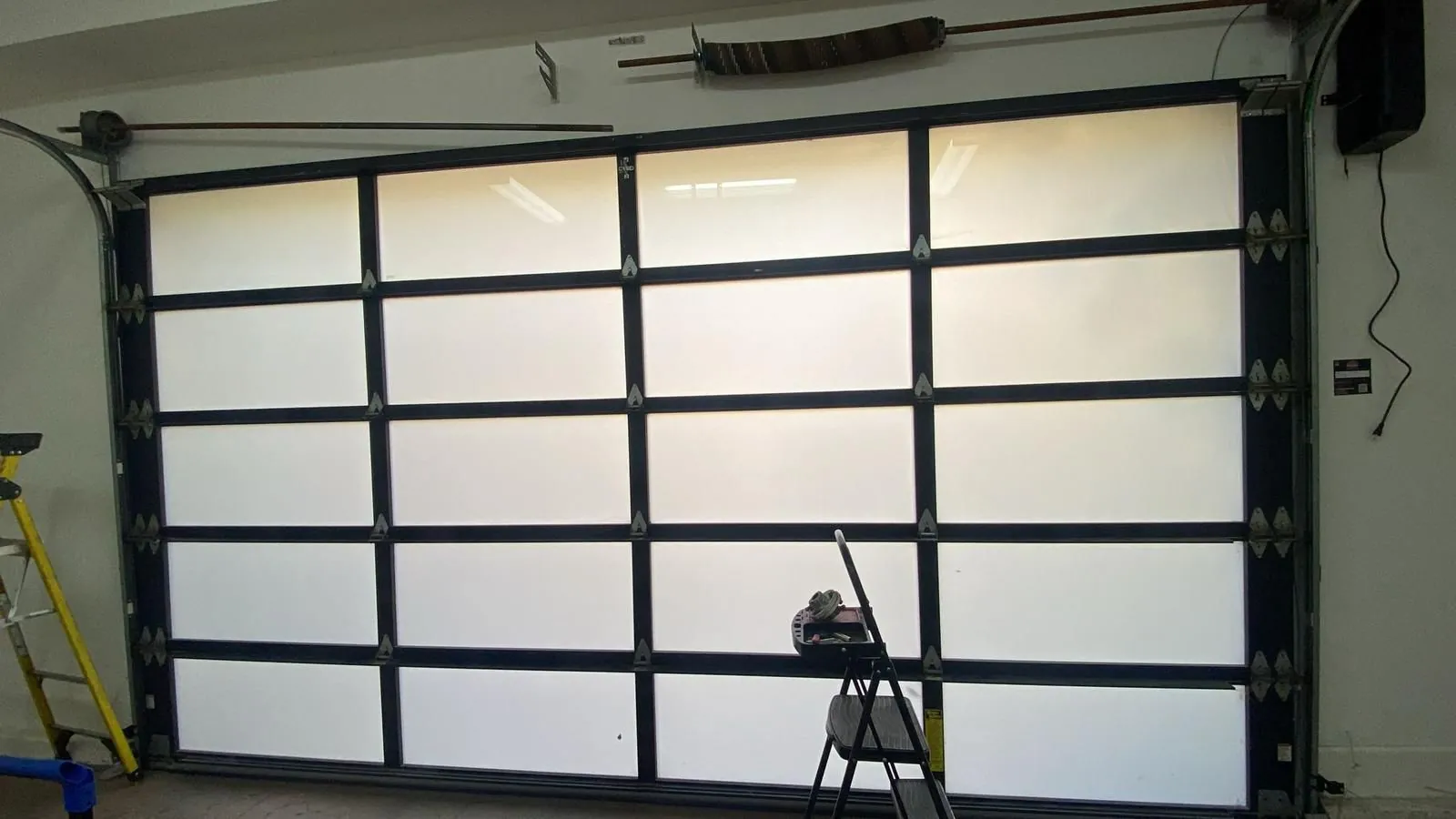
On plenty of capes and ranches the single door is balanced by one torsion spring wound around a bar just over the header. Others, especially older or lighter doors, hang from a long extension spring on each side, running parallel with the ceiling rails over the car. Each type breaks in its own fashion. A torsion spring cracks across a coil and the two halves spin apart on the shaft; an extension spring snaps and, if it has no safety cable through it, can lash across the garage.
Both kinds are under heavy tension. A torsion spring in particular stores enough energy to injure someone badly if it is released the wrong way, so fitting a replacement is not a DIY repair, whatever the hardware shelf suggests. If you look up and see a split in the coil, or an extension spring hanging loose, leave the opener switched off and keep your hands off the door. Its whole weight is now resting on the cables, the opener and nothing else.
When the spring is replaced, it is sized to the door’s actual weight. On a lot where the bottom section has soaked up water or been patched, the door can be heavier than it was when the original spring went in, so the new one has to match the door as it is today.
Openers, sensors and a cold, wet threshold
The opener on a single garage works hard in this kind of setting. It has to break the door loose on frozen mornings, and it is the first thing to notice a door that has become heavier or more awkward to move. A few patterns come up repeatedly:
- The opener hums and the door barely moves, then it gives up. On a cold day that can be ice at the bottom; on a mild day it is usually a broken spring.
- The door reverses before closing. The photo eyes sit close to the floor at the bottom of a slope, where they collect mud, slush and the odd leaf, and where a wet broom or a shovel leaning nearby can knock them out of line.
- The remote only works close to the house. If the driveway is long and steep, the car may be some way above the garage when the button is pressed, so a weak remote battery shows up sooner.
- The opener starts and stops at random. That is sometimes a wall button or its thin bell wire nicked where it runs down the wall near the floor.
We start every opener job by checking the door on its own, with the opener disconnected, because no opener repair lasts if the door behind it is out of balance. Once the door moves freely, the opener’s travel, force and safety reverse are set to suit it. Where the opener itself is worn out or no longer reverses properly, it is replaced, and LiftMaster openers are among the models we work on.
Cables, rollers and tracks
Each cable ends at a steel bracket screwed to a lower corner of the door, and on a downhill drive those brackets spend the winter sitting in the wet. Salt from the driveway, standing water and repeated freezing all attack them. A rusted bracket can let a cable tear away, and a cable that has been sitting in damp grit frays at the bottom first, where you can sometimes see broken strands.
If one cable is slack or has come off its drum, the door hangs crooked. Stop using it there and then. An opener hauling on a lopsided door bends the rail on the loose side, and soon enough the rollers climb out of it.
Rollers and tracks suffer in a quieter way. Grit carried in by water collects in the bottom of the vertical tracks, and rollers grind through it. Where the slab tilts across the opening, the bottom rollers may also be forced against the track on one side, which wears the track and the rollers unevenly. A door that rumbles or catches at the bottom of its travel is often telling you that the lowest pair of rollers or the bottom of the tracks needs attention.
What a visit involves
A visit begins with the door, not the parts list. With the opener’s trolley unhooked, the door is hand-lifted to about the height of a kitchen counter and let go. A door in good balance stays there; one that slides down is under-sprung; one that rises is over-sprung.
Then the whole door is looked over: the spring or springs, both cables and their bottom brackets, the drums, the hinges between sections, every roller, the tracks top to bottom, and the bottom seal against the floor. On a sloping lot we look closely at the bottom section, the bracket fixings and the slab under the door. Each remote, the wall button, the photo eyes and the opener’s motor get their own trial.
Nothing gets unbolted until you have the diagnosis: the failed part, why it failed on this slope, and anything nearby that looks tired. Once the work is done, the spring is trimmed to the door, the opener relearns its stops, and a short length of two-by-four on the threshold confirms the door backs off when it meets something.
Keep the one-car door, or start again?
For a one-car door, mending is normally the answer. The hardware wears by design, and a door whose sections are still solid can carry on for years once the tired pieces are swapped.
Replacement earns its place once the lowest sections themselves are spent. A steel bottom section rusted through, a wooden door rotted along its lowest panel or swollen so much it no longer fits the opening, or a door that has already had its bottom section replaced and is now failing higher up: these are signs that the money is better spent on new garage doors Stoneham MA owners can rely on through more winters. A new door for a sloping lot can be chosen with that in mind, with materials that resist standing water and a bottom seal suited to the floor.
Safe things to do while you wait
You can usefully do a few things without putting yourself at risk:
- Pull the opener’s plug when the door is jammed, iced in or hanging askew, which stops anyone from trying the button once more.
- On a frozen door, clear loose snow away from the outside of the threshold and leave the rest to thaw or to a de-icer.
- Wipe both photo eyes and check that nothing is leaning against them.
- Swap the remote’s battery if the wall button still works.
Keep away from the springs, the cables and the corner brackets, and if the door suddenly feels like lead, stop lifting. Those parts stay loaded in every position the door can take.
Booking a visit
Single garages leave no spare bay, so a failure tends to matter immediately. Our phone gets picked up deep into the night and right through the weekend, so a door that freezes shut before work or snaps a spring at midnight can be called in at once. Every town on our patch is listed on the service areas page; neighbouring Melrose and Woburn have their own pages too.
When you call about garage doors Stoneham MA houses rely on, say whether the drive runs downhill to the garage, how the door is behaving, and whether your car is trapped behind it. Then call us or book online.
Questions from Stoneham
Our door is frozen to the ground. Should we keep pressing the opener?
No. A frozen-down door can tear its seal, bend its bottom section or unwind a cable if the opener keeps pulling. Unplug the opener, clear the snow from the outside, and let the edge thaw or use a de-icer before trying again.
Rainwater runs down the drive and under our door. What stops it?
Usually. A worn or flattened bottom seal is the common cause on a driveway that slopes toward the garage. A new seal of the right depth, and sometimes a threshold strip on the slab, keeps most of the water out.
Why does our door leave a gap at one end when it closes?
The floor is probably not level across the opening, which is common where the slab falls toward a sloping driveway. A deeper seal, adjustments to the bottom bracket and tracks, and a properly set down limit on the opener can close the gap.
We heard a loud bang in the garage overnight. What was it?
Very often a spring breaking. Look up at the spring above the door, or at the stretched springs running beside the overhead rails, without climbing up to them. If a coil has parted, leave things exactly as they are, disconnect the opener at the socket, and phone us.
Rust has eaten the bottom edge of our door. Is it the end of the door?
It depends how far up the damage goes. Where the upper sections are still solid, a matching bottom section is often swapped in by itself. Once rust or rot has crept into the second section too, replacing the door tends to make better sense.