
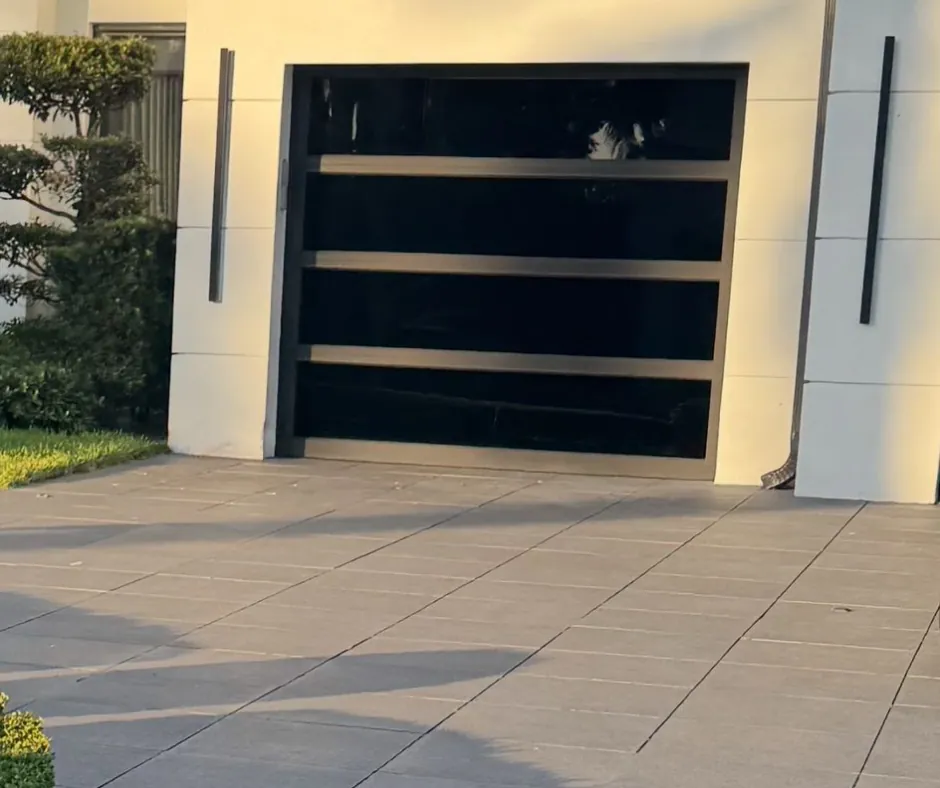
Big doors, long driveways and a canopy of trees
Much of the housing stock here is made up of larger colonials and mid-century houses, each on a lot thick with trees, with the two-car garage joined to the house and a lengthy drive climbing or curving in from the road. Those three details, the size of the door, the trees overhead and the distance from the road, account for most of what we see when we work on garage doors Lexington MA homeowners rely on.
The trees are the part people underestimate. They drop leaves, needles, seed pods and twigs into the tracks and onto the threshold all year. They keep the front of the garage in shade, so the bottom of the door stays damp longer after rain and frost lingers there on winter mornings. In storms they drop limbs, and a heavy branch landing on a driveway can strike a door or a car parked in front of it. And their roots, over many years, can lift the edge of a slab or a driveway apron just enough to change how a door meets the floor.
The size and distance matter too. A two-car door is heavy and wide, and a long driveway means the car is often a fair way off when the remote is pressed. When something goes wrong, it helps to note:
- Whether the door is one double-width door or two singles.
- Whether leaves, needles or a fallen branch are lodged anywhere near the tracks or threshold.
- Does the remote give up only down by the mailbox, or even right beside the garage?
Garage door services in Lexington
Every service below reaches the town, and each card links up to that service’s own page. Most jobs on garage doors Lexington MA colonials and mid-century houses carry begin under one of these.
Repairs on large doors
Bowed top sections, worn centre hinges, rollers clogged with debris, a panel struck by a falling branch. See the main garage door repair page for the full list.
Springs for heavy two-car doors
A wide insulated door hangs from twin torsion coils that must be matched to it closely. Lose one and the door stays put. Spring work is set out on the springs page.
Openers, range and remotes
On a long drive, remote range is half the battle. Openers are repaired or swapped, LiftMaster units among them, and remotes and keypads paired up; details under opener services.
Storm damage and night-time failures
A limb across the door after a nor’easter, or a door that refuses to shut at midnight. Someone is on the phone after midnight too; read emergency garage door repair.
Cable and drum repairs
A cable unwound from its drum after the door closed on a branch, or frayed by grit. Learn more on the cable repair page.
Doors forced off their rails
Debris in a track or a knock from a falling limb can push rollers out. Read off-track garage door repair before doing anything.
New doors, including glass
When the sections are spent, a new door is supplied and installed. On some mid-century houses an aluminium and glass full-view door suits the style; see full view glass garage doors and new garage door installation.
Living with trees around the garage
Among all the garage doors Lexington MA wooded lots shelter, the ones we see most often in trouble are the ones closest to big trees.
Each of the problems is small on its own; together, over years, they wear a door down.
Debris is the first. Oak leaves and pine needles drift into the foot of each upright rail, and every trip the rollers grind through the mulch. A twig wedged in a track can stop a roller dead, and the opener will keep pushing until something bends. Seed pods and acorns on the threshold stop the door sealing, and if the door closes on them repeatedly, the bottom seal splits.
Shade and damp are the second. The front of a garage under trees stays wet long after rain. Wooden doors and wooden trim around the opening soak it up and swell, so a door that worked smoothly in summer can bind in the frame in autumn. Steel doors fare better, but the bottom edge still rusts where the seal retainer holds moisture against it. Moss and algae can take hold on the lower panels and on the jamb weatherstrip.
Storms are the third. A falling limb that strikes a door can crease sections, bend the top section’s hinges or knock the door clean off its tracks. Even a near miss can leave branches lying on the driveway in front of the door, where a reversing car pushes them into the bottom panel. After a big storm, it is worth walking round the garage before using the door.
Roots are the slowest. Over the years, the roots of big trees near a driveway can raise or crack the apron in front of the garage and sometimes the edge of the slab inside. A door that once landed evenly can start meeting the concrete with one corner, opening a wedge of light at the far end and muddling the opener about where the floor really is.
The weight of a big two-car door
Larger colonials often have a single wide door spanning both bays, sometimes insulated, sometimes with windows in the top section, and occasionally with decorative hardware added to make it look like a carriage door. All of that adds weight. Mid-century houses more often have lower, plainer doors, but they may be original or close to it, and their springs and hardware may have been replaced piecemeal over the decades.
A heavy wide door asks a lot of every part. The torsion springs above the opening have to be sized exactly to the door’s weight, and a door this wide nearly always has two, either side of a central bearing plate above the opening. The cables reach their drums at opposite ends of a long bar. The top section spans the full width with only the end hinges and a strut to keep it straight, and if the strut is missing or weak, the section bows. The centre hinges carry more strain than those at the ends, and they wear first.
That is why a wide door that has started to sag, run unevenly or close with a thump is worth attention early. Each of those says some part is overloaded, and its neighbours are next in line.
Springs and safety
Snapped springs make up more of our urgent work than anything else, and a heavy two-car door simply cannot be worked round one. The door rises a short way and stops, the opener strains or hums, or the door drops faster than it should when closing.
The torsion springs on a door this size are wound with a great deal of tension, and they hold it whether the door is open or shut. That tension is dangerous; fitting or re-tensioning one of these coils is not a DIY repair. Its winding cones, set screws, centre bearing and bottom brackets are all under load, and loosening the wrong one can release that load in an instant.
Suspect a broken spring? Then leave everything where it is, pull the opener’s plug, and keep family and cars out of the bay. Hand-lifting a two-car door that has lost a spring is a mistake; without help from the coils it weighs vastly more than you expect. When one spring of a pair has broken, the other is usually close behind, so both are normally replaced together and sized to the door as it is now, including any insulation, glass or hardware added since it was first fitted.
Mid-century doors and their history
The mid-century houses here often still carry something of their original garage arrangement: a low, wide opening, a plain flush door, and hardware that has been replaced bit by bit as parts failed. That piecemeal history is worth knowing about. A door may have springs from one era, rollers from another and an opener added long after the door was hung, and the parts do not always suit each other. Older track brackets may be fixed into framing that has dried and shrunk, and a header designed for a lighter door may now carry a heavier insulated one. On a visit we look at how the pieces fit together, not just at the part that has failed, so the repair suits the whole door.
Openers and the long driveway
The driveway is part of the opener problem here. On a long approach, the remote is often pressed from some distance away, and a remote that works from the garage doors may struggle from the bottom of the drive. Weak batteries, metal in a car’s windscreen, trees between the car and the garage, and the position of the opener’s antenna all affect range. Sometimes the answer is as simple as a new battery or repositioning the antenna; sometimes an outdoor keypad near the garage is more reliable than relying on range alone.
Other common opener faults on these garages:
- Halfway down, the door reverses without anything visibly in the way. On a wooded lot, a leaf, twig or drift of snow across a photo eye’s beam is a regular cause.
- The motor sounds busy yet the door never leaves the floor, which on a heavy door usually points at a spring, not the motor.
- The opener sounds laboured and slow. Behind a big door, that usually says the coils have weakened and the motor is hauling dead weight.
Any opener job starts by freeing the door from its trolley and feeling its weight by hand, since a heavy, badly balanced door will grind down even a brand-new motor. With the balance right, the opener’s stops and force are tuned, the reversing feature is proved, and each remote and keypad is tried from the spot where the household really uses it, down the drive included. Where the gears or board are finished, a replacement opener goes up.
Cables, rollers and tracks
On a wide door, both cables must lift evenly. If one comes off its drum, typically after the door closed onto a branch or a bin and the cable went slack, the door hangs crooked and can bind in the tracks. A cable frayed by grit or by rubbing on a bracket can snap with little warning. Whichever it is, leave the door idle until the cable has been dealt with.
Rollers on a wooded lot work in dirtier conditions than most. Debris in the tracks wears the roller wheels and bearings, and a seized roller skids instead of turning, grinding a groove in the track. If the door has begun to rumble, squeal or catch at the same point every time, rollers and track cleanliness are the first things to look at.
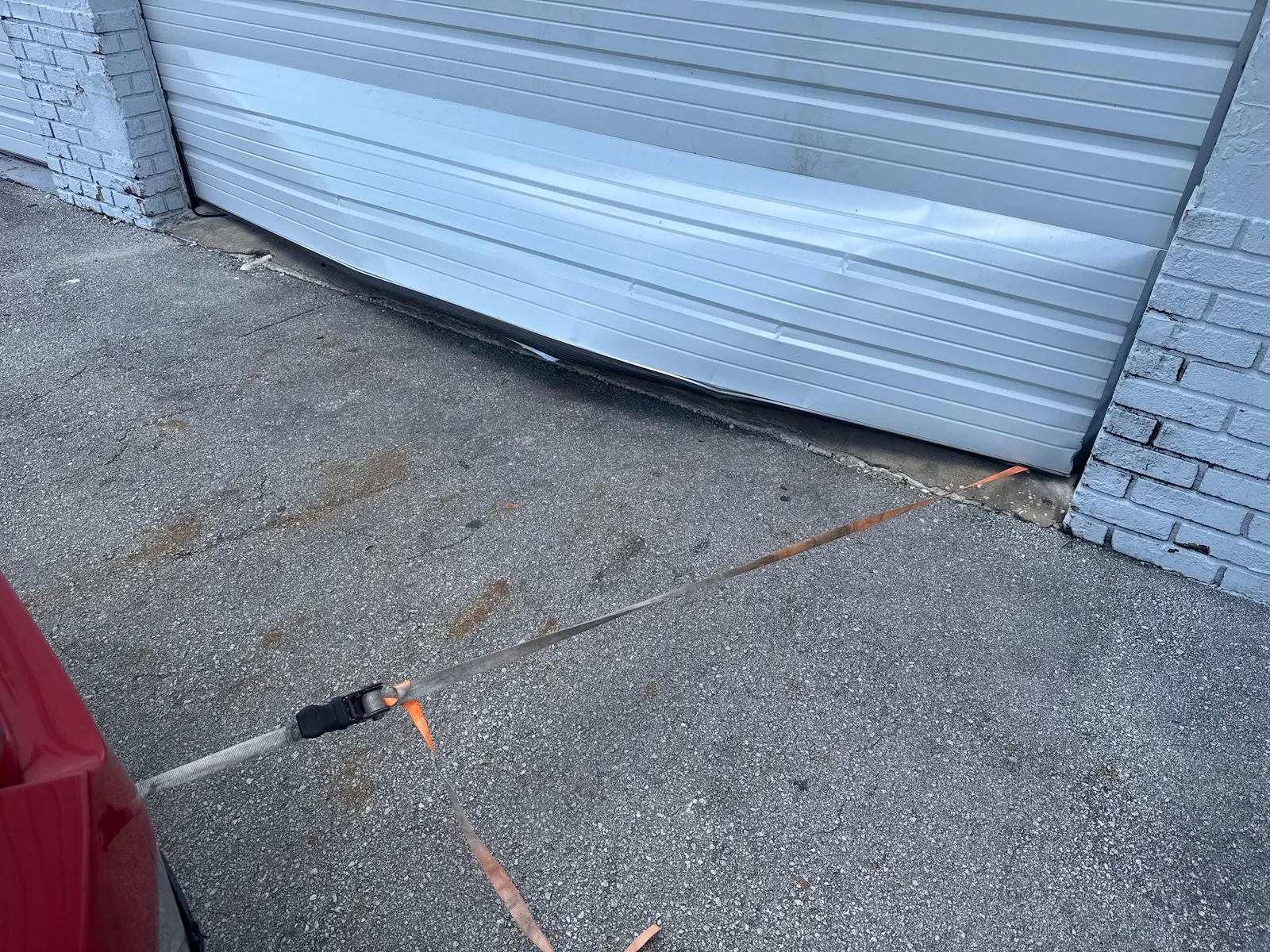
Should the door leave its rails, from debris, a frozen roller or a branch strike, a door this size becomes a real hazard. Keep the motor off, keep your hands off the rollers, pull the plug and phone us. Putting it back means clamping the panels so the rollers carry nothing, steering each one into its rail, renewing any kinked rail, and evening the two cables before the first test run.
A typical visit
The door is judged before anything else. Unhooked from its opener and raised by hand to mid-height, a door with healthy springs just hangs there; any sinking or climbing points straight at them.
Then a thorough inspection: both springs, the cables and drums, the centre bearing and end bearings, every hinge across the width, every roller, the tracks and brackets, the strut on the top section, the bottom seal and the slab under it. On a wooded lot we look closely at debris in the tracks and at the condition of the bottom section and trim. Then the motor, photo eyes, remotes and keypad each get a trial of their own.
You are walked through the broken part, the reason it broke on this lot, and anything nearby showing its age, and no work starts until you say so. Afterwards the coils are tensioned to suit the door, the opener is set to its new travel, and a length of lumber laid across the threshold shows the door reverses when it meets something.
Repair or replace
Repair is usually the sensible route. Coils, cables, rollers and hinges are made to be renewed, and sections in good order can keep going for many more years after that. A bowed top section can often be straightened and strengthened with a strut.
Time for a new door comes when the panels give out: timber swollen, split or rotting along its foot after years in the shade, steel eaten through along the bottom rail, or a door creased in several places by a falling limb. Replacing garage doors Lexington MA houses have had since they were built is also a chance to pick a design in keeping with the architecture, with insulation for an attached garage, windows to bring light in, or, on some mid-century houses, an aluminium and glass full-view door. We hang the new door in the opening already there and tune the opener to its weight.
Simple, safe checks
You can safely:
- With the door down and the opener unplugged, brush leaf litter, needles and twigs off the threshold and out of the lowest stretch of each rail.
- Wipe the photo eye lenses and clear anything in front of them.
- If the wall button works but a remote does not, try a new battery in the remote.
- After a storm, walk round the garage and clear branches from in front of the door before opening it.
The coils, cables, drums and corner brackets are not for tinkering with; they bear the load of a heavy door in every position.
Booking a repair
A wide door that stops working can shut two cars in at once, and on a wooded lot it is often after a storm, late at night or early on a cold morning. There is a person on our line through every night and weekend, so a problem can be reported the moment it turns up. See our service areas page for every town we cover, and the neighbouring Arlington and Burlington pages for nearby towns.
Calls about garage doors Lexington MA homes depend on go fastest when you can tell us: one wide door or two singles, whether a tree had a hand in it, how the door is behaving, and which cars are parked in there. Then call us or book online.
Questions from Lexington
A limb came down on our garage door overnight. Can we open it?
Hold off until it has been inspected. A heavy blow can kink hinges, crack panels or shove rollers out of their rails, and running the door may finish the job. Drag the branch clear only if that is easy and safe, keep the opener unplugged, and ring us.
The remote works beside the garage but not from the road. What limits it?
On a long driveway, range is often the issue. A weak battery, the opener’s antenna position, trees between the car and the garage, or metal in the windscreen can all shorten it. A new battery or an outdoor keypad often solves it, and we can check the opener’s receiver on a visit.
Our door turns round partway down and opens again. What should we check first?
The two little photo eyes low on the door frame. Under trees, a leaf, a twig or a heap of needles in the beam is a regular culprit. Clean both lenses, clear the ground between them, and if the door still refuses, the sensors or the opener settings want a look on a visit.
Our wooden door sticks in wet weather but works in summer. What is happening?
The wood is absorbing moisture and swelling, which is common on a door in the shade of trees. The door, the frame and the weatherstrip can often be adjusted, but if the bottom panels are soft or splitting, replacement usually makes more sense than another round of adjustment.
Can we get a glass garage door on a mid-century house?
Yes. Aluminium and glass full-view doors are supplied and installed, and they suit the look of many mid-century houses. We can advise on whether one fits your opening and how it would work with your opener.