
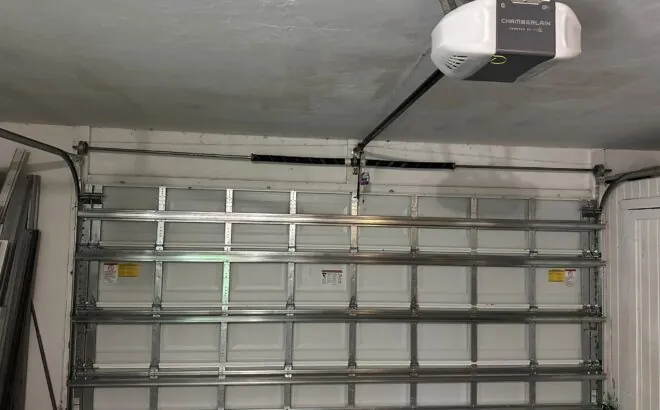
The two-car garage on a post-war colonial
Much of Westwood is post-war colonials set on larger lots with trees around them, each with an attached two-car garage and a driveway wide enough to park several cars side by side. Garage doors Westwood MA homes like these carry tend to come in one of two layouts: one broad door covering the whole double opening, or a pair of narrower doors divided by a centre pier. That one detail shapes much of what can go wrong.
A wide double door is one big, heavy panel assembly moved by one set of springs and one opener. If anything in that system fails, both bays are shut or both are open. Two single doors split the load and the risk: every door carries a separate set of springs, cables and motor, so a fault on the left bay leaves the right bay usable, and the reverse.
Worth noting before you get in touch:
- Is it one wide door or two singles, and which door, or which side of the wide door, is affected?
- Does the door sag in the middle when it is partway open?
- Is the garage used mainly for cars, or mainly for storage, with the cars parked on the driveway?
Garage door services in Westwood
Garage door repair
Sagging sections, split hinges, worn rollers, struts, seals and track brackets on two-car garages, whether one broad door or two singles. Our garage door repair page goes through each part.
Spring repair
A wide double door usually hangs on two torsion springs sharing one long shaft. When one breaks the other cannot carry the door alone. Keep your hands off; see garage door springs.
Openers and remotes
A single opener hauling a broad door, or two openers on two singles, plus car buttons, remotes and a keypad by the side. See opener repair and replacement.
Out-of-hours breakdowns
Both cars shut in behind a wide door that will not budge, or a bay standing open late in the evening. We pick up the phone at any hour, and the emergency garage door repair page says what to do until then.
Cable work
On a wide door the cables carry a large load at each lower corner, and one failing throws the whole door off level. Read about cable repair.
Derailed doors
A wide door that has twisted, or a single door clipped by a mower or a car, can leave the rails. See off-track repair.
Replacement doors
A worn-out double door, or one of a pair of singles, replaced with a new door made for the same opening. Choices are on the new garage door installation page.
One wide door or two single doors
Plenty of post-war two-car garages were built with a single wide opening, and many still have a double door in it. A double door is long and heavy for its height, and that brings a few particular problems.
The first is sag. Over the years, the long horizontal sections of a wide door can bow in the middle, especially the top section, which hangs out over the horizontal tracks when the door is open. A sagging section rubs, pulls on its hinges and can crack along its length. Steel reinforcing struts fixed across the inside of the sections are what stop this, and on an older wide door it is common to find one missing, loose or bent.
The second is the spring system. A wide door usually has two torsion springs on one long shaft, with a centre bearing plate fixed to the header between them. If the centre bearing works loose from the wall, the shaft flexes and the door lifts unevenly. When one spring breaks, the other is left to lift a door it was never sized to carry alone, and the opener strains to make up the difference.
The third is balance across the width. On a wide door, any difference between the two sides shows up quickly: a cable that has stretched on one side, a drum that has slipped on the shaft, or one spring weaker than the other will make one end of the door lead the other. That puts the door at an angle in the tracks and wears rollers and hinges unevenly.
Two single doors avoid most of this. They are lighter, shorter, and each has its own springs and opener. But they come with their own pattern: the door used every day wears much faster than the other, and the post between them takes knocks from cars and bins.
Repair on garage doors Westwood MA owners have in either layout follows the same principle: track down whichever component is doing another part’s lifting, and correct it before something breaks.
A garage used for storage and a door used rarely
With a generous driveway, many households park on the driveway and use the two-car garage for storage, a workshop, a gym or bikes. The garage door may open only now and then. A door used rarely wears differently from one that cycles every day, but it still wears.
Rollers that sit still for months can seize, especially older steel rollers without sealed bearings, so the next time the door moves they slide and grind rather than roll. Springs that sit in one position for a long time can rust in that position. Hinge pins stiffen. An opener that rarely runs may have a dead remote battery, a keypad that has lost its code, or, in a quiet garage, wiring that mice have chewed.
Storage also crowds the door. Boxes stacked against the track, shelving fixed too close to the opening, and bikes leaning against the wall where the sensors sit all get in the way. A door that comes down onto a stored item will reverse if the safety system is working, and can be damaged if it is not.
Practical steps for a garage that is mostly storage:
- Run the door fully up and down every few weeks so rollers and hinges keep moving.
- Keep a clear strip along each track and under the opener rail.
- Check that nothing stands between the safety sensors.
- Give the rollers, hinges and spring coils a light coat of garage door lubricant each spring and autumn.
Trees on the lot
Westwood’s larger lots tend to be wooded, and the trees bring a steady drip of debris. Leaves gather at the bottom of the vertical tracks and along the bottom seal, sticks wedge into the gap under the door, and gutters on the garage overflow in heavy rain, sending water straight down the face of the door. Where water runs down a door repeatedly, the bottom section and its brackets take the brunt of it, and a door that closes onto wet leaves never quite seals.
Falling limbs can do more serious damage. A heavy branch striking a wide double door can bend a section across its full width and twist the door in its tracks. If a branch hits the door, leave the opener off and have the door checked before it is used again.
Shade and leaf litter also hide the slow problems. A roller beginning to rock on its stem, a hinge knuckle with a hairline split or a bottom bracket going rusty is hard to spot behind a curtain of leaves and in the half-light under trees. A walk round the inside of the garage with a torch once each autumn, looking along both tracks and across the lowest two sections, catches most of these early. Anything that looks bent, cracked or flaking at a point where a cable or spring attaches is worth a call before the door is asked to move through another winter.
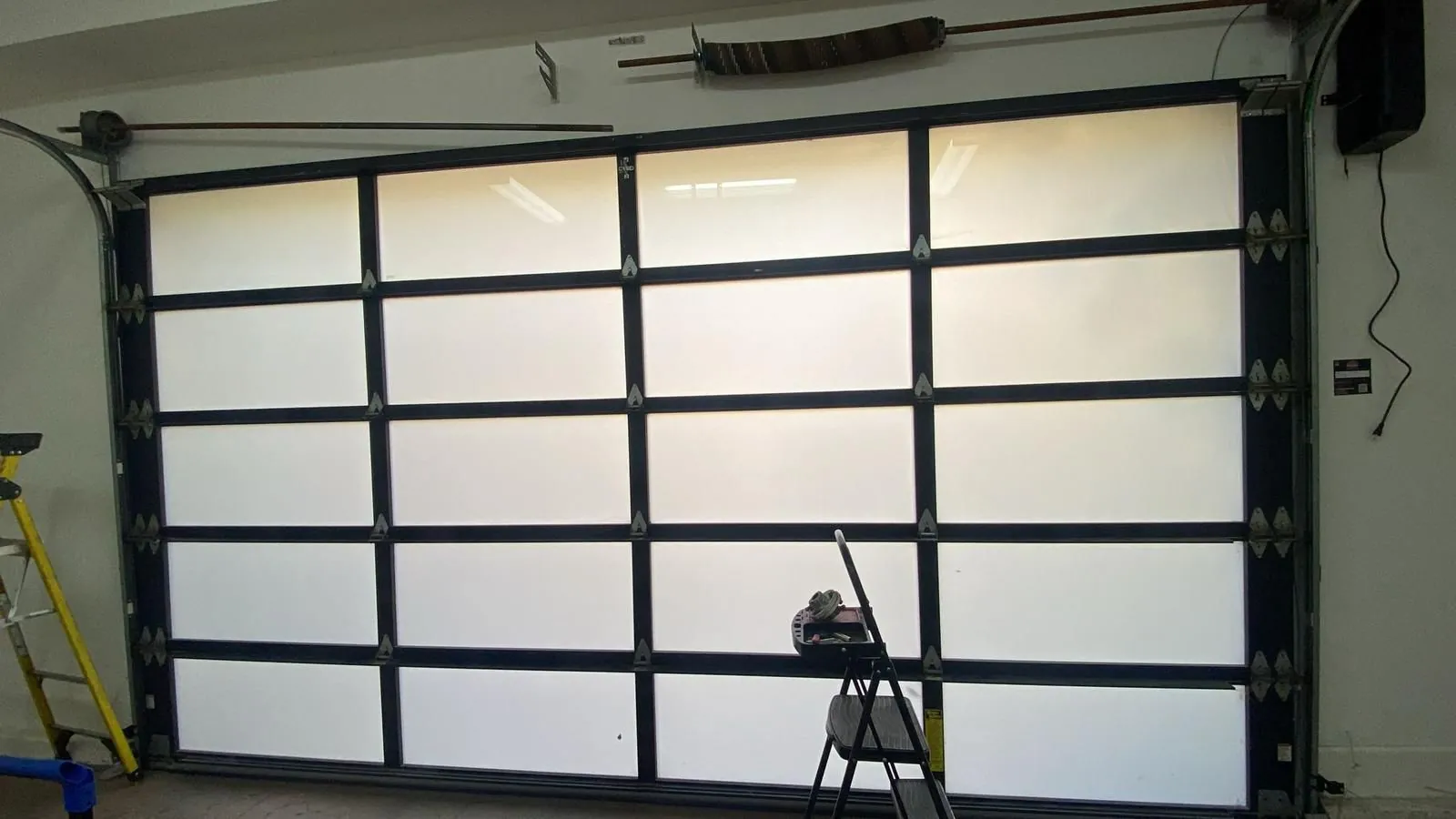
Torsion springs: dangerous and not a DIY repair
Most two-car garages on Westwood colonials have torsion springs on a shaft above the door. They are wound tight when the door is closed, storing the force that lifts it. That force is what makes them dangerous. A torsion spring can release its energy suddenly if it breaks while someone is near it or if the winding cone is loosened without the right bars, and people are badly hurt doing exactly that. Leave winding bars and spring work to a technician; a homeowner should never take it on.
You will usually know a torsion spring has gone from one sharp report out in the garage, loud enough to make the dog bark, a split showing in the coil, a door that the opener can raise only a little, and, on a wide door, a door that rises crookedly because one spring is doing all the work. Leave the door closed and call.
When springs are replaced on a wide door, both are usually replaced together so the door is balanced across its width, and the centre bearing and end bearings are checked at the same time. On a pair of single doors, the springs on the door that broke are replaced, and the other door is checked so you know what to expect from it.
Openers on two-car garages
A wide double door asks a lot of a single opener. If the door is well balanced, the opener only guides it; if a spring has tired or one cable has crept longer than its partner, the opener is lifting real weight on every cycle, and its gears and motor wear quickly. Two single doors with two openers split that work, but they also double the number of remotes, sensors and wall buttons in the garage.
Typical opener problems we hear about in Westwood:
- The door reverses before it reaches the floor because something sits in the sensor beam or the sensors have been bumped.
- A car’s built-in buttons stopped working with one opener after a reset or a replacement.
- One of two openers hums but no longer moves its door.
- A keypad outside the garage that has stopped responding.
- A wide door that the opener lifts unevenly because a spring or cable on one side has failed.
LiftMaster openers are repaired and replaced, and so are other openers. A replacement motor is picked with that particular door’s width and heft in mind, and the travel, force and safety reverse are set before we leave.
How we work through a two-car garage
- First look: the door is examined where it sits, and clamped in place if it has stuck partway or hangs at a slant.
- The opener trolley is unlatched and the door raised manually, so we can feel whether it is even from end to end as well as how heavy it is.
- Every spring, cable, drum, bearing plate, strut, roller, hinge and track length is gone over.
- We walk you through what broke, what is close behind it, and the choices, and you decide before a tool comes out.
- Parts go in, spring tension is adjusted until the door floats, joints are oiled, and the opener’s limits and photo eyes are run through their tests.
On the day, it helps to move cars off the part of the driveway in front of the garage and clear stored items from the area just inside the door.
Repair or a new door
A post-war colonial may be on its second or third garage door by now, and many of those doors are themselves getting old. Repair keeps a sound door working: springs, cables, rollers, hinges, struts and openers are all replaceable. Replacement earns its place when a wide door has sagged so far that its sections are cracked, when several sections are dented or rotted, when the door has been repaired so often it no longer runs true, or when matching sections are no longer available.
Any new door we fit goes into the opening you already have, with springs, cables, tracks, rollers and struts suited to its size and weight. Whether a wide opening keeps one double door or is fitted with two singles depends on the opening and the framing, so it is something to talk through on site rather than assume.
Attached garages, shared walls and the cold
An attached two-car garage shares at least one wall with the house, and often sits beside a kitchen, a mudroom or a family room. In a cold snap, a garage with a thin, uninsulated door and worn seals stays close to the outdoor temperature, and that chill reaches the rooms next to it and anything stored inside. Because a double door runs nearly the full width of the garage, its seals are long too, so a tired seal on a double door lets in a good deal of draught.
Three seals do the work. The bottom seal runs along the underside of the lowest section and closes the gap at the floor; it hardens and splits with age and with being shut on grit. The side and top stops are strips fixed to the frame around the opening, which the door presses against when closed; they warp and pull away from old framing. And on sectional doors, the joints between sections have their own small seals or shaped edges. Replacing worn seals is quick work and often makes more difference to a cold garage than people expect.
For more warmth, an insulated door is the real answer. Insulated sections are heavier than single-skin ones, so when a light old door is replaced with an insulated one, the springs, cables and sometimes the opener have to suit the new weight. When people ask about warmer garage doors Westwood MA colonials can take, this is the main thing to plan around: the door, its springs and its opener are chosen together.
A few signs your door is losing heat:
- Daylight showing along the bottom or the sides when the door is shut.
- Leaves or snow blowing in under the bottom edge.
- Frost on the inside face of the door in deep cold.
- A connecting door into the house that feels icy to the touch.
Neighbouring towns
Westwood is next to Dedham and Norwood. See our garage doors in Dedham and garage doors in Norwood pages, or the full list of towns on our service areas page.
If the door is stuck now
If a wide door has jammed with both cars inside, if one side has dropped, or if a spring has just broken, stop, step back from the door and make sure nobody stands beneath it. For garage doors Westwood MA homeowners need moving again, call us or book online.
Questions from Westwood
Our garage has one wide door. Is it better to switch to two single doors?
That hinges on how the header and side framing were built, and it is a bigger job than a door replacement. A wide door that is well balanced and reinforced works well. If you are thinking about it, we can look at the opening and talk through what is possible.
The middle of our double door sags when it is open. Can that be fixed?
Often, yes. Bowing nearly always traces back to the steel stiffeners across the long panels: one has worked loose, bent, or was never fitted. Adding or replacing struts stops it, as long as the section itself has not cracked.
Our garage is mostly storage and the door hardly moves. Does it still need attention?
Yes. Rollers can seize and springs can rust in place when a door sits still for long periods. Running the door up and down every few weeks and lubricating it once or twice a year helps a lot.
One spring on our wide door broke. Do both need replacing?
Usually both are replaced together, so the door lifts evenly across its width and both springs wear at the same rate.
Is our original post-war door worth keeping?
Many of the older garage doors Westwood MA colonials still wear are worth keeping. When the sections themselves are solid, fresh springs, cables, struts and rollers bring them back. When the sections are cracked through or rotted, we show you where and discuss a new door.