
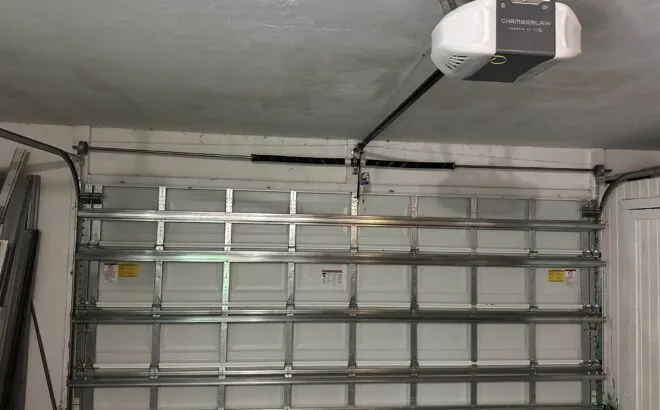
Attached or out back: the garages around Norwood Center
The streets around Norwood Center mix Capes, colonials and two-families, and the garages vary as much as the houses do. Some are attached, joined to the house with an inside door leading through to a hall or kitchen. Others are detached, a small separate building at the back of the driveway. On modest lots, either kind tends to sit close to a fence, a hedge or the neighbour’s driveway, with not much room to spare on any side. That variety is why work on garage doors Norwood MA homeowners book is rarely the same twice: the door may be the same type of sectional door, but the building around it and the way you reach it change from house to house.
The first thing we ask on the phone is which kind of garage it is, because the answer changes what is likely to be wrong and how the visit is planned.
Have a look at three things while you wait for a call back, without touching springs or cables:
- Does the garage join onto the house, or stand by itself?
- Does the door rise level, or does one side lead the other?
- Is there power to the opener, and do the lights on the motor unit come on?
Garage door services in Norwood
Garage door repair
Hinges, rollers, sections, track brackets and bottom seals on the single doors that serve most garages around Norwood Center. Our garage door repair page lists the parts we deal with.
Spring repair
A Cape’s attached bay might lift on a torsion coil; an older detached garage may still use side springs. Neither should be handled by the owner. The garage door springs page has the detail.
Openers and wiring
An opener in a detached garage relies on electricity carried across the yard from the house, and faults there look like a dead motor. See opener repair and replacement.
Calls at awkward hours
A stand-alone garage left wide open until morning, or an attached door that will not shut behind the car. Ring at any hour; the emergency garage door repair page has advice for the meantime.
Cable trouble
A cable that slips off its drum leaves the door tilted in the opening, and it should not be forced either way. Read about cable repair.
Rollers out of the rail
In a garage close to the fence line, a car squeezed in at an angle can push a track out of true. See off-track repair.
A replacement door
When an old door is beyond repair, we supply a new one and hang it in the same opening, on either kind of garage. See new garage door installation.
What differs between an attached and a detached garage
The door and its parts are much the same in both, but the building around them changes how they fail and how they are repaired.
An attached garage is warmed slightly by the house, shares a wall with living space, and usually has power close by. Its opener runs from an outlet in the ceiling that is on the house’s own wiring. The connecting door into the house means the garage door gets used as a main entrance, so its springs and rollers wear in step with the household’s daily comings and goings. Noise travels into the house, so a squealing roller or a rattling chain is noticed early. On the downside, a failed door can also cut off the household’s usual way in.
A detached garage is a building of its own, frequently with a longer history than its present door, and it lives at outdoor temperature. Its concrete slab sits on its own and can move with the frost, so a door that sealed well in autumn may leave a gap on one side by February, or bind against the floor at one corner. Its opener needs electricity brought out from the house, through a buried line or an overhead feed, and a fault anywhere along that line looks exactly like a dead opener. It is also further from the house, so problems go unnoticed for longer: a door left a foot open, a photo eye knocked askew, or a spring that broke while nobody was outside to hear it.
When we are called to garage doors Norwood MA households use every day, knowing which kind of garage it is tells us whether to bring tools for wiring checks, for slab and seal problems, or simply for the door.
Modest lots and tight sides
Many of the garage doors Norwood MA lots hold sit close to something: a boundary fence, a neighbour’s garage, a hedge or the side of the house. That has a few consequences for the door.
There is little room to swing a car in. A driver turning into a garage from a short or narrow driveway often enters at a slight angle, and the jambs, the vertical tracks and the corners of the bottom section take the knocks. A track that has been bumped often enough bends inward at bumper height, the rollers start to bind at that point, and eventually one comes out of the track.
Inside, space is just as tight. Storage on the side walls of a single garage crowds the tracks and the safety sensors, and a ladder or a garden tool leaning in the wrong place blocks the sensor beam or catches the door as it moves. Shelving fixed into the wall above the track can stop the door’s travel altogether.
And from the outside, a garage built close to a boundary may have no working room on one side at all. Work that would usually be done from outside the door has to be done from inside, with the door partly raised and blocked.
Practical steps that help:
- Keep a clear strip along both tracks inside the garage, from floor to ceiling.
- Mount the sensors where a parked car or stored item cannot knock them.
- If the same corner of the door keeps getting hit, a bump stop or a guide on the floor can help a driver line up.
Two-families and shared garages
Around Norwood Center, a good number of houses are two-families, and the garage may be shared between the units, or belong to one unit only. A shared garage door collects remotes and habits from two households. One unit’s car may need the bay early, the other’s late, and nobody sees the door running except the person using it at that moment.
That makes small faults easy to miss. A remote that works only sometimes, a door that reverses now and then, or a fresh grinding sound as the door rises gets blamed on the other unit’s car or the weather. When something in the door finally fails, both units are affected at once.
It helps to agree on a few things: who keeps track of the remotes and codes, who arranges a visit when something seems wrong, and that both units leave the photo eyes and both tracks unobstructed. If a unit changes hands, clearing the opener’s memory and reprogramming the remotes still in use keeps old remotes from opening the door.
Springs: what breaks and what not to touch
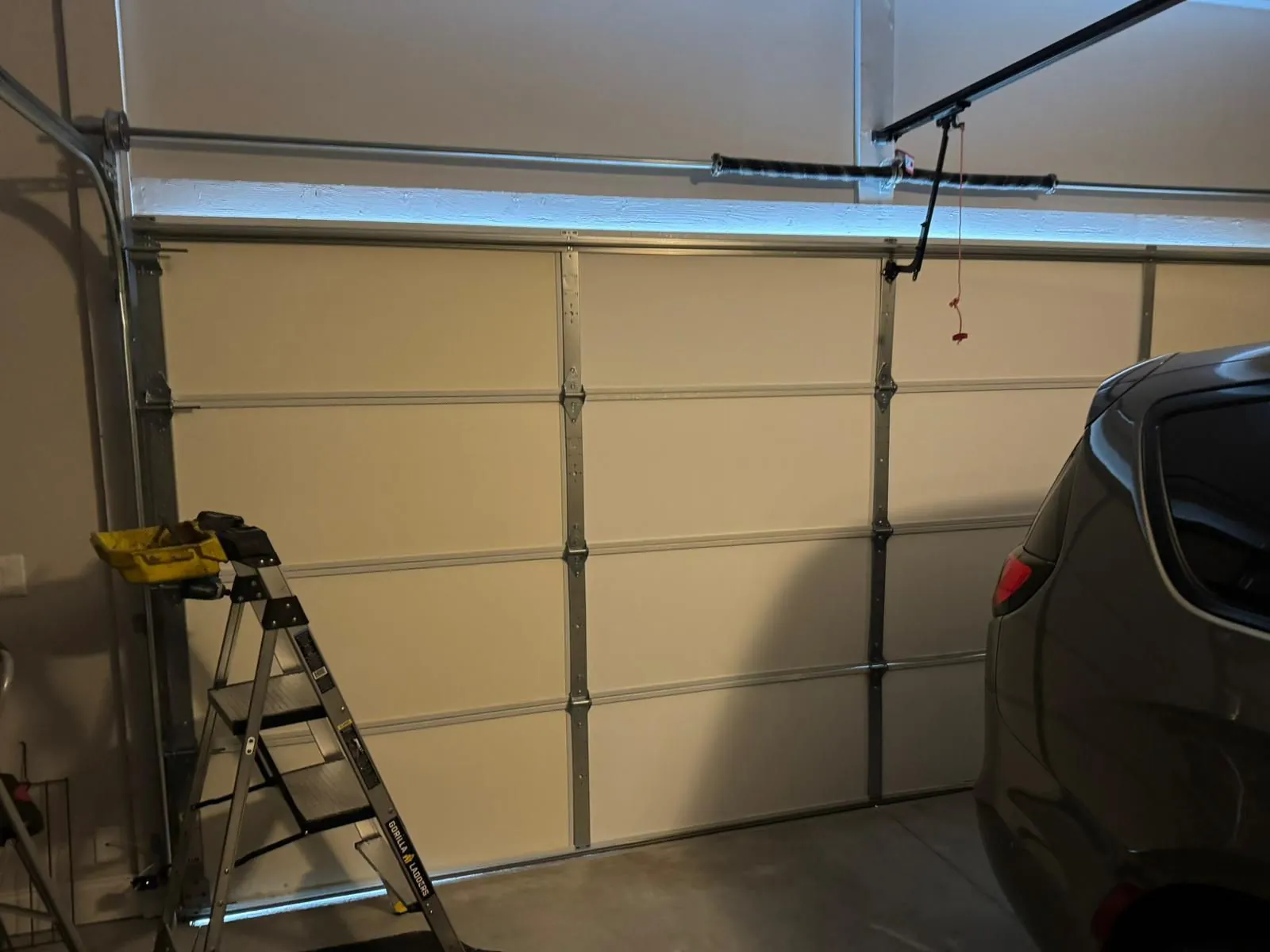
Single garages around Norwood lift on one of two arrangements. On the first, a coiled torsion spring wraps a steel bar fixed across the header; each closing of the door winds the coil tighter and loads it for the next lift. On the second, found on plenty of older and detached garages, a long spring runs beside each ceiling track and stretches as the door comes down, its pull carried to the door through cables threaded over pulleys.
The torsion coil is the one to fear. The twist stored in it is enough to break bones, and it can unload in an instant if the coil snaps beside someone or if a set screw on its winding collar is backed off with a screwdriver instead of proper winding rods. That is a technician’s job, full stop; nobody should try it with household tools. The stretched side springs are loaded too whenever the door is shut, and a steel restraint cable through the middle of each keeps a snapped one from flying loose.
Clues that a spring has failed: a bang like a car door slamming inside a closed garage, two separate halves visible on the coil over the header, a side spring dangling slack from its pulley, or an opener that drags the door a hand’s width up and gives in. Leave the door shut, switch the opener off at the plug if that plug is easy to reach from the floor, and phone.
New springs are chosen for what that particular door weighs, and where a door has two, the pair is changed at the same time so neither side lags. Then the door gets a hand test: let go of it at waist height, and it should hang there.
Openers and the power behind them
Plenty of opener calls in Norwood turn out to be about electricity rather than the opener, above all in a detached garage. A motor housing with every light dark points first at the ceiling outlet, a tripped breaker in the house panel, or the feed running out across the yard. Lights on but no movement shifts the suspicion to the opener’s own gears, or to a door that is too heavy for it.
Other faults that crop up again and again:
- Photo eyes filmed with dust or nudged off line, which makes the opener refuse to lower the door or send it back up.
- Sensor wire pinched along the wall by a stored wheelbarrow, or nibbled by mice in an outbuilding nobody visits after dark.
- A wall button gone dead because its thin wire has been snagged or pulled from its terminal.
- Remotes forgotten by the opener after a power cut.
- A motor labouring every time because the door underneath has a tired spring or a seized roller.
LiftMaster units are among the openers we mend and swap out, alongside other makes. Nobody should buy a new opener for a badly balanced door, as the new motor would wear out on the same problem, so the door is always tried by hand first. Any fault in the house wiring or in the supply run out to a detached garage is one for an electrician.
How a visit works
- A careful first look at the door as it sits; if it is hanging crooked, wedged open or out of its rails, it is clamped and made safe before anything else.
- The opener’s trolley is unlatched so the door can be raised manually to judge its weight and how it travels.
- Springs, cables, drums, rollers, hinges, tracks, seals and the opener all get looked over, and for a detached garage, so does the power supply to the motor.
- We tell you plainly what has gone wrong and lay out the choices, and work starts only when you give the go-ahead.
- Once the parts are in, the door is balanced, every pivot is oiled, and the opener’s stopping points, push force and safety reverse are set and tried.
Before we arrive, move cars off the drive, clear the floor just inside the door, and make space below the motor so a ladder can stand there.
Frost, slabs and the bottom of the door
Winter is particularly hard on detached garages. The slab of a stand-alone garage is not kept warm by a house next to it, and when the ground freezes and thaws, a corner of that slab can lift a little and settle again. A door set to close perfectly onto a level floor in October may by January meet the floor early on one side and leave daylight on the other.
The symptoms are easy to read once you know them. The opener reverses as the door touches the high corner, because it thinks it has hit something. A gap opens at the low corner, and leaves, snow and rodents find it. The bottom seal tears where it is pinched against the high spot. On garage doors Norwood MA detached garages carry, a new bottom seal and reset travel limits usually deal with it; a door on a slab that has moved a lot may need its tracks reset as well.
Attached garages see less of this, but they get their own winter trouble. Snow pushed off the drive piles against the door, melts by day and freezes the bottom seal to the concrete by night. Do not let the opener fight a frozen door. Pull the release cord, break the ice away from the seal, and lift only if the door comes up without a fight.
Repairing an older door, or replacing it
A good share of the doors on Norwood’s Capes, colonials and two-families have been hanging for a long time, and the doors on detached garages have usually taken the worst of the weather. Mending comes first in most cases: the springs, cables, rollers and hinges wear by design, and once fresh ones go on, a structurally sound door gives years more use.
It makes sense to look at a new door if:
- Water lying against the slab has rotted the lowest section, or rust has eaten through it.
- Repeated scrapes from cars squeezing into a tight garage have creased more than one section.
- Patch after patch has left the door hanging out of square in its frame.
- The detached garage still has an old tilt-up one-piece door, or a sectional so worn it is awkward and unsafe to lift.
We supply and fit new doors to the existing opening on either kind of garage, along with the springs, cables, tracks and rollers that suit that door’s weight.
Nearby towns
Norwood borders Westwood and Canton. See garage doors in Westwood and garage doors in Canton. Every other town we cover is listed under service areas.
When the door is stuck now
Attached door refusing to close behind the car? Detached garage gaping open at the back of the yard? A spring just went with a bang? Stand clear, keep children and pets away, and stop working the button. For garage doors Norwood MA homes need back in working order, call us or book online.
Questions from Norwood
Our detached garage opener has no lights at all. Is the opener broken?
Not necessarily. A completely dark motor unit usually means no power is getting to it: a tripped breaker, a dead outlet or a fault on the line from the house. Check the breaker first. If the outlet is live and the opener is still dead, the opener itself needs a look.
The door on our detached garage seals in autumn but leaves a gap in winter. Why?
The slab under a stand-alone garage can rise and settle slightly with frost, so the floor under the door is no longer level. A fresh bottom seal and adjusted travel limits usually cure it; if the slab has shifted a lot, the tracks may need resetting too.
Two households use our garage. Can each have its own remote?
Yes. One opener can learn several remotes and a keypad code, and its memory can be wiped and reprogrammed whenever one unit gets new occupants, so old remotes stop working.
Is a broken extension spring as dangerous as a torsion spring?
Both carry real tension and neither should be touched by hand. The torsion type stores far more energy and is the more dangerous one. Each side spring ought to have a restraint cable through it in case it breaks.
Should we repair the old door on our detached garage or replace it?
If its sections are sound, repair usually wins, and new springs, cables and rollers bring it back. If the bottom has rotted or the sections are split, a new door makes more sense. We show you which applies before anything is done.