
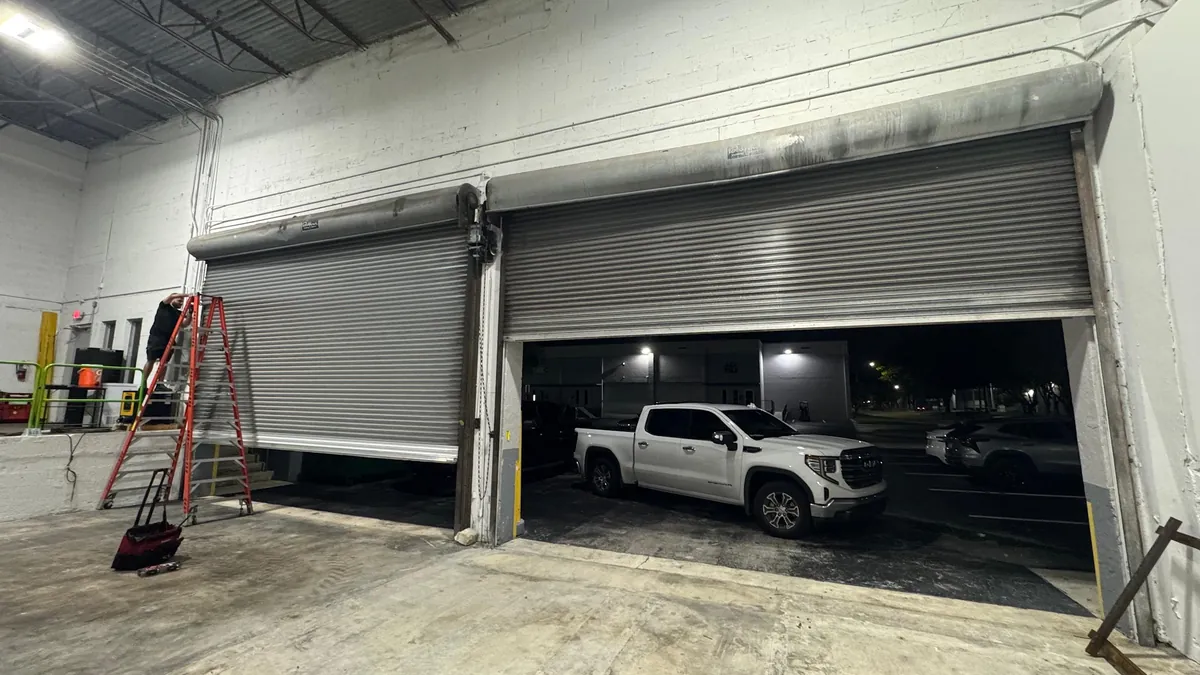
The one-bay garage on a modest cape or ranch
Avon is a small town, and its houses are mostly modest capes and ranches, each with a single garage bay attached at one end and a short driveway running up to it. Almost every call we take about garage doors Avon MA homeowners own concerns that one bay: a lone sectional door, often facing the street, often doing the work of a front door for everyone who lives there.
On a ranch the garage usually sits under the same long, low roof as the bedrooms and kitchen. On a cape it may be tucked under a dormer or added on at the gable end. Either way, the space above the opening is rarely generous, and the ceiling inside can be close to the top of the door. That single fact steers a surprising amount of the work: where the spring can mount, how the overhead rails curve back, and which opener will fit between the door and the joists.
Three quick signs tell you a good deal before anyone arrives:
- A bang from the garage with nothing visibly fallen, followed by a door that barely lifts.
- A grinding or scraping note as the bay travels, worse near the top.
- Daylight showing along one side of the closed door where none used to.
Garage door services in Avon
General repair
Cracked sections, split hinges, loose brackets, a torn bottom rubber, rollers chewing their way along the rails. Each fault gets chased back to whatever caused it. Our garage door repair page lists the whole range.
Spring replacement
Torsion coils over the header, or stretch springs beside the overhead rails. Once one has snapped, the bay weighs what it weighs and nothing should force it. The garage door springs page compares the two.
Openers, keypads and remotes
Motors that run but do not lift, keypads by the driveway that ignore the code, wall buttons gone dead, photo eyes that keep sending the bay back up. LiftMaster units included. See opener services.
After-hours trouble
A bay jammed open on a winter night, or shut tight with the car behind it. We take calls at any hour. Before help gets there, our emergency repair page suggests a few sensible moves.
Cable failures
Once a lift cable unravels, its corner sags and the panels rack sideways. We renew the pair, never just the broken strand. See cable repair.
Bays knocked off course
Rollers popped loose after a knock or a cable failure, rails bent out of line. The bay is braced, then put back. See off-track repair.
Replacement doors
For a tired original door that has gone soft at the bottom or dented across every section, a new one is supplied and fitted. See new door installation.
Low ceilings and where the hardware lives
On many of these single-storey ranches and story-and-a-half capes, the strip of wall above the header, up to where the joists begin, is narrow. Hardware has to fit into that band. A standard torsion spring wants a certain clearance over the header; where the room is tighter, a low-headroom arrangement routes the rails differently so the door can still turn the corner and slide back under the ceiling without scraping a joist.
An opener needs space too. Its rail runs from a bracket above the door to the motor head hung from the ceiling further back. In a cramped bay, the motor may end up only just clearing the car roof or a hatch into the attic. So a swapped-in motor gets picked and hung for that particular ceiling, rather than bolted into whatever holes its predecessor left.
That is why a part off a shelf does not always go straight on. A replacement spring is wound and sized for what this particular bay weighs and how tall it stands. A new rail section has to line up with the curve that the existing hardware follows. Getting those matched is most of the skill in a repair on a low garage.
When a spring lets go
Nearly every pound the bay weighs hangs on its springs. The motor is meant to nudge a bay whose weight the springs have cancelled; dead-lifting one is beyond what its motor and gears were meant for. So when a spring snaps, usually with a crack loud enough to bring someone from the kitchen, the opener struggles, lifts the bay a few hand-widths and stops, or the bay will not stir at all.
With torsion hardware the break is usually visible: look for a split in the coil wrapped around the shaft over the header. On an extension system one of the long side springs hangs limp or lies on the floor. Either way, hands off. A torsion spring holds dangerous tension; its clamps, winding cones and set screws are no place for an experiment. This is not a DIY repair. The stretch-type springs are loaded heavily as well and, on doors without a safety cable threaded through them, can lash out when they break.
Keep the car out of the bay’s path, keep children away from the garage, and call. Our spring repair page has more on how the two kinds differ and why both sides are usually replaced together.
Openers under a bedroom or a dormer
On a cape, the garage ceiling is often the floor of a room above. On a ranch, the bedroom wing may share a wall with the bay. In both cases a worn opener makes itself heard. A chain that rattles overhead, a motor whining for longer than it once did, or a rail that shudders as the trolley passes are all sounds worth reporting, because they usually mean the door has fallen out of balance and the opener is working harder than it should.
Keypads and remotes cause their share of calls as well. With a short driveway the keypad is often on the jamb right by the bay, where rain and road salt reach it. When the remotes still work but the keypad does not, the keypad is the suspect. When nothing responds, the opener itself, its power supply or its board is where we look. Opener faults are repaired where a repair holds, and units are replaced where it does not. We repair and replace LiftMaster units as part of that work. See our opener services page for remotes, wall buttons and the safety sensors.
A bay that hangs crooked or leaves its rails
Each bottom corner of the door is held by a steel cable. If one frays and parts, that corner drops and the bay twists in its opening. Very often a roller then jumps out of its rail, and the door locks itself crooked, wedged partway up. Rollers that have dried out and seized can produce the same jam on their own, and so can a car bumper meeting a half-closed bay on a short driveway.
A crooked or off-rail door is unstable. Leave it crooked; tugging it straight, or pressing the button in hope, can bring it down. Pull the opener’s plug only if the outlet is reachable from beside the bay rather than beneath it. When we arrive, the bay is clamped so it cannot move, the tension is dealt with safely, and the rollers go back into the rails, or the bent rail comes out and is straightened or replaced. Both cables are renewed together. More detail is on our cable repair and off-track repair pages.
When the power goes out
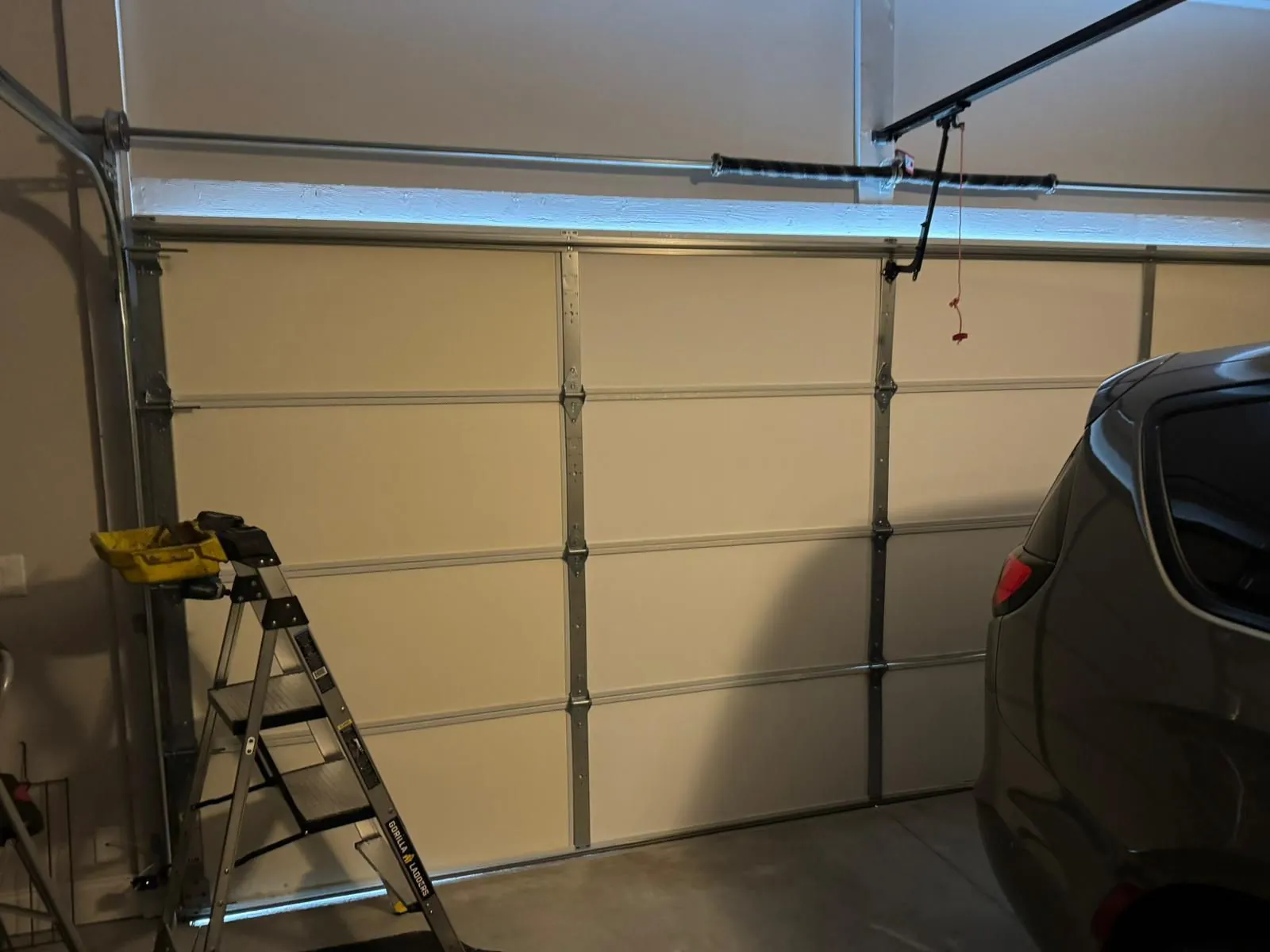
A single attached bay with an opener is normally opened by the opener and nothing else, so a power cut can leave the car shut in. Somewhere along the opener rail dangles an emergency release, most often a red rope ending in a knob. A tug on it unhooks the bay from the carriage, after which the door can be raised by hand.
Two cautions come with that. First, only release the door when it is fully closed if you can help it. A door released partway up will drop if the springs are weak or broken, and it can come down hard. Second, a door lifted by hand should feel light, staying roughly where you leave it. If it is heavy, or wants to slam back down, a spring has failed and the bay should not be used until it is fixed.
When the power returns, the trolley needs reconnecting. On most openers, running the opener once will catch the trolley and re-engage it. If the door then behaves oddly, or the opener light flashes, the travel limits may need resetting, which is a small job on a visit.
Small checks that are safe to make
There are a few things anyone can do to keep a single bay running without touching anything dangerous. Watch the door through a full cycle once in a while. It should move steadily, without jerks, and stop cleanly at the top and bottom. Listen for scraping, popping or grinding, which usually means a roller or hinge is wearing.
Look along the rails for dents or loose brackets, and at the cables near the bottom corners for fraying. Wipe the photo eyes clean, since dust and cobwebs can blind them, and check that their little lights are steady. Test the auto-reverse by laying a piece of wood flat across the threshold under the closing door; the bay ought to bounce back up the moment it meets the wood.
What not to do is equally clear. Springs, cables, drums and the anchor brackets down by the floor all carry tension, so they stay untouched. Do not tighten anything on the spring shaft. Anything beyond watching, listening, cleaning and testing is work for us.
The door as part of the front of the house
With a short driveway, the garage on a modest cape or ranch is right at the front of the lot and in plain view. The door is one of the largest single surfaces on the facade. That is worth remembering when it comes to repair or replacement. A dented section is a functional fault, since it can bind on the rollers, and it is also what anyone driving past notices first.
Facing the street also leaves most garage doors in Avon MA exposed to the weather. Wind-driven rain hits the bottom section, snow piles against it, and the seal across the bottom works hard. When that rubber has split or flattened, water tracks inside, leaves blow in, and on a wood door the lowest section starts to soften. Side and top seals wear in the same way. A worn seal is a small, separate repair, and one worth doing before it costs a section.
A bay that doubles as the workshop
A one-car garage on a modest house rarely holds only a car. It is the tool room, the bike rack, the place the lawnmower lives and the spot where a chest freezer hums in the corner. That mix matters to the door in a few quiet ways.
Bikes and handles leaning near the opening drift into the photo-eye beam, so the bay refuses to close and the owner assumes the opener has died. Shelving bolted close to the rails can catch a roller or a cable as the door travels. An extension cord run across the ceiling may sit in the path of the opener trolley. And a freezer or workbench on the same circuit as the opener can trip it, so the door stops responding until the breaker is reset.
None of these needs a new part. They need a few inches of clearance and the right outlet. When we work in a bay like this, we point out anything that is likely to interfere with the door, so the repair is not undone soon after by a shelf or a bike.
What happens on a visit to Avon
- The bay is checked for anything unstable and secured if it is hanging, crooked or out of its rails.
- Springs, cables, drums, rollers, hinges, rails, seals, the opener and its photo eyes are each looked at in turn.
- We tell you what has failed, what it has affected and what we would do about it, and the work begins only with your say-so.
- Worn pieces come out, new ones go in, the springs are tensioned until the bay floats by hand, and the opener’s limits and force get reset.
- The door runs up and down several times while you watch, with the photo eyes tested so the bay reverses when the beam is broken.
It helps to have the car out of the bay and off the short driveway if possible, and anything stored right inside the opening moved back a little.
Fix it or fit a new one
Most bays are worth fixing. A broken spring, a snapped cable, a cracked roller or a failed opener board is a part, not a verdict on the whole door. Buying a whole new bay only pays off once the panels have given up: soft wood at the bottom, splits running through several panels, dents on every section from years of knocks, or a door that will not balance however the springs are set.
On a modest house where the bay faces the street, a new door is also a change in how the house looks. Insulated sections help a garage that shares a wall with bedrooms. Glass in the top row brings light into a bay that has no window of its own. Whatever you pick, the new door is sized to the opening, the springs are matched to its weight, and the old one is taken away. How a replacement goes from measuring to hanging is laid out on our new garage door installation page.
Help for garage doors Avon MA households use daily
Whatever is wrong, garage doors in Avon tend to fail in the same few ways, and every one of them can be put right, from a seal to a whole new bay.
For garage doors Avon MA homes depend on, start by describing the bay: up or down, square or slanted, quiet or labouring, and whether a bang came first. Our phones ring through at every hour, Sundays and holidays too, and our Google rating stands at 5.0. We also cover the towns around Avon, including Stoughton and Holbrook; each covered town is named on our service areas page. To get a visit arranged, call us or book online.
Questions from Avon
My opener runs but the bay only lifts a little. Why?
That pattern almost always points to a broken spring. The opener cannot lift an unbalanced door for long and stops to protect itself. Leave the bay closed and call before the opener is damaged as well.
The keypad by my driveway stopped working but the remotes are fine. What now?
Try a fresh battery in the keypad first, and check whether the opener’s lock button has been pressed. If the keypad still does nothing, it may need reprogramming or replacing, which we can do on a visit.
Could I re-tension the spring over my door on my own?
We would strongly advise against it. The coil over the header stores a great deal of force, and a slipped winding bar can maim. Leave spring work to a technician.
Water gets in under my closed door. Is that a repair?
Yes. The rubber seal along the bottom edge flattens and splits with age. Replacing it is a small job, and worth doing before water damages the lowest section.
Can a new door fit a low garage ceiling?
Usually, yes. The rails and springs can be arranged for low headroom, and the opener chosen to suit the space. We measure before anything is ordered.