
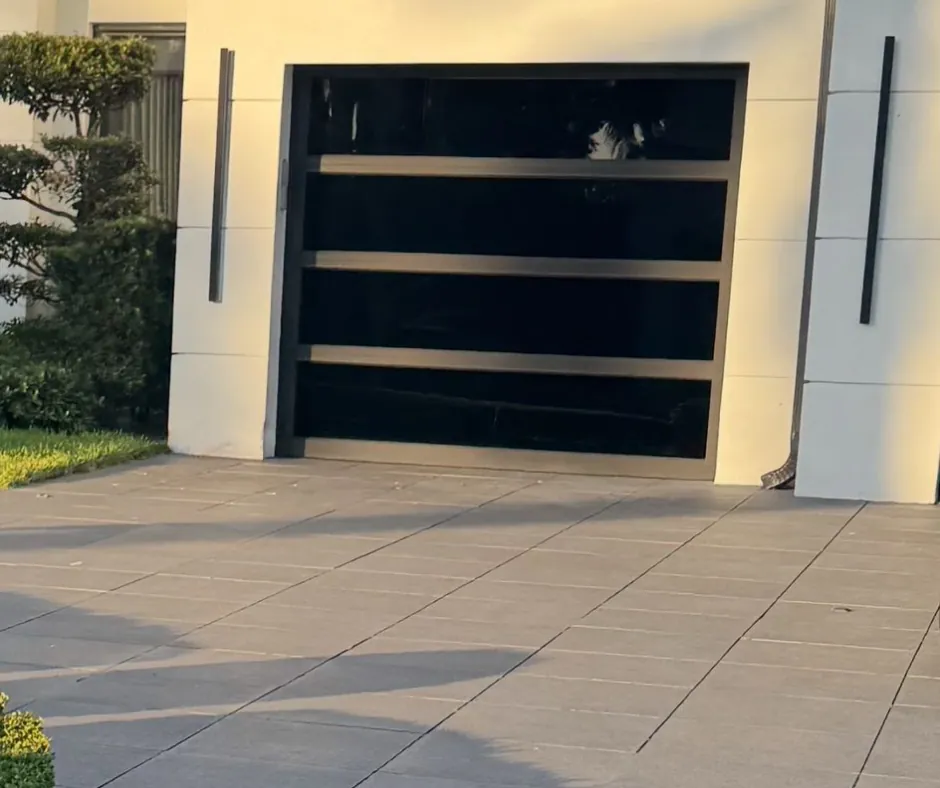
Up the long driveway: Wilmington’s attached garages and their doors
Wilmington’s Capes and ranches mostly sit on larger lots, set back from the road, with the garage built onto the house where a long driveway ends. Some are single bays, some take two cars. When we are asked about garage doors Wilmington MA homeowners have trouble with, distance is part of almost every story: the door is a long way from the street, and a fault often goes unnoticed until someone is halfway up the drive pressing a remote that gets no answer.
A long approach changes how a door is used and how it fails. Remotes are pressed from further away. Doors are left open while someone walks back down to the mailbox or the car. Snow has to be pushed a long way, and it often ends up piled near the garage. With the garage joined to the house, a door jammed in the up position also leaves a route indoors.
Three things to note before you ring us, without putting a hand on the springs or cables:
- Is it a single-bay or a two-bay door?
- Does the opener make any sound at all when you press the wall button inside the garage, as opposed to the remote?
- Is the door sitting level, and is there a cable hanging slack at either lower corner?
Garage door services in Wilmington
General door repair
Cracked hinges, noisy rollers, a lower section bowed by a snowbank, a door that grinds or shudders on its way up the rails. All of that comes under garage door repair.
Spring replacement
Single doors here may use one torsion coil or two side-mounted stretch springs; two-car doors usually run a pair of torsion springs. Both kinds can fail without warning. Read our spring repair page.
Opener trouble
Handsets that respond only once you are beside the garage, keypads that stopped taking a code, wall buttons, safety eyes and motors that whine without result. We mend and replace LiftMaster openers along with others. See opener services.
Late-night breakdowns
A door frozen wide open at night with the house door behind it, or a car shut in by a broken spring. Our line is answered at every hour. How that works: emergency garage door repair.
Snapped cables, derailed doors
A slack cable lets one end of the door drop and can tip a roller out of its track. See cable repair and off-track door repair.
A door to replace the old one
New single and double doors, supplied and fitted to the opening. Details on new garage door installation.
Remotes, range and a long walk up the drive
On a compact city lot, the remote is pressed a few car lengths from the door. Here, people often reach for it near the bottom of the drive, and expect the door to be rising by the time they arrive. That puts the opener’s receiver and the remote’s battery at the edge of what they can manage, and it hides small faults: a door that reverses after closing, for instance, may not be seen at all until someone walks back and finds it standing open.
Some practical points for long-driveway garages:
- Check the door actually closed. If the opener has a light or a status indicator inside the house, use it. Otherwise, glance back before you leave.
- Range falls before the remote dies. A remote that only works from closer and closer in usually needs a battery, not a new opener.
- The receiver’s aerial matters. The thin wire hanging from the opener head is its aerial. If it has been tucked up or damaged, range drops.
- Keypads help. An outside keypad by the garage gives a way in when a remote has been left in another car.
If a remote fails completely and a fresh battery makes no difference, the opener may need to be paired with it again, or the receiver may be failing. We can test which.
Attached singles and attached doubles
The garages here come in two sizes, and the door hardware scales with them.
The single-bay garage on a Cape
On many Capes the garage is one bay, built onto one gable end, with an inner door leading to a mudroom or kitchen. The door is lighter than a double, but it is the only one, and it often runs many times a day. Older singles sometimes still hang on stretch springs running parallel to the ceiling rails, where newer doors would have a torsion coil above the header. Both work; they just fail in different ways, and an extension spring without a containment cable is a hazard when it breaks.
The two-car garage on a ranch
Ranches here often have a two-car garage under the same long roof as the house. A two-car door is heavy, usually hung on two torsion springs, and the opener is relying on those springs to do the lifting. When one weakens, the door lifts unevenly, the opener strains, and the cables take a sideways load they were not designed for.
On either kind, because the garage is attached, the door doubles as a stretch of the house’s exterior. A gap under it lets in cold, water and the odd animal looking for shelter.
Springs come first
Across the many garage doors Wilmington MA households call about, the most frequent urgent job is a broken spring. It announces itself with a bang, and afterwards the door either refuses to rise or lifts a short way and quits while the opener labours.
The torsion spring above the opening is wound under heavy tension; that stored energy is exactly what lifts the door, and it is why handling one is dangerous and never a DIY job. Its winding cones and the shaft it turns are under the same strain, so even loosening the wrong screw can release it suddenly. Extension springs, on older singles, stretch along the tracks; one that snaps without a containment cable can swing across the garage.
If a spring has failed:
- Leave the door in place and do not lift it by hand.
- Unplug the opener, or flip its breaker, so it cannot be run against a dead door.
- If you need a car out urgently, call rather than forcing the door.
We fit springs matched to that door’s weight and height, inspect the cables and drums while the system is unloaded, and balance the door so it rests still part-way up the opening. On a two-spring door, we will tell you the state of the second spring as well, because the pair have shared every lift.
Snow, plow banks and the bottom of the door
A long driveway means a lot of snow to move, and on a larger lot it usually gets pushed toward the top of the drive and banked near the garage. That is hard on a door in three ways.
- Weight against the lower section. Snow piled against the door pushes the bottom section in. When the door is next opened, the rollers drag against that load, and a hinge or section can crack.
- Ice along the seal. Meltwater runs under the door and sets hard overnight. Ask the opener to raise a door that ice is gripping at one end and it twists the door, and the cable on that side can jump its drum.
- Salt and grit. What gets spread on the driveway tracks in on tires and collects at the base of the rails and on the rollers.
Keep a clear strip in front of the door when the drive is cleared, break ice along the seal by hand before running the opener, and rinse grit out of the lower tracks once the weather turns. If an icy morning has already pulled the door crooked, stop and call; running it again usually makes it worse.
Cables and doors off the track
The lift cables carry the door from its bottom corners up to the drums on the spring shaft. They wear where they rub, and they can snap, especially on a door that has been twisted by ice or knocked by a car. The usual sign is a door sagging to one side, or a cable lying loose on the floor.
When a cable fails on a wide door, the door can tilt enough for a roller to leave the track. At that point, the door is unstable. Clear the area beneath it, cut power to the opener, and let it be. Our fix starts by unloading the door’s weight safely; then any kinked rail is trued or renewed, cracked rollers are swapped, both cables are changed as a matched pair, and the door is hung square again.
Openers that struggle
Openers are built to steer a door whose weight the springs have already taken; they are not hoists. Most opener complaints we see fall into a few groups:
- Motor humming, door motionless. The drive gear or belt may have failed, or the release cord may have been pulled.
- The door starts, then reverses. Often a weak spring is making the door too heavy; sometimes the opener’s force setting has drifted.
- The door closes, then goes back up. The safety eyes near the floor may be knocked out of line or blocked by a leaf, a cobweb or a bin.
- Nothing at all. Check the outlet and breaker, then the wall button, then the remote.
We repair or replace openers as needed, LiftMaster among them, and choose a replacement to suit the door’s size, the garage’s headroom, and whether a bedroom sits above or beside the garage.
What happens when we arrive
- We park as close to the garage as the driveway allows and look over the whole door before touching it.
- We point out the failed part, anything close behind it, and anything that is fine for now.
- You decide. No part is replaced without your go-ahead.
- We finish by balancing the door, adjusting where the opener stops and how hard it pushes, and proving the auto-reverse works.
On a long drive, it helps to leave the turnaround by the garage clear so the van can pull right up and the door can travel its whole height while we test.
What you can spot from the bottom of the drive
A garage at the top of a long driveway is seen from a distance more often than it is seen up close, and several faults show from there before they turn into a breakdown. On a walk back from the mailbox, it is worth a glance at the door.
- One side lower than the other. A door that sits with a slope along its bottom edge usually has a cable stretching, a spring weakening on one side, or a roller that has dropped out of line.
- A gap of daylight under one end. Either the slab has settled at that end, the seal has torn, or the door is not closing fully because the opener’s travel needs setting.
- A bowed lower section. Often left behind by a snowbank or a bumper. A bowed section can catch on the rails as it rolls through the bend where the rails turn level.
- A door that pauses or jerks at the same point every cycle. Usually a flat or seized roller, or a bent piece of track at that height.
None of these is an emergency on its own, but each one puts extra load on the springs, cables and opener. Catching them from the driveway means a planned visit instead of a call when the door finally refuses to move.
The door as part of an attached house
Because nearly all of the garages here are attached, the garage door is effectively one of the house’s exterior doors, and the widest one. For garage doors Wilmington MA homes depend on, that brings a few considerations that a detached garage never raises.
That inner mudroom or kitchen door is often left on the latch during the day. A garage door that has stuck open, or that reverses and stands open after someone has driven away, leaves that inner door as the only barrier. The same applies at night: a door that will not come down is worth a call rather than a wait until morning.
An attached garage also passes its temperature to the rooms beside it. A thin, uninsulated door with a worn seal lets cold air pool in the garage and seep into the house through the shared wall, and on a ranch, the garage can run alongside several rooms. Seals, weatherstripping and, where the door is being replaced anyway, insulation all help.
Repair or a new door
A door with solid sections and tired hardware is usually a repair. New springs, cables, rollers and hinges go a long way, and many garage doors in Wilmington MA, on Capes and ranches alike, still have sound panels with years of use in them. Before recommending anything, we look at the sections from inside the garage as well as outside: rust usually starts on the inner face along the bottom, and a panel that looks fine from the driveway can be thin where the seal has held water against it. If the panels pass, a hardware overhaul is the sensible route.
A replacement is worth weighing when:
- Lower sections are cracked, split or rusted, often from years of snow banked against them.
- The door has been bent by a car or ice so often that it no longer runs true.
- An attached garage needs an insulated, better-sealed door to keep cold out of the rooms next to it.
- Odd parts from several earlier repairs have left the door running poorly.
We supply the new door, take away the old one and fit the new door to your opening. A Cape often looks best with a raised-panel or carriage-style door with a row of windows; a ranch often suits a plainer, longer panel. For an attached garage, an insulated door is worth considering, and the longer the winter, the more it pays off.
Neighbouring towns
Our work around Wilmington takes us into Burlington and Reading as well. Every town we serve is on our service areas page.
Get the door sorted
Door dead, lopsided, or refusing to shut behind you? Then call us or book online. The phone is answered whatever the hour, any day you call, so a problem with garage doors Wilmington MA households depend on can be passed to us the moment it shows up.
Questions from Wilmington
Our remote only works when we are close to the house. Is the opener failing?
Usually not. Try a new battery and check that the opener’s aerial is hanging down, unbent and undamaged. If range does not improve, the remote may need re-pairing or the receiver may need attention.
Snow was piled against our door and now it sticks. What should we do?
Stop running it. Clear the snow and any ice along the bottom seal by hand, then try once. If the door still binds or lifts unevenly, a section, hinge or cable may have been strained, and it should be looked at.
We have side springs on our single door. Are they safe?
They can be, provided a containment cable runs through each spring. If yours have none, or one spring has broken, call before using the door.
Should both springs on our two-car door be replaced together?
Often, yes, because both have done the same work. We will look at the remaining spring and tell you its condition.
Does an insulated door make sense for an attached garage?
When a kitchen or mudroom backs directly onto the garage, an insulated door with a tight seal keeps the adjoining rooms warmer and quieter, and the benefit grows with the length of the winter.