
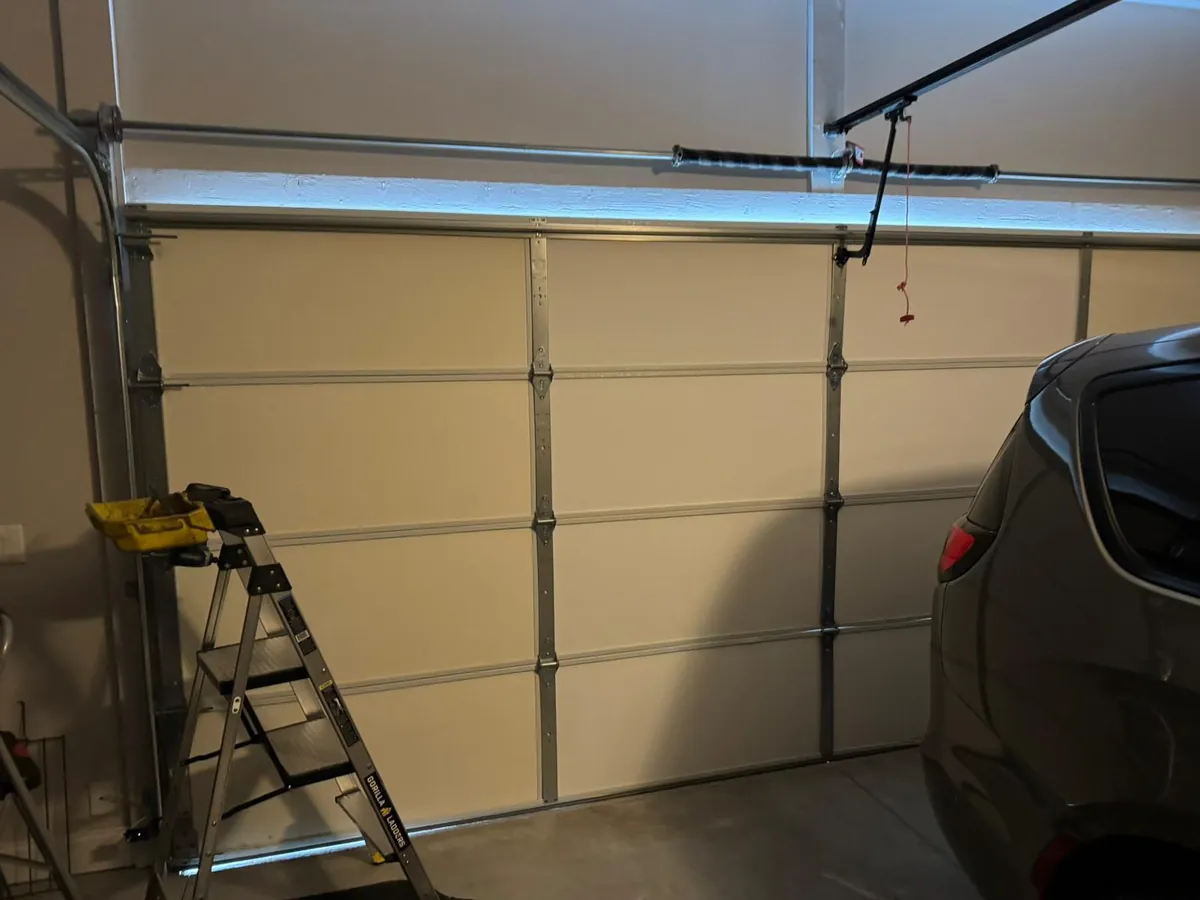
The two-car doors on the colonials around the center
Around Medfield’s center, the typical house is a colonial on a wooded lot, with an attached two-car garage facing a generous driveway. Garage doors Medfield MA homeowners ask us about are nearly always on that kind of garage: a large door, or a pair of doors, that fills much of the street-facing elevation, gets used several times a day, and lives under trees.
That combination brings two sets of concerns. One is mechanical: a two-car garage door is heavy, and its springs, cables and opener carry a lot of load. The other is how it looks: on a colonial, a passer-by notices the garage almost before the front porch, so a dented section, a mismatched replacement panel or a door hanging out of line spoils the whole front.
Before you call, a look from inside the garage helps, as long as you keep your hands away from the springs and cables:
- Is it one wide door or two single doors side by side?
- Has a spring parted, leaving a visible gap in its coils?
- Is the door hanging evenly, or lower at one corner?
Garage door services in Medfield
Fixing the door itself
Split hinges, tired rollers, a bottom section soft with damp, rails knocked out of true, a door that grumbles all the way up. That is all garage door repair.
Spring work
Two-car doors lean on a pair of heavy torsion springs; a pair of single doors has a spring system each. When one gives way, the door cannot be raised safely. See spring repair.
Openers and handsets
Twin openers on twin doors, remotes for several cars, keypads, wall buttons and the photo eyes at floor level. LiftMaster openers are part of the range we repair and replace. More at opener services.
After-hours trouble
A door that will not shut as night falls, or both cars stuck behind a broken spring. Our phone is answered at any hour. Details: emergency garage door repair.
Worn cables, tilted doors
A worn lift cable drops one corner; a twisted door can jump a roller out of its rail. See cable repair and off-track door repair.
New doors for a colonial front
Replacement doors chosen to suit the house, supplied and fitted. See new garage door installation.
One double door or a matched pair
Colonial two-car garages around here are fitted either with a broad door across the full width, or twin narrower doors either side of a centre pier. Each layout behaves differently, and it is worth knowing which you have before anything goes wrong.
A single wide door
A double-width door is one long, heavy panel stack. It usually runs on two torsion springs sharing one shaft, two cables, two drums and one opener. Because everything is shared, a fault anywhere affects both bays: one broken spring shuts the whole garage. A wide door also flexes more across its span, which is why the struts across its sections and the hinges between them matter so much. A loose strut or a split hinge lets the middle sag and the door rub or bind.
Two single doors
A matched pair splits the load. With separate hardware on each side, a failure on the left leaves the right-hand bay in service. The catch is that the pair were usually hung together and have clocked up similar mileage, so when one fails, its partner is rarely far behind. They also need to match: replacing one section, one door or one opener on a pair is fine mechanically, but the two should look the same from the road.
Whichever you have, we look at both bays when we come for one.
The garage door on a colonial’s face
A colonial is a formal, symmetrical house, and an attached two-car garage puts a large rectangle of door beside it. That door can make the front look tidy and in keeping, or it can look like an afterthought.
The things that make the most difference:
- Panel style. Raised panels and carriage-style designs sit naturally with a colonial’s shutters and trim. A flat, plain door can look out of place on a traditional front.
- Windows. A row of small windows across the top section echoes the house’s own windows and lets light into the garage.
- Colour. Matching the trim, or the front door, ties the garage to the house.
- Straight lines. A door hanging lower at one end, or with a dented lower section, draws the eye. Fixing the balance often does as much for the front as anything cosmetic.
When a door is replaced, we can help you choose a style that suits the house, and fit it so it sits level and square in the opening.
What the trees bring to the garage
Wooded lots are part of what makes these streets what they are, and the trees have their say on the door too.
Under a canopy, the apron dries slowly after a downpour and holds on to snow well into a thaw. Leaves and twigs gather at the foot of the door. More than anything, though, a wooded lot means wildlife, and a garage with a worn bottom seal is an open invitation. Mice and chipmunks squeeze under a gap that a torn seal leaves, and squirrels have been known to chew at seals and weatherstripping. Once something is nesting in the garage, it can get at wiring, including the wires running to the opener’s safety eyes.
Keeping the bottom seal and the side weatherstripping in good order is one of the simplest jobs on the door, and on a lot like this it is one of the most useful. If the opener has started reversing for no reason, it is worth checking the safety-eye wiring for chewing as well as checking the eyes for alignment.
Mudroom, kitchen and the door beside them
An attached two-car garage on a colonial usually backs onto the busiest rooms on the ground floor: a mudroom, a laundry, the kitchen, sometimes a family room added along the same side. Whatever the garage lets in, those rooms feel.
The garage door is the largest single opening in that envelope. A door with no insulation, or with gaps along its jambs and under its bottom edge, turns the garage into a cold box in January and a hot one in August, and the shared wall passes much of that through. On a wooded lot, a door that never quite seals also lets damp air settle in the garage, which is hard on anything stored there and on the door’s own lower sections.
For garage doors Medfield MA homes have on an attached garage, the practical steps are simple. Renew a flattened or torn bottom seal. Replace perished weatherstripping along the jambs and header. Make sure the door actually closes fully, because an opener whose travel has drifted can stop a finger’s width short of the floor. And when the time comes to replace the door, give real thought to an insulated one: on a garage this size, against rooms used every day, the difference is noticeable.
When the opener and the door are different ages
Many two-car garages here have had an opener replaced at some point while the door stayed, or a door replaced while an older opener carried on. That mismatch causes its own faults. A newer, more powerful opener can mask a weak spring for a while by simply hauling the door up, until the drive wears out or a cable gives. An older opener on a newer, heavier insulated door may struggle from the first day.
The rule of thumb is that the springs should carry the door and the opener should only guide it. When we work on either, we check the other: lifting the door by hand with the opener disengaged, once the springs are known to be sound, tells us whether the door is balanced. If it is not, adjusting the springs comes before blaming the opener. It is a quick test, and it often saves replacing a motor that was never at fault, one of the commonest surprises on garage doors Medfield MA owners call us about. Where the opener genuinely is worn out, we size its replacement to the door that is actually hanging there, not to the door the old opener was bought for, and we set its force low enough that the safety reverse responds properly on a door of that weight.
Springs and the weight they carry
Of all the garage doors Medfield MA households call about, a snapped spring is behind more urgent jobs than anything else. On a two-car door you will know: a report like a dropped plank echoes through the house, and afterwards the door either stays down or crawls up a hand’s width while the opener labours.
A torsion spring is a steel coil wound tight on a shaft above the opening. The energy wound into it lets a heavy door glide up with a light touch, and it is also why a torsion spring is dangerous: the cones, shaft and brackets all hold that energy, and releasing it the wrong way can throw a tool or a hand with real force. It is never a DIY job.
If one has broken:
- Do not try to lift a two-car door by hand. Without its springs, it is far heavier than it looks.
- Pull the opener’s plug so it is not run against the dead weight.
- If a car has to come out, call us rather than forcing the door.
We fit new springs sized for the door, check the cables, drums and bearings while the system is unloaded, and set the balance so the door rests still part-way up. On a door hung on two springs, we usually renew both at once because they split the work evenly; on a pair of single doors, we tell you the state of the other door’s springs too.
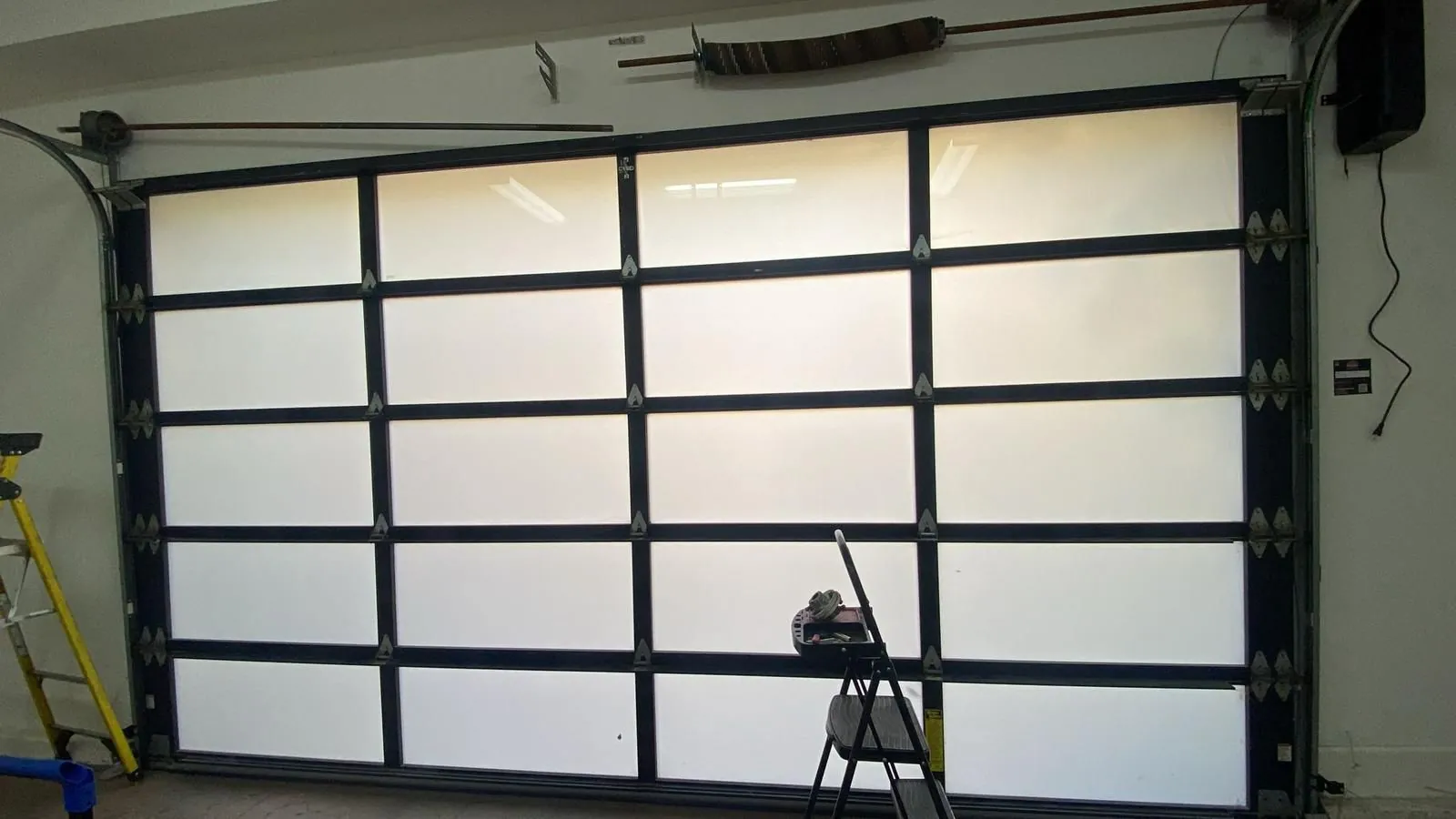
Openers, remotes and several cars
A two-car garage on a generous driveway often serves several drivers and several cars, each with its own remote, plus a keypad outside and a wall button by the house door. On a pair of doors, there may be two openers. That is a lot of controls, and faults tend to show up in a few ways:
- One handset goes dead. Swap its battery first; if that does nothing, it probably needs linking to the opener again.
- The wrong door opens. On a pair, remotes can end up paired to the wrong opener after a reset.
- The door reverses on the way down. The safety eyes may be knocked out of line, blocked, or have damaged wiring.
- The motor whirs, the door ignores it. Suspect a stripped drive gear, a snapped belt or a release cord that has been tugged.
- Total silence. Look at the socket and the breaker panel before anything else.
When the opener itself is failing, we repair or replace it, LiftMaster openers included. A heavy two-car door needs an opener that suits its weight, and a quieter drive helps when bedrooms sit above or beside the garage. If a handset is lost, wipe the opener’s stored codes and re-link only those you can account for.
Cables, drums and a door that has come off track
Lift cables tie each lower corner of the door to a drum on the spring shaft. On a wide door, a fraying cable lets one end drop first, and the door starts to twist. That twist can lift a roller clean out of its track, leaving the door hanging at an angle.
If the door is crooked, stop using it. Unplug the opener, keep cars and people away from it, and leave the rollers where they have landed. We take the load off safely, straighten or replace damaged track, replace worn rollers, renew the cables left and right as a pair, and rehang the door level. On a door this wide, getting both sides equal is what keeps it from happening again.
How a visit runs
- Both bays get inspected before any tool comes out, struts and seals included.
- You hear which part has let go, which ones are on their way, and which can be left.
- Only the work you approve gets done.
- To finish, the door is balanced, the opener’s stopping points and pushing force are adjusted, and the auto-reverse is proved with an obstruction.
A generous driveway makes this easy. Park both cars on the far side of the drive and leave the apron empty, and we can run the door through a full test without anything in the way.
Repairing the door, or starting over
Where the panels are sound and only the moving parts are tired, we generally recommend repair. Fresh springs, cables, rollers, hinges and seals can transform an old door, and on a colonial, a door that hangs straight again often looks better at once.
Replacement makes more sense when:
- The lowest panels have gone soft, rusty or split after long seasons in the shade.
- Several sections are dented and replacements no longer match the rest.
- The door’s style looks out of keeping with the house.
- An attached garage needs better insulation and sealing against the rooms beside it.
We bring the new door, remove the old one, and hang the replacement in your opening. If you have a single wide door and would rather have two singles, or the other way around, we can talk through what the opening allows.
A seasonal look at the door
Twice a year, ideally before winter and after the leaves are down:
- Clear leaves and debris from the bottom of both tracks and along the seal.
- Check the bottom seal and side weatherstripping for gaps and chewing.
- Open and shut it once while you stand inside and listen for grinding or popping.
- Test the safety reverse with a soft object on the floor under the door.
- Peer at each cable where it meets its lower bracket for broken strands, hands off.
Springs, cables and drums are best left to us.
Neighbouring towns
Near Medfield, we also work in Walpole, Dover, Westwood and Norwood. See all of them on our service areas page.
Getting someone out
A two-car door that is stuck, lopsided or will not come down is a reason to call us or book online. Whoever answers will take down the details whether it is dark or light outside, so trouble with garage doors Medfield MA homes depend on can be reported when it starts.
Questions from Medfield
We have two single doors. If one spring breaks, should the other door be checked?
Yes. Twin doors are normally installed together, so the second door’s springs have usually had a similar workload. We will tell you what we see.
Can a new door match the style of our colonial?
Yes. Raised-panel and carriage-style doors, with or without a row of windows, suit most colonial fronts. We help you choose one that sits well with the house.
Mice are getting into our garage. Is the door the problem?
Often. A torn or flattened bottom seal leaves a gap that small animals use. Replacing the seal and the side weatherstripping usually closes it off.
The wrong door opens when we press the remote. Can that be fixed?
Yes. The remotes have been paired to the wrong opener. Clearing and re-pairing them sorts it out.
Our two-car door sags in the middle. What causes that?
Usually a loose or missing strut across a section, or split hinges between sections. Both can be fixed, and fixing them early stops the door rubbing and binding.