
The most salt on the North Shore, and lanes too narrow for a car
Two kinds of property set the pattern here. In the Old Town, antique houses line lanes so narrow that a garage is a rarity, and the few that exist were squeezed into whatever space a lot could spare. Out on the Neck, newer houses have proper garages and modern doors, set right in the path of the wind off the water. Salt is the common thread: this is the hardest salt exposure anywhere on the North Shore, and garage doors Marblehead MA owners keep running are fighting it every day of the year.
That exposure shortens the life of everything metal on a door. Springs pit and snap sooner. Cables lose strands inside their twist. Hinges seize, rollers grind, track bolts weep rust down the jambs, and opener sensor brackets corrode until the photo eyes droop out of line. A door on the Neck can look fine from the drive and be in poor shape behind its panels.
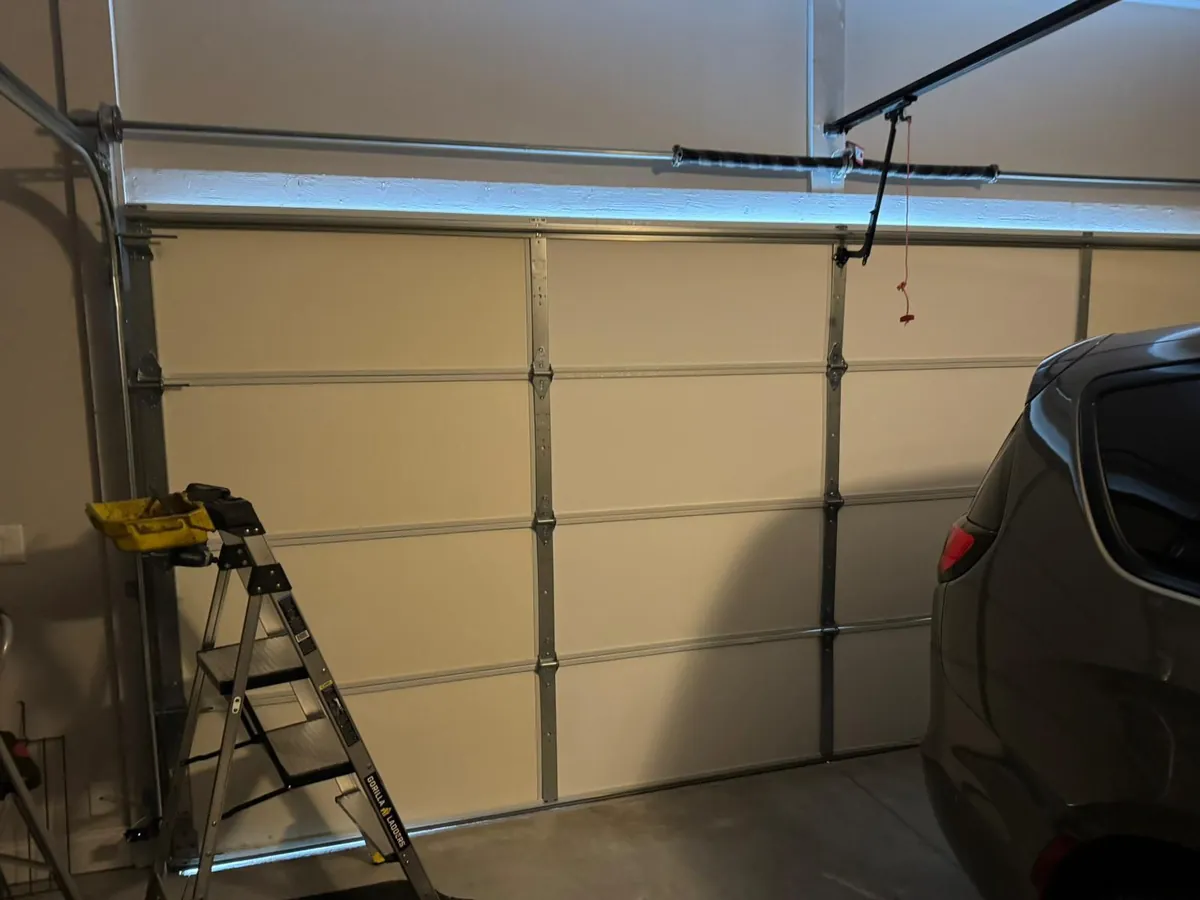
From a step back, without reaching up to the shaft or the bottom corners, look for:
- White crust or orange bloom on the coils, the cable ends and the lowest hinges.
- One of the two photo eyes hanging at an angle on its bracket.
- A door that now crawls, or hesitates at the same height on every lift.
Garage door services in Marblehead
Door and hardware repair
Hinges seized by salt, rollers worn to flats, sections bent by a gust while the door was open, rails weeping rust. Each of those is part of our garage door repair work on the Neck and in town.
Springs that rust out
On the most exposed garages, coils pit faster than anywhere inland and fail without much warning. Replacement of torsion and extension types is covered on our garage door springs page.
Openers in sea air
Circuit boards, sensor brackets and wiring all suffer by the water. Openers are repaired or replaced, LiftMaster ones included, along with handsets and keypads. More on opener services.
A door that fails in a nor’easter
A door blown out of shape, or jammed open as the weather closes in. Someone picks up whatever the clock says; read emergency garage door repair.
Corroded lift cables
Salt works into the twist of a cable long before a broken strand shows outside. Both cables come off and go back on as a matched pair. See cable repair.
Off-track doors, and replacement
A door forced out of its rails by wind or a car is rehung by off-track repair. Where salt has eaten through the sections, new garage doors are supplied and installed.
How salt shortens a door’s life here
Salt exposure is a gradient. Inland towns get some of it from winter roads. The rest of the shore gets it from the air. Marblehead, and the Neck above all, gets it at full strength: spray carried on the wind, fog that leaves a film on everything, and the road salt of winter on top.
On a garage door, that film settles first on the parts that are bare steel or thinly plated. Springs are the obvious example. A coil that might serve for many years in a dry inland garage begins to pit within a few seasons on an exposed lot, and a pit is where the coil eventually breaks. Cables are next: water and salt sit in the twist, and the strands corrode from the inside out. Then hinges, roller stems and the small fasteners that hold the rails to the wall.
The effect builds slowly. A door that ran smoothly when it was new starts to sound rougher. The opener takes longer, then begins to stop and reverse for no obvious reason because the extra friction is tripping its force limit. Finally something gives. We tend to see these doors at that last stage, which is why we look at every metal part on a visit, not only the one that failed.
The Old Town: antique houses and almost no garages
In the Old Town, the antique houses press close to very narrow lanes. Cars barely fit through some of them, and most of these lots never had room for a garage at all. When one turns up, it is usually small and tightly fitted to its lot, with limited headroom and an opening that may not match any standard door size.
That affects every part of a repair. A torsion spring wants space over the header that a cramped garage may not have, so extension springs or a low-headroom arrangement may be what fits. An opener needs a run of ceiling. Track brackets need sound framing, and older framing in a damp, salty spot is not always sound. When a new door goes into a garage like this, it is built around that particular opening and the room behind it rather than a catalogue size.
Access is the other consideration. On the narrowest lanes, a van may not be able to stop at the door, and springs, rails or a whole new door may have to be carried the last stretch. Mention the lane when you ring, so we know before setting out whether to bring the van up or walk the parts in.
The Neck: newer houses and exposed doors
Out on the Neck, the houses are newer and the garages are what you would expect of modern construction: attached or close to the house, with standard openings, steel rails fixed to sound timber and a motor hung from the ceiling joists. Many face open water or sit with nothing between them and the wind.
These doors are well built, but they lead hard lives. Wind pushes on a large door, especially when it is partly open, and a strong gust can bow sections, strain hinges or push the rails. Salt arrives every day of the year rather than only in winter. A door on the Neck that has never been looked at can be weeks from a spring failure without showing much from the outside.
For garage doors Marblehead MA houses on the Neck present, the useful habit is to have the hardware checked before it fails rather than after.
Springs: leave them alone
Whether it is wound on the bar above the header or stretched beside the overhead rails, the spring is what lifts the door. Lose it, and the motor is suddenly asked to raise a slab of steel it was never sized to carry.
Make no mistake: a torsion spring holds dangerous tension, and loading or unloading it is done with purpose-made bars and a set order of steps, because one slip sends the bar spinning with the spring’s whole stored force behind it. Treat it as never a DIY repair; the little quarter-turn some owners try, hoping to stop a door drifting, is no safer. Extension springs, found on some of the smaller garages in town, each want a containment cable running through their middle so that a break is caught and held.
On the most exposed lots, the two coils of a double door pit side by side and tend to give out within a short time of each other. Swapping the pair on one visit usually makes better sense than two separate call-outs. That reasoning is laid out for you at the door, and the decision stays with you.
A report like a rifle shot from inside the garage, then a door that stays put however long the motor hums, is the classic sign. Leave the door down, keep your hands away from the shaft and its cones, and get in touch.
Cables, drums and the brackets at the floor
The lift cables loop round the bottom corners of the door, where wet tyres, blown spray and puddles of meltwater all collect. On the Neck in particular, cables and the corner brackets they hook onto are often the most corroded parts of the whole door.
Snap one, and that corner drops while the far side carries on rising, so the door slews across its opening. A cable that unspools from its drum does much the same. In either case, keep the motor switched off and stand well back. New cables are fitted two at a time, and the coils are then re-tensioned until the door climbs evenly.
Those corner brackets are worth a separate warning. Each one anchors a cable and carries spring load, so unbolting a rusty one while the spring is still wound can cause a serious injury. However bad it looks, it is a job for us.
Openers and their sensors in sea air
Openers suffer by the water as well. Circuit boards in a damp, salty garage corrode at their contacts. Sensor wiring corrodes at its terminals. The thin steel brackets that hold the photo eyes rust and sag until the two eyes no longer line up across the opening, and the door refuses to close unless you hold the wall button.
Openers are fixed or renewed, LiftMaster units among them, and so are remotes, keypads, wall consoles and the sensors. Before blaming the opener, though, we check the door. An opener straining against a rusted, stiff door will keep failing, and the cure is in the door’s hardware, not the motor.
If you are replacing an opener on the Neck, it is worth thinking about where it sits and how exposed it is when the door is open. We talk through the options on the day.
Doors forced off their tracks
A door can leave its rails because a corroded roller crumbled, because one cable let go, because a car caught it before it was fully open, or because wind loaded a partly open door. On an exposed lot, wind is a genuine cause, not a figure of speech.
A derailed door still hangs from its springs and may lurch without warning. Back away, unplug the motor, and resist pushing rollers back in with a pry bar. On our visit, spring tension is released in the right order, kinked rail is trued or renewed, crumbled rollers are swapped, sections and hinges are inspected for knock-on damage, and the door is hung square again. See off-track garage door repair for the wider picture.
Storm nights
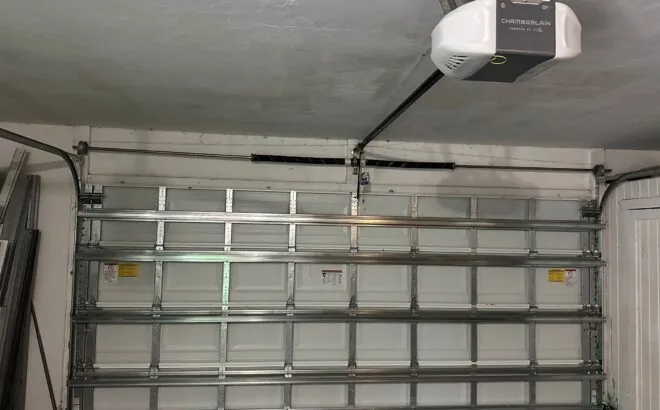
Coastal storms hit this town early and hard, and they find weak doors. A door that jams open as a storm arrives leaves the garage and whatever is in it open to wind and rain. A door blown out of shape may not close at all. Calls are picked up in the dark hours and on holidays alike, so ring as soon as it happens. Expect no promised arrival time, just an honest read of the options and a few steps to keep the door from getting worse.
Until help is there, a failed door should stay exactly as it is. If it is stuck up because a coil has gone, hauling it down by hand is risky. If it is shut, prising it open is just as unwise. That red release handle dangling from the motor rail is for a door already resting on the ground, and only then.
What a visit looks like
Everything begins with the door as a whole. Where it is safe to cycle it, we cycle it and watch. After that, each metal part gets looked at with salt in mind: coils, cables and drums, rollers, hinges, rail fixings, corner brackets, the motor and its sensors.
Our findings come in plain terms, separating parts that are close to failing from parts that are merely stained. Nothing starts until you agree. Once finished, the coils are tuned so the door hovers once unhooked from the motor, the motor’s travel and force are matched to the door, the auto-reverse is proved against an object in its path, and you watch the door cycle.
On an Old Town lane, the visit also means getting parts to the garage. We sort out how with you on the phone.
Repair or replace in the harshest salt
On many doors, it is the hardware that is worn while the panels are fine. Fresh coils, wire rope, rollers and hinges will keep a sound door going for years.
On the most exposed lots, though, the sections themselves eventually go. Steel rusts through along the bottom edge where spray and meltwater gather, and wooden doors rot where they stay wet. Once the panels are going, money spent on new hardware for them is largely wasted. Replacement doors are supplied and installed by us, sized to the actual opening, whether that is a standard two-car opening on the Neck or an odd one in the Old Town. See new garage doors. Garage doors Marblehead MA lots put this close to the sea are worth choosing with the salt in mind: sections, finish and hardware that will cope with it.
Helping a door last by the water
A few habits slow the damage:
- After a storm, hose fresh water over the lowest panels, the rubber seal and the corner brackets to lift the brine off them.
- Sweep standing water and grit away from the threshold.
- Keep an eye on the two photo eyes; if one starts to droop on its bracket, let us know before it stops the door.
- A drop of light oil on roller stems and hinge pins helps, done only with the door shut and the motor’s plug pulled out.
Coils, cables, drums and corner brackets are off limits for owners. Everything in that group is loaded, and a mistake with any of it can hurt.
Weather, timing and the Neck in winter
The Neck takes the weather head-on, and the doors there feel it in every season. In summer, fog and damp keep salt sitting on the hardware for days. In winter, spray freezes, road salt is tracked in on tyres, and the bottom seal can be glued to the slab overnight. A motor asked to lift a frozen door will strain and reverse, and repeated tries can strip its drive or slacken a cable.
On a frozen morning, loosen the bottom edge before pressing anything, and if it stays stuck after that, leave it rather than forcing it. Of all the garage doors Marblehead MA weather batters, the ones that last longest are those looked at between storms, before a small rust problem becomes a broken spring at the worst possible moment.
Next door along the shore
Our vans cover the towns either side as well. See Salem and Swampscott, or every area we cover on our service areas page.
Ring us about your door
Whether it is a rusted coil on a door facing the water or a tight garage on an Old Town lane, describe the fault, where the house is, and how close a van can get. For garage doors Marblehead MA salt has worn down, there is one move to make whatever the hour on the kitchen clock: call us or book online.
Questions from Marblehead
Our door on the Neck is fairly new but the springs already look rusty. Should we worry?
It is worth having them looked at. On the most exposed lots, springs pit quickly, and a pitted spring breaks sooner. We can tell you whether the rust is surface staining or real loss of strength.
Can you reach a garage on one of the narrow Old Town lanes?
Yes, though it may mean carrying parts the last stretch on foot. Describe the lane when you ring, and the trip is organised to suit it.
The door will only close if I hold the wall button. Why?
That usually means the photo eyes cannot see each other. In sea air their brackets rust and sag, or their wiring corrodes. Check that both lights are steady; if not, the sensors need attention.
A gust caught the door while it was half open and now it rubs. What now?
Leave it closed if it is closed, and do not keep running it. Wind on a partly open door can bow sections and push the rails out of line, and running it can pull it off its track. Call us to look at it.
Our door is badly rusted. Repair, or start over?
It depends where the rust is. Rusty hardware on sound sections is usually worth replacing. Sections rusted through along the bottom usually mean a new door is the better choice.