
Stand under a closed garage door and it looks as if the motor on the ceiling does all the work. It does very little. Knowing how garage door springs work explains nearly every lifting fault a homeowner runs into: coiled steel stores enough energy to cancel out the weight of the panels, leaving the opener, or your own arm, to guide something that feels almost weightless. When a spring gives up, that help vanishes in an instant and the full heft of the door lands on parts that were never meant to bear it.
The idea behind the springs: counterbalance
A sectional door is heavy. Steel or timber panels, the hinges between them, the struts stiffening them and the hardware along each edge add up to a load nobody ought to wrestle upward alone. Rather than ask a motor to haul all of that, the door is counterbalanced. The springs are loaded, twisted or stretched, while the door is down, and as it rises they give that energy back bit by bit, matching the load at each point of its travel.
That is the heart of how garage door springs work. Disconnect the opener on a healthy door, raise it to waist height, and it ought to hover there without much drift. A door that sinks toward the floor, or creeps up by itself, is out of balance, and the springs are the usual suspect.
Torsion springs: twisting force over the opening
Most newer doors use torsion springs, and they show most clearly how garage door springs work in practice. The coils are threaded onto a steel shaft mounted along the header, steadied by a centre bracket. Each end of the shaft carries a grooved cable drum, and a lift cable runs from each drum down to a fixing on the lowest corner of the door.
Closing the door rotates the shaft and winds the coil tighter. Opening it lets the coil relax, the shaft turns the other way, and the drums gather in cable, hauling the foot of the door upward. With the door shut, that coil is loaded hard. That stored twist is what makes a torsion spring so hazardous: if a winding bar slips, or set screws are slackened in the wrong order, all of it comes out at once.
For the trade-offs between the two systems, the guide to torsion or extension springs puts them side by side.
Extension springs: stretching along the tracks
Older doors, and plenty of single doors in freestanding garages, use extension springs instead. These hang parallel to the horizontal tracks overhead, one per side. A cable looped over a set of pulleys ties each spring to the bottom of the door. Lowering the door draws the springs out long; raising it lets them shorten and pull.
The principle is identical, only the force pulls instead of twists. Each spring ought to have a containment cable threaded down its centre, so a spring that snaps stays captive rather than flying across the bay. Quite a few older installations lack one.
Why springs break
Each spring is built to survive a finite tally of cycles, one trip up plus one trip down. Each trip flexes the wire slightly, until fatigue finally cracks it. Several things wear that allowance away sooner:
- Constant traffic. A door the household uses as its everyday front entrance racks up cycles quickly.
- Rust. Damp air and road salt dripping off cars corrode the coils, adding friction and weak spots.
- Cold. Steel turns more brittle in a deep chill, which is why a tired spring so often breaks on a bitter morning.
- Poor sizing. A spring that was mismatched to the door at the outset strains on every cycle.
- Extra weight added later, such as insulation, new panels or decorative hardware, with no change to the springs.
The usual clue is a sharp crack from the garage, often while nobody is near the door. A broken torsion coil shows an obvious gap. A broken extension spring dangles loose or lies on the floor.
What you can safely look at, and what you must leave alone
Looking is fine. Keep your distance and check whether the coils above the opening are continuous or split. Notice whether each cable still sits in its drum groove or pulley. Notice whether the bottom edge of the door is level.
Touching is not. Never wind, unwind or tweak a torsion spring, never unhook an extension spring, and never loosen the lift cables or the hardware anchoring them at floor level, because all of them are tied directly to spring tension. Stop pressing the opener button as well: a motor straining against a dead spring can chew its gears or crease the uppermost panel. If a spring fails with the door raised, nobody should walk or park underneath it.
How Greater Boston garages affect the springs
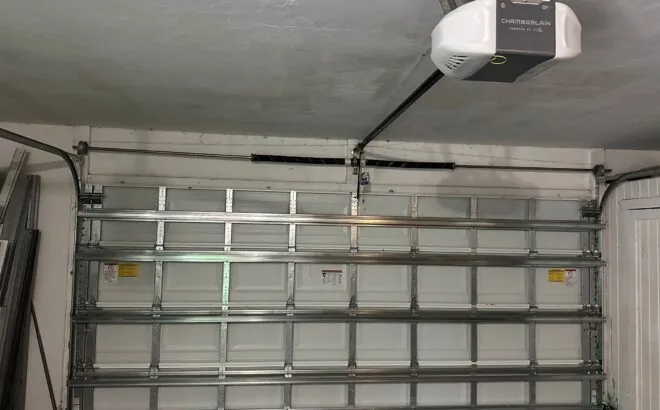
Freestanding single garages behind triple-deckers. Many date from the twenties, and the doors hanging in them have been replaced, patched and adapted more than once. Extension springs are typical here, sometimes with no containment cable, and sometimes holding up a door heavier than the springs were picked for. Seeing how garage door springs work on one of these old doors usually means seeing a system altered by several hands.
Row houses without a garage. Many homes in the tighter neighbourhoods have nowhere to park indoors, and the only overhead door nearby belongs to a shared rear lot or a converted carriage house. The spring rules do not change, but several households using one door means the cycles pile up fast.
Suburban attached two-car garages. That broad double door is heavy, so it nearly always hangs on torsion springs, frequently a pair. If one of the pair snaps, its partner suddenly carries the whole load, which is why both normally get renewed together.
What a spring repair involves
A technician first confirms which spring failed, then checks the cables, drums, rollers and bearings that absorbed the jolt. The broken spring comes off with its tension safely released, a replacement suited to the door’s weight and height goes on, and the door is balanced and tried both by hand and on the opener. Our garage door spring repair service describes that visit in full; if a cable unspooled or frayed in the same moment, cable repair covers it.
A door that also jumped its rails needs off-track repair. An opener that spent a while fighting a dead spring may deserve a check through opener repair and replacement too. If the door has just stopped dead after a loud crack, our post on a broken garage door spring covers the first few minutes, and more guides sit on the blog.
Once you understand how garage door springs work, the rule sticks: the springs carry the door, so anything connected to them belongs to someone with the proper tools.
Questions about how springs work
Which kind of spring is on my door?
Look at the wall above the closed door. Coils wrapped around a bar spanning the header mean torsion. Long springs alongside each overhead track, ending in pulleys, mean extension.
Will the opener still raise the door with a spring gone?
It may try, and it should not be allowed to. Openers are built to steer a balanced door; making one haul the full weight risks the motor, the gears and the top panel. Leave the button alone and phone us.
Why did the spring snap when nobody was using the door?
Fatigue cracks can finish their work while a spring simply sits loaded. A cold morning is a common moment for that final break.
Should the second spring be renewed if only one broke?
On a paired door, usually yes. Both springs have lived through identical use, so the survivor is nearly worn out too, and matching springs keep the door level.
Can I adjust the tension myself?
No. A wound torsion coil stores a dangerous amount of energy, and extension springs can let go with similar force. Neither is a homeowner job.
Book a spring repair
Heard that crack, or found the door suddenly too heavy to budge? Call us or book online. Our phones are answered through the night and over weekends, so a spring that lets go after dark goes on our list as soon as you ring.