
A garage door grinding noise almost always means metal is dragging where it ought to roll, or teeth are slipping where they ought to mesh. The door may still open and close, which tempts people to ignore it, but the sound is wear happening in real time. Before calling anyone, stand inside the garage while somebody else runs the door, and notice where the noise is loudest: up at the motor on the ceiling, along one of the vertical tracks at the sides, or across the top of the opening where the spring bar runs. That single observation does more to narrow the cause than any amount of guessing.
Tracing a garage door grinding noise to its source
Doors are made of a handful of moving parts, and each one grinds in its own way.
Along the side tracks. The rollers fixed to the edge of each section are meant to spin as the door travels. When a roller’s bearing rusts or its wheel cracks, it stops turning and gets dragged instead, scraping the inside of the track with a rough, rhythmic sound that moves up or down with the door. A dented or twisted track does something similar at one spot: the door runs quietly, then grates as a roller passes the bent section, then goes quiet again.
Up at the opener. A rumble from the motor housing that sounds like gravel in a gearbox usually means the nylon gear in the drive has lost the edges of its teeth. The motor keeps spinning, the gear slips, and the door hesitates or stalls partway. When the grinding ends with a motor that spins and a door that sits still, read our guide for a motor that turns without lifting anything.
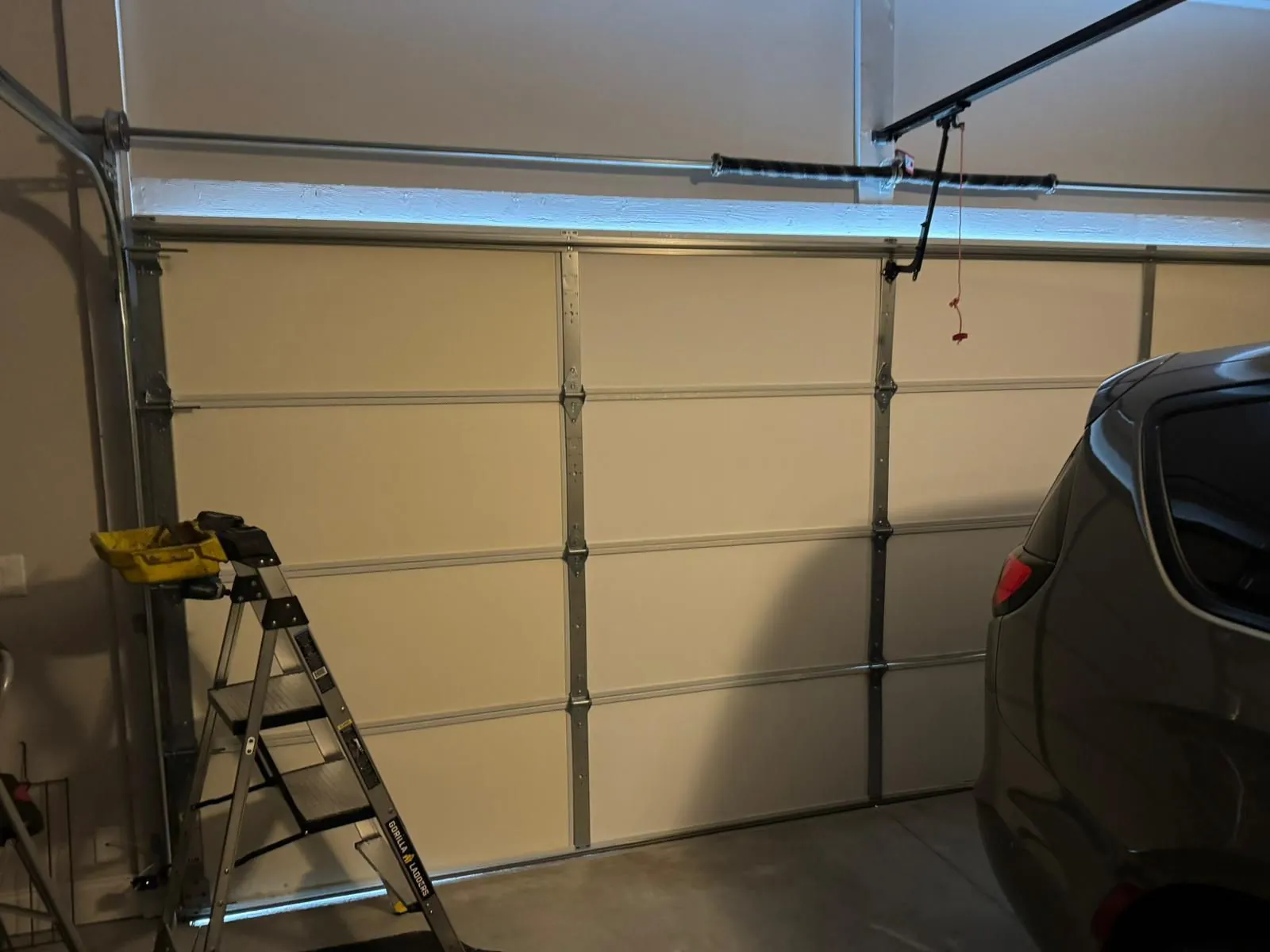
Across the top of the opening. On most sectional doors the torsion spring sits on a steel bar above the door, with a cable drum at each end. Grinding from this area can mean a bearing plate has worn, a drum is rubbing, or a spring coil has cracked and the broken ends are scraping against each other. This is the zone to stay well away from.
Between the sections. The hinges joining the panels flex every time the door rounds the curve at the top. Dry or loose hinges tend to creak and pop rather than grind, though a hinge that has cracked can catch and grate.
What changed, and when
Pay attention to timing as well as location. A sound that has grown slowly over a season is usually wear on rollers, hinges or the opener gear. A noise that appeared suddenly, especially after a loud bang, points to something breaking: a spring, a cable starting to unwind from its drum, or a roller jumping out of its track. Sudden noises are the ones that mean parking the door until a technician has seen it.
What you can safely look at, and where to stop
Plenty can be checked from the floor without touching anything dangerous.
- Close the door and look along both vertical tracks for dents, kinks or brackets that have worked loose from the wall.
- Watch the rollers as the door moves. A roller that wobbles, stops spinning or sits at an angle in the track is easy to spot.
- Look at the lift cables from a safe distance. They should be smooth, tight and evenly wound on both drums. Frayed strands or slack on one side mean the door needs to stay put.
- Check the bottom of each track for grit, leaves or a stray toy wedged in the curve.
- If the only sound is a dry squeak from the hinges, a light lubricant on the hinge pivots is a sensible first step. It will not quiet a worn gear or a seized bearing, and grease packed into the tracks only collects dirt.
Then stop. The spring above the door is wound tight enough to snap bone if it lets go, and the cables and bottom brackets are connected straight to that force. Do not try to tighten, loosen or adjust any of them, do not hammer a bent track back into line while the door is raised, and do not keep cycling a door that grinds louder each time. Every extra run grinds a little more off whatever is failing.
Cold mornings, harbour air and short driveways
Greater Boston puts its own strain on these parts. On a hard winter morning, lubricant in the rollers and hinges stiffens, the steel contracts, and a tired spring is under more stress than at any other time of year. A door that only grumbled in October can grind properly by January, and a spring that was close to failing often picks a frosty morning to go.
Close to the water the problem is corrosion. In Winthrop, Revere and Marblehead, salt air works into roller bearings, track fasteners and the lift cables themselves. Rusted bearings stop turning and start scraping, and a cable that has rusted at the drum can fray strand by strand, which you will often hear as a dry, gritty rasp from the top corners of the door before anything visibly gives way. If you live near the shore and the garage door grinding noise is coming from the corners rather than the middle, have the cables looked at soon.
Then there is the space itself. Many city garages sit at the end of a narrow driveway, with no room to leave a car outside. A grinding roller that finally pops out of its track can leave the door jammed half open, blocking the only parking the household has and leaving the garage exposed. Better to chase the noise down while the door still runs.
The repairs that stop the noise
Once the source of a garage door grinding noise is found, the fix usually matches it directly:
- Worn or rusted rollers are replaced, and bent tracks are straightened or replaced, under off-track garage door repair. If the door has already left the track, read our post on a garage door off track first.
- A slipping drive gear, a stretched chain or a failing motor is the work of opener repair and replacement, which covers LiftMaster openers as well.
- A cracked spring means spring repair. If you heard a bang before the noise began, our broken garage door spring post explains what to do in the meantime.
- Frayed cables and worn drums are fixed through cable repair.
- Cracked hinges, loose brackets and damaged sections come under general garage door repair.
A visit starts with the door run up and down while the technician listens and watches, then a look at every moving part, not just the noisy one. You hear what is worn and what the work involves before anything is replaced.
When to stop using the door altogether
Leave the door shut, or wherever it has stopped, and call if the grinding arrives alongside any of these: a bang from up near the spring, one side rising ahead of the other, slack in a cable, a roller that has jumped its rail, or an opener that labours and quits. Nobody should stand or park under it in the meantime. For a raised door you cannot safely bring down, the post on a garage door stuck open explains how to judge it, and other door faults are covered across the Elite Boston blog.
Questions about a garage door grinding noise
Can I keep using a door that grinds?
For a short time, if it opens and closes evenly and the sound has built up gradually. If it is getting louder week by week, if the door shudders, or if one side lags, stop using it and have it inspected.
Will spraying lubricant fix the grinding?
Only if the sound comes from dry hinges or roller bearings that are still sound. A stripped opener gear, a cracked roller, a bent track or a broken spring will keep grinding however much you spray, and grease in the tracks makes things worse.
Why is the door louder in winter?
Cold thickens lubricant and stiffens every moving part, and the springs are working harder. A door that grinds mainly on frosty mornings usually has rollers or hinges close to the end of their life.
The grinding comes from the opener on the ceiling. Is that serious?
It often means the drive gear inside is wearing out. Left alone, the gear eventually strips and the motor runs without moving the door. The opener can usually be repaired, or replaced if it is past that point.
Is it safe to adjust the spring to stop the noise?
No. The spring carries the weight of the door under heavy tension, and adjusting it without the right tools and training causes serious injuries. Leave the spring, its cables and the bottom brackets alone and call.
Book the repair
If your door has started to grind, call us or book online and a technician will track it down. The phone is answered at any hour, any day, so a noise that turns into a jammed door can be phoned in there and then, whatever the hour.