
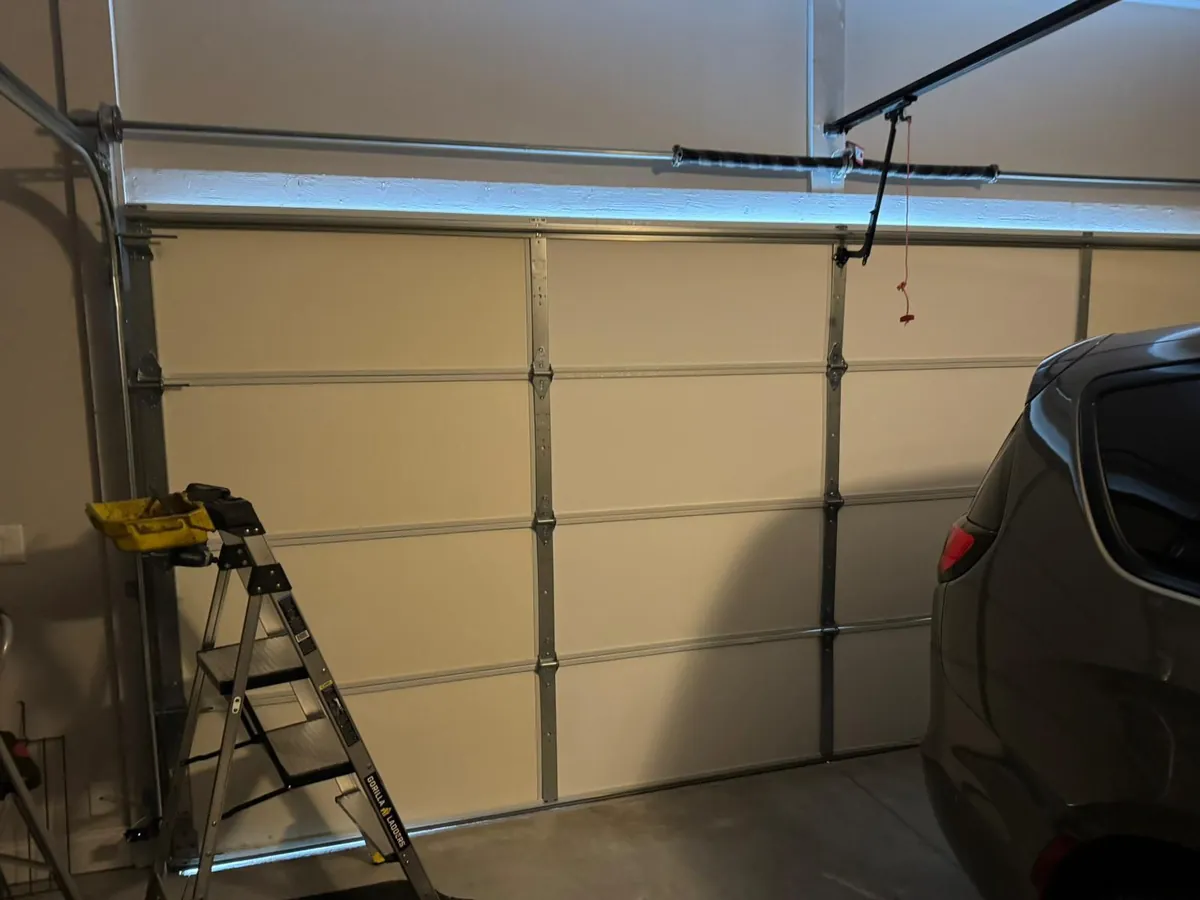
Detached garages at the end of Wakefield’s long driveways
Around Lake Quannapowitt, the usual pattern is a Victorian or a colonial built close to its neighbour, with the garage standing as its own small building well behind the house. Reaching it means walking the length of a driveway that threads between two sets of clapboard walls with little to spare on either side. Most calls about garage doors Wakefield MA owners make start in that back building: a door that refuses to lift, an opener that clicks without moving anything, or a section caught on the frame halfway up.
A garage set apart from the house keeps its own schedule of wear. It tends to be the last structure on the lot anyone checks, it faces the weather on every side, and its overhead door is the only barrier between a snowstorm and whatever is parked inside. When that door quits, there is no connecting door through to a mudroom to fall back on; the car waits behind it until the door moves again.
Before picking up the phone, stand a few steps back and look, hands off, for three things:
- A break partway along the torsion spring above the header, or one extension spring hanging limp beside a ceiling track.
- A lift cable gone slack, or unwound from its drum, at either bottom corner.
- A roller resting outside its rail, or a track bowed away from the garage wall.
Garage door services in Wakefield
Garage door repair
Panels, hinges, rollers, tracks, weatherseals and sensors, on doors that sit a long carry from the curb. The garage door repair page lists each part we handle.
Spring repair
The snapped spring is the call that comes in most from these back-lot garages. Torsion springs hold dangerous tension, so replacing one is not a DIY repair. Read up on garage door springs.
Openers, remotes and wall buttons
Motors mounted in an outbuilding, remotes that no longer reach from the top of the driveway, and photo eyes nudged out of line by a mower or a bike. See what our opener services include.
Emergency calls
A door jammed open after dark on a garage you cannot see from the kitchen window deserves a call that night. Someone picks up whatever the hour; our emergency garage door repair page explains the rest.
Cables and drums
One frayed lift cable, or one that has jumped off its drum, lets a corner of the door sag. We fit new cables as a matched pair, as described under garage door cable repair.
Off-track doors
Rollers out of the rails, kinked track sections and doors wedged at an angle in the opening, lowered safely and set square again: off-track garage door repair.
New doors
A replacement door supplied and hung in the outbuilding’s own opening, sized to the frame as it stands today. Details are under new garage door installation.
An outbuilding takes the weather on four sides
Garages at the back of a Wakefield lot get no shelter from the house. Wind pushes rain against the door face and under the bottom seal, drifting snow piles up along the lowest section all winter, and with no heated wall shared with the living space the interior swings hard between cold nights and mild afternoons. Springs, rollers and opener gears all feel those swings. The bottom section, which spends the winter sitting in meltwater and grit, usually shows wear before anything else.
The distance from the back door plays its part as well. Small warning signs that would be obvious in an attached garage go unnoticed behind a house near the lake: a roller beginning to wander in its track, a cable with a few broken strands, a door that hesitates before it settles on the concrete. A good share of the repairs we carry out on garage doors Wakefield MA lots hide away from the street would have been simpler a season earlier, when the first squeal started and nobody was near enough to hear it.
It is worth walking out to the garage now and then purely to watch the door cycle. Stand inside, see how it travels, listen to it, and notice what has changed from one walk to the next. That small routine finds more trouble early than any once-a-decade inspection. With garage doors Wakefield MA owners rarely see from the house, the habit matters more than usual.
Springs carry the weight, not the opener
A sectional door is balanced by springs; the opener only nudges it. On most doors in these outbuildings the spring is a torsion spring wound onto a steel bar above the header. On older or lighter doors you may instead find a pair of extension springs stretched along the ceiling tracks. In both arrangements the springs take almost the whole weight, and once one gives out the door suddenly behaves like a slab of lumber.
You can usually confirm a broken spring from a few steps away. On a torsion bar the giveaway is a clear gap in the coil. With extension springs, one side sags slack. Many owners also report a sharp crack from the garage some time before they found the door would not move; that is the coil letting go.
Wound up, a torsion spring stores enough energy to break a wrist or worse when someone loosens the wrong set screw or slips with a screwdriver. Handling one is not a DIY repair, however handy you are. Do not wind it, unwind it or remove it, and resist the urge to keep hitting the opener button in the hope the door will lift anyway. Leave the door exactly where it stopped, keep cars and children away from the opening, and give us a call. Our explainer on how garage door springs work goes into both spring types and why the stored tension matters.
Lift cables, drums and a door sitting crooked
The springs pass their pull down to the door’s lowest corners by way of two steel lift cables. With a torsion setup, each cable winds onto a grooved drum fixed to the spring bar; with extension springs, the cable runs over a pair of pulleys. When one cable frays, slips its drum or parts altogether, that side of the door loses support and the door drops, tilts or twists in its frame.
A tilted door should be taken out of use right away. Driving the opener with one side unsupported can fold the bottom section, rip a track from its brackets or snarl the surviving cable on its drum. Pull the opener’s plug, leave the door alone, and tell us which corner sits lower. We always fit cables in pairs, because a fresh cable working against a tired one on the other side just sets up the next failure.
Openers and remotes at the far end of the drive
An opener in a detached building usually has its own power feed, and most of the time it is triggered by a remote from a car that may still be halfway up the driveway. That set-up has faults of its own. A remote that once worked from the street may now only open the door from a couple of car lengths away. The wall button inside may be the one control that still does anything. The motor may hum and stay put, or start the door up and then reverse it.
Some of these have simple causes: a weak battery, a remote that has dropped its pairing, a photo eye bumped out of line by the lawnmower. Others point at the opener itself, such as a stripped drive gear or a failing control board. And some, like a motor that strains and gives up a foot off the floor, are really a spring or cable fault showing itself at the opener. We find out which before swapping any part, and we repair and replace openers of every common type, LiftMaster included.
Our troubleshooting article on a garage door remote not working lists the checks that are safe to try yourself first.
Rollers out of the rails on a narrow drive
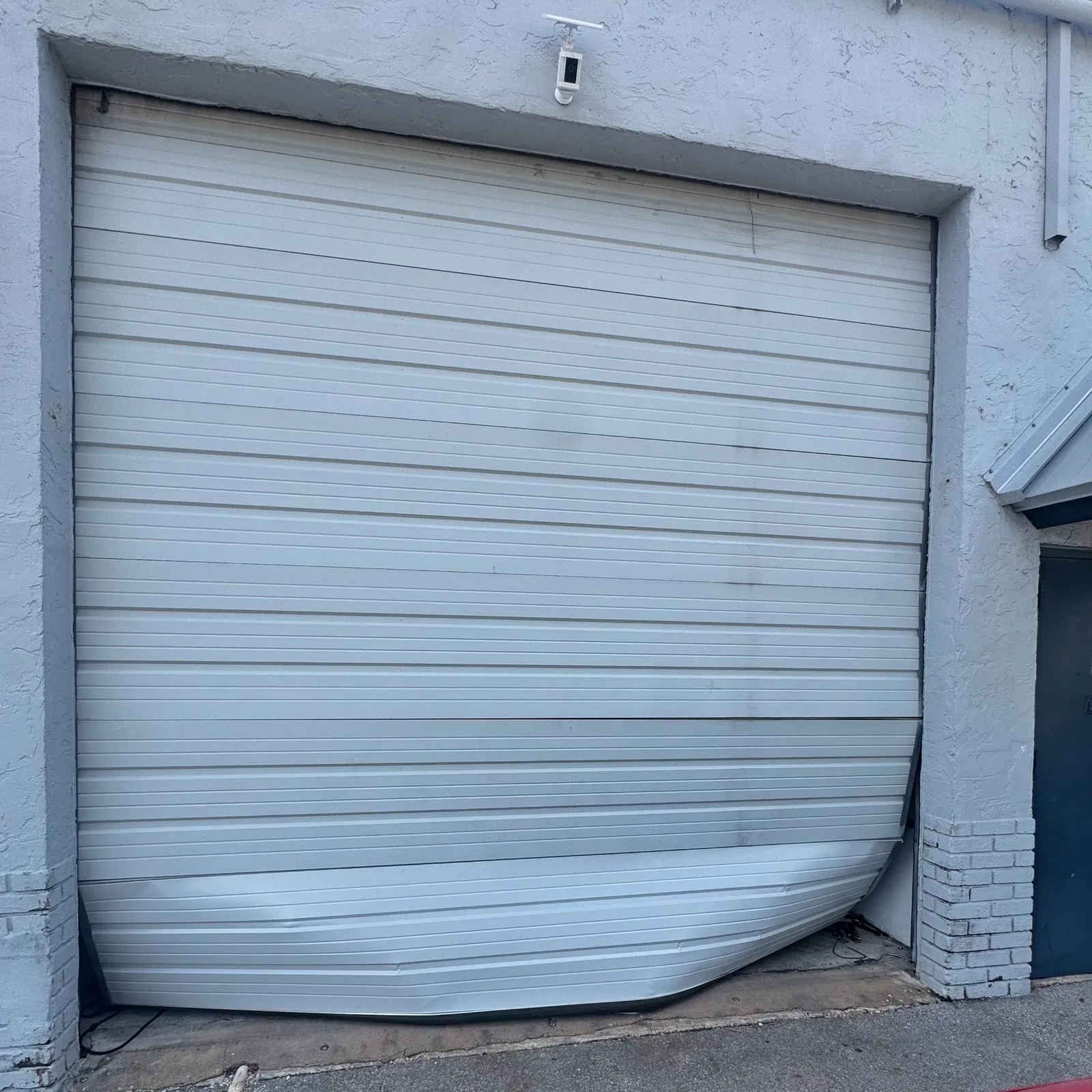
A door leaves its tracks when one or more rollers pop out of the rails, usually because something struck the door, a track bracket shook loose, or one side lost its cable. On a narrow driveway pinched between two close houses, the most common culprit is a car that touched the door or the jamb while reversing with very little room to straighten up. What you see afterwards is a door jammed at an angle, rollers hanging outside the rail, and the bottom panel shoved out of line.
Do not try to bully it back into place with the opener or by lifting it. A door in that state can drop, and the springs and cables behind it are still loaded. Keep everyone out of the garage, unplug the motor, and call. On site, we look over the tracks for bends and the rollers and hinges for damage, bring the door down under control, seat it back in the rails and square it to the opening. Our off-track door guide explains the usual causes and what not to do while you are waiting.
Old framing behind a Victorian or colonial
Plenty of the garages behind Wakefield’s Victorians and colonials are older timber-framed outbuildings, and the wood around the opening has shifted with the seasons. Jambs lean a touch, headers dip a touch, and the studs the track brackets are fastened into have often held a previous set of brackets. A door can still run sweetly in a frame like that, but its tracks have to be measured against the opening, not just against each other.
That changes how certain jobs are done. A track bracket that keeps working loose may need relocating into fresh, solid timber rather than a fatter lag screw in a worn hole. A door that drags along one side may be square in itself while the jamb next to it has crept. A low ceiling in an older outbuilding can dictate where a spring can be mounted and which opener will physically fit. Whenever a part goes into a door in one of these buildings, it is fitted to the building as it actually is today.
How a visit to a Wakefield garage goes
- On the phone or in the booking form, you describe what the door is doing, whether a car is stuck inside, and the best way to reach the garage from the street.
- When we arrive, the door is examined exactly as it is before anything moves: springs, cables, rollers, tracks, opener and sensors.
- You get our findings, including anything else the fault has harmed, and what the fix involves, before work begins.
- Once you agree, the work is done, the spring tension is set to the door, the opener’s up and down limits are adjusted, and the auto-reverse is tested.
- You see the door run up and down before we pack up.
On a long, tight driveway it helps a great deal if cars can be moved and the floor just behind the garage door is clear. If the only way in is through a side gate or a rear door, mention it when you book.
Fix it or replace it
In most cases, a repair is the right call. The moving hardware on a door, from springs and cables to seals and opener gears, is consumable, made to wear and be swapped out, and a door with solid sections can go on working well for a long time once its moving parts are renewed.
The balance tips toward replacement once the sections themselves are giving up: timber gone soft or split along the bottom rail, steel rusted through where snow sat against it, cracks running through more than one panel, or timber sections so waterlogged that the springs struggle to hold them up. A Wakefield door that has needed patch after patch, where each repair seems to set up the next, is another clue. The signs are set out one at a time in when to replace a garage door.
A new door in an old outbuilding
When replacement is the sensible choice, we supply and hang a door built around the opening the outbuilding really has, low header and slightly out-of-plumb jambs included. The old door is taken down a section at a time and carried back up the drive, the opening is checked and made sound where it needs it, and the new tracks, sections, springs and opener go in, balanced to the new door’s weight.
For garage doors Wakefield MA owners want to suit a Victorian or a colonial, most of the decisions are about looks and finish: raised or recessed panels, a carriage-house face, a band of glazing in the uppermost section, or a full view glass door where the house can carry a more modern look. There is more on full view glass garage doors, and our new garage door guide covers sizes, materials and insulation.
Calls at any hour, around the lake and beyond
Calls are taken at any hour, meaning a Wakefield door that jams on a Sunday night or before dawn on a workday can be reported the moment it happens. That is a fact about the phone line, not a promise about when someone will be at your driveway; whoever answers will tell you when a visit can be made.
Mention it when you call if a car is trapped inside, if the garage is standing open to the weather, or if the door is hanging out of square. An outbuilding left gaping open behind the house is worth securing before dark. The emergency garage door repair page lists the sensible things to do in the meantime.
Booking a Wakefield visit
Let us know what the door is up to, whether the car is shut in, and roughly how far back from the street the outbuilding stands. For garage doors Wakefield MA homeowners count on every day, that is enough for us to get started. Call us or book online.
Close by, we also look after doors in Melrose and Stoneham; every town we cover appears on the service areas page.
Questions from Wakefield
Our garage is at the very back of the lot. Do we have to be there?
Being there at the start is best, so you can describe what the door has been doing and hear what we find. If you cannot be, explain how to get to the garage and leave it accessible, and the repair can be talked through by phone before any work goes ahead.
The driveway between the houses is barely wider than a car. Can you still work?
Yes. When a van cannot get close, parts and tools come down the driveway on foot. Moving cars out of the way helps, as does a word with any neighbour who shares the drive.
Our door opens from the wall button but ignores the remote. Why?
Nearly always the remote rather than the opener: a tired battery, a lost pairing, or a signal that no longer carries to the outbuilding from where you are pressing it. Swap the battery first. If nothing changes, we can test the opener’s receiver and re-pair the remotes.
One spring has snapped but the other looks fine. Can we still run the door?
Please do not. A door missing a spring is far heavier than any opener is designed to haul, and the remaining spring, both cables and the motor are all overloaded. Leave it shut if it is shut, unplug the opener and call.
Is an old wooden door on a detached garage worth repairing?
Frequently, as long as the timber is sound. Springs, cables, rollers, hinges and seals can all be replaced on a wooden door. If the bottom rail has rotted or several panels are split, a new door usually makes more sense.