
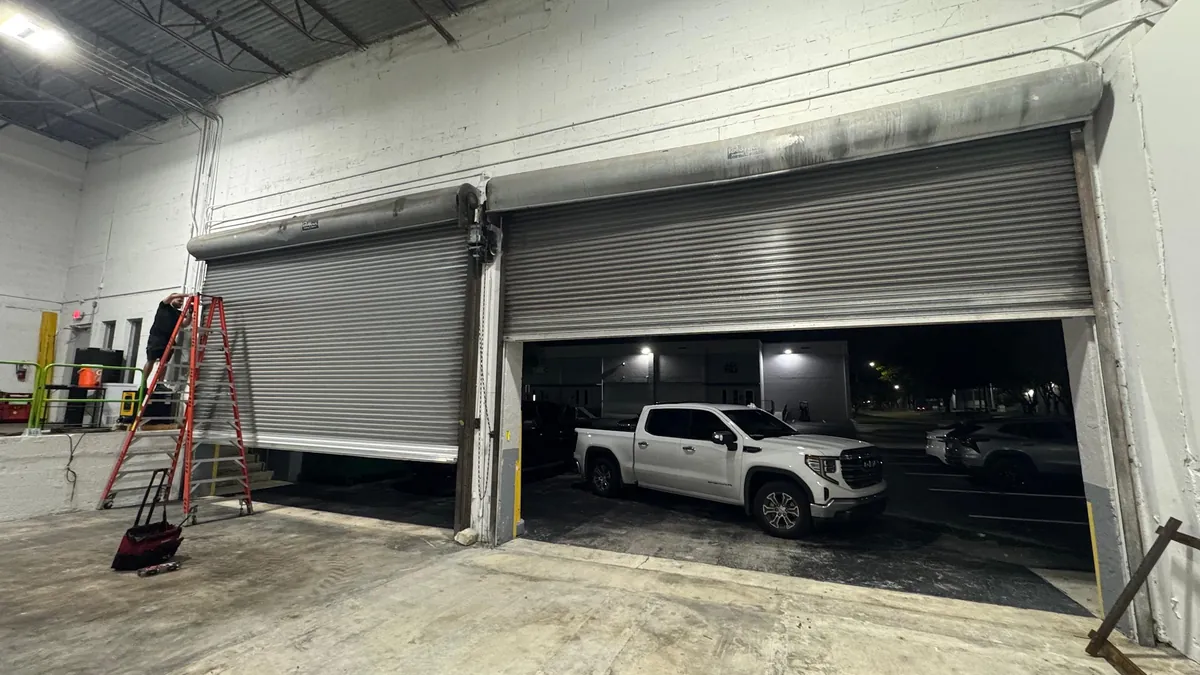
Multi-car garages at the end of Dover’s gravel drives
On a multi-acre Dover lot, the garage is often more than one building. A large house may have its own attached bays, and a detached garage or barn-style outbuilding farther across the property with more bays of its own. Both are reached by a long gravel drive, sometimes a long way from the road. Service calls about garage doors Dover MA properties need tend to involve several doors at once, spread across buildings that see very different amounts of use.
The attached bays usually work hard, opening and closing for the daily cars. The detached building may hold a vehicle that comes out a few times a season, equipment, or a workshop, and its doors can sit still for weeks. Both patterns wear doors out, just in different ways: one through constant cycling, the other through rust, stiffened rollers and openers that have not moved in a long while.
Gravel adds its own layer. Every car that crosses the drive kicks up grit and stones, and the area just in front of each door collects them. Look for these before calling us:
- A small stone or packed grit under the bottom seal, stopping the door from closing fully.
- A visible break in the wound spring over any one of the bays.
- A loose lift cable, or a door sitting higher on one side than the other.
Garage door services in Dover
Garage door repair
Panels, hinges, rollers, tracks, seals and photo eyes, across every bay in the attached garage and the outbuilding. The garage door repair page details each part.
Spring repair
Bays that run daily wear springs out sooner, and idle bays can rust them. Torsion springs hold dangerous tension, and fitting new ones is not a DIY repair. Background is on the garage door springs page, for both spring types.
Openers, remotes and keypads
Openers in two buildings, remotes for every car, and keypads at a detached garage set far from the house. LiftMaster repairs are part of our opener services.
Emergency calls
A bay that will not shut on an outbuilding out of sight across the lot is worth reporting at once, whatever the time. The emergency garage door repair page lists first steps.
Cables and drums
Rust on an idle door, or heavy daily load on a busy one, frays lift cables. Both cables on the bay get renewed as a set under garage door cable repair, as standard.
Off-track doors
A bay door pushed out of its rails by a car, a mower or a plough blade, taken down safely and put back square. Read off-track garage door repair for detail.
New doors
Replacement doors for one bay, a whole garage or both buildings, sized to each opening. See new garage door installation for how it works.
Gravel, grit and the bottom of the door
A gravel drive is part of what gives these properties their character, but it is hard on garage doors. Tyres carry small stones and dust right up to each opening, and the strip of concrete in front of the bays collects them. When a stone sits under the bottom seal, the door cannot close flat; the opener feels the resistance, stops, and reverses, and the owner is left with a door that keeps bouncing back up for no visible reason.
The dust does slower damage. It settles in the lower part of the vertical tracks, where rollers pick it up and grind it in. It coats the lenses of the photo eyes, mounted near ankle height at the jambs, until the beam weakens and the opener refuses to close. It works into the bottom seal and wears it, so the seal no longer meets the floor and lets in more dust, leaves and water.
The fixes are mostly simple. A quick sweep in front of each bay, especially after a dry spell or a plough has been through, removes most of the trouble. Wiping the photo eye lenses with a soft cloth often cures a door that will not close. Where the bottom seal has been ground down or torn on stones, it can be replaced. For garage doors Dover MA gravel drives lead up to, these small habits prevent a surprising share of service calls.
Two buildings, two kinds of wear
Doors in the attached garage cycle every day. The springs count every trip, the rollers turn over and over, and hinges flex at every joint. On a busy bay, springs and rollers are the most common parts to fail, and they tend to go in the order they were installed.
Doors in a detached garage across the lot can fail through neglect rather than use. A door that sits closed for weeks lets rust form on its spring coils and cables, rollers stiffen in their bearings, and lubricant dries out. When the door is finally opened for the summer car or the mower, the opener has to fight all of that at once. A spring that has rusted along its coils can snap on the first cycle after a long rest.
It helps to run any idle door up and down every week or two, even if nothing needs to come out. That small habit keeps the moving parts moving, spreads lubricant, and shows up a stiff roller or a weak spring before it fails on the day you need the door. Among garage doors Dover MA outbuildings hold, the ones exercised regularly are the ones that open without complaint in spring, when the mower and the summer car finally come out.
Spring breaks across several bays
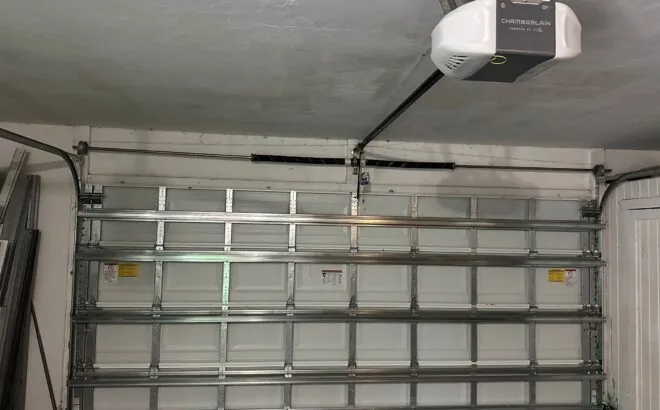
On a property with many doors, a broken spring often shows itself when one bay suddenly refuses to open while the others work normally. Press the button and the motor may raise that bay a hand’s width before quitting, or simply drone while nothing moves. Look up at the bar above the door; a broken torsion spring shows a clear break in the coil. On older or lighter doors with extension springs along the tracks, one may be hanging loose or lying on the floor.
A wound torsion spring holds dangerous tension, and the bars, clamps and set screws involved in replacing one can cause serious injury if handled wrongly, so on a Dover property or anywhere else, spring replacement is not a DIY repair. Do not prise the door up with a bar or by hand to get a car out, and stop pressing the button. If the door is shut, leave it shut; if it is partway open, keep everyone well clear of the opening.
When doors in the same garage were fitted together, their springs have done similar work and tend to wear out close together. Ask, and the neighbouring bays can be looked at on that same trip, so that a second spring does not fail a week after the first. Our guide to a broken garage door spring explains the signs, and how garage door springs work covers the mechanics.
Openers and remotes over a long distance
Distance is the first thing to think about when an opener misbehaves on a large property. A remote that opens the attached garage from the drive may not reach a detached garage from the house, and a keypad on the outbuilding may be the only practical control there. Remotes that worked from a long way out may gradually need to be pressed from closer in as batteries fade.
Beyond range, the usual opener faults apply: a door that starts down and reverses because a photo eye is dusty or knocked, a motor that hums without moving because a gear has worn or a spring has broken, or an opener that responds to the wall button but not to any remote. In an outbuilding that sees little use, mice and damp can also damage sensor wiring and openers over time.
Openers of the usual types are repaired or swapped, LiftMaster among them, and we set up remotes and keypads so each control opens the right door in the right building. Our guide to opener types compares the main kinds of drive.
Cables, ploughs and doors out of their tracks
Lift cables carry the springs’ pull down to the bottom of each door. On a busy attached bay they wear with use; on an idle detached one they can rust. A cable that frays through, or one that comes off its drum when a door meets an obstruction, leaves one side of the door unsupported and the door tilts. Stop using it, unplug the opener and keep the bay clear until it has been looked at.
On a property with long gravel drives and wide turning areas, doors get knocked out of their tracks in ways that do not happen on a small lot. A plough blade pushing snow too close to the garage, a ride-on mower turning tight against a door, or a car backing out of one bay and catching the edge of the next can all push a door or a track out of line. The result can be a door twisted in its opening with rollers out of the rails.
An off-track door is dangerous to move because its springs and cables are still loaded. Once on site, we ease it down without letting it drop, look over the rails, rollers, hinges and cables, and rehang it true. What not to do in the meantime is covered in garage door off track.
Laying out a property with several garages
On a large lot, the way the garages relate to each other and to the drive affects how they wear. Bays that face the prevailing weather take more wind-driven rain and snow on their faces and seals. Bays closest to where cars turn on the gravel take more grit. Bays at the far end of a row, or in the outbuilding, may only be used by one vehicle or for storage and see far fewer cycles than the doors nearest the kitchen entry.
That pattern is useful to know when a repair comes up. If the bay nearest the house has just broken a spring, its neighbour, fitted at the same time and used nearly as often, may not be far behind. The rarely used bay at the end, by contrast, is more likely to suffer from rust and stiffness than from worn-out springs. On garage doors Dover MA estates spread across more than one building, it is worth looking at the whole set as a group rather than one door at a time.
Access matters as well. A detached garage set well back across a lawn or along a separate spur of the drive may be hard to reach with a service vehicle in mud season or after heavy snow. If the ground is soft or the spur has not been cleared, let us know when you book, so the visit can be planned around it.
Records help too. If you know roughly when each door or spring was last replaced, or which bay has had trouble before, mention it. On a property with many doors, that history often points straight at the next likely failure.
Snow, ice and the threshold
On a long gravel drive, snow is usually cleared by plough or blower, and both can leave a ridge of compacted snow, ice and gravel across the front of the garage. A door closing onto that ridge stops short, and the opener reverses. A door that freezes to the ridge overnight may tear its bottom seal or strain its opener when it is next opened.
When a bay appears glued to the slab after a freezing night, hold off on the button. Chip away the frozen ridge along the threshold, ease the seal loose gently, and only then try the opener again. If the opener strains, hums or the door lifts unevenly, stop and call. More cold-weather faults are described in winter garage door problems.
How a Dover visit works
- When you call or book, name the building and the bay, describe the fault, and mention any vehicle stuck inside.
- Let us know how to find the right garage on the property, especially if there is more than one building or the drive forks.
- The door is examined as found, before anything is moved, and the cause and proposed fix are explained to you.
- With your agreement, the work goes ahead, spring tension is set to that door, the opener limits are trimmed, and the reversing system is tried with an object in the doorway.
- Every bay we touched is run open and shut in front of you before the van leaves the drive.
Repair, or a new door for one bay or all of them
Most faults are repairs. Hardware such as springs, cables, rollers, hinges, seals and opener gears is meant to be replaced as it wears, and a door with good sections behind it keeps going once that is done.
Replacement makes sense when sections have rusted through, split or been badly bent, when a door in the outbuilding has deteriorated after long spells of little use and less care, or when owners want the doors on both buildings to match. When the decision is to replace, we supply and install doors to suit each opening, from a single bay to a full set across the attached garage and the outbuilding. There is help choosing in the complete guide to a new garage door, and when to replace a garage door describes the tipping point.
Book a visit in Dover
Name the building, the bay and the symptom, and we will take it from there. For garage doors Dover MA properties rely on, calls are taken at any hour; a bay that jams near midnight can be phoned through before you head back up the drive. Call us or book online.
We also cover neighbouring Needham and Westwood, and every town is listed on our service areas page.
Questions from Dover
Our door keeps reversing just before it closes. What is wrong?
On a gravel drive, the most common cause is a small stone or packed grit under the bottom seal, or dust on the photo eye lenses. Sweep the threshold and wipe the lenses with a soft cloth. If the door still reverses, the sensors may be out of line or the door’s balance may have changed, and it is worth a visit.
The door in our detached garage has not been used for months. Is it safe to open?
Usually, but watch it closely. Run it once with the area clear and stop at once if it strains, jerks or goes up crooked. Rust on a spring that has sat still for a long time can cause it to break on the first cycle.
Can one visit cover doors in both our attached and detached garages?
Yes. Mention every door that needs attention when booking, and say where each building sits on the lot, and one visit can take in both.
The remote opens the attached garage but not the detached one. Why?
Usually range. The detached garage may simply be too far from where the remote is pressed, or the remote is not programmed to that opener. A keypad at the outbuilding, or re-pairing the remotes, often solves it.
Our plough pushed snow into the garage door. Is it damaged?
Possibly. Check for a creased bottom panel, a door hanging out of level, or a wheel sitting outside its rail. Any of those means unplugging the opener and leaving the bay closed until someone has inspected it.