
Look at the bottom corners of most sectional garage doors and you will find a thin braided steel cable climbing the edge of the door to a grooved drum overhead. Those two cables are what turn the springs’ stored force into lift. They do a lot of quiet work, and when one starts to unravel or lets go entirely, the door stops behaving like a door. Garage door cable replacement is the fix, and because the cables are tied into the spring tension, it is a job for a technician.
What the cables actually do
Torsion doors carry their coil on a horizontal shaft fixed over the doorway. A drum at each end of that bar holds one cable, and each cable drops to the fixing plate low on that edge of the door. As the spring unwinds, the drums turn, the cables wind on, and the door rises evenly on both sides.
On a door with extension springs, the springs stretch along the horizontal tracks and the cables run through pulleys to the bottom corners. The principle is the same: the cables are the link between spring and door.
Either way, the two cables share the load. If one is weaker, longer or slipping, the door lifts crooked. If one breaks, all the spring force lands on the other side.
Signs a cable is failing
These are the warnings to look and listen for:
- Loose strands or a fuzzy look where the cable meets the bottom bracket. Damp and road salt work on that corner first.
- A cable hanging slack beside the track when the door is closed.
- A cable that has jumped off its drum and is wound loosely or bunched at the top.
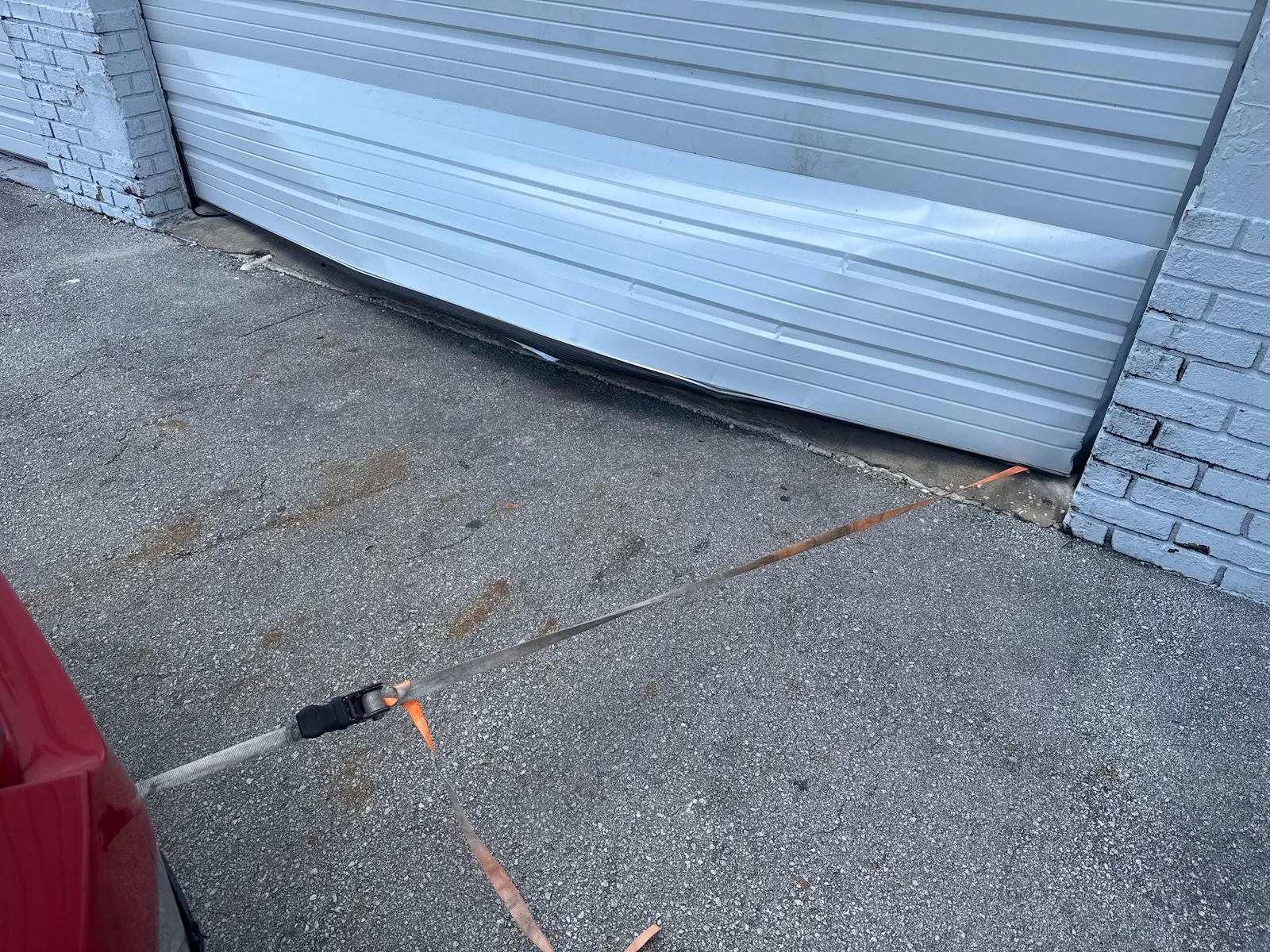
- One side of the door rising before the other, or the door closing with a gap under one end.
- A sharp crack or whip sound, then a door sitting at an angle in the opening.
- The opener straining or stopping partway on a door that used to run smoothly.
The first two are early signs, and catching them at that stage means garage door cable replacement can be booked while the door still opens. The rest mean the door should not be used until it has been looked at.
Why cables fray and snap
A cable wears for a handful of ordinary reasons, and knowing them helps make sense of when garage door cable replacement comes up.
Rust at the bottom corner. The lowest part of the cable sits near the floor, where meltwater, puddles and salt from car tyres collect. Once rust gets into the braid, strands start to break one by one.
Rubbing. A wobbling roller, a dented or misaligned track, or a shifted bracket lets the cable rub against metal on every cycle.
Uneven tension. If a spring has weakened or one drum has slipped on its bar, one cable ends up doing more work than its partner.
A door that came off its track. When a door jams crooked, the cables are often pulled off their drums or kinked, and a kinked cable never runs true again.
Extra weight. A heavy door, such as one of the aluminium and glass full view designs, asks more of its cables on every lift.
Plain age and use. Every trip up and down flexes the cable around the drum. A busy door, opened and shut all day, wears through its cables sooner.
Looking is fine, touching is not
You can safely look. With the door closed, check both bottom corners for fraying and both sides for slack. Watch the door go up once from a safe distance and see whether it rises level. Listen for scraping along the tracks.
You should not touch the cables, the drums or the bottom brackets. The bottom bracket is fastened to the cable and holds the full spring tension; undoing it can release that force violently. The same goes for the drums and the set screws on the spring bar. Leave every spring, cable and bottom bracket fastened as it is, and never try to rewind a cable onto its drum by hand.
If a cable has already broken:
- Leave the door exactly where it stopped. Do not try to lift or lower it.
- Do not pull the emergency release on the opener. With one cable gone, the door can fall to one side.
- Keep children, animals and vehicles clear of the doorway.
- Call, and describe which side has failed and how the door is sitting.
The guide to a door that is crooked or uneven goes into what a tilted door means, while the emergency repair page is the one to read if a cable lets go after dark. More plain guides are on the blog.
How cable faults show up in different garages
Older detached garages behind triple-deckers. A 1920s single-car garage in Malden, Mattapan or Roslindale often has a slab that has cracked and settled over the decades. Water pools at one corner, and that is usually the corner where the cable rusts first. These doors also tend to have been patched and re-hung over the years, so a cable fault may come with a worn drum or a bent bracket that needs attention at the same time.
Row houses without a garage. Most row houses in the South End or on Mission Hill never had a garage, so cable trouble there tends to come from a shared carriage house out back or a ground-floor bay cut into the building. These doors sit in tight spaces where a door that tilts can catch the wall or frame quickly, which is a good reason not to run it once a cable looks wrong.
Wide attached two-car openings. In Wellesley, Arlington or Weymouth, a modern attached double door is wide and heavy, and each cable carries a large share of that weight. A snapped cable on a door that size usually leaves it wedged in the opening, and because that garage connects to the living space, a half-open door leaves the house exposed.
What garage door cable replacement involves
A technician starts by securing the door so it cannot move, then takes the tension off the spring in a controlled way with the proper tools. The damaged cable comes off, along with any drum or bottom bracket that is worn. Replacing both cables together is often the sensible choice, since the second cable has seen the same years and weather as the first and matching lengths keep the door level.
New cables are wound onto the drums with equal tension, the spring is set again, and the door is cycled a few times to confirm it rises evenly, closes flat on the floor, and that the opener and safety sensors respond as they should. If the cable failed because of a worn roller, a bent track or a tired spring, that is found and talked through before anything else is done.
The cable repair page covers this work in more detail. When the cause is a door that left its tracks, see off-track repair, and where a spring is behind it, spring repair. The post on how garage door springs work explains how cables and springs depend on each other.
Questions about garage door cables
Is a door with a frayed cable still usable?
It is best not to. A fraying cable can let go without warning, and when it does the door may drop or jam crooked. Stop using the opener and have the cable looked at.
Why replace both cables when only one has broken?
The two cables have lifted the door together through the same winters, so the survivor is usually worn too. Replacing them together also means both have the same length and stretch, which keeps the door rising level.
Is replacing a cable a DIY job?
No. The cables are connected to the spring tension through the drums and bottom brackets. Undoing one without proper tools and training can unleash that stored force in an instant, with serious injuries as the result.
My cable came off the drum but is not broken. Is that easier?
It still needs a technician. A cable usually comes off its drum because something else is wrong, such as a slack spring, a door that went off track or an obstruction under one side. The cause is found and fixed, and the cable is checked for kinks before it goes back on.
What if the door is stuck open after a cable snaps?
Leave it where it is and do not try to force it down. Ring whatever the hour, say how the door is resting, and you will get advice on keeping clear until a technician gets there.
When a cable looks wrong
Spotted fraying at a bottom corner, or a door that now sits at a slant? To arrange garage door cable replacement, call us or book online. Lines stay open at all hours, so a cable that gives way late in the evening can be reported straight away.