
Down near the floor on each side of most garage door openings sit two small boxes, one facing the other across the gap. They look like an afterthought, but garage door safety sensors are what keep a descending door off a toddler, a dog, a bike or the front of a car. When they work, nobody notices them. When they do not, the door goes halfway down, changes its mind and goes back up, and a homeowner is left standing in the driveway pressing the remote again.
How the sensors work
Garage door safety sensors come in pairs. One unit sends an invisible beam of light straight across the opening, just above floor level. The other unit receives it. As long as the beam arrives unbroken, the opener is allowed to close the door. If anything crosses the beam while the door is coming down, the opener stops and sends the door back up.
Each unit usually has a small indicator light. On many openers, a steady glow on both units shows they are in contact, while a flashing or unlit lamp on one unit shows the beam is not getting through. The exact meaning of the lights varies between openers, so the opener’s own manual is the place to confirm it.
The sensors only govern closing. A door with a sensor fault will normally still open, which is why the complaint is nearly always a door that refuses to shut.
Signs the sensors are the problem
- The door starts down, then reverses for no visible reason.
- The door closes only while you hold the wall button down and reverses if you let go.
- The opener light flashes when you try to close the door.
- One unit’s lamp is dark or flashing and its partner’s is not.
- The trouble appears only at certain hours, often when low sun shines straight into the garage.
If the door also struggles to open, hums without moving, or hangs crooked, the sensors are probably not the whole story. See also the posts on a door that reverses when closing and one that will not close for those wider causes, or browse the blog.
Checks you can make safely
Unlike springs and cables, the sensors are one part of a garage door a homeowner can safely look at. Work through these in order:
- Clear the beam. Look for anything in the line between the two units: a bin, a boot, a leaf, a spider’s web, a coiled hose.
- Clean the lenses. Wipe each lens with a soft dry cloth; grime, webs and condensation are the usual offenders.
- Check the alignment. The two units should face each other squarely at the same height. A knock from a car tyre, a shovel or a lawnmower can turn one just enough to break the beam. Many brackets can be eased back by hand until the indicator light settles.
- Look at the wires. A thin wire runs from each sensor up to the opener. Check for a staple through it, a chewed section, or a connection that has worked loose.
- Shade the receiving sensor. If the fault happens only when sunlight hits one unit, shading it can confirm that.
Then try the door again from the wall button and stand clear while it closes.
What not to do: never disconnect, tape over, or bypass the sensors so the door will close. They are there to stop the door landing on someone. And none of these checks involve the springs, cables or bottom brackets; those hold heavy tension and are never something to loosen or adjust yourself.
Why sensors get knocked out of line
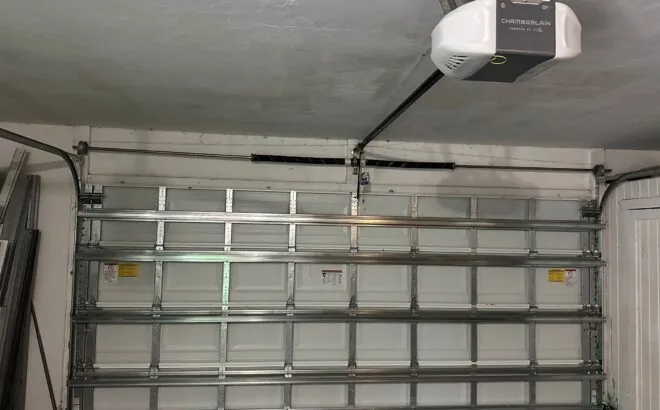
The housing around Greater Boston shapes how garage door safety sensors get disturbed.
Narrow 1920s single-car garages behind triple-deckers. In Brighton, Everett and Roxbury, the detached garage at the back of a triple-decker lot is often barely wider than a car. Bins, bikes and tools stack up along the walls, which puts them right where the sensors sit. Old slabs that have settled can also leave the two sides of the opening at different heights, so the sensors need fine alignment.
Row houses lacking a garage. Charlestown, the North End and Bay Village are full of rows that never had one. Where a back-lane carriage house survives or a lower floor was opened up for parking, the door often opens onto a lane or a shared passage. Leaves, grit and blown snow collect at the threshold and cover the low-mounted lenses.
Attached two-car openings in the suburbs. In Belmont, Milton and Woburn, the wide attached garages are busy spaces: cars, strollers, bikes, a snowblower. The sensors at each side of a double opening are easy to clip with a tyre or a handlebar. Low winter sun across a wide west-facing opening can also blind a receiving lens late in the afternoon.
The guide to winter garage door problems covers how snow and ice interfere with sensors.
When a sensor fault needs a technician
Call when the checks above do not settle it, or when:
- A sensor or its bracket is cracked or broken.
- The wiring is damaged somewhere you cannot see or reach safely, such as along the ceiling.
- The indicator lights stay off on both sides even with the opener powered.
- The door reverses even with the beam clear and the sensors aligned.
- The door does not reverse when something crosses the beam. That is a safety problem; stop using the opener until it is fixed.
Sensors are part of the opener system, and they are covered by opener repair and replacement. For LiftMaster openers, see LiftMaster opener repair. If the opener itself is ageing, the post comparing garage door opener types is a useful next read, and broader faults sit under garage door repair.
A technician checks the beam, the alignment, the wiring back to the opener and the opener’s own response, and sets the close force and travel so the door turns back whenever it ought to. When new garage door safety sensors are needed, they are fitted, aligned and tested with the door before the visit ends.
Testing the sensors yourself
A simple test once a month is worth the minute it takes. With the door open, place a soft object such as a roll of paper towels on the floor in line with the sensors and press close. The door should stop and reverse before it reaches the object. Then wave a hand or foot through the beam as the door closes; it should reverse again. If either test fails, have the garage door safety sensors looked at before the door is used again.
Questions about safety sensors
Why does my garage door only close when I hold the button?
Most openers let the door close while the wall button is held down, even with a sensor fault, as a way to shut it in a pinch. That is a sign the sensors cannot see each other. Clean and line them up, and call if that does not fix it.
Can I remove the sensors if they keep causing trouble?
No. They are the only thing between a closing door and whatever is under it. Fixing the cause is the answer, whether that is alignment, wiring or a faulty unit.
Does sunlight really affect the sensors?
It can. Strong low sun shining straight into a receiving lens can drown out the beam. Shading the receiving sensor often helps, and a technician can suggest what suits your opening.
Will the door still open if a sensor fails?
Usually, yes. The sensors govern closing, so a fault there normally means the door rises fine yet will not come back down.
Are sensor problems urgent?
A door stuck open after dark is a security worry, so call at any hour. A door that does not reverse when something crosses its path is a safety issue: stop using the opener until it has been checked.
Door refusing to close?
If the sensors are clean and lined up and the door still will not shut, or if it fails the reversal test, call us or book online. A garage gaping open at midnight deserves a midnight call, and that is exactly when the phone will be picked up.